
Omega Speedmaster Buying Guide
Moonwatch Professional, Hesalite versus sapphire, Calibre 3861 and 321, FOIS, Silver Snoopy, Speedmaster '57, ceramic Dark Side models, fit, condition and exact-reference buying decisions—explained for real buyers.
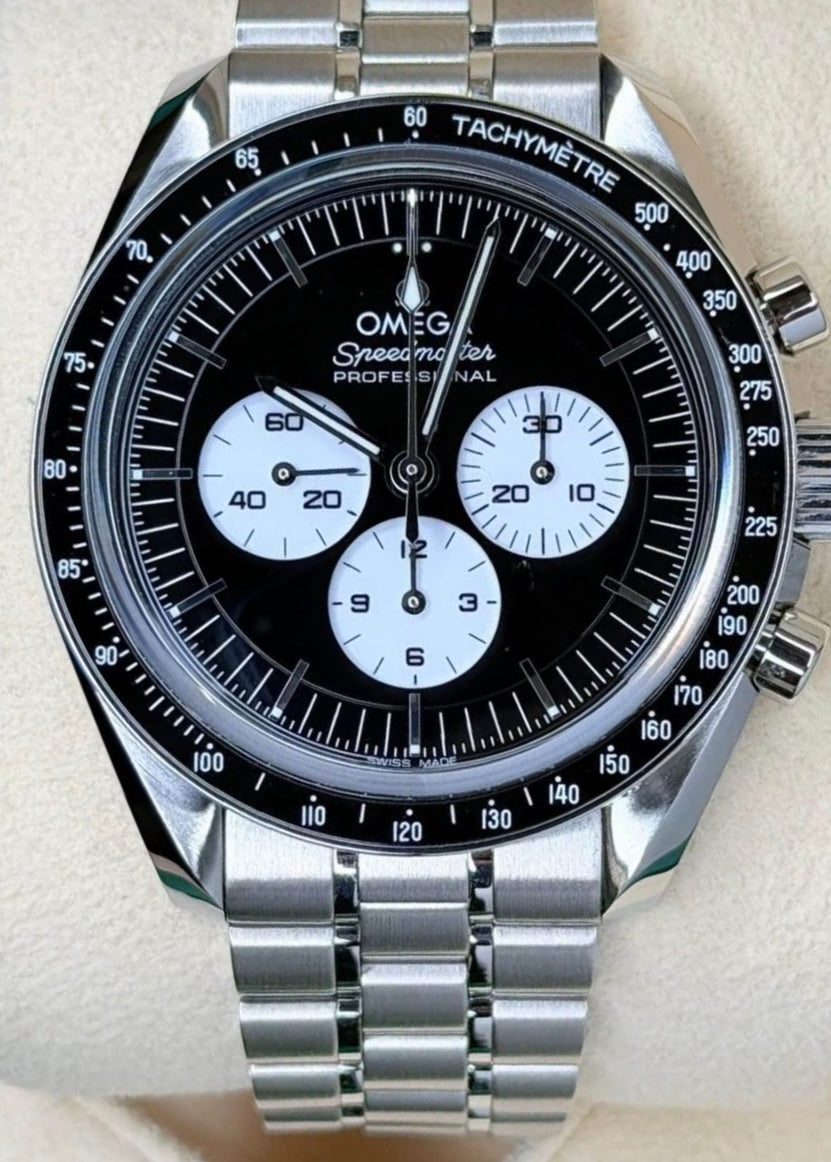 Current Superlative Watch Co. example · Ref. 310.30.42.50.01.004 · View watch →
The Omega Speedmaster is not one watch. It is a large chronograph universe that includes the manually wound Moonwatch Professional, historically inspired Calibre 321 and FOIS references, Silver Snoopy collector models, hand-wound Speedmaster '57 and Chronoscope watches, automatic Racing and Super Racing chronographs, compact Speedmaster 38 models, ceramic Dark Side of the Moon watches, moonphase complications and specialist analog-digital instruments.
The safest way to buy a Speedmaster is to begin with the exact ownership experience you want. Do you want the closest modern expression of the Moonwatch? Do you want a sapphire crystal and visible movement? Do you want a smaller 39.7mm straight-lug case? Do you want automatic winding, a date, a ceramic case, a moonphase, or higher water resistance? The Speedmaster name alone does not answer those questions.
At Superlative Watch Co., we help clients buy, sell, trade and source new, unworn, pre-owned, discontinued and collectible Omega Speedmaster watches. This guide explains the popular current families, the movement differences that matter, the best references by buyer type, the ownership tradeoffs, and the condition and documentation details buyers should verify before purchase.
Quick answer: the standard black-dial Moonwatch Professional with calibre 3861 is the best all-around Speedmaster for most buyers. Choose Hesalite for the warmer and more historically faithful experience. Choose sapphire for scratch resistance and the exhibition caseback. Choose Calibre 321 if movement history and 39.7mm proportions matter more than price. Choose FOIS for straight-lug vintage character with modern 3861 performance. Choose Silver Snoopy for modern collectibility, Dark Side of the Moon for ceramic cases and larger wrist presence, Speedmaster '57 for a thinner two-register hand-wound design, Super Racing for automatic winding and Spirate regulation, and Speedmaster 38 for a compact automatic chronograph.
Research standard: reference dimensions, movements, water resistance, certification and history were checked against OMEGA's official Speedmaster catalog and press material. Current inventory, condition and purchase details are available in the individual Superlative Watch Co. watch listings. See the full methodology and primary-source index.
Popular Speedmaster Examples With Photos
Explore Superlative Watch Co. examples across the Moonwatch, Calibre 321, Silver Snoopy, ceramic, Speedmaster '57 and Chronoscope families. Open each listing to examine photographs and current details of that individual watch.
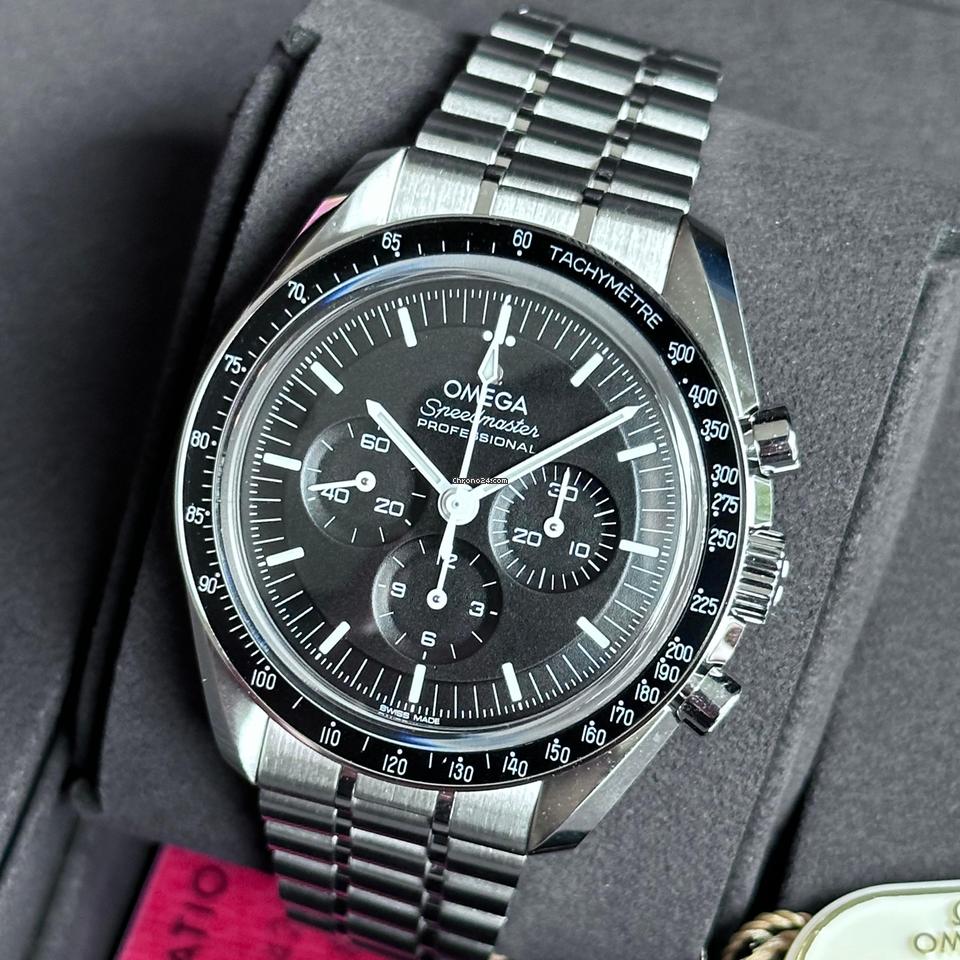
The core black-dial sapphire Moonwatch with steel bracelet and exhibition caseback.
View watch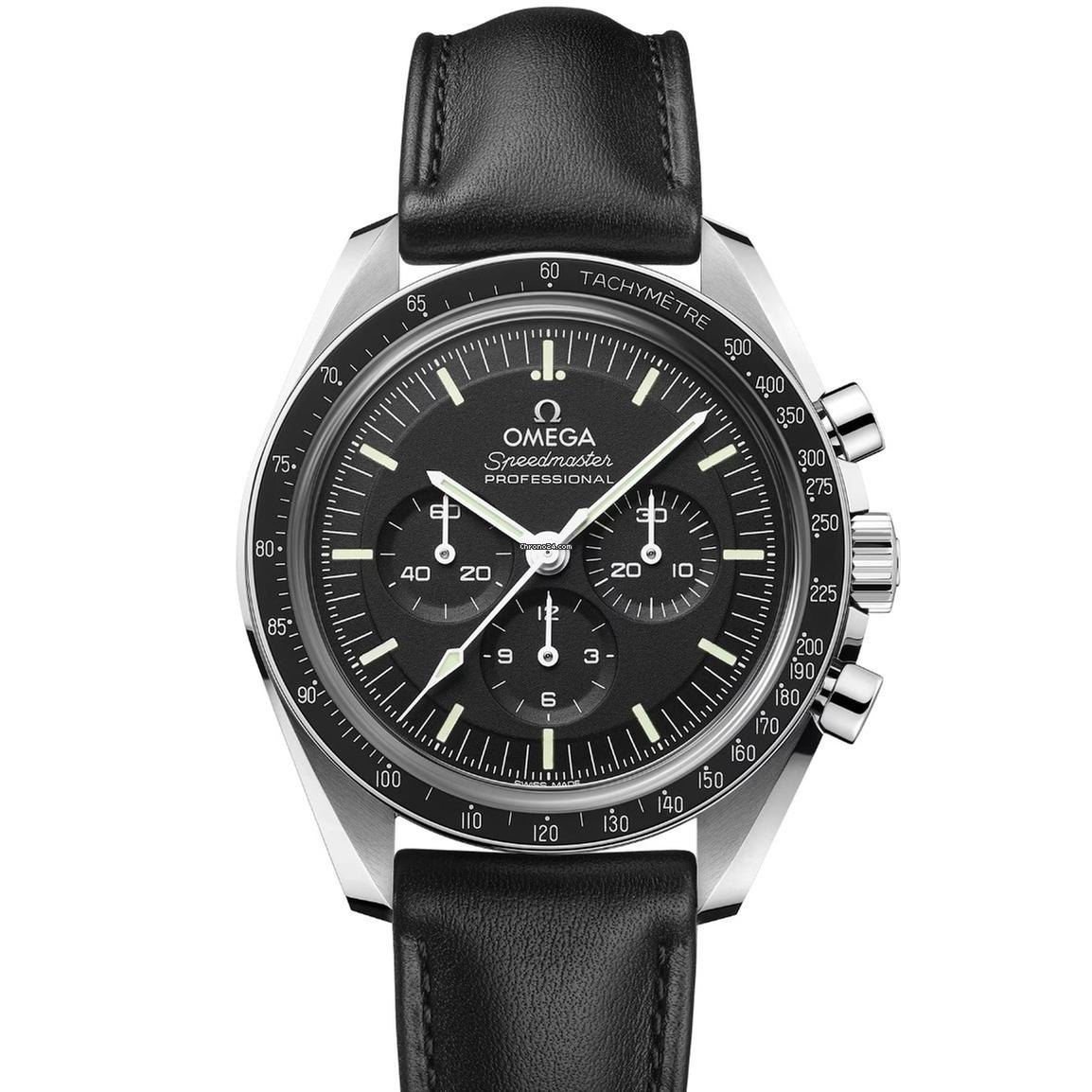
The sapphire-sandwich Moonwatch on black leather for a softer, more formal profile.
View watch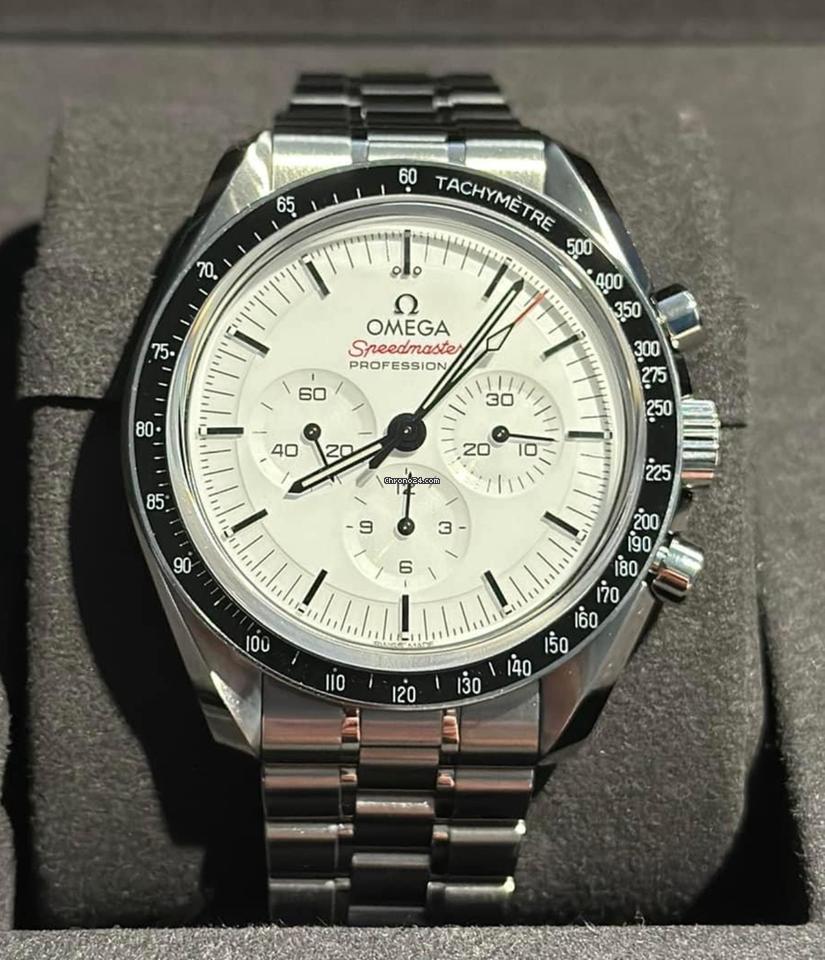
The high-contrast white lacquer Moonwatch on the modern five-link steel bracelet.
View watch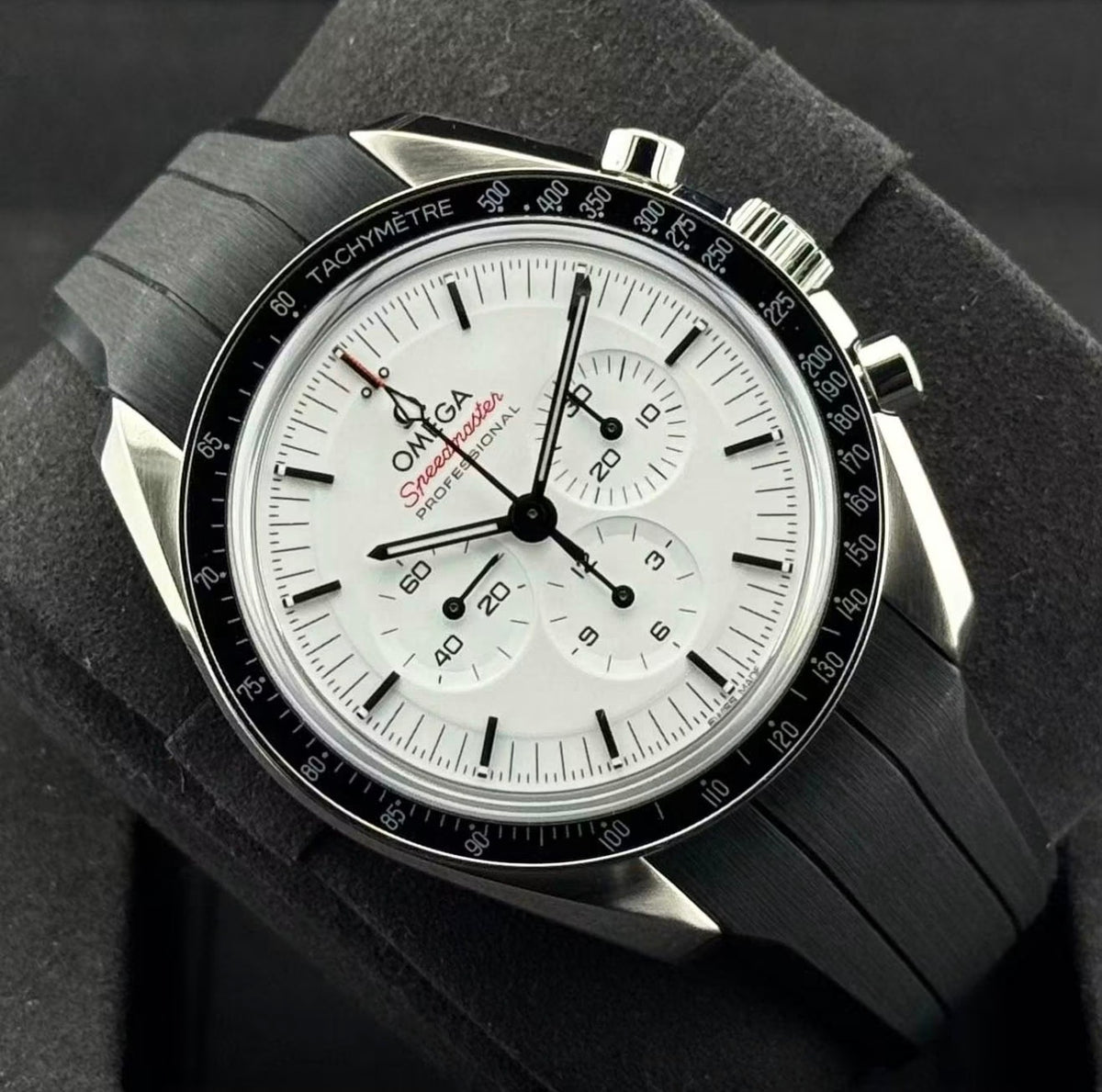
The white lacquer Moonwatch paired with a perforated black leather strap.
View watchA contemporary black lacquer execution with contrasting white chronograph counters.
View watch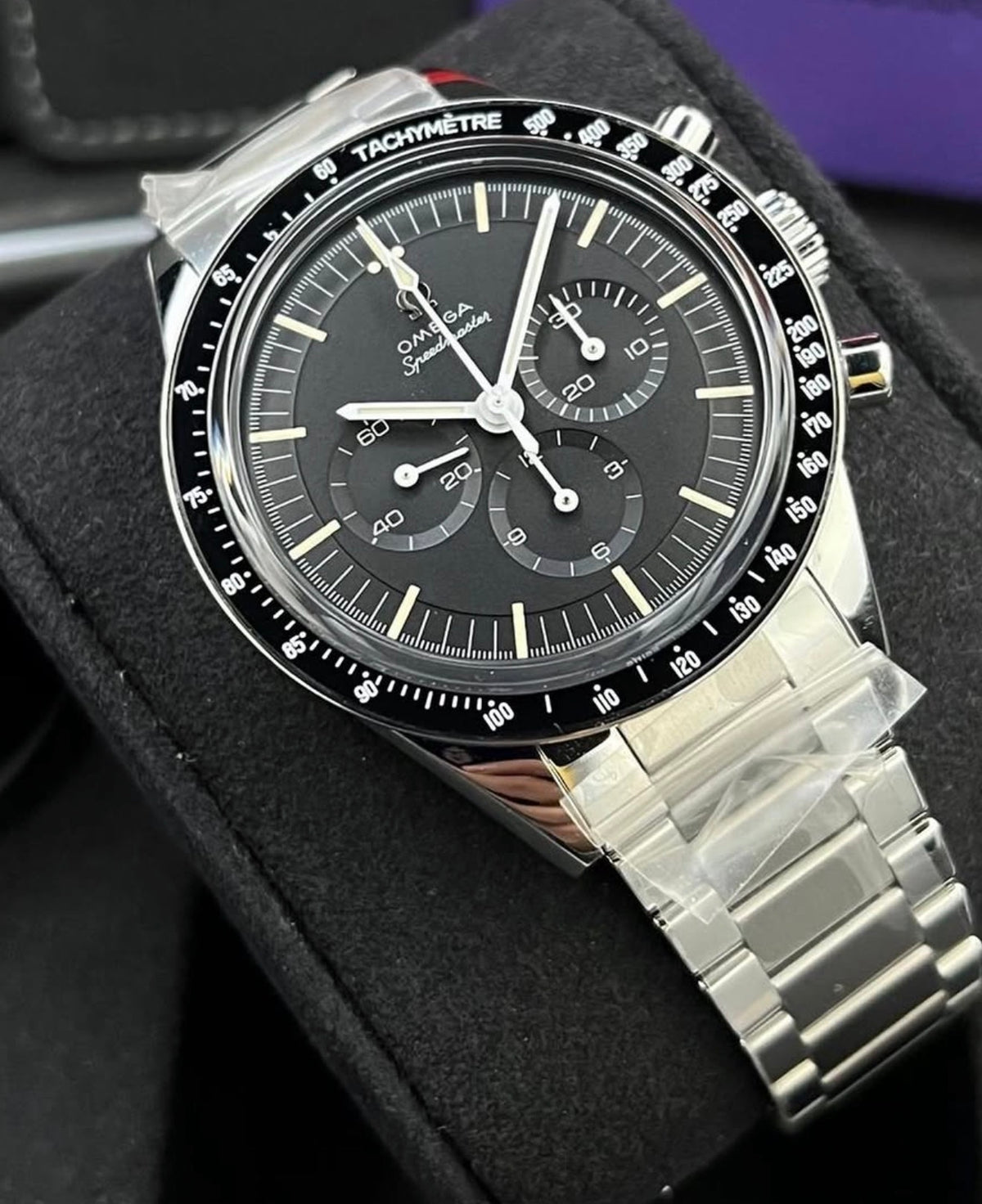
The straight-lug collector reference built around Omega's historically recreated calibre 321.
View watch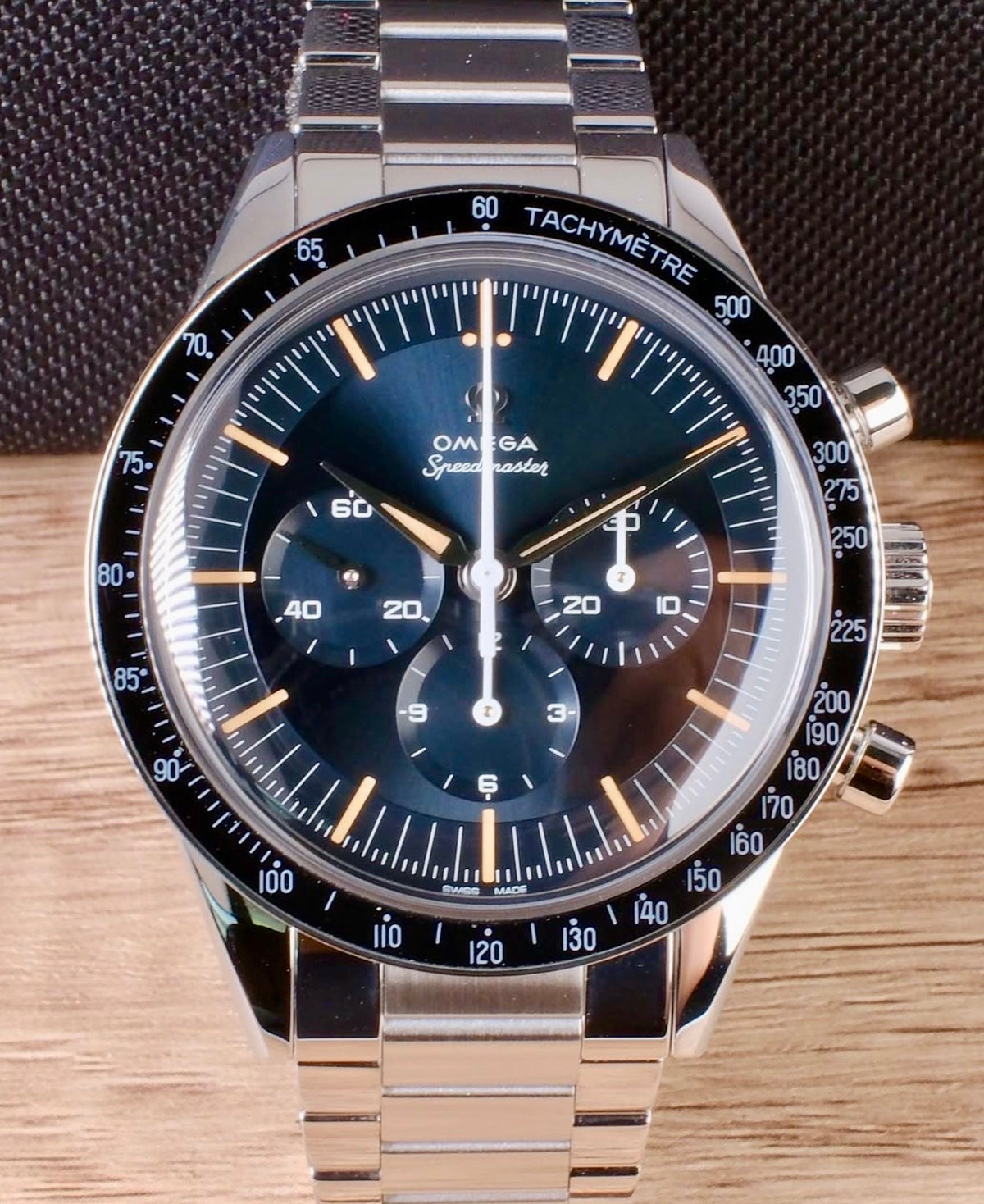
The modern FOIS combines CK 2998 proportions and Alpha hands with Master Chronometer performance.
View watch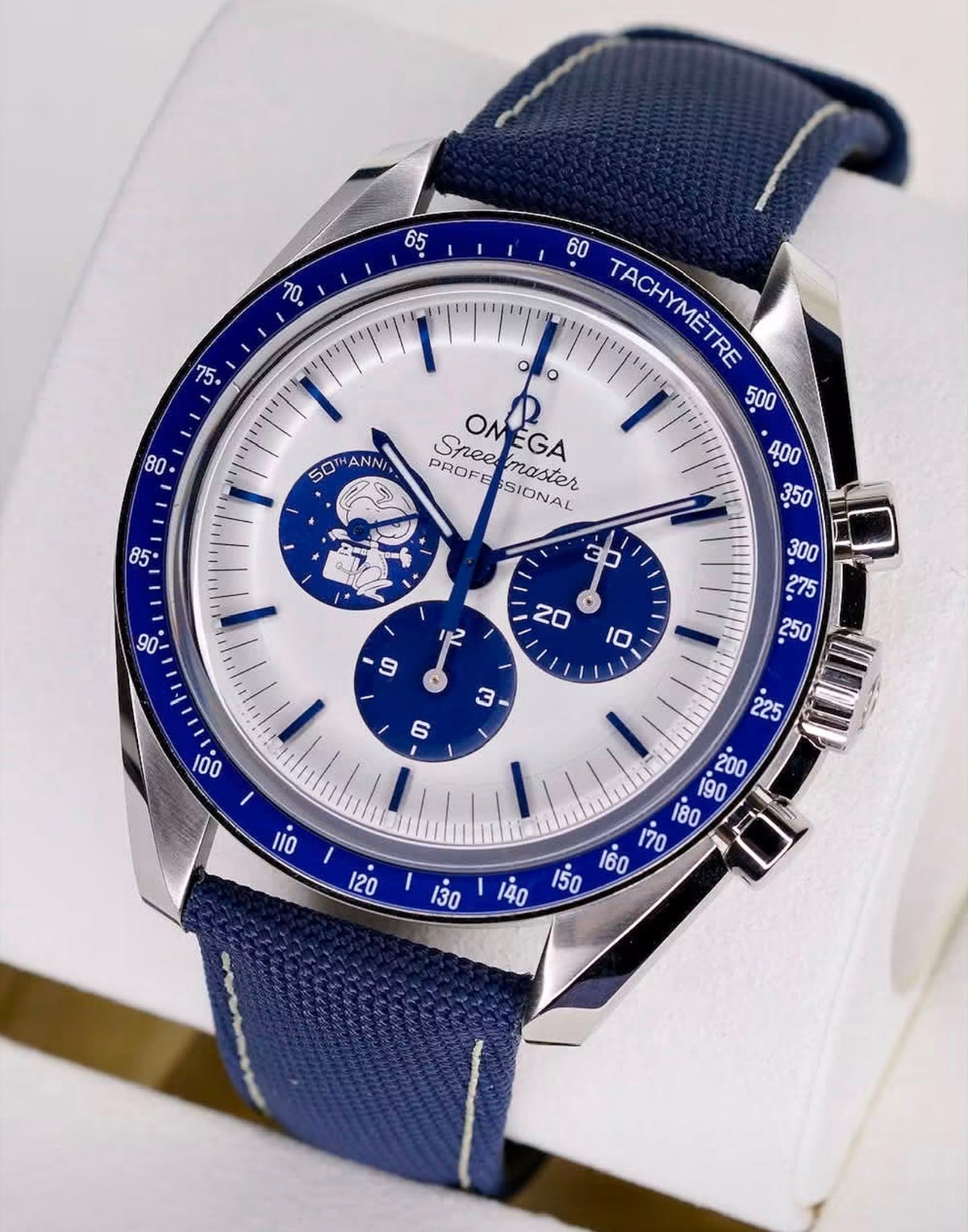
The blue-and-silver collector model with the celebrated animated caseback.
View watch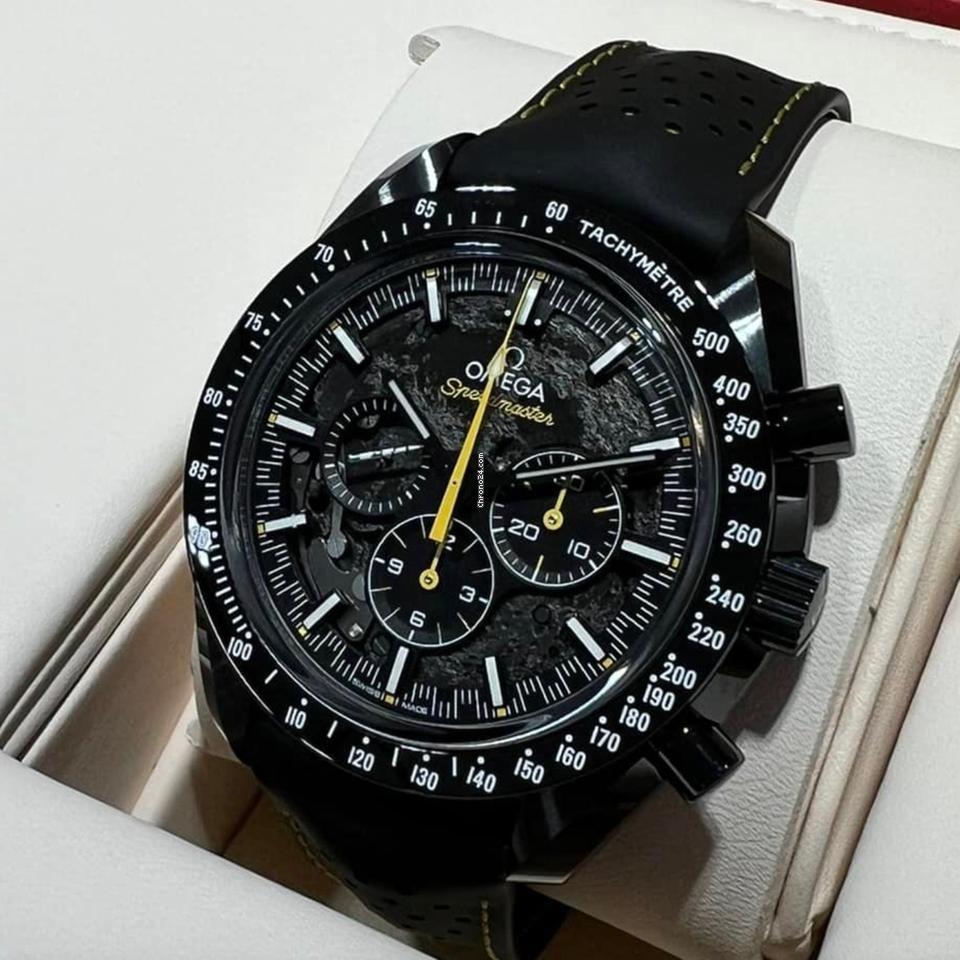
A manual-wind black ceramic Speedmaster with lunar-surface movement decoration.
View watch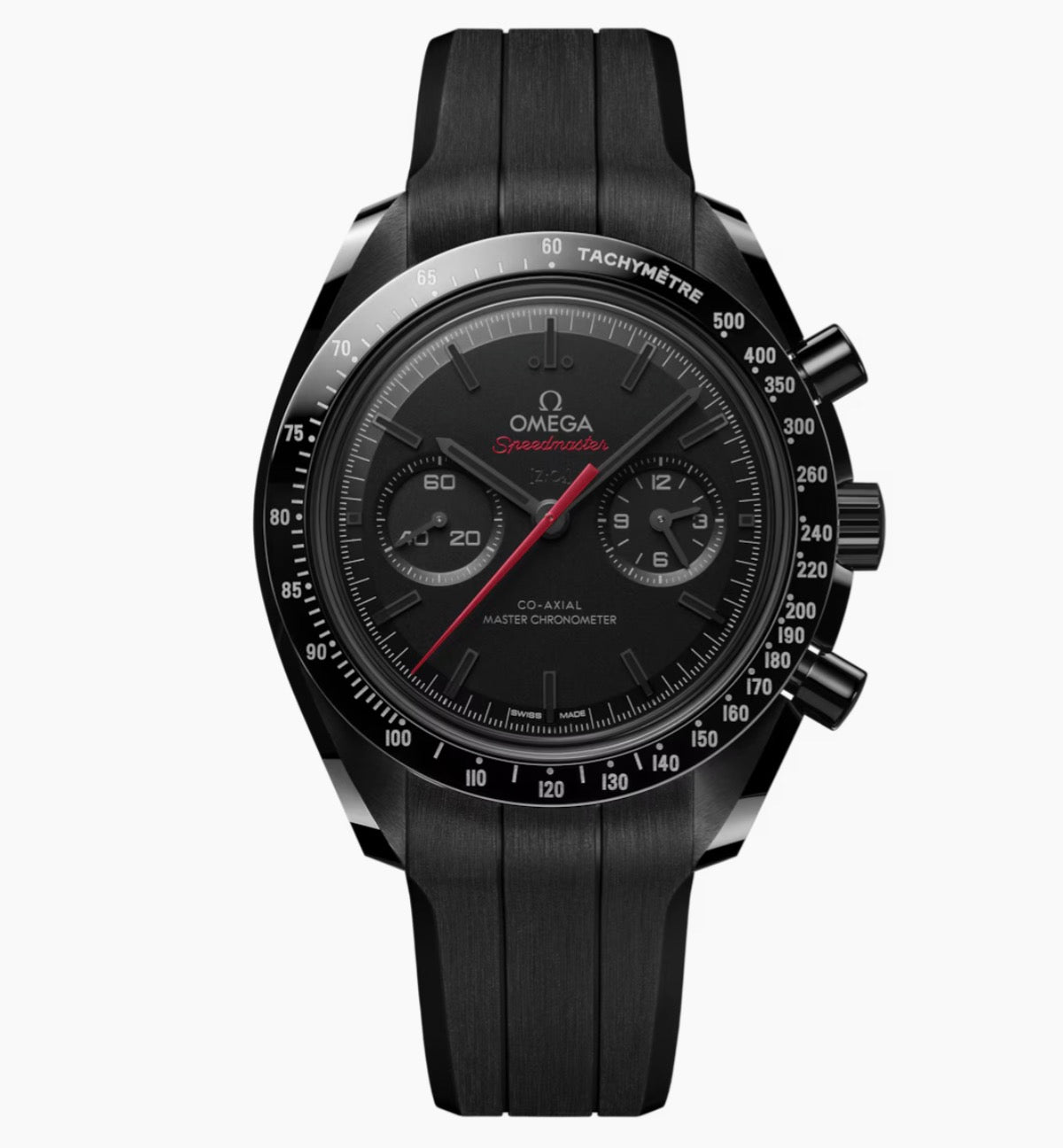
A modern automatic ceramic chronograph with a monochromatic technical profile.
View watch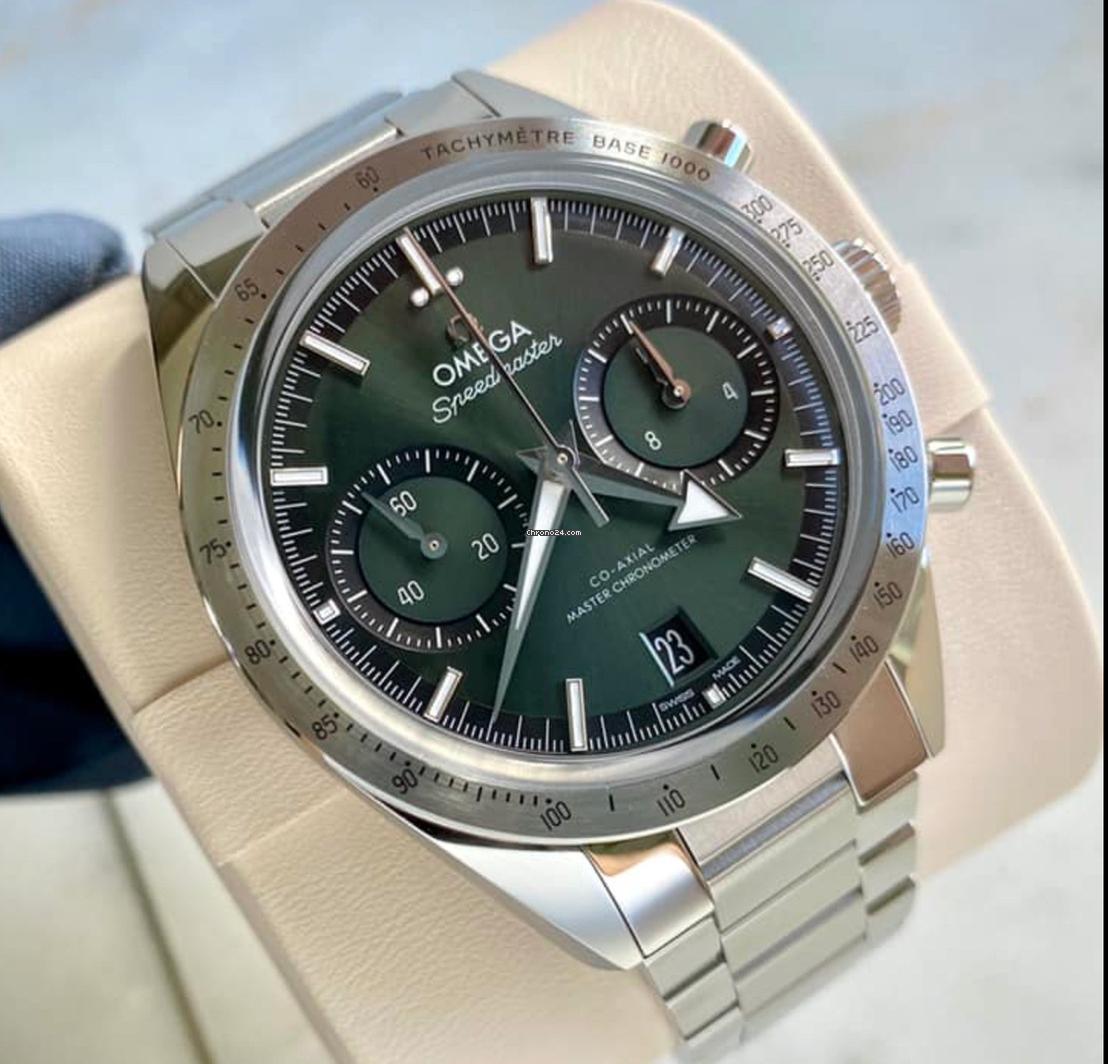
The slim two-register, hand-wound '57 with broad-arrow styling and a green dial.
View watch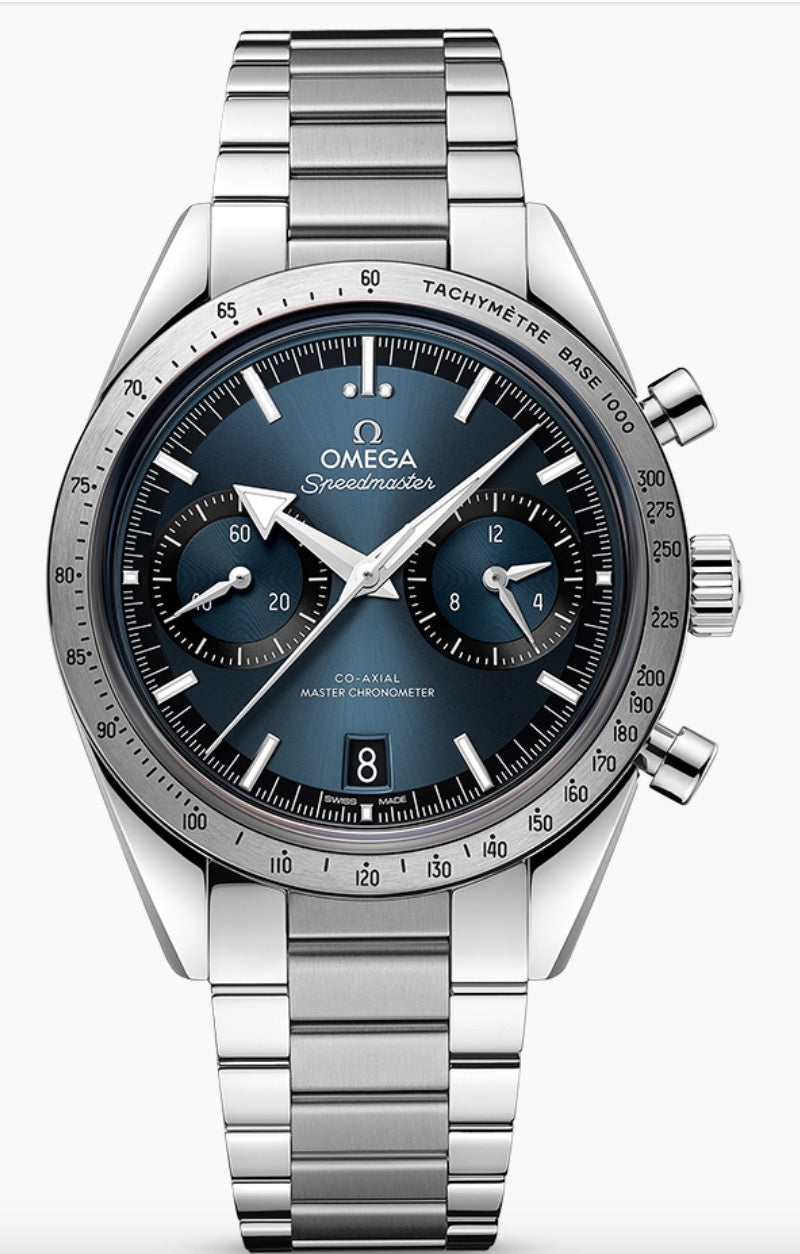
The blue-dial counterpart with the same hand-wound two-counter architecture.
View watch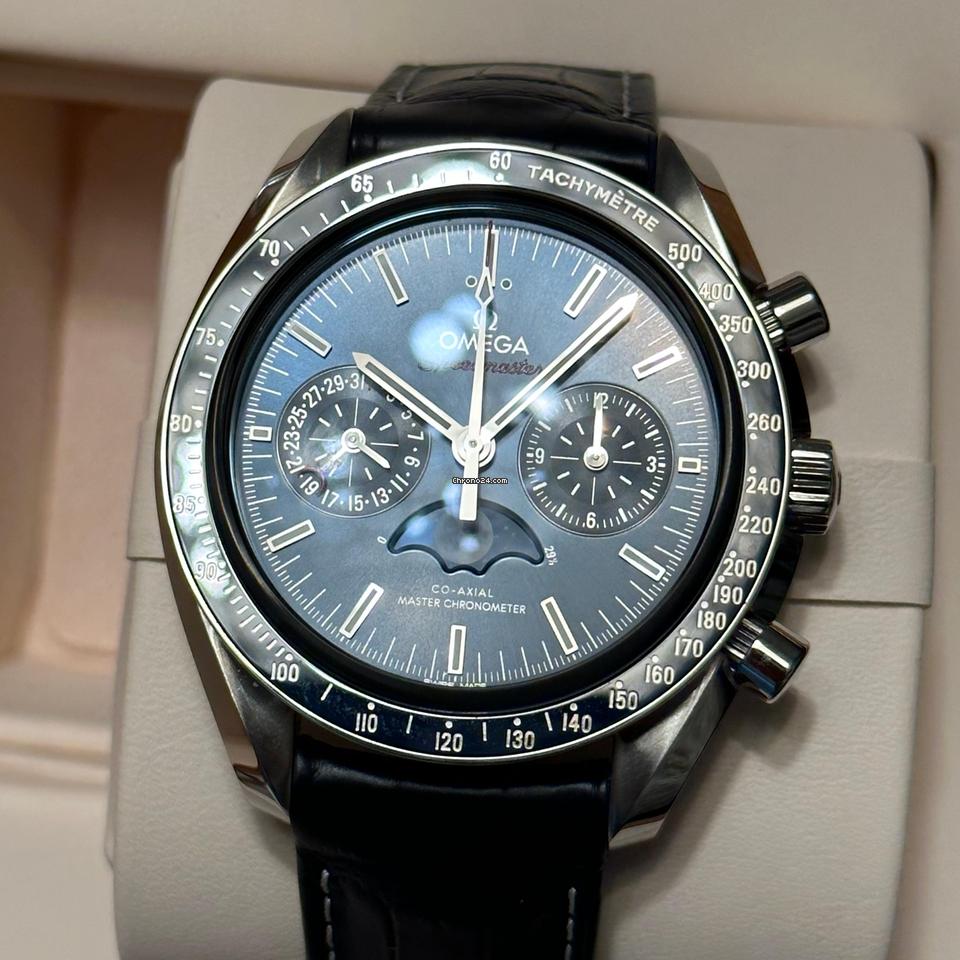
A blue-dial automatic Moonphase with pointer date and a matching blue leather strap.
View watch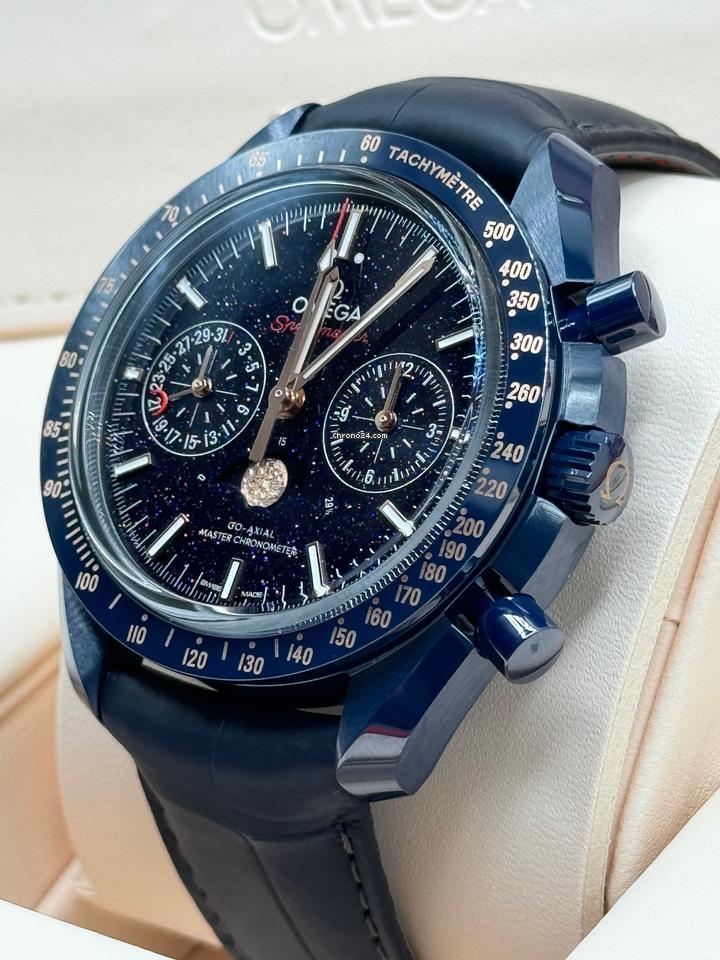
A premium Moonphase whose aventurine-glass dial brings exceptional depth to the calendar display.
View watch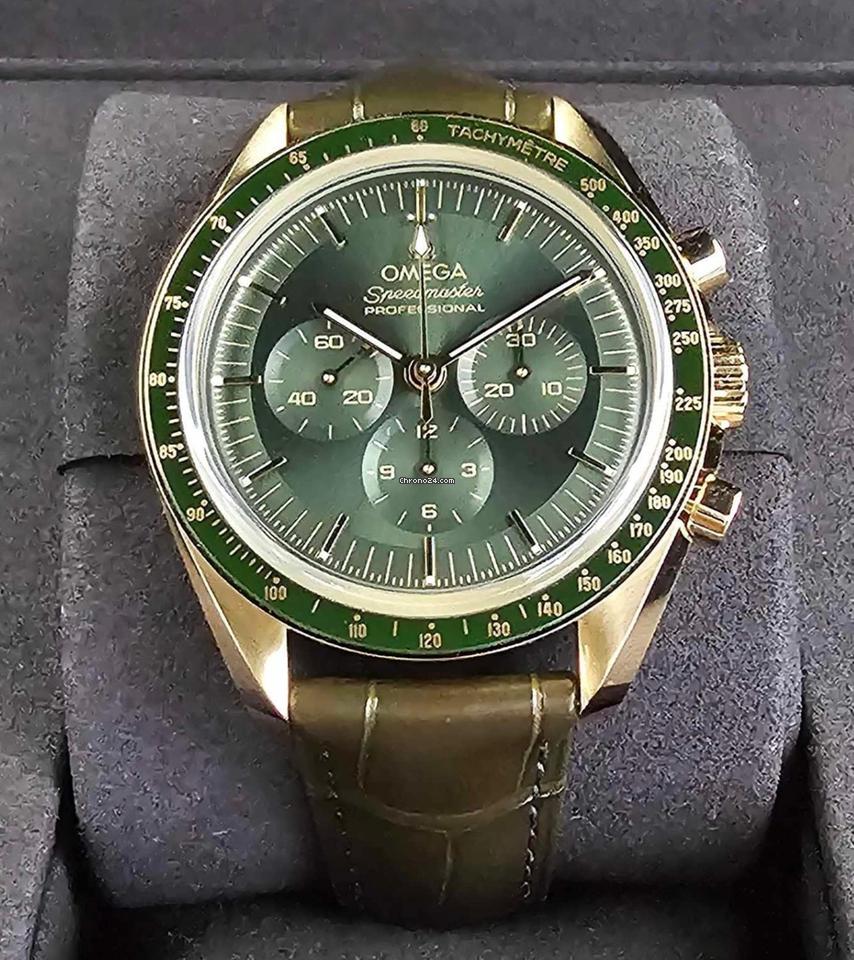
The Moonwatch architecture translated into Moonshine Gold with a rich green dial and leather strap.
View watchA discreet white-gold Moonwatch with a silver-toned dial and leather strap.
View watchThese are current Superlative Watch Co. product examples as reviewed on August 22, 2026. Price, availability, card date, condition and set contents are live on each linked watch and can change. If a reference has sold, the Buying Desk can help source the same or closest configuration.
Current Speedmaster Reference Navigator
Use the exact reference—not the family name alone—to compare the case, movement and configuration you are actually buying. Each inventory link below points directly to the corresponding Superlative Watch Co. product page.
| Exact Reference | Family / Configuration | Buyer Decision | Inventory |
|---|---|---|---|
| 310.30.42.50.01.002 | Moonwatch Sapphire · bracelet | Core black-dial Moonwatch with sapphire front and display back | View watch → |
| 310.32.42.50.01.002 | Moonwatch Sapphire · leather | The same sapphire-led ownership experience on a softer strap | View watch → |
| 310.30.42.50.04.001 | White Lacquer Moonwatch · bracelet | Maximum dial contrast with the modern Moonwatch bracelet | View watch → |
| 310.32.42.50.04.001 | White Lacquer Moonwatch · leather | White-dial character with a lighter, more formal strap profile | View watch → |
| 310.30.42.50.01.004 | Black Lacquer Moonwatch · bracelet | Polished black lacquer and white counters in the familiar 42mm format | View watch → |
| 311.30.40.30.01.001 | Calibre 321 “Ed White” | 39.7mm straight-lug proportions and historically reconstructed movement architecture | View watch → |
| 310.30.40.50.06.001 | First Omega in Space · bracelet | 39.7mm straight-lug heritage, grey-blue dial and calibre 3861 | View watch → |
| 310.32.42.50.02.001 | Silver Snoopy 50th Anniversary | Apollo 13 storytelling, blue-and-silver identity and animated caseback | View watch → |
| 310.92.44.50.01.001 | Dark Side Apollo 8 | Manual-wind ceramic Speedmaster with lunar-surface movement treatment | View watch → |
| 310.92.44.51.01.001 | Dark Side of the Moon | Automatic ceramic chronograph with a more contemporary technical profile | View watch → |
| 332.10.41.51.10.001 | Speedmaster '57 · green | Slimmer hand-wound two-counter layout with date and broad-arrow styling | View watch → |
| 332.10.41.51.03.001 | Speedmaster '57 · blue | The same 40.5mm architecture with a cooler blue-dial presentation | View watch → |
| 304.33.44.52.03.001 | Moonphase · blue dial | Automatic winding, pointer date and moonphase in a larger case | View watch → |
| 304.93.44.52.03.002 | Moonphase · aventurine | A visually richer take on the automatic Moonphase architecture | View watch → |
| 310.63.42.50.10.001 | Moonshine Gold · green dial | Precious-metal Moonwatch presence with a rich green-dial identity | View watch → |
| 310.63.42.50.02.001 | Canopus Gold · silver dial | Discreet white-gold execution for the precious-metal buyer | View watch → |
Table of Contents
- 1. Quick Answer: Which Speedmaster Should You Buy?
- 2. Why the Omega Speedmaster Matters
- 3. Speedmaster History Timeline
- 4. Current Speedmaster Catalog Map
- 5. Moonwatch Professional Calibre 3861
- 6. Moonwatch Hesalite vs. Sapphire
- 7. Black, White & Reverse-Panda Moonwatches
- 8. Calibre 3861 Quality, Finishing & Performance
- 9. Manual Winding: What Ownership Is Really Like
- 10. Moonwatch Bracelet, Clasp, Straps & 20mm Lugs
- 11. Speedmaster Calibre 321 / Ed White
- 12. First Omega in Space (FOIS)
- 13. Speedmaster '57
- 14. Silver Snoopy Award Speedmasters
- 15. Dark Side of the Moon Ceramic Speedmasters
- 16. Dark Side of the Moon Apollo 8
- 17. Speedmaster Moonphase & Meteorite
- 18. Speedmaster Chronoscope
- 19. Super Racing, Racing & Spirate
- 20. Speedmaster 38
- 21. Speedmaster Pilot, X-33 & Instruments
- 22. Speedmaster Calibre Comparison
- 23. Calibre 321 vs. 861 vs. 1861 vs. 3861
- 24. Speedmaster Size, Thickness & Wrist Fit
- 25. Steel, Ceramic, Gold & Movement Finishing
- 26. Water Resistance & Daily Wear
- 27. New, Unworn & Pre-Owned Speedmasters
- 28. Box, Papers, Warranty Cards & Accessories
- 29. Speedmaster Authentication & Condition Checklist
- 30. Value Retention, Discounts & Market Pricing
- 31. Best Speedmaster by Buyer Type
- 32. Nicknames, Special Editions & Collector Terms
- 33. Common Speedmaster Buying Mistakes
- 34. Final Speedmaster Buying Checklist
- 35. Frequently Asked Questions
- 36. Research Methodology & Official Sources
- 37. Related Guides & Inventory
Estimated reading time: 45-60 minutes
Quick Answer: Which Speedmaster Should You Buy?
| If You Want... | Best Starting Point | Why |
|---|---|---|
| The safest first Speedmaster | Moonwatch Professional sapphire or Hesalite | The central model, strongest recognition, broadest service knowledge and easiest reference family to understand. |
| The most historically faithful modern choice | Moonwatch Professional Hesalite 310.30.42.50.01.001 | Hesalite crystal, solid back and classic black dial deliver the closest modern emotional connection to historical Moonwatch ownership. |
| The most practical standard Moonwatch | Moonwatch Professional sapphire 310.30.42.50.01.002 | Scratch-resistant sapphire, visible calibre 3861 and the same 42mm professional case family. |
| The best smaller heritage Speedmaster | FOIS 310.30.40.50.06.001 View watch → |
39.7mm straight-lug case, 19mm lugs, sapphire crystal and calibre 3861. |
| The movement collector's choice | Calibre 321 311.30.40.30.01.001 | Column-wheel calibre 321, 39.7mm case and historically informed architecture. |
| The strongest modern collector piece | Silver Snoopy Award 50th Anniversary | Distinctive blue-and-white identity, animated caseback and broad collector recognition. |
| The best ceramic Speedmaster | Dark Side of the Moon or Apollo 8 | Black ceramic construction and highly specialized dial and movement treatment. |
| The best automatic Speedmaster | Super Racing or Speedmaster 38 | Super Racing for technology and size; Speedmaster 38 for compact daily wear. |
| The best value-minded purchase | Standard-production Moonwatch bought at the right market price | Large buyer pool and stable identity without paying the specialized premium of Snoopy or 321 references. |
Best one-watch answer: choose the standard black-dial Moonwatch Professional. The real decision is not whether the Moonwatch is good enough; it is whether you prefer Hesalite tradition or sapphire convenience.
Why the Omega Speedmaster Matters
The Speedmaster matters because it has credibility in several different worlds at once. It began as a racing chronograph with a tachymeter scale moved to the bezel for clearer timing. It became a professional instrument associated with NASA, crewed spaceflight and lunar exploration. It later developed into a broad modern platform for movement technology, ceramic cases, precious metals, moonphase complications, anti-magnetic Master Chronometer performance and high-horology experiments.
That history is not merely marketing decoration. It explains why the core Moonwatch still uses a manually wound movement, why the dial remains highly legible, why the chronograph has three registers, why the bezel is fixed and why buyers tolerate 50-meter water resistance and no date. The traditional Moonwatch is intentionally specialized. It does not try to be a dive watch, GMT or annual calendar.
If water-ready construction and hard-use capability matter more than Moonwatch historical purity, compare it with our rugged luxury sport chronograph alternatives.
Omega's modern strength is that buyers do not have to stop with the traditional formula. The current Speedmaster catalog includes automatic and manual-wind options, two- and three-register layouts, 38mm to 44.25mm mainstream mechanical cases, steel and ceramic construction, moonphase and date complications, and multiple movement families. That breadth makes the Speedmaster more complex to shop than a single iconic reference, but it also allows a buyer to choose a version that genuinely fits the wrist and lifestyle.
The Moonwatch has a direct link to NASA testing, crewed missions and lunar exploration. Historical continuity remains central to the design.
Buyers can choose cam- or column-wheel chronographs, manual or automatic winding, Co-Axial escapements, Master Chronometer testing and specialized regulation systems.
Many standard-production Speedmasters can be acquired below retail depending on condition and channel, while specialized collector models can behave very differently.
The professional case and black dial are iconic, but white dials, reverse-panda layouts, straight lugs, ceramic cases and moonphase displays provide real variety.
Omega Speedmaster History Timeline
The timeline explains why Speedmaster buyers often care about details that appear minor to casual shoppers: applied versus printed logos, stepped dials, dot placement on tachymeter bezels, straight versus twisted lugs, calibre families, crystal material and mission-specific packaging. The Speedmaster has enough continuity that design differences can be read as chapters in a long story.
Current Omega Speedmaster Catalog Map
Omega currently organizes the Speedmaster catalog into several major branches. The names are useful, but the movement type, case size and intended use are more important than the menu category.
| Branch | Core Identity | Typical Movement Families | Typical Size | Best For |
|---|---|---|---|---|
| Moonwatch | Professional case, manual-wind chronograph, strong NASA and lunar identity | Calibre 3861 family; selected collector variants | 42mm class | First Speedmaster, heritage buyer, daily chronograph |
| Heritage Models | Historically inspired straight-lug, broad-arrow and early-Speedmaster designs | Calibre 321, 3861, 9906 and related families | 39.7-40.5mm common | Smaller wrists, movement collectors, vintage-inspired buyers |
| Dark Side of the Moon | Ceramic cases, modern styling, manual and automatic chronographs | 3869, 9900, 9908 variants | 44.25mm class | Ceramic buyers, larger wrists, modern technical design |
| Speedmaster 38 | Compact automatic chronograph with date and higher water resistance | Calibre 3330 | 38mm | Smaller wrists and automatic-winding preference |
| Two Counters | Chronoscope, Moonphase, Racing, Super Racing, Pilot and high-complication pieces | 9900-series, 9914, 9920, 1932 and others | 40.85-44.25mm common | Buyers wanting date, moonphase, automatic winding or modern movement technology |
| Instruments | Analog-digital mission, aviation and space-tool watches | Quartz multifunction calibres | Large instrument cases | Specialist buyers who prioritize function over traditional mechanical watchmaking |
Do not buy by collection name alone. A Speedmaster 38 and a Moonwatch are both Speedmasters, but one is an automatic 38mm chronograph with 100-meter water resistance and the other is a manually wound 42mm professional chronograph with 50-meter water resistance. The ownership experience is completely different.
Moonwatch Professional Calibre 3861
The current Moonwatch Professional is the center of the Speedmaster universe. It keeps the familiar asymmetric 42mm case, black tachymeter bezel, three-register chronograph layout and manual winding while updating the movement to calibre 3861. For most buyers, this is the reference family that should be considered first and used as the benchmark against every other Speedmaster.
The modern case wears more compactly than the 42mm number suggests because the diameter includes the crown-guard side of the asymmetric case. Lug-to-lug length is approximately 47.5mm, which is manageable on many medium wrists. The bracelet tapers and the case uses curved lyre-style lugs, so the watch can feel more balanced than a slab-sided 42mm chronograph.
Standard black-dial versions remain the most versatile and historically recognizable. The white-dial and reverse-panda versions add stronger visual contrast without changing the essential case and movement platform. That makes dial choice primarily an aesthetic and market-demand decision rather than a functionality decision.
Best for most buyers: the calibre 3861 Moonwatch is the strongest combination of history, serviceability, modern performance and recognizable Speedmaster design. It is the right first comparison even if you ultimately choose a Snoopy, FOIS, Calibre 321 or ceramic Speedmaster.
Moonwatch Hesalite vs. Sapphire
Official specification anchors: OMEGA's current pages for the Hesalite 310.30.42.50.01.001 and sapphire 310.30.42.50.01.002.
Hesalite versus sapphire is the most important standard Moonwatch decision. Both current steel versions use calibre 3861 and share the same general 42mm case shape, 20mm lug width, 47.5mm lug-to-lug length and 50-meter water resistance. The crystal, caseback, thickness, weight, visual warmth and ownership psychology are different.
| Feature | Hesalite Moonwatch 310.30.42.50.01.001 | Sapphire Moonwatch 310.30.42.50.01.002 |
|---|---|---|
| Crystal | Hesalite acrylic with Omega logo at center | Domed scratch-resistant sapphire |
| Caseback | Solid engraved back on the core steel reference | Transparent sapphire display back |
| Thickness | Approximately 13.54mm | Approximately 13.18mm |
| Approximate weight | About 134g on bracelet | About 138g on bracelet |
| Visual character | Warm, softer distortion at angles, vintage feel | Clearer, sharper, more contemporary |
| Scratch behavior | Scratches more easily; many light marks can be polished | Highly scratch resistant; hard impacts can chip or fracture |
| Movement visibility | Movement hidden | Calibre 3861 visible |
| Historical connection | Closest material experience to historical flight watches | Modern practical interpretation |
| Best buyer | Tradition-first collector | Daily wearer or movement-viewing buyer |
Why Buy the Hesalite Moonwatch?
Hesalite creates the optical warmth many collectors associate with the Moonwatch. The crystal can distort the minute track and hands slightly at oblique angles, which gives the dial more depth and a less clinical appearance. The solid caseback also preserves the traditional tool-watch feel.
The tradeoff is scratch sensitivity. A desk edge, door frame or zipper can mark acrylic more easily than sapphire. Light scratches are often manageable with acrylic polish, but owners who dislike visible wear may find themselves thinking about the crystal too often.
Why Buy the Sapphire Moonwatch?
The sapphire version is easier for many owners to wear daily. The crystal resists ordinary scratches far better, the case is slightly thinner by Omega's published measurements, and the display back reveals calibre 3861. The movement view adds real value because the 3861 has decorative finishing that cannot be seen on the Hesalite model.
Sapphire can show a brighter edge or ring under certain lighting, and collectors sometimes call that visual effect the "milky ring." Whether it is noticeable or objectionable is personal. Buyers should inspect both versions under normal light rather than deciding only from close-up internet photos.
Simple recommendation: choose Hesalite if you want the Moonwatch as a historical object. Choose sapphire if you want the Moonwatch as a frequent modern daily watch. The sapphire version is not less legitimate; it simply prioritizes practical ownership and movement visibility.
Black, White & Reverse-Panda Moonwatches
The modern Moonwatch family now gives buyers several dial personalities without forcing them into a completely different case or movement. The traditional black dial remains the safest and most historically recognizable. The white lacquer dial is brighter and visually larger. Reverse-panda layouts add contrast and a stronger collector-oriented personality.
| Dial Style | Visual Identity | Strength | Main Caution |
|---|---|---|---|
| Traditional black | Black dial with white hands and markers | Most historically recognizable, easiest to wear, strongest traditional Moonwatch identity | Can feel familiar or conservative to buyers wanting something more distinctive |
| White lacquer | White lacquer dial with dark hands and registers | Bright, clean, highly legible, contemporary and visually larger | More noticeable on wrist and less historically traditional |
| Reverse panda | Dark dial with contrasting light subdials | High contrast, sportier appearance, modern collector appeal | Can command different market pricing and may be harder to source |
| Full precious-metal variations | Gold cases and bracelets with specialized dials | Major material presence, high finishing impact, collector status | Heavy, expensive and less universally liquid than steel |
Dial color changes perceived size. White and high-contrast dials tend to make the watch look broader, while a traditional black dial visually compresses the case. A buyer with a smaller wrist may find the same 42mm case feels larger in white than in black even though the dimensions are identical.
Market demand can also move faster than the underlying watch. A new dial may trade at a premium when supply is limited, then normalize as more watches reach the market. Buy the dial you actually want to wear rather than assuming every new color will remain permanently more valuable.
Calibre 3861 Quality, Finishing & Performance
Calibre 3861 is the most important modern Moonwatch movement because it connects the traditional manually wound Speedmaster architecture to Omega's current Co-Axial and Master Chronometer platform. It preserves the familiar three-register chronograph and hand-wound ownership ritual while adding stronger magnetic resistance, modern escapement technology and finished-watch testing.
The movement powers central chronograph seconds, a 30-minute recorder, a 12-hour recorder and running seconds without an automatic rotor.
The Co-Axial escapement is designed to reduce sliding friction compared with a conventional Swiss lever interface.
The finished watch is tested within Omega's METAS-supervised Master Chronometer framework for precision, magnetic resistance, water resistance and power reserve.
Non-ferrous components and silicon technology provide substantially stronger everyday magnetic resistance than older Moonwatch calibres.
Visible versions show straight Geneva waves, contrasting screws and a clean industrial-luxury finish appropriate to the Moonwatch's tool-watch identity.
A full wind generally carries the watch through a day and into the next, but daily winding keeps ownership simple and consistent.
How Good Is the Finishing?
Calibre 3861 is not finished like a hand-decorated independent chronograph or a top-level Patek Philippe movement. That is not its purpose. The bridges are machine-finished cleanly, the striping is attractive, the architecture is visually coherent and the movement has a strong technical story. The sapphire caseback gives buyers a meaningful view of the gears, levers, chronograph components and balance without pretending the watch is a traditional Geneva Seal dress chronograph.
The finishing quality is best understood as high-grade industrial Swiss watchmaking: precise, consistent, attractive and technically relevant. For the price category, the combination of an integrated manual chronograph, Co-Axial escapement, anti-magnetic engineering, Master Chronometer testing and visible decoration is a major strength.
Is Calibre 3861 Better Than Older Moonwatch Movements?
For daily ownership, calibre 3861 is the most complete standard Moonwatch movement. It offers stronger magnetic resistance and modern certification compared with calibre 1861. However, collectors may prefer 861 or 1861 references for period character, lower entry price, discontinued status or the exact bracelet and dial proportions of an earlier generation. "Better" depends on whether the buyer prioritizes modern performance or historical generation.
Movement verdict: calibre 3861 is one of the strongest reasons to buy a current Moonwatch. It modernizes the watch where modern performance matters while preserving the manual-wind architecture and visual identity that define the Speedmaster Professional.
Manual Winding: What Speedmaster Ownership Is Really Like
The Moonwatch, Calibre 321, FOIS, Speedmaster '57, Chronoscope and several Dark Side or Moonphase references are manually wound. There is no rotor topping up the mainspring while the watch is worn. The owner supplies energy by turning the crown.
For many collectors, that interaction is part of the appeal. Winding creates a daily ritual and a direct mechanical connection to the watch. For other buyers, it becomes an annoyance. Neither reaction is wrong. The key is to decide honestly before purchase.
| Question | Practical Answer |
|---|---|
| How often should I wind it? | A daily wind at roughly the same time is simple and keeps reserve high. A fully wound 3861 has approximately 50 hours of reserve. |
| Can I overwind it? | A properly functioning manual movement reaches a firm stop when fully wound. Do not force the crown beyond that resistance. |
| Should the chronograph run continuously? | It can run, but doing so uses power and increases component activity. Most owners leave it stopped unless timing something. |
| Does manual winding reduce reliability? | Not inherently. Manual movements eliminate the automatic-winding rotor and its related components, but crown and winding-system condition still matter. |
| Is the crown hard to grip? | The guarded Moonwatch crown is smaller and more recessed than some dress-watch crowns. Buyers with hand-mobility issues should test the winding action. |
| What if I rotate watches? | A manual Speedmaster can sit stopped without a winder. Set and wind it when you return to it. |
Buying advice: do not buy a Moonwatch assuming manual winding will feel automatic after a week. Some owners love the ritual forever; others strongly prefer an automatic Racing, Super Racing, Speedmaster 38 or Dark Side model.
Moonwatch Bracelet, Clasp, Straps & 20mm Lugs
The current steel Moonwatch uses a 20mm lug width, which gives owners broad strap choice. The bracelet is one of the most important improvements of the current generation: it tapers toward the clasp, articulates comfortably and visually matches the vintage character of the watch better than some broader older bracelets.
The bracelet finish also changes by version. Buyers should examine whether the center links are fully brushed or include polished surfaces, because that affects scratch visibility and overall formality. Clasp generation matters as well; later examples with comfort adjustment can be easier to live with than earlier fixed-clasp versions.
| Option | Strength | Main Caution |
|---|---|---|
| Steel bracelet | Best all-around fit, strongest factory look, good resale completeness | Adds weight and shows desk wear; sizing and clasp version matter |
| Black leather | Dressier, lighter and historically appropriate | Less suitable for heat, sweat and water |
| NATO strap | Casual, secure and strongly connected to military/space-tool styling | Adds height under the case and can make a thick watch sit taller |
| Rubber strap | Comfortable in heat and gives a sportier modern look | Not the most historically traditional Moonwatch presentation |
| Velcro-style space strap | Fun mission-inspired identity and easy adjustment | Very casual and can feel costume-like outside enthusiast settings |
| Aftermarket fitted straps | Can improve comfort or create a custom look | Check spring-bar fit, lug clearance and whether the strap rubs the case |
Why the 20mm Lug Width Matters
Twenty millimeters is one of the easiest strap sizes to source. It allows leather, rubber, NATO and textile options from Omega and many aftermarket makers. By contrast, FOIS and Calibre 321 models commonly use 19mm lugs, and Chronoscope, Super Racing, Apollo 8 and Moonphase references commonly use 21mm. Those odd-width choices reduce the number of off-the-shelf straps available.
Keep the original bracelet even if you primarily wear the watch on a strap. A complete watch with the correct bracelet, clasp and links is generally easier to resell than a watch missing its factory bracelet.
Speedmaster Calibre 321 / Ed White
Official source: OMEGA's Calibre 321 steel reference 311.30.40.30.01.001 and Calibre 321 reconstruction history. Calibre 321 is not presented here as a Master Chronometer.
The modern steel Calibre 321 Speedmaster is aimed at movement-focused collectors. It uses a 39.7mm straight-lug steel case, 19mm lug width, approximately 48mm lug-to-lug length and a display back revealing the recreated calibre 321. The design is commonly associated with the "Ed White" style because astronaut Ed White wore an early straight-lug Speedmaster during the first American spacewalk.
The movement is the main event. Calibre 321 is a manually wound column-wheel chronograph with a Breguet-style balance spring and a 55-hour power reserve. Omega gives the modern movement an 18K Sedna Gold PVD-colored finish, and the slower 2.5Hz beat gives the chronograph a different mechanical character from the 3Hz calibre 3861.
| Feature | Calibre 321 Speedmaster | Calibre 3861 Moonwatch |
|---|---|---|
| Case | 39.7mm straight-lug steel | 42mm asymmetric professional steel |
| Lug width | 19mm | 20mm |
| Movement | Calibre 321, manual, column wheel | Calibre 3861, manual, cam-actuated chronograph architecture |
| Frequency | 2.5Hz | 3Hz |
| Power reserve | Approximately 55 hours | Approximately 50 hours |
| Certification | Not a Co-Axial Master Chronometer | Co-Axial Master Chronometer |
| Magnetic resistance | Traditional movement architecture | Engineered for 15,000-gauss-class magnetic resistance |
| Finishing focus | Historically styled, warm gold-color treatment, collector emphasis | Rhodium industrial finishing, modern technical emphasis |
| Price position | Significantly more specialized and expensive | Core production model and broader value proposition |
| Best buyer | Movement historian and smaller-case collector | First-time or daily-wear Speedmaster buyer |
Is Calibre 321 Better?
Calibre 321 is more romantic and more traditional in chronograph architecture. Its column wheel, slower frequency and historic link make it appealing to serious Speedmaster collectors. But it is not objectively better for everyday ownership. Calibre 3861 offers stronger magnetic resistance, modern certification and a much lower entry point.
The 321 should be bought because you specifically want the movement, straight-lug case and historical execution. If you merely want a great Speedmaster, the standard Moonwatch usually provides more value.
Service and Ownership Considerations
Specialized movement architecture can influence service access, parts handling and turnaround. Buyers should preserve the complete set and service documentation, avoid unnecessary polishing and confirm condition carefully. The 321's value is tied to the whole package: case shape, dial, bezel, bracelet, movement and documentation.
Calibre 321 verdict: this is the connoisseur's Speedmaster, not the default Speedmaster. It rewards buyers who understand why the movement matters and are willing to pay for historical architecture rather than only specifications.
First Omega in Space (FOIS)
Official source: OMEGA's FOIS return and Wally Schirra history and the current 39.7mm bracelet reference.
FOIS stands for First Omega in Space. On October 3, 1962, astronaut Walter “Wally” Schirra wore his personally purchased Speedmaster CK 2998 aboard Mercury-Atlas 8, the Sigma 7 mission. That flight made it the first Omega worn in space—before NASA formally qualified the Speedmaster for crewed missions in 1965. Modern FOIS references translate that straight-lug, Alpha-hand design language into a contemporary watch.
The current FOIS reference 310.30.40.50.06.001 uses a 39.7mm steel case, 19mm lugs, approximately 48mm lug-to-lug length, a sapphire crystal shaped to resemble the profile of Hesalite, 50-meter water resistance and calibre 3861. The blue-grey dial and straight-lug case create a different personality from the standard Professional Moonwatch.
Schirra’s personal CK 2998 established the First Omega in Space story. This current 39.7mm bracelet model preserves the early straight-lug profile while adding sapphire crystal and the METAS-certified calibre 3861.
View watch| Feature | Current FOIS | Moonwatch Professional |
|---|---|---|
| Case identity | Straight lugs and 39.7mm diameter | Twisted lyre lugs and 42mm asymmetric case |
| Hands | Alpha-style hour and minute hands | White baton-style professional hands |
| Crystal | Hesalite-shaped sapphire | Hesalite or sapphire depending reference |
| Lug width | 19mm | 20mm |
| Movement | Calibre 3861 | Calibre 3861 |
| Dial personality | Blue-grey vintage-inspired | Traditional black, white or reverse-panda modern options |
| Best buyer | Smaller-case and pre-Professional design enthusiast | Buyer wanting the definitive Moonwatch shape |
| Current inventory | View watch → | View watch → |
The FOIS can be the better fit for a buyer who finds the Moonwatch visually broad or wants a more elegant vintage profile. It is not necessarily shorter lug-to-lug than the Moonwatch, so wrist fit should still be tested. The smaller diameter mainly changes dial scale and case shape rather than making the watch universally tiny.
FOIS verdict: choose FOIS for straight-lug history and design, not merely because the listed diameter is smaller. It is one of the strongest alternatives for buyers who want calibre 3861 without the standard Professional case.
Speedmaster '57
Official source: OMEGA's current Speedmaster '57 40.5mm reference specifications.
The Speedmaster '57 revisits the broad-arrow, straight-lug language of the original 1957 Speedmaster while using a modern two-register chronograph layout and date. The current manually wound generation is 40.5mm, approximately 12.99mm thick and powered by calibre 9906 with a 60-hour reserve.
Calibre 9906 is a manually wound column-wheel Co-Axial Master Chronometer chronograph with twin barrels, a date and a timezone-adjustable hour hand. Its two-counter layout combines elapsed hours and minutes in one register, which gives the dial a cleaner appearance than a traditional three-register Moonwatch.
| Feature | Speedmaster '57 | Moonwatch Professional |
|---|---|---|
| Movement | Manual calibre 9906, column wheel, Co-Axial, Master Chronometer | Manual calibre 3861, Co-Axial, Master Chronometer |
| Case | 40.5mm straight-lug style | 42mm asymmetric professional style |
| Thickness | Approximately 12.99mm | Approximately 13.18-13.54mm depending crystal |
| Display | Two counters plus date | Three counters, no date |
| Power reserve | Approximately 60 hours | Approximately 50 hours |
| Timezone function | Independent hour adjustment | Traditional time setting |
| Design | Broad arrow and 1957-inspired | NASA/Moonwatch professional identity |
| Best buyer | Buyer wanting a thinner hand-wound date chronograph | Buyer prioritizing Moonwatch continuity |
The '57 is one of the strongest choices for buyers who want movement technology and vintage character but do not need the Moonwatch story. Its date is practical, the case is relatively slim for a modern Omega chronograph and the two-counter layout is visually distinctive.
Silver Snoopy Award Speedmasters
Official source: OMEGA's Silver Snoopy Award 50th Anniversary reference page, including its 42mm format and animated caseback.
NASA's Silver Snoopy Award recognizes exceptional achievement related to human flight safety or mission success. Omega received the award in 1970 following the Speedmaster's role during Apollo 13. Modern Silver Snoopy Speedmasters turn that history into highly recognizable collector editions.
The 50th Anniversary Silver Snoopy uses a white and blue dial, calibre 3861 and an animated caseback. When the chronograph is activated, the caseback display uses mechanical animation to move Snoopy around the Moon-themed scene. The watch combines serious history with playful execution, which is why demand extends beyond traditional Moonwatch buyers.
| Category | Buyer Note |
|---|---|
| Why collectors want it | Distinctive dial, animated back, NASA story and lower everyday visibility than a precious-metal watch |
| Movement | Calibre 3861 family, manual wind, Master Chronometer |
| Market behavior | Can trade differently from standard Moonwatches because supply and collector demand are specialized |
| Condition priority | Caseback animation, bezel, crystal, strap/clasp and full-set accessories should be reviewed |
| Packaging | Special packaging and complete accessories matter more than on a routine production watch |
| Main mistake | Paying a collector premium without confirming exact reference, full set, card date and condition |
Silver Snoopy is not automatically the best first Speedmaster. It is more expensive, more visually specific and more sensitive to market sentiment than a standard Moonwatch. It is best for a collector who already understands the core Speedmaster and specifically wants the Snoopy story.
Snoopy verdict: one of the strongest modern collector Speedmasters, but buy it as a special edition you love rather than as a guaranteed investment.
Dark Side of the Moon Ceramic Speedmasters
The Dark Side of the Moon family is Omega's modern ceramic interpretation of the Speedmaster. First launched in 2013, it moved the design away from a steel manual-wind Moonwatch and into larger black ceramic cases with automatic chronograph movements, contemporary dial finishing and a stronger technical-luxury identity.
Omega's 2025 evolution of the collection introduced redesigned ceramic cases, crowns, dials and pushers and expanded Master Chronometer certification across the current lineup. The official current family mixes automatic and manual-wind references and uses black, grey or white ceramic elements depending on the model.
| Category | What It Is | Best Buyer |
|---|---|---|
| Standard Dark Side automatic | 44.25mm class ceramic case, automatic 9900-family chronograph, date | Buyer who wants a modern automatic ceramic Speedmaster |
| Black Editions | Blackened movement and monochromatic case/dial treatments | Buyer prioritizing stealth design and visual coherence |
| Grey Side | Grey or light ceramic appearance with lunar-surface inspiration | Buyer who wants ceramic without an all-black watch |
| Manual-wind Black Edition | 9908 Black Edition family, two-counter manual chronograph | Buyer wanting ceramic and a hand-wound movement |
| Apollo 8 | Manual calibre 3869, skeletonized lunar-surface design, yellow accents | Space-history collector wanting the most theatrical ceramic Speedmaster |
Why Ceramic Is Attractive
Ceramic is highly scratch resistant, non-magnetic, chemically stable and lighter than steel by volume. A black ceramic Speedmaster can preserve its case color and surface appearance extremely well in ordinary wear. The material also allows Omega to create black cases, bezels, crowns, pushers and clasps with a level of visual integration that coated steel cannot match.
What Buyers Should Know About Ceramic
Ceramic resists scratching but is not indestructible. A severe impact can chip or fracture a ceramic component. Repair usually means replacement rather than refinishing. Buyers should inspect case edges, lug tips, bezel, crown, pushers and ceramic clasp components carefully. Replacement costs can be meaningful.
Dark Side watches also wear much larger than a Moonwatch. A 44.25mm diameter, broad dial, 21mm lug width and approximately 50mm lug-to-lug span create strong presence even when the ceramic reduces weight. Do not buy one because ceramic sounds advanced if the case dominates your wrist.
Ceramic buying rule: scratch resistance is not impact immunity. Ask for clear edge and lug photographs, confirm whether the case has chips, and understand replacement-part cost before purchasing a pre-owned ceramic Speedmaster.
Dark Side of the Moon Apollo 8
Official source: OMEGA's Apollo 8 launch and movement story and current reference specifications.
The Apollo 8 is one of the most distinctive Speedmasters in the current catalog. Its 44.25mm black ceramic case houses manually wound calibre 3869, a decorated version of the 3861 architecture. The movement and dial are laser-ablated to evoke the near and far sides of the Moon, making the movement treatment part of the visual design rather than merely hidden engineering.
The current reference 310.92.44.50.01.001 measures approximately 12.97mm thick, uses a 21mm lug width, weighs roughly 99g on its rubber strap and has 50-meter water resistance. A grade 5 titanium small-seconds hand is shaped like a Saturn V rocket, while the caseback includes mission-related engravings.
| Feature | Details |
|---|---|
| Case | 44.25mm black ceramic |
| Movement | Manual-wind calibre 3869, Co-Axial Master Chronometer |
| Power reserve | Approximately 50 hours |
| Thickness | Approximately 12.97mm |
| Weight | Approximately 99g on strap |
| Special detail | Laser-decorated lunar surfaces and Saturn V-shaped small-seconds hand |
| Best buyer | Collector who wants a visually technical Speedmaster rather than a traditional Moonwatch |
Apollo 8 is thinner and lighter than many buyers expect from the 44.25mm diameter, but it is still visually large. The skeletonized dial is less instantly legible than a standard Moonwatch. This is a statement collector watch, not the safest one-watch Speedmaster.
Speedmaster Moonphase & Meteorite
Official source: OMEGA's Moonphase Meteorite launch material and current 43mm Moonphase reference specifications.
Speedmaster Moonphase references add lunar-cycle display and date functionality to the chronograph. They use larger cases and more complicated movements than the core Moonwatch. The current 43mm meteorite model, reference 304.30.43.52.06.001, uses a grey meteorite dial, a manual-wind calibre 9914, a 60-hour reserve and a 21mm lug width.
The meteorite dial creates natural pattern variation. No two examples should look exactly identical because the Widmanstatten pattern depends on the cut and treatment of the material. That makes photographs of the actual watch more important than catalog renders.
| Category | Details |
|---|---|
| Case | 43mm steel, approximately 48.6mm lug-to-lug and 13.61mm thick |
| Movement | Manual-wind calibre 9914, Co-Axial Master Chronometer |
| Power reserve | Approximately 60 hours |
| Functions | Chronograph, moonphase, date, small seconds and timezone-adjustable hour hand depending reference |
| Dial | Meteorite or other specialized material/color depending configuration |
| Best buyer | Buyer who wants a complicated space-themed Speedmaster and accepts a larger, more expensive watch |
Moonphase Speedmasters should be compared by exact calibre and generation. Older automatic Moonphase references, newer manual Master Chronometers and limited precious-metal models can differ in size, thickness, display layout, servicing and value. "Speedmaster Moonphase" is a category, not one uniform watch.
Speedmaster Chronoscope
The Chronoscope is a 43mm two-counter Speedmaster with a dense historical timing-scale dial. In addition to the tachymeter, the dial integrates telemeter and pulsometer scales, creating a visual reference to early twentieth-century chronographs. Current steel versions use manually wound calibre 9908 with a column wheel, Co-Axial escapement, Master Chronometer certification and approximately 60 hours of power reserve.
| Feature | Purpose |
|---|---|
| Tachymeter | Measures speed over a known distance using elapsed time |
| Telemeter | Estimates distance from an event seen and heard, such as lightning and thunder |
| Pulsometer | Calculates pulse rate over a specified number of beats |
| Two-counter layout | Combines elapsed hours and minutes in one register for a cleaner architecture |
| Calibre 9908 | Manual-wind column-wheel Co-Axial Master Chronometer with twin barrels and timezone function |
| Best buyer | Buyer who loves printed instrument dials and wants a more complex visual identity than the Moonwatch |
The Chronoscope is not the easiest Speedmaster to read quickly because the dial contains several scales. Its appeal is visual and historical. Buyers who want immediate chronograph legibility should prefer the Moonwatch; buyers who enjoy technical typography and two-register architecture may find the Chronoscope more interesting.
Super Racing, Racing & Spirate
Official source: OMEGA's Super Racing reference page and Spirate technical introduction.
The Super Racing is one of the most technically advanced standard-production Speedmasters. It uses a 44.25mm steel case and automatic calibre 9920 with a column wheel, Co-Axial escapement, twin barrels, Master Chronometer certification and Omega's Spirate fine-regulation system.
Spirate allows very fine adjustment of the silicon balance-spring assembly. On the Super Racing, Omega advertises a 0/+2 seconds-per-day performance target, tighter than the brand's ordinary Master Chronometer 0/+5-second daily window. The movement is visible through the caseback with rhodium-plated arabesque Geneva-wave finishing.
| Feature | Details |
|---|---|
| Diameter | 44.25mm |
| Lug-to-lug | Approximately 50mm |
| Thickness | Approximately 14.90mm |
| Weight | Approximately 155g on bracelet |
| Movement | Automatic calibre 9920 |
| Reserve | Approximately 60 hours |
| Regulation | Spirate system with fine rate adjustment |
| Best buyer | Large-wrist buyer prioritizing automatic winding and current Omega movement technology |
The Super Racing is impressive technically but physically demanding. It is wider, thicker and heavier than a Moonwatch. Buyers should not assume the advanced movement automatically makes it the better everyday watch. The Moonwatch remains more balanced for many wrists; the Super Racing is the technology-forward alternative.
Other Racing references may use related automatic 9900-series calibres without Spirate. Compare exact movement, dial, case material, date layout and water resistance before treating all Speedmaster Racing watches as equivalent.
Speedmaster 38
Official source: OMEGA's Speedmaster 38 reference specifications. This calibre 3330 model is described as a Chronometer, not a Master Chronometer.
The Speedmaster 38 is the compact automatic branch of the family. A representative steel reference measures 38mm in diameter, approximately 44.9mm lug-to-lug, 14.7mm thick, uses 18mm lugs, offers 100-meter water resistance and is powered by automatic calibre 3330 with a 52-hour reserve.
Calibre 3330 is a self-winding column-wheel chronograph with a Co-Axial escapement and silicon balance spring. It is COSC chronometer certified, but it is not the same Master Chronometer platform as calibre 3861 or 9900-series movements.
| Feature | Speedmaster 38 | Moonwatch Professional |
|---|---|---|
| Winding | Automatic | Manual |
| Diameter | 38mm | 42mm |
| Lug-to-lug | Approximately 44.9mm | Approximately 47.5mm |
| Thickness | Approximately 14.7mm | Approximately 13.18-13.54mm |
| Water resistance | 100m | 50m |
| Date | Yes | No |
| Movement | Calibre 3330, column wheel, Co-Axial, COSC | Calibre 3861, Co-Axial Master Chronometer |
| Best buyer | Smaller wrist or automatic preference | Heritage and traditional Moonwatch buyer |
The Speedmaster 38 can wear thicker than expected because the smaller diameter does not reduce movement height proportionally. It is compact across the wrist but not ultra-thin. The buyer gains automatic winding, a date and 100-meter water resistance while giving up the exact Moonwatch case, dial and movement identity.
Speedmaster 38 verdict: this is the best Speedmaster for many smaller wrists and for buyers who refuse to hand-wind. It should be judged as its own automatic chronograph, not as a miniature Moonwatch.
Speedmaster Pilot, X-33 & Instruments
Official source: OMEGA's Speedmaster Pilot launch and current 40.85mm Pilot specifications. OMEGA does not state or show a date for this reference.
The Speedmaster Pilot and instrument branches show how far the collection extends beyond the Moonwatch. The current Pilot reference uses a 40.85mm steel case, approximately 49.6mm lug-to-lug length, 14.65mm thickness, 100-meter water resistance and automatic calibre 9900 with a 60-hour reserve.
The Pilot dial is more aviation-instrument inspired and busier than the Moonwatch. Automatic winding and 100-meter water resistance make it practical, but the 49.6mm span and thick case create more wrist presence than its 40.85mm diameter suggests.
X-33 and related Instruments references use quartz analog-digital movements designed around mission timing, alarms, elapsed time, multiple time zones and specialist operational functions. They are legitimate Speedmasters, but they appeal to a completely different buyer than a mechanical chronograph.
| Model Type | Core Character | Best Buyer |
|---|---|---|
| Speedmaster Pilot | Automatic mechanical chronograph, 40.85mm, 100m | Buyer wanting aviation styling and modern daily practicality |
| Skywalker X-33 | Titanium analog-digital multifunction instrument | Space and aviation enthusiast who values alarms and mission timing |
| Spacemaster Z-33 | Analog-digital quartz instrument with distinctive case | Specialist collector who wants unconventional design |
| Mechanical Moonwatch | Manual-wind traditional chronograph | Buyer who values mechanical history over multifunction utility |
Speedmaster Calibre Comparison
Speedmaster movements vary dramatically. Some are historically faithful manual chronographs. Others are modern automatic column-wheel movements with dates, twin barrels and timezone functions. A buyer should compare winding type, chronograph control, power reserve, certification, magnetic resistance, finishing and service complexity.
| Calibre | Winding | Chronograph Control | Reserve | Master Chronometer | Key Character | Common Use |
|---|---|---|---|---|---|---|
| 321 | Manual | Column wheel | 55h | No | Traditional architecture; 2.5Hz; warm Sedna-color finish | Calibre 321 / Ed White collector |
| 3861 | Manual | Cam-actuated integrated chronograph | 50h | Yes | Co-Axial, anti-magnetic, rhodium finish, straight Geneva waves | Core Moonwatch, FOIS, Snoopy |
| 3869 | Manual | 3861-derived | 50h | Yes | Laser-decorated lunar surfaces; Apollo 8 specialization | Apollo 8 ceramic buyer |
| 9906 | Manual | Column wheel | 60h | Yes | Twin barrels, date, timezone, arabesque waves | Speedmaster '57 |
| 9908 | Manual | Column wheel | 60h | Yes | Two-counter architecture, twin barrels, arabesque waves | Chronoscope / manual Dark Side |
| 9914 | Manual | Column wheel family | 60h | Yes | Moonphase/date complication and high decorative visibility | Moonphase Meteorite |
| 9900 | Automatic | Column wheel | 60h | Yes | Twin barrels, date/timezone functions, arabesque waves | Pilot, Dark Side, Racing variants |
| 9920 | Automatic | Column wheel | 60h | Yes | Spirate fine regulation, twin barrels, 0/+2 target on Super Racing | Super Racing |
| 3330 | Automatic | Column wheel | 52h | COSC, not Master Chronometer | Co-Axial, Si14 spring, compact automatic platform | Speedmaster 38 |
| 1932 | Manual high complication | Specialized | 60h class | Master Chronometer family | Chronograph and minute-repeater/chime engineering | Chrono Chime collector |
| Quartz X-33 calibres | Quartz | Digital timing functions | Battery powered | Mission-specific testing varies | Alarms, mission elapsed time, multiple displays | Professional instrument buyer |
Column Wheel vs. Cam-Actuated Chronograph
A column wheel coordinates chronograph start, stop and reset through a rotating wheel with vertical columns. Collectors often value it for historical prestige and pusher feel. A cam-actuated system uses shaped levers and cams to perform the same control tasks and can be robust, efficient and easier to produce at scale.
Calibre 321 is column-wheel controlled. The standard Moonwatch lineage moved through cam-actuated 861, 1861 and 3861 movements. That does not make the Moonwatch inferior; the cam system is part of the professional Speedmaster's own history. Buyers should avoid treating one mechanism as automatically superior without considering the complete movement and intended use.
Horizontal Coupling and Chronograph Feel
Many traditional Speedmaster chronographs use lateral or horizontal coupling that allows the owner to see more of the chronograph engagement in an open movement. Modern automatic 9900-series calibres use different architecture optimized for smooth operation, automatic winding and additional functions. Pusher feel, reset action and visible mechanics can differ even when both watches are accurate and reliable.
What Master Chronometer Adds
Master Chronometer is more than a movement-only accuracy certificate. The finished watch and movement undergo a METAS-supervised testing framework that includes precision in multiple positions and states of wind, magnetic resistance, water resistance and power reserve. It does not mean every Master Chronometer will run identically forever, but it gives the buyer a documented modern performance standard.
Calibre 321 vs. 861 vs. 1861 vs. 3861
These four movement families define the core mechanical history of the Moonwatch. The differences matter for collectibility, service, daily use and price.
| Calibre | Era | Architecture | Main Strength | Main Caution |
|---|---|---|---|---|
| 321 | Early Speedmasters through the late 1960s; modern recreation | Manual, column wheel, 2.5Hz | Historical architecture and strongest early-space link | Vintage originality is complex; modern 321 is expensive and specialized |
| 861 | Late 1960s onward in many vintage/neo-vintage Moonwatches | Manual, cam-actuated, 3Hz | Robust evolution and important post-321 Moonwatch history | No modern anti-magnetic or Master Chronometer performance |
| 1861 | Long-running modern Moonwatch generation before 3861 | Manual, cam-actuated, 3Hz, approximately 48h | Familiar, service-known and often less expensive pre-owned | Older bracelet/case details and no Co-Axial/METAS |
| 3861 | Current Moonwatch generation | Manual, cam-actuated, Co-Axial, 3Hz, approximately 50h | Modern anti-magnetic performance, Master Chronometer, improved bracelet generation | Higher price than many 1861 examples; still only 50m water resistance |
Which Generation Should You Buy?
Choose a current 3861 if you want the strongest all-around daily ownership package. Choose an 1861 if you want a more affordable discontinued Moonwatch and like the previous bracelet and case generation. Choose an 861 if vintage or neo-vintage character matters and you are prepared to evaluate originality. Choose a 321 only if the movement and history are central to the purchase.
A movement number should never be evaluated alone. A sharp-case 1861 full set can be a better purchase than an over-polished or incomplete watch with a more prestigious movement. Condition and price paid still control the quality of the deal.
Speedmaster Size, Thickness & Wrist Fit
Diameter is only the beginning. Lug-to-lug length determines how far the watch spans the wrist, thickness determines how high it sits, and dial openness changes perceived size. Bracelet end links and strap stiffness also affect fit.
| Reference / Model | Diameter | Lug-to-Lug | Thickness | Lug Width | Approx. Weight | Fit Note |
|---|---|---|---|---|---|---|
| Moonwatch Hesalite 310.30.42.50.01.001 | 42mm | 47.5mm | 13.54mm | 20mm | 134g | Balanced professional case; wears smaller than 42mm suggests |
| Moonwatch Sapphire 310.30.42.50.01.002 | 42mm | 47.5mm | 13.18mm | 20mm | 138g | Slightly thinner; display back and sapphire |
| White Dial 310.30.42.50.04.001 | 42mm | 47.5mm | 13.18mm | 20mm | 140g | Looks visually larger because of bright dial |
| Reverse Panda 310.30.42.50.01.004 | 42mm | 47.5mm | 13.54mm | 20mm | 142g | High-contrast dial; strongest visual presence among steel 3861 variants |
|
FOIS 310.30.40.50.06.001 View watch → |
39.7mm | 48.0mm | 13.38mm | 19mm | 133g | Narrower dial/case but not shorter lug-to-lug |
| Calibre 321 311.30.40.30.01.001 | 39.7mm | 48.0mm | 13.70mm | 19mm | 128g | Compact visual scale and lighter bracelet feel |
| Speedmaster '57 332.10.41.51.01.001 | 40.5mm | 49.64mm | 12.99mm | 20mm | 134g | Slimmer but long across the wrist |
| Chronoscope 329.30.43.51.03.001 | 43mm | 48.6mm | Verify exact reference | 21mm | 145g | Large dial but controlled lug span |
| Super Racing 329.30.44.51.01.003 | 44.25mm | 50.0mm | 14.90mm | 21mm | 155g | Large, thick and heavy |
| Speedmaster 38 324.30.38.50.01.001 | 38mm | 44.9mm | 14.70mm | 18mm | 132g | Short across wrist but relatively thick |
| Apollo 8 310.92.44.50.01.001 | 44.25mm | 50.0mm | 12.97mm | 21mm | 99g | Large visually but light and relatively thin |
| Moonphase Meteorite 304.30.43.52.06.001 | 43mm | 48.6mm | 13.61mm | 21mm | 154g | Substantial bracelet watch with complicated dial |
| Pilot 332.10.41.51.01.002 | 40.85mm | 49.6mm | 14.65mm | 20mm | 144g | Diameter sounds moderate, but span and thickness are substantial |
Speedmaster Recommendations by Wrist Size
| Wrist Circumference | Models to Compare | Important Note |
|---|---|---|
| Under 6.25 inches | Speedmaster 38, vintage Reduced, selected 39.7mm references | Prioritize lug-to-lug length and case thickness. Try before buying whenever possible. |
| 6.25-6.75 inches | Speedmaster 38, FOIS, Calibre 321, Moonwatch on bracelet or strap | Most mainstream families can work, but Super Racing and Dark Side require deliberate preference. |
| 6.75-7.25 inches | Moonwatch, FOIS, 321, '57, Chronoscope, Apollo 8 | The broadest fit range; choose by thickness and visual style. |
| 7.25-7.75 inches | Moonwatch, Chronoscope, Dark Side, Super Racing, Moonphase | Larger two-counter and ceramic models become more naturally proportioned. |
| Over 7.75 inches | Any Speedmaster, including 44.25mm Racing and Dark Side families | Do not automatically choose the largest watch; Moonwatch and 321 can still look elegant. |
These are starting points, not rules. A flat 6.5-inch wrist can carry a 42mm Moonwatch better than a round 7-inch wrist in some cases. Photographs also exaggerate size depending on lens distance. The correct test is whether the lugs remain within the flat top of the wrist and whether the watch stays stable without overtightening the bracelet.
Steel, Ceramic, Gold & Movement Finishing
Speedmaster materials change weight, durability, visual impact and service cost. Steel is the safest and most liquid. Ceramic offers color stability and scratch resistance. Gold creates major wrist presence and price. Titanium appears most prominently in instrument-oriented references and specialized editions.
| Material | Strength | Main Caution |
|---|---|---|
| Stainless steel | Durable, serviceable, refinishable and broadly desired | Scratches and polished areas show wear; aggressive refinishing can soften case geometry |
| Black/grey/white ceramic | Highly scratch resistant, color stable, light for size and non-magnetic | Can chip or fracture under severe impact; replacement rather than refinishing |
| Moonshine Gold | Omega's pale yellow-gold alloy with strong luxury presence | Heavy, expensive and more vulnerable to visible scratches |
| Sedna Gold | Omega's warm rose-gold alloy | High material value and warmth; less understated than steel |
| Canopus Gold | Omega's white-gold alloy with discreet color and precious-metal weight | Looks like steel to casual observers but is far heavier and more expensive |
| Titanium | Light, corrosion resistant and appropriate for instrument watches | Surface texture and color differ from steel; refinishing requires expertise |
Case and Bracelet Finishing
Modern steel Moonwatches combine radial or directional brushing with polished bevels and polished case surfaces. The transitions should appear clean and symmetric. Excessive polishing can flatten lug facets, round case edges and reduce the visual tension that makes the Speedmaster case attractive.
Current bracelets use fine links and taper toward the clasp, creating a more refined feel than older broad, flat bracelet generations. Polished center elements on some references show hairlines more quickly than fully brushed surfaces. Condition should be judged against the intended finish rather than expecting every used bracelet to look untouched.
Movement Finishing Across the Range
Omega uses different decorative languages. Calibre 3861 typically shows rhodium-plated bridges with straight Geneva waves. The 9900-series often uses arabesque Geneva waves radiating across bridges and rotor. Calibre 321 uses a warmer gold-color treatment to evoke historical copper-toned movements. Apollo 8 uses laser ablation as both decoration and storytelling. The finishing is consistent and technically clean rather than hand-finished in the independent-watchmaking sense.
Water Resistance & Daily Wear
Most core mechanical Speedmasters are not dive watches. Standard Moonwatch, FOIS, Calibre 321, Speedmaster '57, Chronoscope, Apollo 8 and Moonphase references commonly carry 50-meter ratings. Speedmaster 38 and the current Pilot provide 100-meter ratings in representative configurations. Exact reference specifications should always be confirmed.
A 50-meter rating is a real manufacturer rating when the watch is properly sealed and within service condition, but it does not turn the Moonwatch into a Seamaster. Gaskets age, crowns can be left incompletely secured, and pre-owned watches may have unknown pressure-test history. A buyer who regularly swims, sails or spends time around water will usually be better served by an Aqua Terra or Seamaster as the primary water watch.
| Family | Typical Rating | Practical Guidance |
|---|---|---|
| Moonwatch / FOIS / 321 / '57 | Commonly 50m | Daily life, rain and incidental exposure when properly sealed; verify before swimming |
| Chronoscope / Moonphase | Commonly 50m | Complicated chronographs; treat as land-focused unless pressure-tested |
| Dark Side / Apollo 8 | Commonly 50m | Ceramic case does not imply dive-watch water resistance |
| Speedmaster 38 | Commonly 100m | More practical around water, subject to gasket and crown condition |
| Speedmaster Pilot | 100m on current reference | One of the more practical mechanical Speedmasters for daily exposure |
| X-33 / Instruments | Varies by reference | Check the exact instrument specification |
Never assume a pre-owned watch is water resistant because the dial says so. If water use matters, have the watch pressure tested. Do not operate conventional chronograph pushers underwater unless the specific reference is designed and documented for that use.
New, Unworn & Pre-Owned Speedmasters
Omega pricing creates one of the best opportunities in modern luxury watches. Many standard-production Speedmasters can be acquired below current retail pricing on the secondary market, and authorized retailers may sometimes offer discounts depending on the reference, region, relationship and inventory. That is very different from the market behavior of many high-demand steel Rolex sport watches, which can trade above retail when authorized-dealer access is limited.
This does not mean every Omega is a bargain or every Rolex is overpriced. It means the buyer must understand channel economics. Paying full retail for a readily discounted standard Omega may create immediate resale loss. Paying a reasonable secondary-market price for an unworn complete set can deliver exceptional watchmaking value. Conversely, Silver Snoopy, Calibre 321, rare vintage, discontinued limited editions and newly released high-demand dials may trade at premiums.
| Condition / Channel | Strength | Main Caution |
|---|---|---|
| Authorized Dealer New | Original retail sale, manufacturer relationship, boutique experience and direct warranty context | May be highest price; discount depends on model and retailer |
| Unworn Secondary Market | Pristine condition, recent card, potentially meaningful savings | Confirm card date, warranty status, source, full set and whether handling marks exist |
| Pre-Owned Modern | Lower entry price and immediate availability | Inspect polishing, bracelet, crystal, bezel, service history and remaining warranty |
| Discontinued / Limited | Access to references no longer available at retail | Market price may exceed original retail; full-set completeness becomes more important |
| Vintage | Historical dials, bezels, movements and case character | Originality is complex; service parts and restoration can dramatically affect value |
Why Do Many Omegas Sell Below Retail?
Omega produces a broad catalog and distributes many standard references through a large authorized network. Supply can exceed immediate secondary-market demand for certain configurations. Retail pricing also includes boutique experience, warranty administration, distribution margin and brand positioning. The secondary market strips away some of that structure and prices the watch according to immediate buyer demand.
A discount does not imply low quality. The same calibre, case, dial and bracelet can be technically excellent whether the watch is bought at retail or below retail. The discount is a market-access issue, not a movement-quality judgment.
When Paying Retail Can Make Sense
Retail can make sense for a new release you cannot source safely elsewhere, a boutique-only edition, a relationship-building purchase, a personalized buying experience or a watch you plan to keep long enough that short-term resale is irrelevant. The buyer should simply understand the opportunity cost.
Value strategy: standard-production Speedmasters are often strongest when bought at a disciplined market price. Specialized collector references require a different analysis because scarcity, condition and completeness can overwhelm the ordinary retail-discount pattern.
Box, Papers, Warranty Cards & Accessories
Modern Speedmasters often come with substantial presentation sets. Depending on reference and production period, a complete package may include an outer box, presentation box, pictogram card, warranty card, Master Chronometer card or access information, instruction manual, card wallet, hang tag, extra links and model-specific accessories.
Moonwatch presentation sets have changed over time. Earlier oversized Moonwatch boxes could include straps, tools, loupe or booklets. Newer packaging may be more compact. A buyer should compare the package to the exact reference and card date rather than assuming every Moonwatch should have identical contents.
| Item | Why It Matters | Buyer Check |
|---|---|---|
| Warranty card | Connects reference and sale date to manufacturer warranty context | Check card format, date, reference and consistency with watch |
| Pictogram / specification card | Documents movement and feature codes on many modern Omegas | Often missing from incomplete sets |
| Master Chronometer information | Provides access or context for individual test results on applicable watches | Not relevant to non-Master-Chronometer generations |
| Presentation box | Important for collector experience and resale | Large older boxes can deteriorate; condition and correct generation matter |
| Extra links | Essential for sizing and resale | Replacement links can be expensive, especially in ceramic or precious metal |
| Straps and tools | Some Moonwatch sets include additional accessories | Verify exact original contents by reference and production period |
| Limited-edition certificate | Can be central to numbered or special editions | Missing certificates can materially reduce collector confidence |
Box and papers do not authenticate a watch by themselves. Counterfeit cards and mismatched sets exist. The physical watch, serial, reference, movement, dial, bezel, bracelet and paperwork must all make sense together.
Speedmaster Authentication & Condition Checklist
Modern Speedmasters are counterfeited, and vintage Speedmasters can be assembled from genuine but incorrect parts. Authentication therefore requires more than checking a serial number or logo. The process should confirm identity, configuration, condition and documentation.
| Area | What to Verify |
|---|---|
| Reference and serial | Confirm case reference, serial range, card data and expected movement generation |
| Dial | Check printing, logo, subdial spacing, lume, minute track, step profile and whether the dial is correct for the reference |
| Hands | Check shape, length, lume color, chronograph hand and service-replacement possibility |
| Bezel | Confirm tachymeter font, dot placement, insert material, wear and generation correctness |
| Case | Inspect twisted or straight lugs, polished bevels, crown-guard geometry, caseback and signs of over-polishing |
| Pushers and crown | Check shape, action, winding feel, chronograph start/stop/reset and water-resistance condition |
| Movement | Confirm calibre, serial, bridge layout, finishing and function; movement inspection may require a qualified watchmaker |
| Bracelet and clasp | Confirm reference, end links, clasp generation, links, stretch and finish |
| Crystal | Confirm Hesalite logo where applicable, sapphire profile, chips, scratches and anti-reflective condition |
| Documentation | Confirm warranty card, pictogram card, certificate, box, accessories and consistency with the watch |
| Seller | Verify reputation, business identity, return terms, payment instructions and willingness to provide additional media |
Vintage Speedmaster Originality
Vintage value can depend on details as small as a dot over ninety bezel, applied logo, step dial, correct lume plots, movement serial range or caseback engraving. A watch can be fully genuine yet contain later service parts that reduce collector value. Service dials and hands may improve functionality but change historical originality.
Do not reject every service part automatically. A wearable vintage watch with documented service can be a sensible purchase. The issue is disclosure and price. A restored watch should not be sold or valued as an untouched original example.
Modern Counterfeit Risk
Modern counterfeits can imitate case shape, dial layout, cards and packaging convincingly. Movement architecture remains one of the strongest differentiators, but opening a watch should be performed by a qualified professional and may require gasket and pressure-test attention afterward. Trusted sourcing and layered verification are more reliable than a single visual trick.
For the broader process, review our Authentication & Verification Process and Reviews & Reputation page.
Value Retention, Discounts & Market Pricing
No Speedmaster is a guaranteed investment. Value depends on reference, condition, originality, production status, full-set completeness, purchase price and market timing. The collection contains both heavily available standard models and genuinely scarce collector references, so broad statements about "Omega resale" are usually misleading.
| Category | Market Character | Buyer Strategy |
|---|---|---|
| Standard black Moonwatch | Strongest broad Speedmaster liquidity; often available below retail | Buy at a disciplined price and preserve full set |
| White / reverse-panda current Moonwatch | Higher near-term demand can create premiums or smaller discounts | Do not assume launch-period premium is permanent |
| Silver Snoopy | Strong modern collector recognition and specialized demand | Price can be sentiment-sensitive; full set and condition matter |
| Calibre 321 | Movement prestige, lower supply and strong collector identity | High entry price narrows buyer pool |
| FOIS / Speedmaster '57 | Attractive enthusiast demand but less universally recognized than Moonwatch | Exact generation and market entry price matter |
| Dark Side ceramic | Strong design appeal; standard variants can depreciate materially from retail | Pre-owned condition and replacement-part cost matter |
| Limited editions | Some perform very well; others do not | Do not confuse limited production with guaranteed demand |
| Vintage pre-Moon / early references | Potentially significant collector value | Originality, provenance and restoration dominate price |
| Speedmaster Reduced | Accessible entry and smaller size | Service complexity and lower collector status than Moonwatch |
| Precious metal | Material value and rarity | High retail price and narrower resale audience |
Omega Value vs. Rolex Premiums
Many standard Omega watches can be bought at discounts while high-demand Rolex sport models often require premiums over retail for immediate access. That makes Omega attractive to buyers who care about movement technology and finishing rather than scarcity signaling. The buyer may receive a sophisticated chronograph for substantially less than a comparable-market Rolex Daytona.
The tradeoff is resale. A buyer who purchases a standard Omega at full retail and sells quickly may lose more than a buyer who acquired it at the correct secondary-market price. The smart comparison is not retail price versus retail price; it is actual acquisition cost, condition and expected ownership period.
Investment warning: buy the watch because you want to own and wear it. Historical performance, scarcity and current premiums do not guarantee future value.
Speedmaster Service & Maintenance
Chronographs contain more components than simple three-hand watches. Service need depends on movement generation, age, use, lubrication, accuracy, power reserve, pusher action, water exposure and prior service history. A watch that loses amplitude, stops early, winds roughly, resets incorrectly or fails a pressure test needs attention even if a calendar interval has not elapsed.
Manual Moonwatches should have smooth winding and a clean, positive chronograph sequence. The seconds hand should start without excessive jump, stop decisively and reset to zero. Automatic Speedmasters should wind efficiently and maintain expected reserve. Ceramic watches may require specialized case-part handling, while vintage watches need a watchmaker who understands originality and will not replace valuable components without approval.
Before authorizing service on a collectible Speedmaster, request a written plan. Confirm whether the case will be polished, whether dial or hands will be replaced, whether old parts will be returned, and whether water-resistance testing is included. On vintage pieces, an unnecessary service dial or aggressive case refinish can cost more in collector value than the mechanical service itself.
Best Speedmaster by Buyer Type
| Buyer Type | Best Starting Point | Why |
|---|---|---|
| First luxury chronograph buyer | Moonwatch Professional sapphire | Practical crystal, visible movement and strongest all-around identity |
| Traditionalist | Moonwatch Professional Hesalite | Warm acrylic crystal and closest modern traditional experience |
| Small-to-medium wrist | FOIS, Calibre 321 or Speedmaster 38 | Smaller diameter or shorter lug span than the standard 44.25mm families |
| Automatic-only buyer | Speedmaster 38, Pilot, Racing or Super Racing | No daily hand-winding requirement |
| Movement collector | Calibre 321 | Column-wheel history and recreated early architecture |
| Modern technology buyer | Super Racing | Automatic calibre 9920 and Spirate fine regulation |
| Vintage design buyer | FOIS or Speedmaster '57 | Straight lugs, historical hand shapes and early-Speedmaster character |
| Modern collector | Silver Snoopy 50th | Distinct identity, animated caseback and strong market recognition |
| Ceramic-watch buyer | Dark Side of the Moon | Integrated ceramic construction and modern styling |
| Space-story statement watch | Apollo 8 | Laser-decorated lunar surfaces and Saturn V detail |
| Complication buyer | Moonphase Meteorite or Chronoscope | Moonphase/date or multiple timing scales beyond the Moonwatch |
| Large-wrist buyer | Dark Side, Super Racing or Moonphase | 44.25mm and 43mm families provide intentional presence |
| Best value buyer | Pre-owned or unworn standard Moonwatch at a disciplined price | Broad demand, known movement and strong quality without collector-edition premium |
Nicknames, Special Editions & Collector Terms
Speedmaster collectors use shorthand that can describe a reference, dial, bezel, movement, mission, retailer or visual detail. The nickname is only the beginning; the exact reference and configuration must still be verified.
Common Speedmaster Buying Mistakes
| Mistake | Why It Matters | How to Avoid It |
|---|---|---|
| Assuming every Speedmaster is a Moonwatch | Movement, case, winding, water resistance and value can differ completely | Confirm exact reference and calibre |
| Buying 42mm by number alone | The Moonwatch wears compactly, while 40.85mm Pilot can wear larger due to span and thickness | Compare lug-to-lug and thickness |
| Choosing Hesalite without accepting scratches | The historical material marks more easily | Handle realistically or choose sapphire |
| Choosing sapphire only because it is more expensive | Higher price does not make it more historically correct | Choose based on ownership preference |
| Buying calibre 321 only for prestige | It is specialized and expensive, not automatically better daily | Understand the movement and case first |
| Confusing Speedmaster 38 with a small Moonwatch | It is automatic, thicker, dated and 100m water resistant | Judge it as a separate chronograph |
| Ignoring manual winding | Daily winding can become either a pleasure or annoyance | Test the crown and be honest about routine |
| Buying ceramic without inspecting edges | Ceramic resists scratches but can chip | Request macro photos of lugs, bezel and pushers |
| Paying retail without checking market price | Many standard Omegas can be acquired below retail | Compare exact reference, condition and warranty |
| Assuming limited means valuable | Edition size does not guarantee demand | Study actual collector interest |
| Ignoring box and special accessories | Collector editions can lose confidence when incomplete | Confirm reference-specific contents |
| Polishing a vintage case automatically | Case geometry can be more valuable than cosmetic perfection | Use a collector-aware watchmaker |
| Replacing vintage dial or hands without discussion | Service parts can reduce originality | Approve parts policy before service |
| Using the chronograph underwater | Conventional pushers can compromise sealing when operated | Do not use underwater unless specifically designed |
| Buying from photos only | Wrist fit and dial scale can surprise buyers | Use measurements and request wrist/video views |
Final Speedmaster Buying Checklist
| Category | Question to Answer |
|---|---|
| Exact reference | Do I know the full reference, generation, dial and bracelet? |
| Movement | Is it manual, automatic or quartz, and do I understand the calibre? |
| Crystal | Do I genuinely prefer Hesalite or sapphire? |
| Case fit | Have I checked diameter, lug-to-lug, thickness and weight? |
| Lug width | Is it 18mm, 19mm, 20mm or 21mm, and do I care about strap availability? |
| Water resistance | Will this watch match my actual water use? |
| Condition | Are case, bezel, pushers, crystal, bracelet and clasp accurately represented? |
| Polishing | Has the case been refinished, and are the lug facets still correct? |
| Chronograph function | Does it start, stop and reset correctly? |
| Power reserve | Does it run for the expected period after a full wind? |
| Box and papers | What exactly is included, and is it correct for the reference? |
| Warranty / service | Is there active warranty or documented service history? |
| Market price | Am I comparing the exact reference and condition, not a different Speedmaster? |
| Seller trust | Can I verify the business, watch, payment instructions and shipping? |
| Long-term desire | Would I still want this watch if its market price never increased? |
Frequently Asked Questions
Which Omega Speedmaster should I buy first?
For most buyers, the best first Speedmaster is the standard Moonwatch Professional with calibre 3861. Choose Hesalite for the most traditional experience or sapphire for scratch resistance and a display caseback.
Should I buy a Hesalite or sapphire Moonwatch?
Choose Hesalite if historical feel, warm crystal distortion and the traditional solid-back presentation matter most. Choose sapphire if you prioritize scratch resistance, a slightly thinner case and seeing calibre 3861 through the display back.
Is the Omega Speedmaster Moonwatch automatic?
No. The core Speedmaster Moonwatch Professional is manually wound. Omega also makes automatic Speedmasters, including Speedmaster 38, Pilot, Racing, Super Racing and several Dark Side of the Moon references.
How often do I need to wind a Moonwatch?
A daily wind at approximately the same time is the simplest routine. Calibre 3861 has about 50 hours of power reserve, so a fully wound watch can run beyond one day, but daily winding keeps reserve consistent.
What is the difference between calibre 3861 and calibre 1861?
Calibre 3861 adds a Co-Axial escapement, Master Chronometer certification and much stronger magnetic resistance while retaining manual winding and the traditional Moonwatch chronograph layout. Calibre 1861 is the long-running discontinued predecessor and can offer a lower pre-owned entry price.
What is the difference between calibre 3861 and calibre 321?
Calibre 3861 is a modern Co-Axial Master Chronometer movement with anti-magnetic engineering and cam-actuated chronograph control. Calibre 321 is a historically recreated column-wheel movement with a slower beat rate, warmer decorative treatment and stronger early-space heritage.
Is the Omega calibre 321 better than calibre 3861?
Calibre 321 is more historically romantic and uses a column wheel, but calibre 3861 is generally more practical for daily ownership because of Master Chronometer testing, modern magnetic resistance and lower acquisition cost. The better choice depends on whether history or modern performance matters more.
What does FOIS mean on an Omega Speedmaster?
FOIS means First Omega in Space. Modern FOIS references are inspired by the straight-lug CK 2998-style Speedmaster worn by astronaut Wally Schirra during the Sigma 7 mission in 1962.
What is the Omega Speedmaster '57?
The Speedmaster '57 is a vintage-inspired branch based on the broad-arrow and straight-lug design language of the original 1957 Speedmaster. The current manual-wind generation uses calibre 9906, a two-counter layout, date and Master Chronometer certification.
What is the Omega Silver Snoopy Speedmaster?
Silver Snoopy Speedmasters celebrate NASA's Silver Snoopy Award to Omega. The modern 50th Anniversary model uses a blue-and-white dial, calibre 3861 and an animated caseback connected to the Apollo 13 story.
Are Dark Side of the Moon Speedmasters automatic?
Some Dark Side of the Moon Speedmasters are automatic and others are manually wound. The current collection includes 9900-series automatic movements and 9908 or 3869 manual-wind variants, so the exact reference must be checked.
Is an Omega ceramic Speedmaster scratchproof?
Ceramic is highly scratch resistant but not indestructible. Severe impact can chip or fracture the case, bezel, crown, pushers or clasp components, and damaged ceramic generally requires replacement rather than refinishing.
What is special about the Speedmaster Apollo 8?
The Apollo 8 uses a 44.25mm black ceramic case and manually wound calibre 3869 with laser-decorated lunar surfaces. It also includes yellow accents and a grade 5 titanium small-seconds hand shaped like a Saturn V rocket.
What is the Speedmaster Moonphase Meteorite?
The current Moonphase Meteorite is a 43mm manual-wind Master Chronometer chronograph with calibre 9914, a moonphase and date display, and a naturally patterned meteorite dial. Exact dial pattern varies from watch to watch.
Is the Speedmaster 38 a smaller Moonwatch?
No. The Speedmaster 38 is a separate automatic chronograph with a date, 100-meter water resistance, calibre 3330 and a thicker 38mm case. It is compact across the wrist but does not share the Moonwatch's manual movement or professional case.
Is the Speedmaster Reduced the same as a small Moonwatch?
No. The discontinued Speedmaster Reduced is a smaller automatic chronograph with modular movement construction. It resembles the Moonwatch but differs in movement, subdial spacing, case construction, servicing and collector position.
Can a 6.5-inch wrist wear an Omega Moonwatch?
Often yes. The modern Moonwatch is 42mm but measures approximately 47.5mm lug-to-lug, so it can fit many 6.5-inch wrists. Wrist shape, bracelet sizing and personal preference still matter.
Can I swim with an Omega Speedmaster Moonwatch?
A current Moonwatch is rated to 50 meters when properly sealed, but a Seamaster or Aqua Terra is a more natural choice for regular swimming. A pre-owned watch should be pressure tested if water use matters, and conventional chronograph pushers should not be operated underwater.
Do Omega Speedmasters hold their value?
Some Speedmasters hold value better than others. Standard Moonwatches have broad liquidity, while Silver Snoopy, calibre 321, selected limited editions and important vintage references can attract stronger collector demand. Purchase price, condition and completeness remain critical.
Why are many Omega Speedmasters discounted?
Omega has broad production and distribution across many standard references, so secondary-market supply can exceed immediate demand. A discount reflects market structure and availability, not necessarily lower movement or case quality.
How good is Omega Speedmaster movement finishing?
Modern Omega finishing is high-grade industrial Swiss watchmaking. Calibre 3861 uses clean rhodium-plated finishing and straight Geneva waves, 9900-series movements use arabesque Geneva waves, calibre 321 uses a warm historically inspired finish, and Apollo 8 uses laser decoration as part of the design.
How often should an Omega Speedmaster be serviced?
Service need depends on age, use, water exposure, accuracy, power reserve and chronograph function. Rough winding, poor reserve, incorrect reset, moisture or failed pressure testing should be addressed promptly, while collectible watches should be serviced by a watchmaker who understands originality.
Do box and papers matter for an Omega Speedmaster?
Yes, especially for modern Moonwatch, Silver Snoopy, calibre 321, mission, limited and discontinued references. A complete set supports buyer confidence and resale, but authenticity, condition and correct configuration remain more important than packaging alone.
Can Superlative Watch Co. source a specific Omega Speedmaster?
Yes. Superlative Watch Co. can help source Moonwatch, Hesalite, sapphire, white-dial, reverse-panda, Silver Snoopy, calibre 321, FOIS, Speedmaster '57, Dark Side, Apollo 8, Moonphase, Racing, Speedmaster 38 and discontinued Speedmaster references through its dealer and supplier network.
Research Methodology & Official OMEGA Sources
How this guide was built: the Buying Desk reviewed current official OMEGA product pages and OMEGA press material at the exact-reference level, then separately audited Superlative Watch Co.'s live product destinations and images. Specifications are attached to the named reference anchors; they are not assumed to apply to every watch that shares a family name.
Editorial boundaries: diameter is not treated as a complete fit verdict, ceramic scratch resistance is not described as impact immunity, Calibre 321 is not called a Master Chronometer, Speedmaster 38 Calibre 3330 is identified as a Chronometer, and no date is claimed for the current Pilot reference where OMEGA does not state or show one. Market observations are dealer analysis—not promises of appreciation or future value.
Commerce boundary: product prices, availability, year, condition and included set should be confirmed on the linked watch listing. See Superlative Watch Co.'s Editorial Standards and Data Integrity Protocol.
- OMEGA Speedmaster collection
- Moonwatch Hesalite 310.30.42.50.01.001
- Moonwatch Sapphire 310.30.42.50.01.002
- White Lacquer Moonwatch launch
- First OMEGA in Space history and return
- Calibre 321 steel 311.30.40.30.01.001
- Silver Snoopy Award 50th Anniversary
- Speedmaster '57 40.5mm
- Speedmaster Super Racing
- Moonphase Meteorite launch
- Dark Side of the Moon Apollo 8
- Dark and Grey Side 2025 evolution
- Speedmaster 38 specifications
- Speedmaster Pilot launch
- 60 years since NASA qualification
Related Guides & Inventory
Need Help Choosing an Omega Speedmaster?
The Speedmaster catalog becomes much easier once the buyer identifies four priorities: manual or automatic winding, preferred case size, historical versus modern design, and standard-production versus collector-edition pricing. From there, the right comparison may be Hesalite vs. sapphire, Moonwatch vs. FOIS, Moonwatch vs. calibre 321, Speedmaster '57 vs. Chronoscope, Silver Snoopy vs. standard Moonwatch, or Dark Side vs. Super Racing.
If you are comparing references, send us your wrist size, preferred dial, winding preference, budget, desired condition and the exact models you are considering. We can help compare fit, movement, crystal, bracelet, box and papers, card date, condition, market price and sourcing options.
This guide is for buyer education and is not financial advice. Omega specifications, references, catalog availability, retail pricing, market pricing, warranty terms, service guidance and collector demand can change. Always evaluate the exact watch, reference, calibre, condition, documentation, seller, payment instructions and complete transaction details before purchasing. Superlative Watch Co. is an independent luxury watch dealer and is not an authorized dealer for Omega or affiliated with Omega SA unless expressly stated.