
Omega Seamaster Buying Guide
Compare the blue, black and green Diver 300M, ceramic/date and aluminium/no-date branches, bracelet and rubber options, the redesigned Planet Ocean 600M, fit, movements, condition and exact-reference buying decisions.
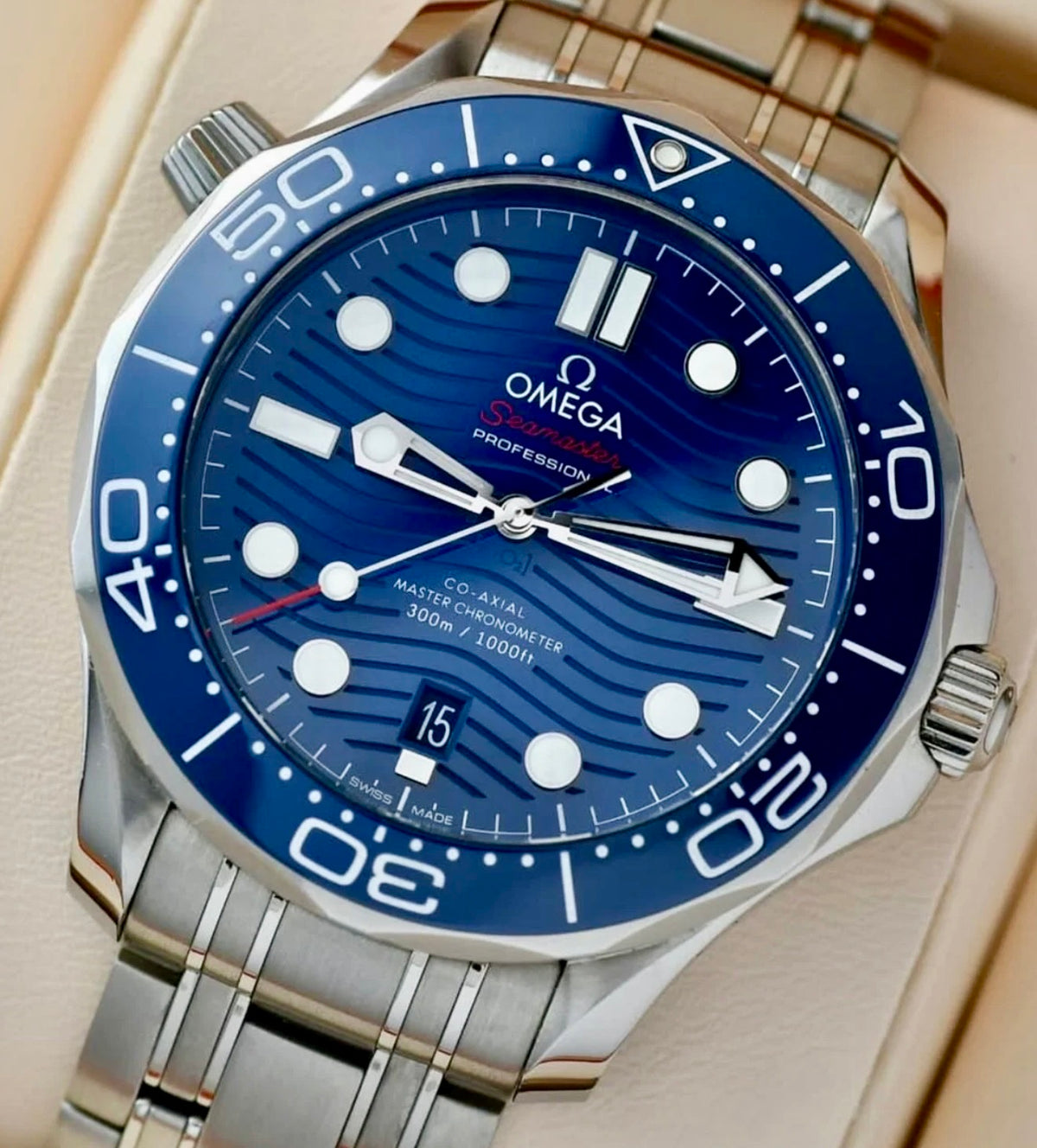 Current Superlative Watch Co. example · Ref. 210.30.42.20.03.001 · View watch →
For most buyers, the 42 mm Seamaster Diver 300M is the best first Seamaster. It combines 300 m water resistance, Master Chronometer performance, broad color choice and bracelet or rubber flexibility. The fourth-generation Planet Ocean is the technical alternative when 600 m capability, Calibre 8912 and a shorter 47.5 mm lug-to-lug case matter more.
Which “Seamaster” do buyers mean? Buyers often call the Diver 300M the “Seamaster Professional” or “Seamaster 300M.” Its correct current family name is Seamaster Diver 300M: the 42 mm wave-dial diver with skeleton hands and an external helium valve. It is distinct from the 41 mm Seamaster 300, OMEGA’s heritage model inspired by the 1957 diver.
Superlative Buying Desk verdict: choose the blue ceramic/date Diver 300M for the clearest signature Seamaster identity; black for the most neutral presentation; green for color distinction without changing the core technical package; the no-date aluminium branch for domed sapphire and mesh or integrated rubber; and the redesigned Planet Ocean for 600 m engineering, Calibre 8912 and orange, blue or black bezel choices.
Research standard: reference specifications were checked against OMEGA product pages and primary press material; the selected watch photographs, prices and availability were checked against Superlative Watch Co. listings. Confirm current details on each linked watch page. See the methodology and official source index.
Current Seamaster Watches: 16 Exact References
Explore live Superlative Watch Co. examples led by blue, black and green Diver 300Ms, then compare no-date, Bond, ceramic, chronograph and redesigned Planet Ocean configurations. Every card uses a current product photograph and links directly to that watch’s individual page.
The signature blue ceramic wave-dial configuration with Calibre 8800, date and steel bracelet.
View watch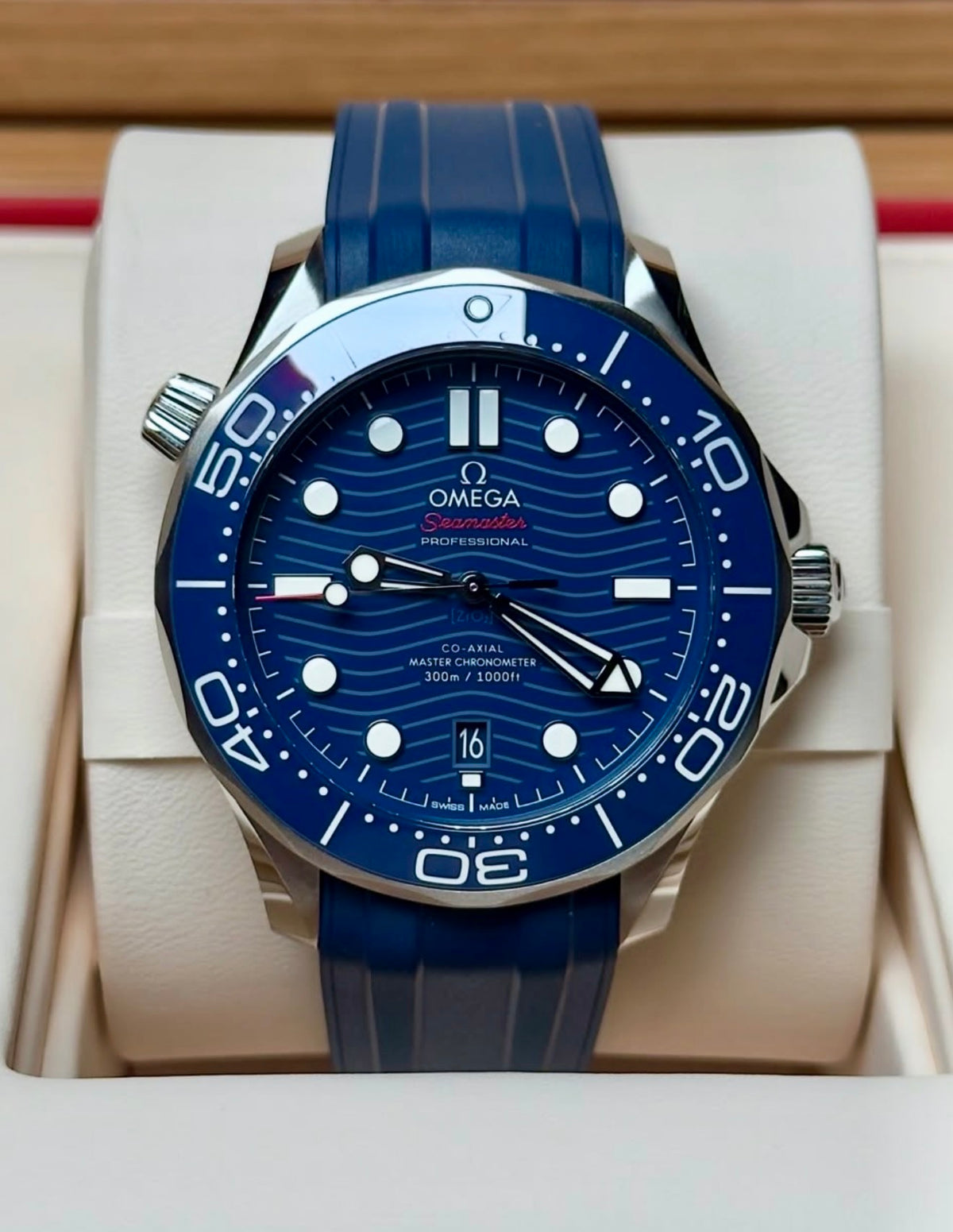
The same core blue ceramic/date watch with a materially lighter blue-rubber wearing profile.
View watch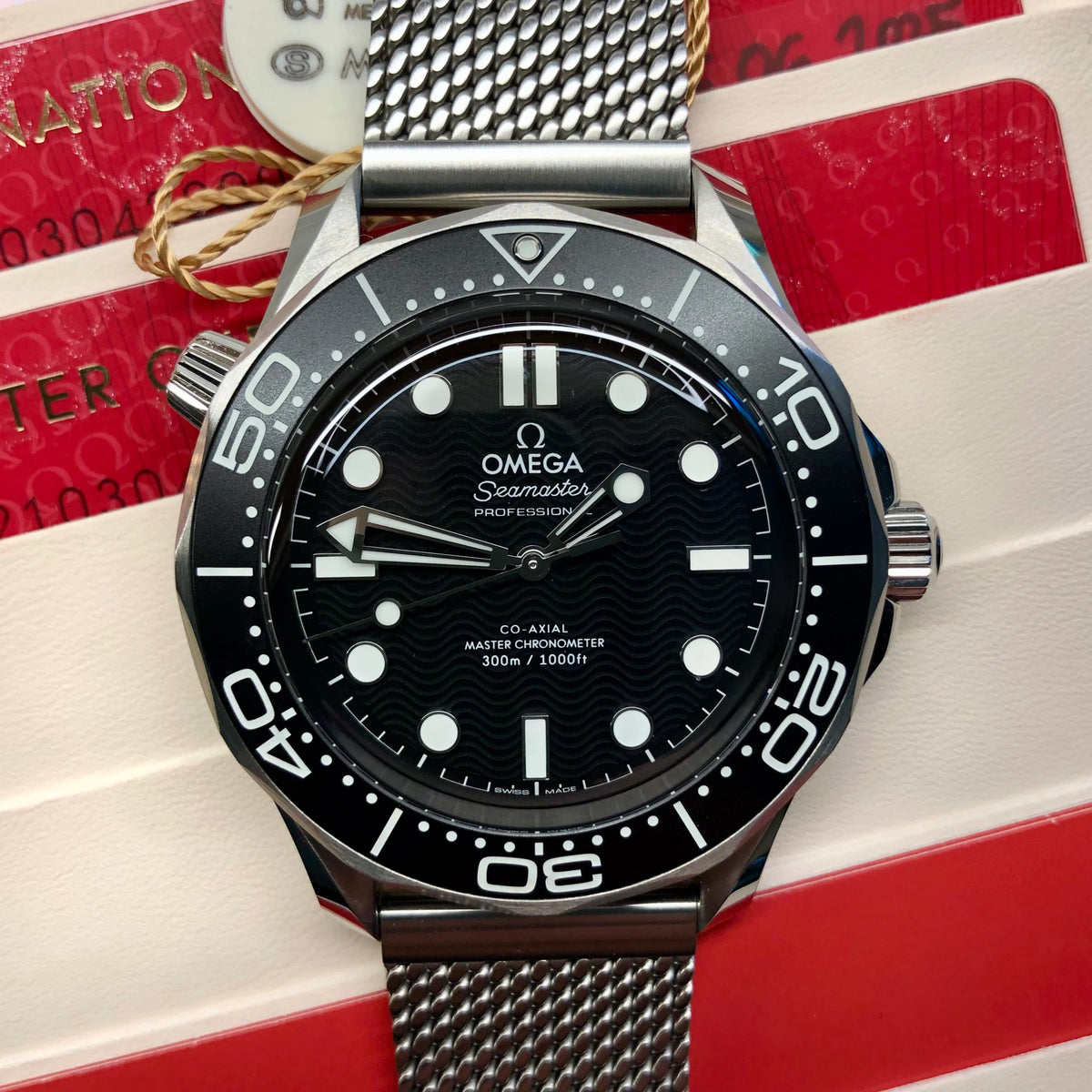
Black aluminium, domed sapphire, Calibre 8806 and brushed steel mesh in the current no-date branch.
View watch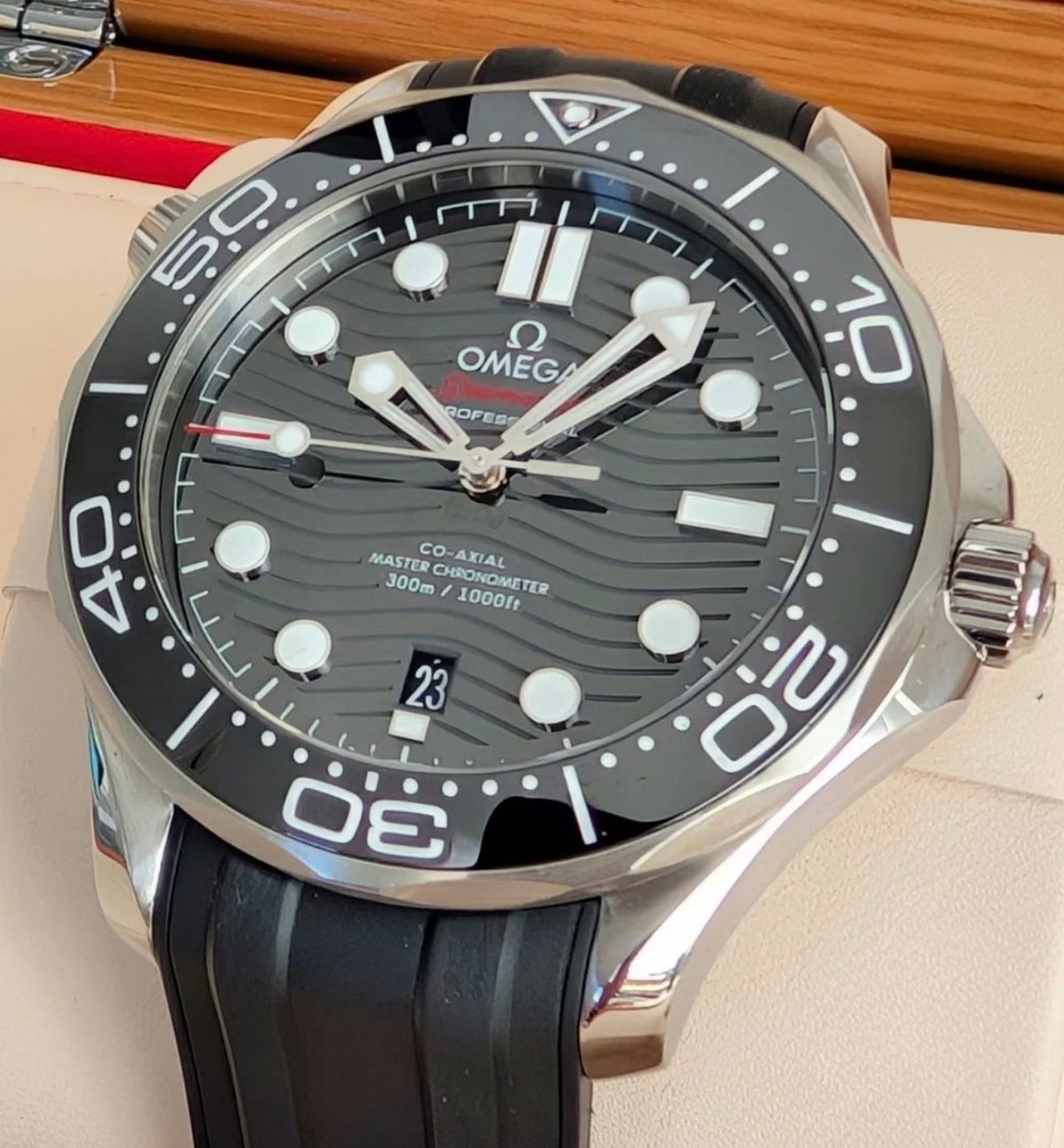
The neutral black ceramic/date configuration on rubber for a lighter everyday fit.
View watch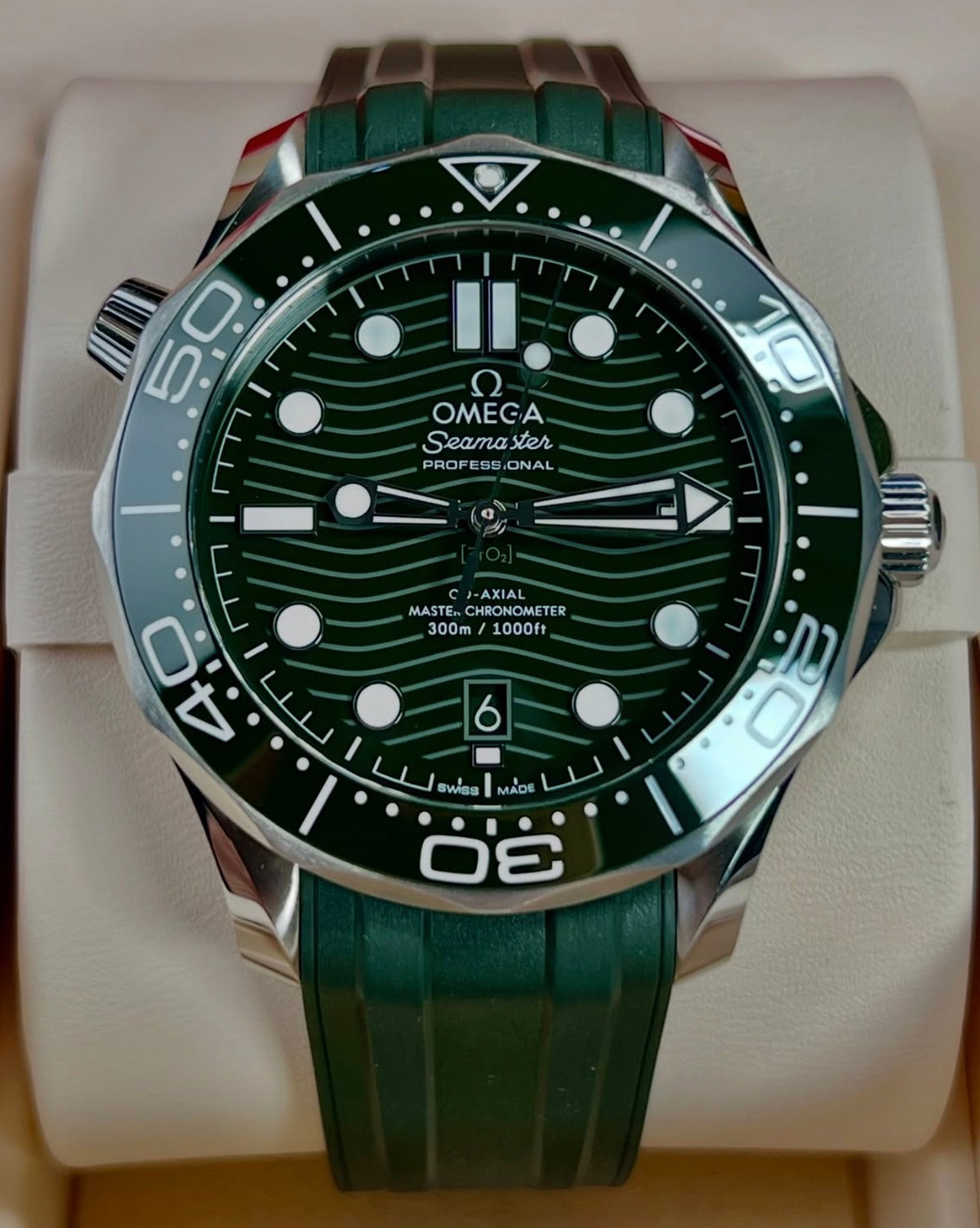
The green ceramic/date configuration with the same 42 mm technical package as core blue and black models.
View watch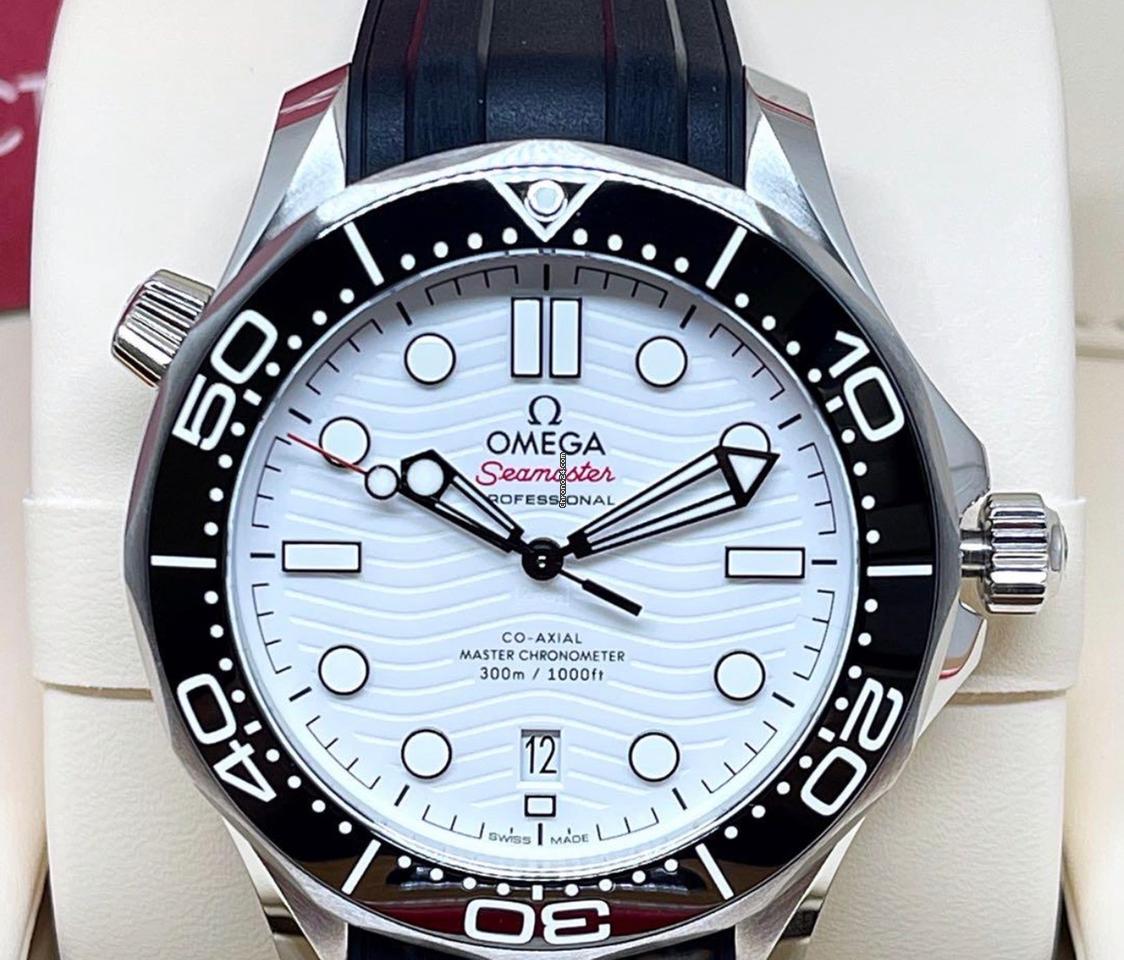
High-contrast white ceramic wave dial, black ceramic bezel and black rubber strap.
View watch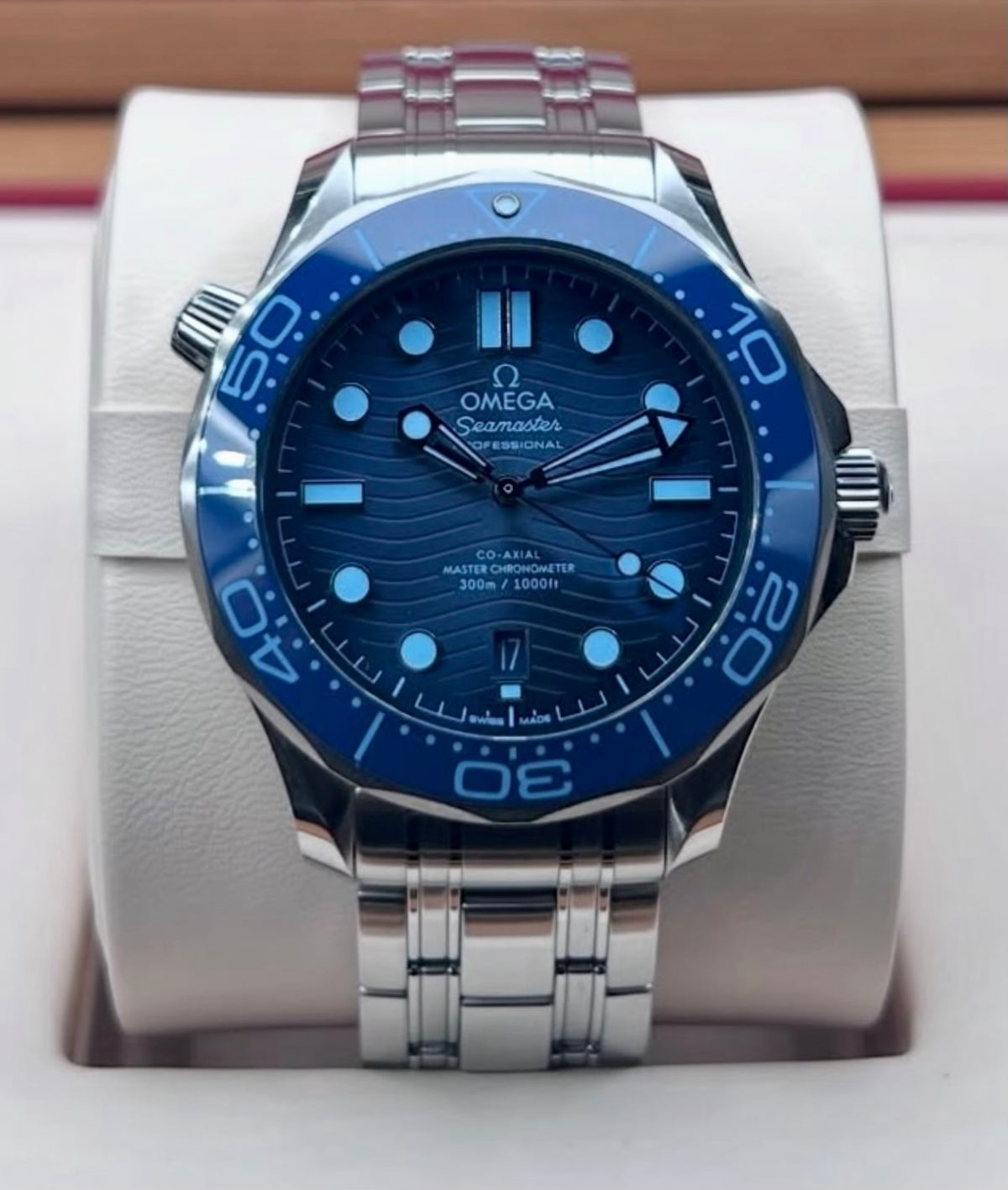
An anniversary colorway that moves the familiar Diver 300M architecture into a graduated aquatic palette.
View watch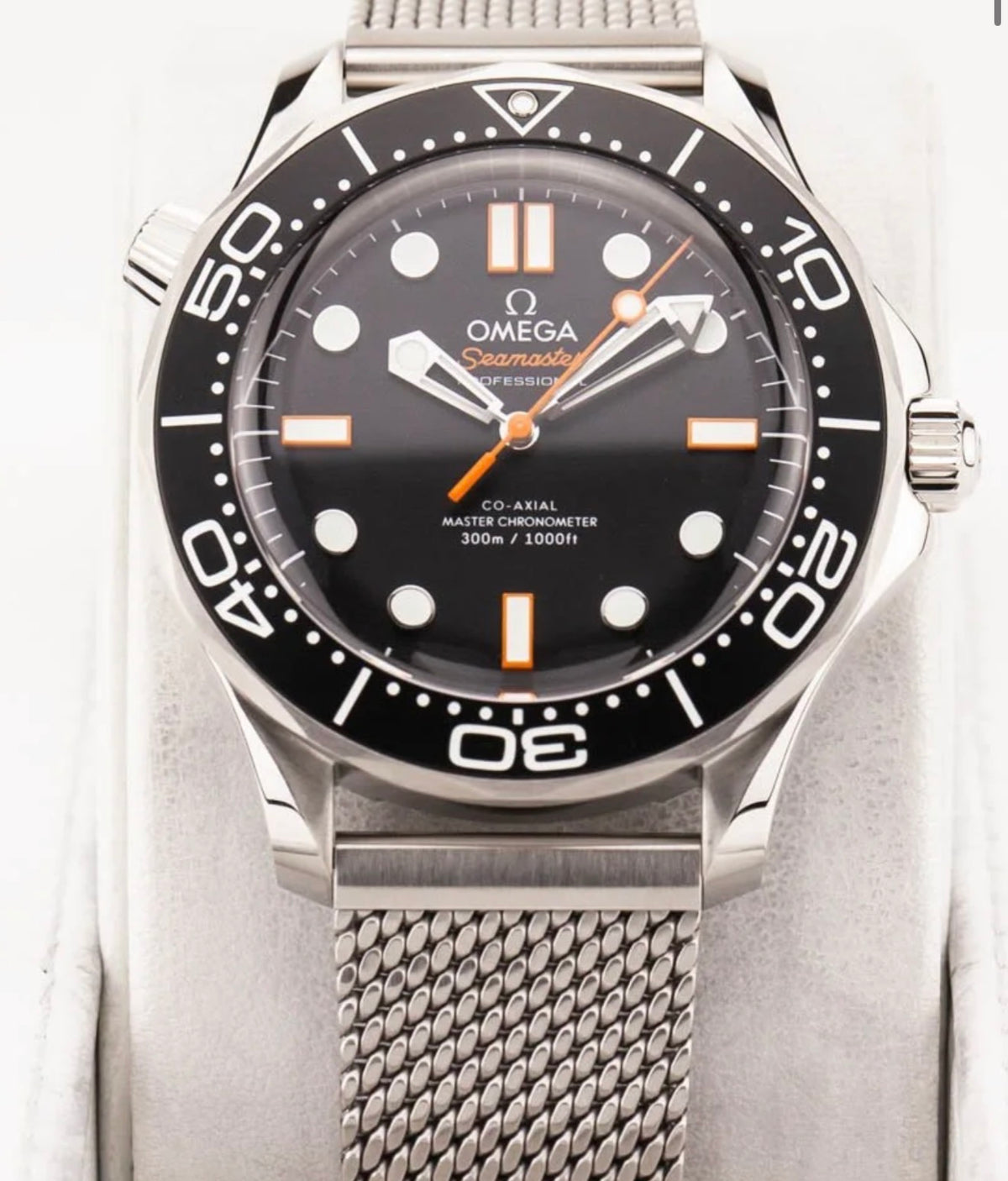
Domed sapphire, black aluminium, orange accents, Calibre 8806 and brushed steel mesh.
View watch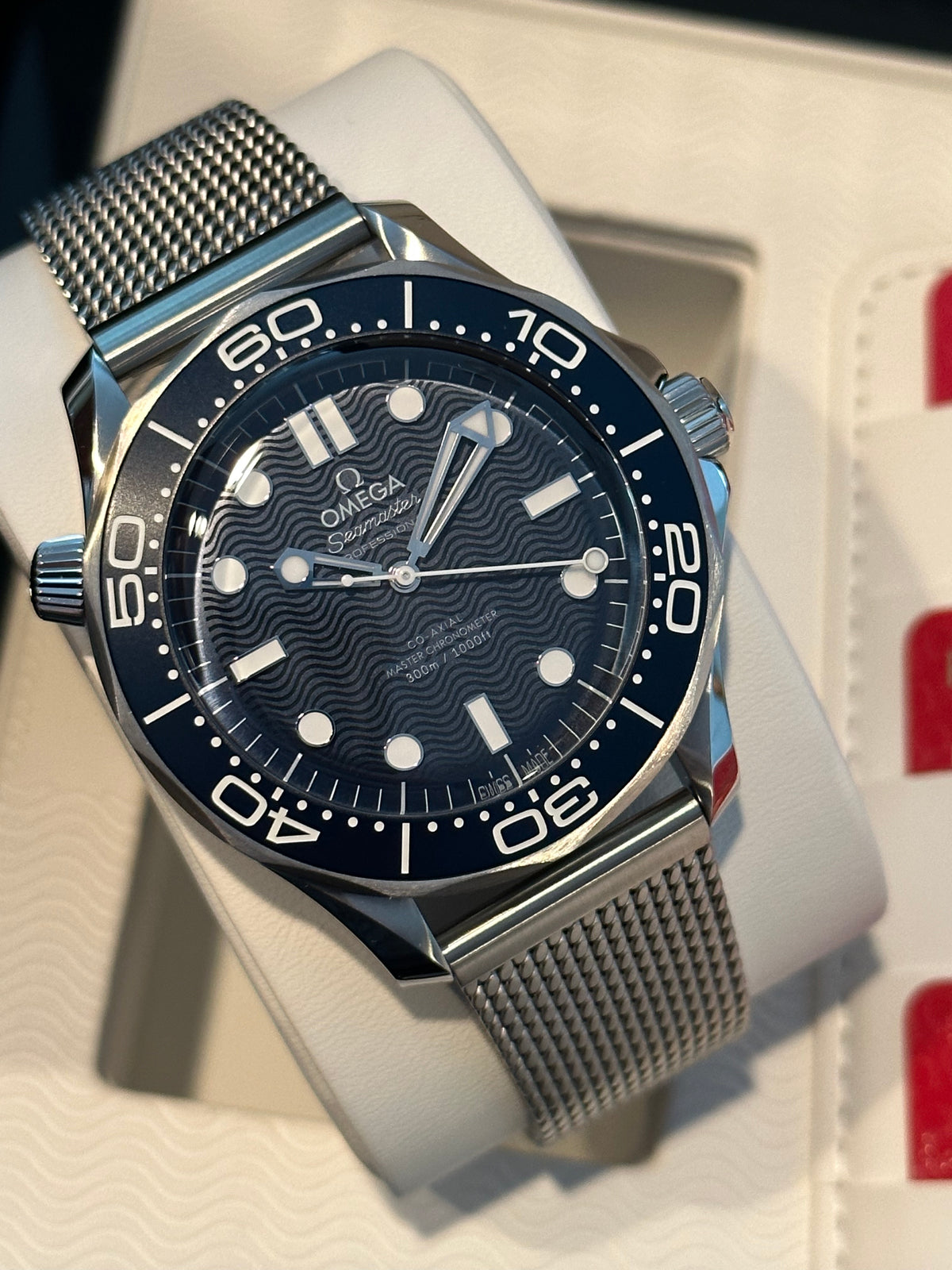
A blue no-date Diver on steel mesh with an animated gun-barrel caseback.
View watch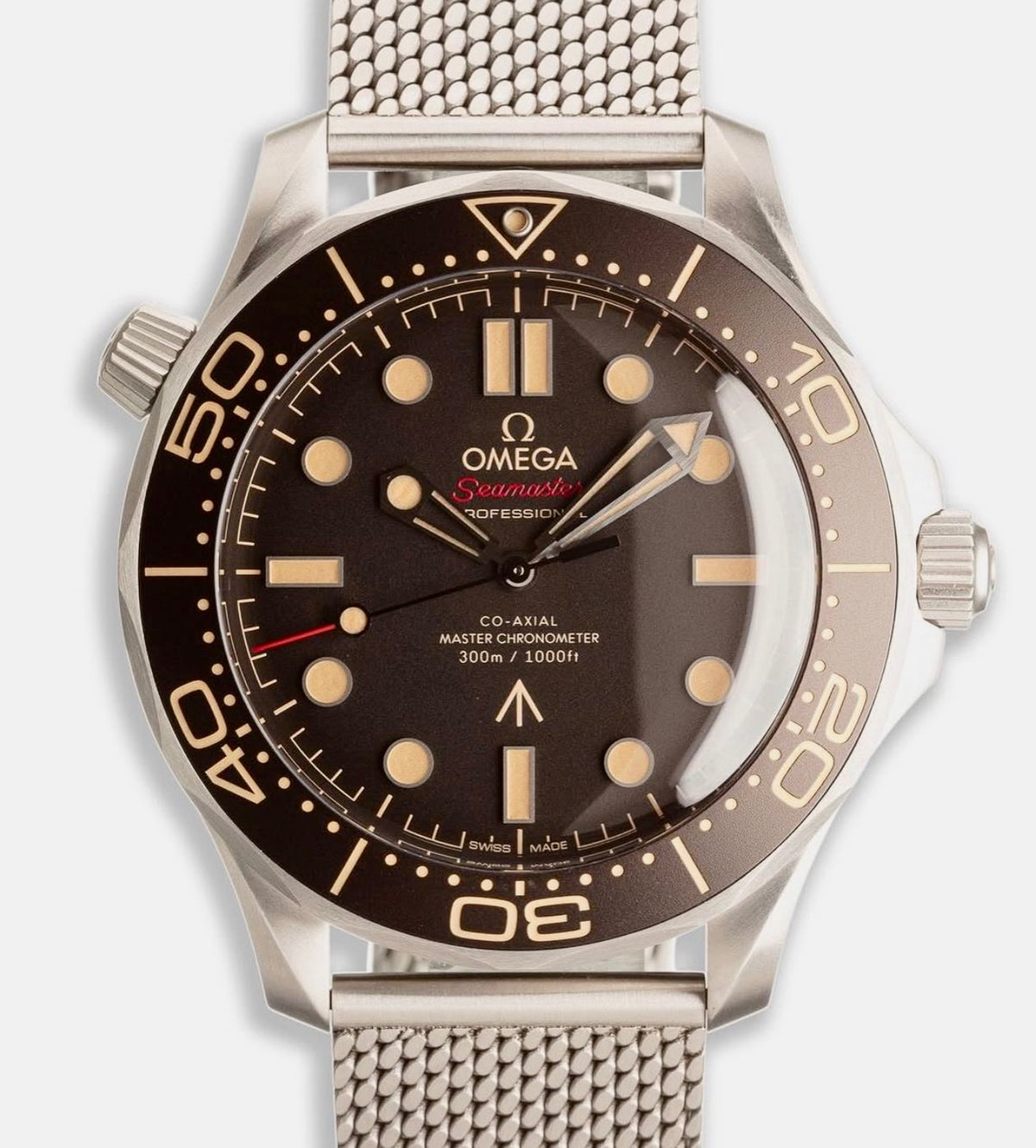
Grade 2 titanium, tropical-brown aluminium and titanium mesh at an official listed weight of about 93 g.
View watch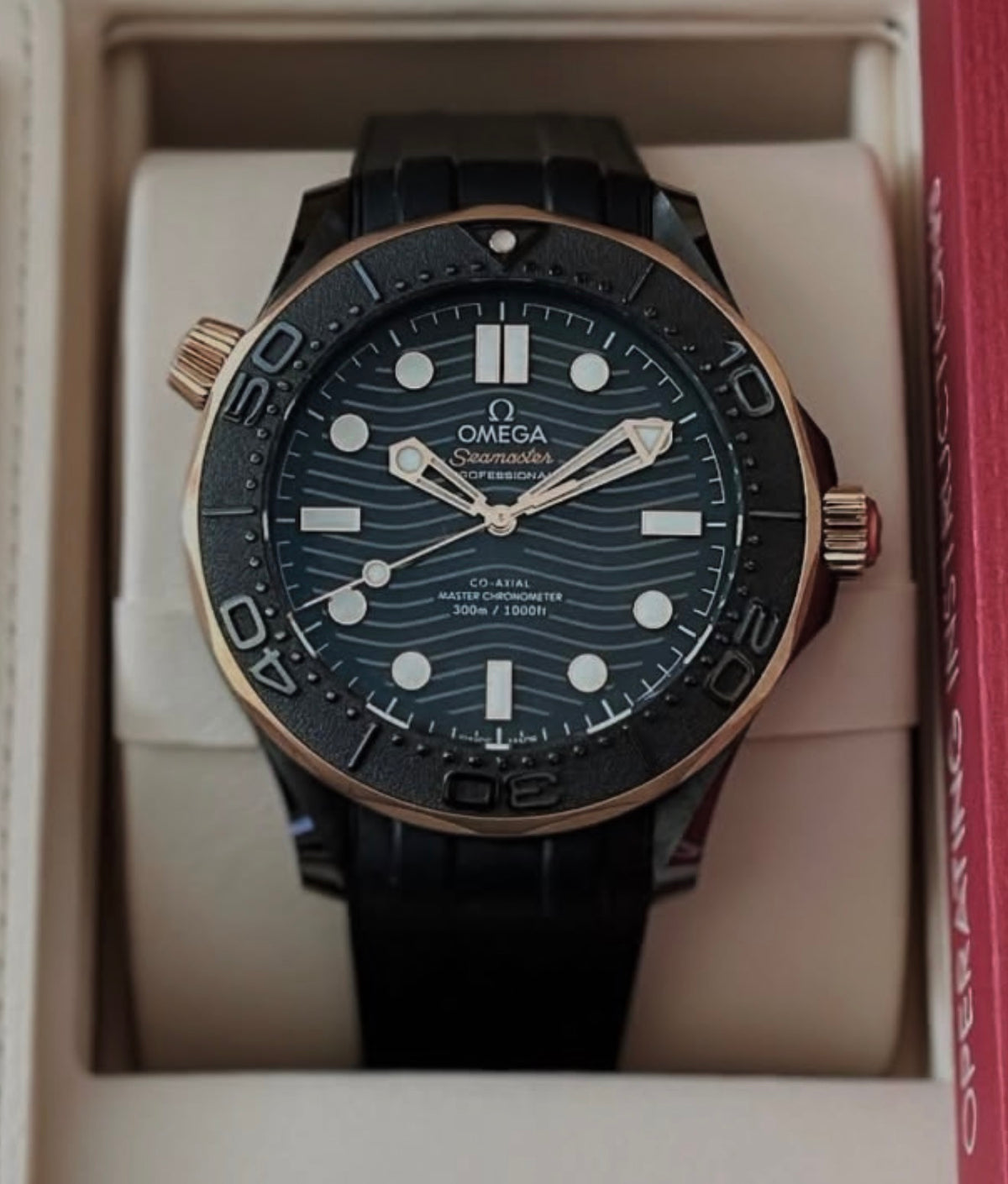
A premium black ceramic execution with Sedna Gold details and an integrated rubber strap.
View watch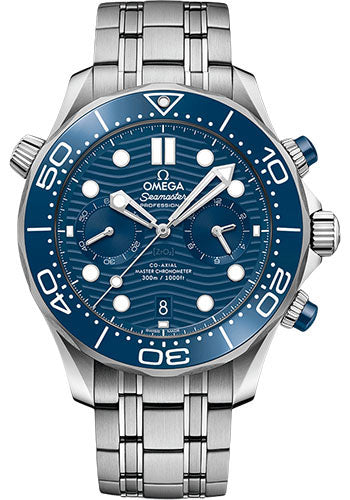
The chronograph branch in blue, pairing dive-watch architecture with an automatic timing complication.
View watch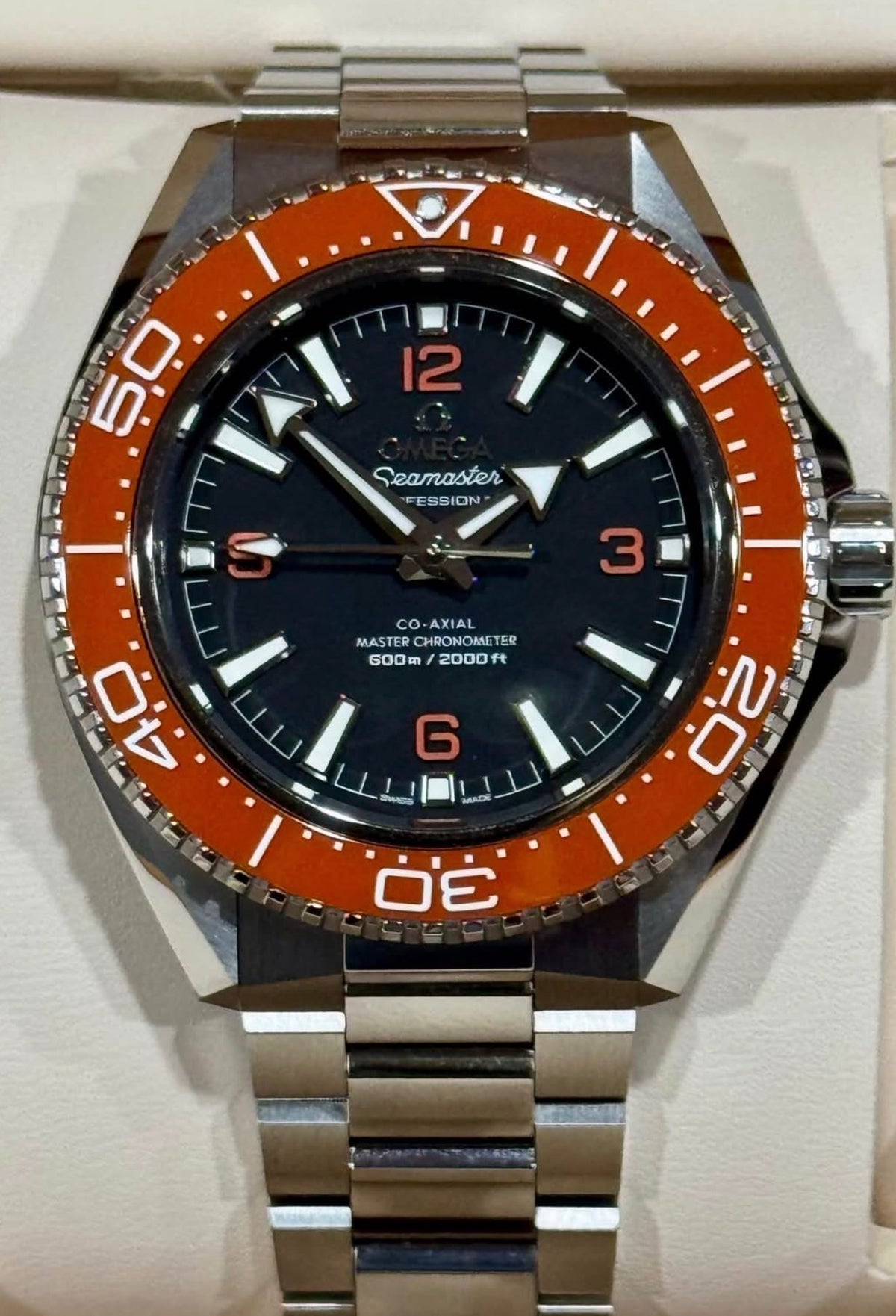
The fourth-generation orange-bezel 42 mm Planet Ocean on steel, led by Calibre 8912.
View watch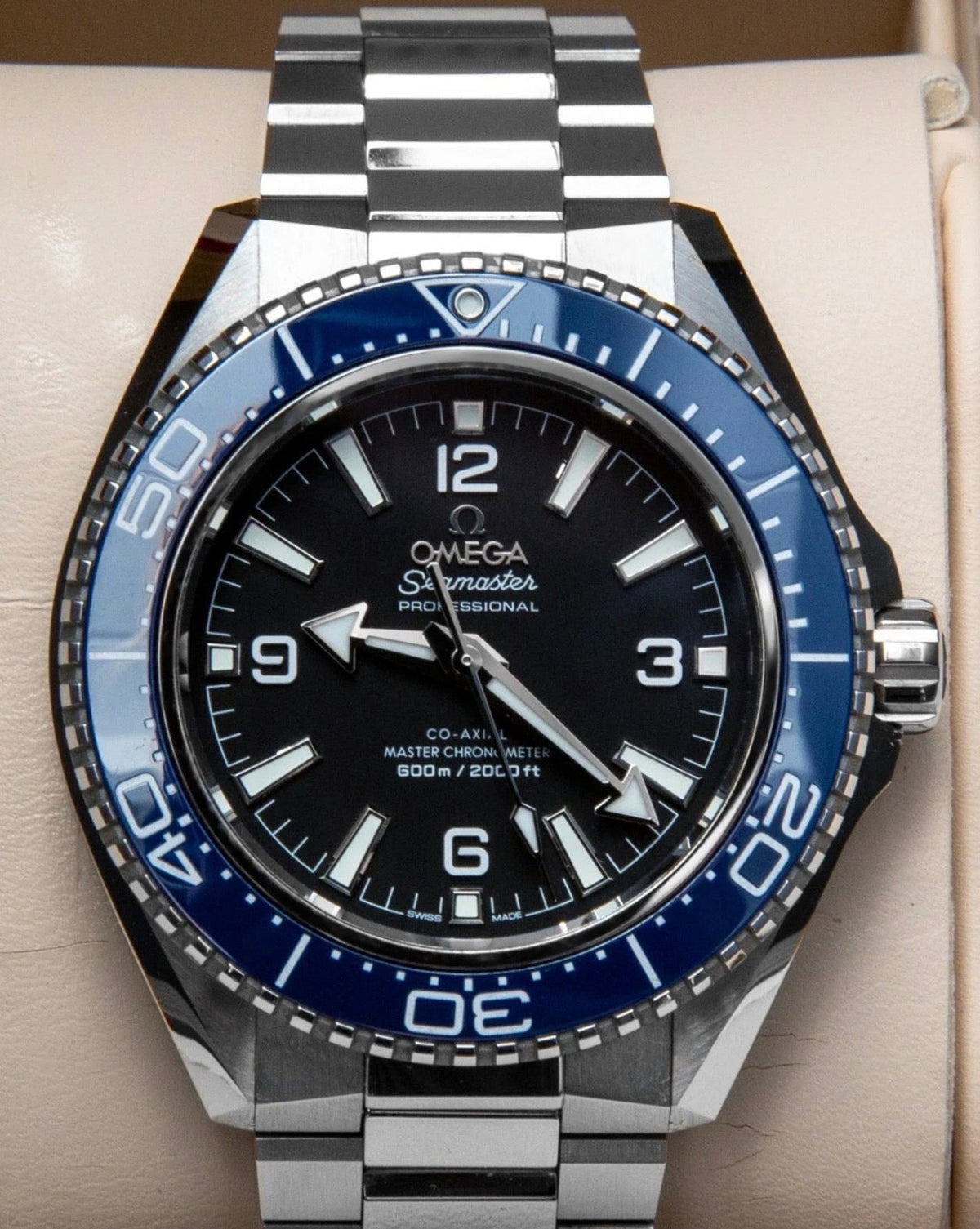
A blue ceramic bezel over a matte black dial in the redesigned 42 mm Planet Ocean case.
View watch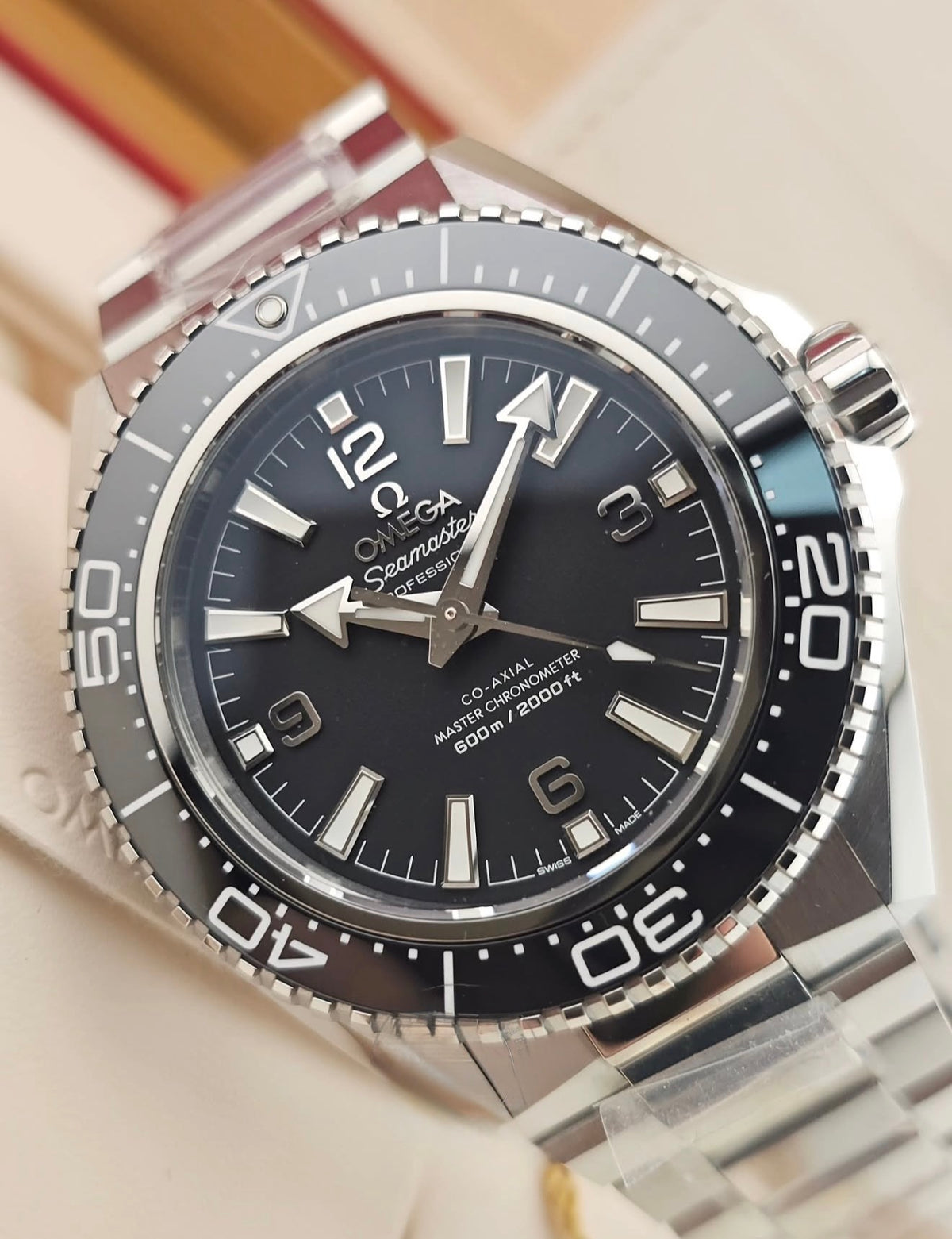
The restrained black-bezel baseline for the fourth-generation 600 m platform.
View watch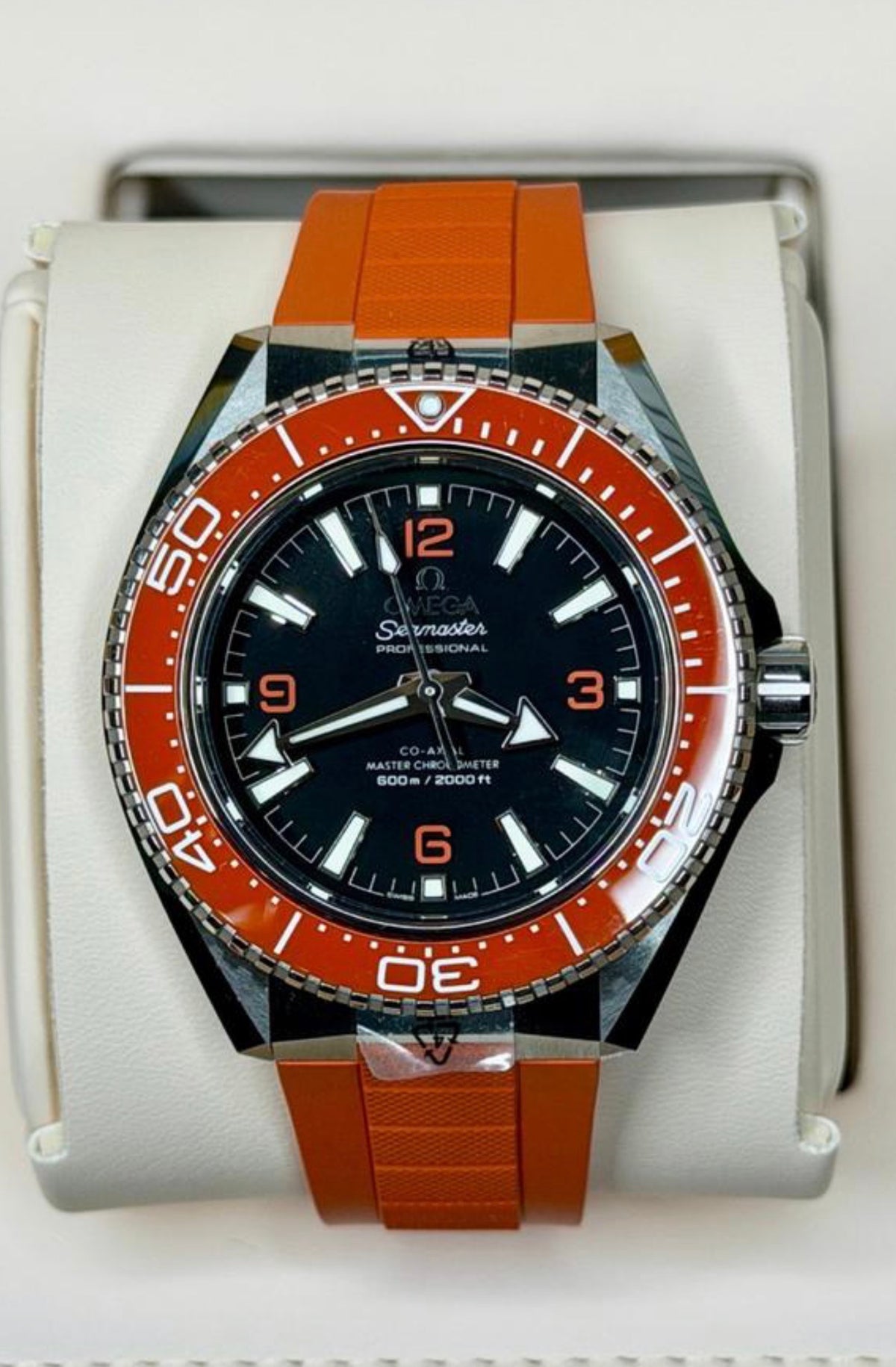
The high-identity orange execution on integrated orange rubber with foldover clasp.
View watchThe linked watch listings show current price, availability, condition and included set. If a reference has sold, the Buying Desk can help source the same or a similar configuration.
Exact-Reference Seamaster Navigator
Use the complete reference—not “Seamaster” alone—to compare the exact dial, bezel, bracelet or strap, and movement family. Select the model name or “View watch” to open the individual listing.
| Model / Exact Reference | Family / Configuration | Why It Is Here | Price / Availability |
|---|---|---|---|
| Blue Diver 300M — BraceletRef. 210.30.42.20.03.001View watch → | Diver 300M · Stainless-steel bracelet | The signature blue ceramic wave-dial configuration with Calibre 8800, date and steel bracelet. | View current price & availability → |
| Blue Diver 300M — RubberRef. 210.32.42.20.03.001View watch → | Diver 300M · Blue rubber strap | The same core blue ceramic/date watch with a materially lighter blue-rubber wearing profile. | View current price & availability → |
| Black No-Date Diver — MeshRef. 210.30.42.20.01.010View watch → | Diver 300M · Brushed steel mesh | Black aluminium, domed sapphire, Calibre 8806 and brushed steel mesh in the current no-date branch. | View current price & availability → |
| Black Diver 300M — RubberRef. 210.32.42.20.01.001View watch → | Diver 300M · Black rubber strap | The neutral black ceramic/date configuration on rubber for a lighter everyday fit. | View current price & availability → |
| Green “Seaweed” Diver — RubberRef. 210.32.42.20.10.001View watch → | Diver 300M · Green rubber strap | The green ceramic/date configuration with the same 42 mm technical package as core blue and black models. | View current price & availability → |
| White Dial Diver — RubberRef. 210.32.42.20.04.001View watch → | Diver 300M · Black rubber strap | High-contrast white ceramic wave dial, black ceramic bezel and black rubber strap. | View current price & availability → |
| Diver 300M — Summer BlueRef. 210.30.42.20.03.003View watch → | Diver 300M · Stainless-steel bracelet | An anniversary colorway that moves the familiar Diver 300M architecture into a graduated aquatic palette. | View current price & availability → |
| Black & Orange No-Date DiverRef. 210.30.42.20.01.018View watch → | Diver 300M · Brushed steel mesh | Domed sapphire, black aluminium, orange accents, Calibre 8806 and brushed steel mesh. | View current price & availability → |
| James Bond 60th AnniversaryRef. 210.30.42.20.03.002View watch → | Diver 300M · Stainless-steel mesh bracelet | A blue no-date Diver on steel mesh with an animated gun-barrel caseback. | View current price & availability → |
| No Time To Die 007 EditionRef. 210.90.42.20.01.001View watch → | Diver 300M · Titanium mesh bracelet | Grade 2 titanium, tropical-brown aluminium and titanium mesh at an official listed weight of about 93 g. | View current price & availability → |
| Ceramic & Sedna Gold DiverRef. 210.62.44.20.01.001View watch → | Diver 300M · Black rubber strap | A premium black ceramic execution with Sedna Gold details and an integrated rubber strap. | View current price & availability → |
| Blue Diver 300M ChronographRef. 210.30.44.51.03.001View watch → | Diver 300M Chronograph · Stainless-steel bracelet | The chronograph branch in blue, pairing dive-watch architecture with an automatic timing complication. | View current price & availability → |
| Planet Ocean 600M — OrangeRef. 217.30.42.21.01.003View watch → | Planet Ocean 600M · Stainless-steel bracelet | The fourth-generation orange-bezel 42 mm Planet Ocean on steel, led by Calibre 8912. | View current price & availability → |
| Planet Ocean 600M — BlueRef. 217.30.42.21.01.002View watch → | Planet Ocean 600M · Stainless-steel bracelet | A blue ceramic bezel over a matte black dial in the redesigned 42 mm Planet Ocean case. | View current price & availability → |
| Planet Ocean 600M — BlackRef. 217.30.42.21.01.001View watch → | Planet Ocean 600M · Stainless-steel bracelet | The restrained black-bezel baseline for the fourth-generation 600 m platform. | View current price & availability → |
| Planet Ocean 600M — Orange RubberRef. 217.32.42.21.01.004View watch → | Planet Ocean 600M · Orange rubber strap | The high-identity orange execution on integrated orange rubber with foldover clasp. | View current price & availability → |
Guide Navigator
- 1. Current Seamaster Watches and Exact References
- 2. Quick Answer: Which Seamaster Should You Buy?
- 3. Which Seamaster Do You Mean?
- 4. Seamaster History
- 5. Seamaster Collection Map
- 6. Diver 300M: Colors, Date and Attachments
- 7. Diver 300M Generations
- 8. Diver 300M Date vs No-Date
- 9. James Bond Seamaster
- 10. Aqua Terra 150M
- 11. Diver 300M vs Redesigned Planet Ocean
- 12. Planet Ocean Generations
- 13. Ultra Deep 6000M
- 14. Seamaster 300 Heritage Models
- 15. Specialist and Discontinued Seamaster Families
- 16. Movement and Calibre Map
- 17. Co-Axial and Master Chronometer
- 18. Water Resistance and Diving
- 19. Size, Thickness and Wrist Fit
- 20. Major Brand and Model Comparisons
- 21. Value and Market Pricing
- 22. Authentication and Condition
- 23. Best Seamaster by Buyer Type
- 24. Frequently Asked Questions
- 25. Research Methodology and Official Sources
- 26. Related Guides, Inventory and Buying Help
Long-form reference guide · use the exact-reference navigator for current inventory
Quick Answer: Which Omega Seamaster Should You Buy?
Start with the wearing experience, then select color and attachment. The Diver 300M is the central commercial choice, the Aqua Terra is the polished all-purpose alternative, and the redesigned Planet Ocean is the 600 m technical choice. The model name never replaces an exact-reference check.
| Buyer Priority | Best Starting Point | Reference-Specific Reason | Trade-Off to Check |
|---|---|---|---|
| Signature modern Seamaster | Blue Diver 300M | 42 mm, 300 m, ceramic wave dial, Calibre 8800 and date | Bracelet versus rubber changes listed weight substantially |
| Neutral daily diver | Black Diver 300M | Available in ceramic/date and aluminium/no-date branches | Confirm dial, bezel, crystal, calibre and attachment |
| Color without a technical change | Green Diver 300M | Core 42 mm ceramic/date architecture in green | Confirm bracelet or rubber by exact reference; official listed weight and fit differ. |
| No date and domed sapphire | 2024-and-later Diver 300M branch | Calibre 8806, aluminium or PVD-steel dial, mesh or integrated rubber | It did not replace the ceramic/date family |
| 600 m engineering | Fourth-generation Planet Ocean | 42 mm, 47.50 mm lug-to-lug, 13.79 mm thick and Calibre 8912 | 21 mm lugs and a distinct bracelet/strap system |
| Heritage diving design | Seamaster 300 | 41 mm model inspired by OMEGA’s 1957 diver | Do not confuse it with the Diver 300M |
Which Omega Seamaster Do You Mean?
“Seamaster” is a parent collection, and buyer shorthand is often ambiguous. Searchers commonly use “Seamaster Professional” and “Seamaster 300M” for the Diver 300M, while OMEGA reserves “Seamaster 300” for a separate 41 mm heritage model.
| Buyer Phrase | Correct Current Family | How to Identify It |
|---|---|---|
| “Seamaster Professional” or “Seamaster 300M” | Seamaster Diver 300M | 42 mm core model, skeleton hands, wave dial, external helium escape valve and 300 m rating |
| “Seamaster 300” | Seamaster 300 | 41 mm heritage model based on OMEGA’s 1957 diver, with open numerals and vintage-colored lume |
| “Planet Ocean” | Seamaster Planet Ocean 600M | Current fourth-generation 42 mm model with black, blue or orange bezel and 600 m rating |
| “Ultra Deep” | Planet Ocean Ultra Deep 6000M | 45.5 mm specialist production diver with a 6,000 m rating |
Naming rule: never use “Seamaster 300” as shorthand for the Diver 300M. Use the complete reference on the card, case documentation and product individual before comparing specifications.
Omega Seamaster History: 1948 to Today
The Seamaster began in 1948 and evolved from a robust everyday watch into one of the broadest maritime watch families in Swiss watchmaking. Its history is best understood as several parallel lines: refined water-resistant watches, professional divers, anti-magnetic tool watches, Bond-era sports watches and modern extreme-depth instruments.
This history matters because the secondary market contains multiple design eras at once. A 1960s Seamaster De Ville, a quartz Bond-era Diver 300M, a current no-date Calibre 8806 Diver, a 41 mm heritage Seamaster 300 and a 6,000-meter Ultra Deep all belong to the same parent family, yet they require different buying checklists.
Collectors often use nicknames and shorthand, but original documents, correct references and period-appropriate components matter more than nicknames. When researching a vintage or discontinued watch, establish the reference first, then determine the expected case, dial, hands, bezel, movement, bracelet, end links and production period.
Historical buying principle: the older the watch, the more important originality becomes. A current Seamaster can be evaluated mainly on reference, condition, completeness and warranty. A vintage Seamaster may require dial, hand, lume, case, crown, crystal and movement analysis before value can be estimated.
Complete Seamaster Collection Map
Omega currently organizes the core Seamaster range around six named families: Diver 300M, Aqua Terra 150M, Seamaster 300, Railmaster, Planet Ocean 600M and Ploprof 1200M. Ultra Deep sits within the broader deep-diving Planet Ocean universe, while Bond, Olympic, regatta, chronograph and special-material references cross those families.
| Family | Typical Identity | Water-Resistance Class | Common Movement Direction | Best For |
|---|---|---|---|---|
| Diver 300M | Wave dial, skeletonized hands, scalloped rotating bezel, helium valve | 300 meters on the standard modern diver | 8800 date or 8806 no-date families; chronographs use 9900-series variants depending on reference | Modern dive-watch buyers, Bond fans and buyers comparing with a Submariner |
| Aqua Terra 150M | Polished sport-watch case, clean dial, date, no external dive bezel | 150 meters on current standard models | 8750/8751 in 30 mm; 8800 family in selected smaller models; 8900 family in many 41 mm versions | One-watch collections, office-to-water use, travel and buyers comparing with Datejust |
| Seamaster 300 | Vintage-inspired dive layout, broad-arrow cues, restrained dial | 300 meters on modern heritage models | 8912 no-date family on many current references | Heritage buyers who want a cleaner design than the Diver 300M |
| Railmaster | Simple anti-magnetic three-hand or small-seconds tool watch | Reference-specific; not designed around a dive bezel | 8806 or 8804 on the 2025 38 mm return | Understated daily wear and anti-magnetic performance |
| Planet Ocean 600M | Substantial professional diver, prominent bezel and technical case | 600 meters | 8800/8900/8906/other families depending size and complication; fourth generation is Master Chronometer | Buyers who want heavier construction and more depth capability |
| Ultra Deep | Extreme-depth case and specialized architecture | 6,000 meters on production models | 8912 family on prominent no-date references | Large wrists, engineering collectors and extreme technical capability |
| Ploprof 1200M | Asymmetrical professional case, bezel lock and specialized controls | 1,200 meters on modern models | 8912 or earlier 8500-family depending generation | Collectors prioritizing purpose-built design over conventional wearability |
The collection map should be used as a filter, not a ranking. An Aqua Terra is not a lesser Planet Ocean; it solves a different problem. A Ploprof is not automatically a better diver for daily life because it has a higher depth rating. Most owners will never approach the rated depth of a 300-meter watch, so comfort, visibility, bezel feel, clasp adjustment and service condition may matter more than the largest number on a specification sheet.
Omega's current official Seamaster category page lists the six primary families. Buyers can review the manufacturer's current grouping in the Omega Seamaster press-room collection index, then use this guide to interpret the differences in ownership terms.
Seamaster Diver 300M: Blue, Black, Green, Date and No-Date
The 42 mm Diver 300M is the commercial center of the modern Seamaster family. Core blue, black and green references use ceramic dials and bezels, a date at 6 and Calibre 8800. The 2024-and-later branch adds no-date Calibre 8806 references with domed sapphire, aluminium or brushed PVD-steel dials and mesh or integrated-rubber options.
| Color | Bracelet Reference | Rubber Reference | Shared Official Specification | Buying Desk View |
|---|---|---|---|---|
| Blue | 210.30.42.20.03.001 | 210.32.42.20.03.001 | 42 mm · 300 m · Calibre 8800 · 55 h | Clearest signature Seamaster identity |
| Black | 210.30.42.20.01.001 | 210.32.42.20.01.001 | 42 mm · 300 m · Calibre 8800 · 55 h | Most neutral all-purpose color |
| Green | 210.30.42.20.10.001 | 210.32.42.20.10.001 | 42 mm · 300 m · Calibre 8800 · 55 h | Distinctive color, unchanged core package |
| Specification | Ceramic / Date Branch | Aluminium / No-Date Branch |
|---|---|---|
| Representative references | 210.30.42.20.03.001, .01.001, .10.001 | 210.30.42.20.01.010; 210.30.42.20.01.018 |
| Diameter / water resistance | 42 mm / 300 m | 42 mm / 300 m |
| Thickness / lug-to-lug | 13.56 mm / 49.90–49.93 mm | 13.80 mm / 49.70 mm |
| Movement | Calibre 8800 · date · 55 h | Calibre 8806 · no date · 55 h |
| Dial / crystal direction | Polished ceramic wave dial / domed sapphire | Aluminium or brushed PVD steel / domed sapphire |
| Attachment direction | Steel dive bracelet or color-matched rubber | Brushed steel mesh or integrated foldover-clasp rubber |
Weight changes the watch: OMEGA lists core blue and black ceramic/date models at about 194 g on bracelet and 109 g on rubber—an approximate 85 g difference. Fit therefore depends on the exact reference and attachment, not the shared 42 mm diameter alone.
Official configuration facts were checked against OMEGA’s exact-reference pages and its November 2024 Diver 300M launch.
Diver 300M Generations and Reference Families
Diver 300M generations differ in size, movement, bracelet, dial construction and overall feel, so the newest watch is not automatically the best watch for every buyer. Older quartz and automatic references can be slimmer and closely connected to the 1990s Bond era. Modern Master Chronometer versions provide stronger anti-magnetic performance, display casebacks on many references and more elaborate materials.
The earliest modern Diver 300M references established the blue wave dial, skeletonized hands, scalloped bezel, helium valve and multi-link bracelet. Quartz examples are historically important rather than inferior by definition: the first Pierce Brosnan Bond watch was quartz, and quartz can offer lower acquisition cost, high accuracy and straightforward ownership. Mechanical examples appeal to buyers who prioritize a traditional automatic movement and visible horology.
Later Co-Axial generations introduced Omega's proprietary escapement architecture, while the 2018-era Master Chronometer update made the modern 42 mm ceramic-wave-dial watch the dominant reference point. The 2024 and 2025 no-date refresh created another branch: domed sapphire, mesh bracelet or rubber strap, aluminium or titanium elements and calibre 8806. That means a current showroom can contain two legitimate modern aesthetics rather than a simple old-versus-new progression.
1990s Bond-era — Typical Traits: Blue wave dial, compact-feeling case, quartz or automatic, distinctive bracelet; Movement Direction: Quartz or ETA-based automatic depending reference; Buyer Appeal: Direct GoldenEye-era identity, often lower entry cost and wearable proportions; Condition Focus: Bezel, bracelet stretch, lume, dial, water resistance, service history and correct reference. 2000s Co-Axial transition — Typical Traits: Updated cases and movements, broad variety of colors and complications; Movement Direction: Co-Axial automatic and quartz families; Buyer Appeal: Middle-ground pricing and many discontinued configurations; Condition Focus: Movement service, case polishing, bezel condition and bracelet completeness.
Ceramic modern generation — Typical Traits: 42 mm, ceramic dial and bezel on many references, date at 6, display back; Movement Direction: Calibre 8800 family on common date models; Buyer Appeal: Modern materials, strong technical specification and broad availability; Condition Focus: Ceramic damage, clasp adjustment, full set, card date and pressure test. 2024-2026 no-date branch — Typical Traits: Domed sapphire, mesh or rubber, aluminium/titanium design language, no date; Movement Direction: Calibre 8806; Buyer Appeal: Vintage-leaning modern aesthetic and cleaner dial; Condition Focus: Mesh fit, clasp, crystal edge, aluminium marks, full reference and warranty.
Chronographs and special editions — Typical Traits: Larger cases, subdials, Bond or event-specific details; Movement Direction: 9900-series or other reference-specific movements; Buyer Appeal: Complication, narrative and collector interest; Condition Focus: Pusher function, reset alignment, caseback mechanism, special packaging and service history.
Use the generation as a starting point, then verify the complete reference. Omega reference numbers are long because they encode configuration details. One digit can separate steel from titanium, bracelet from strap, or one dial/bezel combination from another. Copy the full number from the warranty card and case documentation, then compare it with the physical watch.
Value insight: discontinued does not mean collectible, and current does not mean common in every configuration. Collector demand usually follows a combination of design significance, production volume, narrative, condition and complete accessories. Buy the exact watch you prefer before trying to predict future scarcity.
Black and Orange Diver 300M 210.30.42.20.01.018
Reference 210.30.42.20.01.018 is a 42 mm stainless-steel, no-date Diver 300M with a black aluminium dial, orange accents, brushed mesh bracelet and calibre 8806. It is an excellent guide hero because it clearly represents the refreshed Diver 300M design while remaining recognizable as a Seamaster.
The black-and-orange model uses orange selectively rather than turning the whole watch into a bright color piece. The central seconds hand, quarter-hour accents and Seamaster signature create visibility and energy against the black dial. The domed sapphire crystal and aluminium components soften the highly polished ceramic look of the prior mainstream generation, while the mesh bracelet reinforces the instrument-like style.
The watch retains the Diver 300M identifiers: scalloped rotating bezel, projecting crown guards, helium valve at 10 o'clock and skeletonized hands. The no-date layout produces cleaner symmetry and avoids a date-setting complication. Calibre 8806 is visible through the sapphire caseback and carries Master Chronometer certification.
Aluminium bezel — What to Inspect: Scratches, impact marks, lume application and alignment; Buyer Interpretation: Aluminium can show wear more readily than ceramic; some buyers like the softer, tool-watch character. Domed sapphire — What to Inspect: Edge chips, coating marks and reflections; Buyer Interpretation: The dome contributes to the vintage-leaning appearance and can change how the dial looks at an angle. Mesh bracelet — What to Inspect: Length, clasp fit, articulation and comfort near the wrist bone; Buyer Interpretation: Mesh can distribute weight well, but fit is personal and may not offer the same adjustment pattern as a conventional link bracelet.
Orange details — What to Inspect: Consistency of hand and marker color under neutral light; Buyer Interpretation: The color is a defining feature; inspect photographs and the physical watch rather than relying on saturated online images. Calibre 8806 — What to Inspect: Timekeeping, power reserve, winding feel and Master Chronometer documentation; Buyer Interpretation: The movement is a modern no-date automatic; operational condition still matters even when certification is present. Complete set — What to Inspect: Warranty cards, reference, serial, box, manual and removed bracelet components; Buyer Interpretation: Completeness supports resale and confirms configuration, but does not independently authenticate the watch.
OMEGA introduced the black-and-orange models in 2025 and described the 42 mm case, black aluminium dial, mesh or orange-rubber options and calibre 8806 in its official Diver 300M in Orange announcement.
Diver 300M Date vs. No-Date
Choose a date Diver 300M for daily practicality and a no-date Diver 300M for symmetry, cleaner reading and a more direct tool-watch appearance. The choice also determines which movement and design generation you are likely to buy, so it is more than a dial preference.
Common modern date models place the date at 6 o'clock and use ceramic-wave-dial styling. The date is useful for daily wear and preserves vertical dial balance better than a 3 o'clock window.
Recent no-date models use a cleaner dial and often pair domed sapphire with mesh or rubber. The absence of a date reduces setting steps and emphasizes the hour markers.
A date complication is not automatically less robust, nor is a no-date movement automatically more collectible. The best choice depends on behavior. If the wearer checks the date several times a day, a no-date watch may become frustrating. If the watch rotates with several others and is frequently reset, the simpler no-date experience may be preferable.
Movement setting also matters. Some Omega movements provide an independently adjustable local-hour hand, which is convenient for travel and date correction. Calibre 8800 and 8806 references are typically set differently from 8900/8912-family watches. Confirm the manual for the exact calibre before assuming a travel feature.
Dial symmetry — Date Model: Balanced but interrupted by date aperture; No-Date Model: Most symmetrical and closest to a pure timing instrument. Daily practicality — Date Model: Better for frequent date use; No-Date Model: Requires another source for the date. Resetting after rotation — Date Model: Date must be corrected when stopped; No-Date Model: Faster setup: time only. Current design choices — Date Model: Broad ceramic-dial and bezel selection; No-Date Model: Strong presence in refreshed aluminium, titanium and Bond-influenced designs. Movement examples — Date Model: Calibre 8800 family on common three-hand references; No-Date Model: Calibre 8806 on recent three-hand no-date references.
Collector logic — Date Model: Reference-specific; a date does not reduce collectibility by itself; No-Date Model: Reference-specific; no-date symmetry may attract enthusiasts but is not a guarantee of value.
Diver 300M Bracelet, Mesh and Rubber Options
The bracelet or strap can change the Diver 300M more dramatically than the dial color. The conventional multi-link bracelet creates the classic 1990s-to-modern Seamaster look; mesh produces a more technical and vintage-influenced profile; rubber reduces visual weight and can improve comfort in heat and water.
The traditional Diver 300M bracelet is one of Omega's most recognizable designs. Some buyers admire its continuity and polished-brushed complexity; others prefer a more tapered bracelet. When evaluating it, focus on clasp adjustment, link condition, end-link fit, total length and whether removed links are included. A bracelet that cannot be sized correctly has little practical value regardless of condition.
Mesh bracelets articulate differently. They can hug the wrist and create a smoother visual transition from case to strap, but the clasp and folded mesh sections may sit differently on small wrists. Buyers should check where the clasp lands, whether the mesh end creates pressure, and how the watch head balances. A photo of the watch lying flat does not answer those questions.
Rubber is often the best comfort option for swimming, travel and warm climates. Integrated rubber can visually shorten the case and reduce total mass. Check strap length, keeper condition, clasp or buckle, cracking near the holes and whether the rubber is an original Omega part. A replacement strap may be practical, but it should be disclosed and valued correctly.
Traditional steel bracelet — Strengths: Classic Seamaster identity, durable, dressier than rubber, good long-term pairing; Trade-Offs: Can feel visually busy and less tapered than competitors; sizing and clasp generation matter; Best Buyer: Buyer who wants the complete traditional package. Steel or titanium mesh — Strengths: Supple appearance, Bond-inspired style, distributes weight differently, distinctive tool-watch look; Trade-Offs: Clasp position and mesh fold can be sensitive on small wrists; Best Buyer: Buyer attracted to refreshed no-date and Bond-influenced models. Integrated rubber — Strengths: Light, water-friendly, strong color coordination and comfortable in heat; Trade-Offs: Less formal; replacement cost and strap length must be checked; Best Buyer: Active daily wearer and warm-climate owner.
NATO-style textile — Strengths: Fast visual change, security if one spring bar fails, Bond association; Trade-Offs: Raises the watch on the wrist and can add bulk under the case; Best Buyer: Casual or narrative-driven buyer. Aftermarket strap — Strengths: Large variety and lower cost; Trade-Offs: May affect fit, appearance and completeness; quality varies widely; Best Buyer: Owner experimenting after securing the correct original components.
Best buying practice: purchase the watch on the most expensive or reference-correct bracelet when possible, then add rubber or textile later. Replacing a missing factory bracelet can cost more and be harder than adding an accessory strap.
Steel, Titanium, Ceramic and Bronze Gold Diver 300Ms
Material choice changes weight, surface behavior, color and long-term appearance more than it changes basic timekeeping. Steel is the universal baseline. Titanium reduces weight and creates a darker technical tone. Ceramic offers high scratch resistance with impact sensitivity. Bronze Gold and precious-metal combinations add warmth, patina and a substantially different price category.
Stainless steel — Feel and Appearance: Familiar weight, bright polished surfaces, broad availability; Ownership Considerations: Scratches can be refinished, but excessive polishing changes geometry; Who Should Choose It: Most buyers and anyone wanting the easiest reference comparison. Grade 2 titanium — Feel and Appearance: Noticeably lighter, darker grey, usually brushed; Ownership Considerations: Surface marks look different from steel; refinishing requires appropriate technique; Who Should Choose It: Buyer prioritizing comfort, corrosion resistance and low weight. Grade 5 titanium components — Feel and Appearance: Can accept sharper finishing and polishing than Grade 2; Ownership Considerations: Often used selectively; verify which parts are actually Grade 5; Who Should Choose It: Buyer comparing technical mixed-material references.
Ceramic case or dial/bezel — Feel and Appearance: Deep color and high scratch resistance; Ownership Considerations: Ceramic can chip or crack from impact and should not be refinished like metal; Who Should Choose It: Buyer who values color permanence and modern execution. Bronze Gold — Feel and Appearance: Warm tone and slower, controlled patina compared with conventional bronze; Ownership Considerations: Material-specific care, premium pricing and color change should be understood; Who Should Choose It: Collector wanting a distinctive proprietary alloy. Gold or two-tone — Feel and Appearance: High visual warmth and luxury weight; Ownership Considerations: Higher replacement and repair costs; surface wear is more visible and value is material-sensitive; Who Should Choose It: Buyer treating the Diver 300M as a luxury object as much as a tool watch.
OMEGA's recent material experiments include titanium with Bronze Gold and full Bronze Gold cases. Manufacturer descriptions explain that Bronze Gold includes gold, palladium and silver and is designed to develop patina differently from conventional bronze. Buyers should still inspect actual color and aging because studio images cannot show how a specific used watch has changed.
Ceramic requires particular care. A light scratch that would be cosmetic on steel can be irrelevant on ceramic because ceramic resists scratching well, but a hard impact can create damage that is not polished away. Inspect bezel edges, case corners and threaded interfaces. Do not assume 'scratch resistant' means indestructible.
Diver 300M Chronographs, Regatta and Specialist Models
Diver 300M chronographs add elapsed-time capability but also add diameter, thickness, pushers, movement complexity and service cost. They are best for buyers who specifically want a mechanical chronograph in a water-oriented case, not buyers who simply want the most capable or most valuable Seamaster.
Modern Diver 300M chronographs commonly use 9900-series Co-Axial Master Chronometer architecture, with a combined hour-and-minute recorder on one subdial and small seconds on the other. Exact case size, date placement, pusher construction and material vary by reference. The watch should be evaluated for pusher action, chronograph start-stop-reset behavior, hand alignment and service history.
OMEGA also produces regatta and America's Cup-related watches that may use mechanical or electronic functions. These models belong to a different buyer category from a standard three-hand diver. A regatta scale, digital logbook, temperature sensor or analog-digital display may be fascinating, but replacement parts, battery or module support, user manuals and complete accessories deserve extra attention.
In 2026, OMEGA introduced the first chronograph in the James Bond Diver 300M line for the 007 First Light game. The 44 mm steel watch uses a black ceramic dial and bezel, calibre 9900, Bond-specific details and a NATO strap. Its relevance is both technical and narrative, so a future secondary-market buyer should verify the special box and accessories as carefully as the movement.
Purpose — Three-Hand Diver: Simple time, seconds, optional date and dive timing bezel; Chronograph Diver: Adds mechanical elapsed-time recording. Case — Three-Hand Diver: Usually easier to wear and thinner; Chronograph Diver: Typically larger and thicker. Movement — Three-Hand Diver: 8800 or 8806 family on common current references; Chronograph Diver: 9900-series or reference-specific chronograph calibre. Water use — Three-Hand Diver: Fewer controls and simpler inspection; Chronograph Diver: Confirm manufacturer instructions for pusher operation; do not assume conventional pushers can be used underwater. Service — Three-Hand Diver: Lower complexity; Chronograph Diver: More components and potentially higher service cost. Best buyer — Three-Hand Diver: Wants a daily dive watch; Chronograph Diver: Specifically values chronograph function or special-edition narrative.
For a current example of the expanding Bond chronograph branch, review OMEGA's 007 First Light manufacturer announcement.
James Bond Seamaster Buying Guide
James Bond editions should be bought first as watches and second as memorabilia. The strongest purchase is a reference whose size, material and daily-wear characteristics already suit the owner, with the Bond narrative adding enjoyment rather than compensating for poor fit.
The modern Bond relationship began in 1995 with GoldenEye and a blue quartz Seamaster Professional Diver 300M. Later films used automatic Diver 300Ms, Planet Ocean models, Aqua Terra references and specially developed editions. The relationship helped define the modern Seamaster, but 'Bond watch' can mean the exact on-screen reference, a commemorative edition, a limited edition, a standard model associated with a film or a later collector release.
Those categories should not be priced identically. An on-screen-equivalent standard reference may be historically important without special packaging. A commemorative release may have an animated caseback, unique dial, edition number or themed presentation box. A standard No Time to Die-style watch may be valued for its material and design rather than scarcity.
Is this the exact on-screen reference or a commemorative edition? — Why It Matters: Sellers often use 'Bond' broadly. The distinction affects history and pricing. Was it limited, numbered, special production or standard production? — Why It Matters: Those terms are not interchangeable, and production structure affects collector expectations. Are the special box and accessories present? — Why It Matters: Themed packaging can represent a meaningful portion of collector value. Does the caseback animation or special mechanism work? — Why It Matters: Mechanical or visual novelty must be inspected, not assumed from photographs. Is the bracelet, mesh or NATO correct for the reference? — Why It Matters: A substitute strap may be wearable but should not be represented as a complete original set.
Is the premium justified by condition and completeness? — Why It Matters: Bond branding alone does not erase polishing, missing accessories or mechanical needs. Would the buyer choose this watch without the 007 connection? — Why It Matters: This question prevents paying a narrative premium for a watch that will not be comfortable or useful.
The James Bond 60th Anniversary Diver 300M is an instructive example. It uses a blue aluminium dial, a commemorative 60 on the bezel, mesh bracelet, calibre 8806 and an animated gun-barrel caseback. Its special presentation box and caseback are part of the product, so a loose watch should be valued differently from a complete set.
Collector verdict: Bond editions can be highly enjoyable and some trade differently from standard Seamasters, but there is no universal 'Bond premium.' Reference, production structure, condition, completeness, cultural relevance and entry price determine the outcome.
Aqua Terra 150M Overview
The Aqua Terra is the most versatile Seamaster for buyers who do not need an external dive bezel. It combines a polished sport-watch design, screw-down crown, 150-meter water resistance, automatic Master Chronometer movements on many current references and enough dial, size and strap variety to work as a single daily watch.
The collection's identity is built around balance. It is cleaner than a Diver 300M, more water-capable than a conventional dress watch and generally easier to wear than a Planet Ocean. The absence of a dive bezel makes the dial appear larger for a given case diameter, while the polished surfaces and applied markers allow the watch to dress up.
Aqua Terra dials have appeared with horizontal or vertical teak-style patterning, sun-brushed color, gradients, small seconds, gem setting and worldtime displays. That diversity means two watches with the same 38 or 41 mm diameter can have very different personalities. Buyers should compare dial finish, hand contrast, date position, bracelet or rubber integration and movement rather than shopping by diameter alone.
150-meter water resistance — What It Means in Ownership: Suitable for swimming when properly sealed and pressure tested; Trade-Off: No rotating bezel for elapsed dive timing. Clean sport-watch case — What It Means in Ownership: Works with business, travel and casual clothing; Trade-Off: Polished surfaces show hairline wear. Multiple sizes — What It Means in Ownership: Allows a more precise wrist fit than many dive-watch families; Trade-Off: Reference research is essential because movement and dial options change by size. Master Chronometer movements — What It Means in Ownership: Strong anti-magnetic specification and whole-watch testing on current certified references; Trade-Off: Certification does not eliminate maintenance or damage risk.
Bracelet and rubber options — What It Means in Ownership: The same dial can be configured for formal or active use; Trade-Off: Integrated straps and bracelets can be expensive to replace. Independent hour adjustment on many 8900-family references — What It Means in Ownership: Convenient for travel and daylight-saving changes; Trade-Off: Not every Aqua Terra calibre has the same setting behavior.
The Aqua Terra is often compared with the Rolex Datejust and Oyster Perpetual. The Omega typically offers more visible movement technology, more anti-magnetic emphasis and broader secondary-market access. The Rolex usually has stronger immediate recognition and often stronger resale behavior. The best choice depends on whether the buyer prioritizes technical specification and purchase value or brand liquidity and conservative design.
Aqua Terra 30, 34, 38 and 41 mm Size Guide
Aqua Terra sizing should be chosen by dial opening, lug span and desired presence, not by gender labels. The 30 and 34 mm watches provide compact polished options; 38 mm is the broadest middle ground; 41 mm creates a stronger sport-watch presence and often brings 8900-family movement architecture.
Because the Aqua Terra has no thick external timing bezel, more of its diameter is dial. A 41 mm Aqua Terra can look visually larger than a 41 mm dive watch even if it is physically thinner. Conversely, a 38 mm Aqua Terra may have enough dial area to satisfy a buyer who normally wears 40 mm sports watches.
OMEGA introduced the first 30 mm Aqua Terra collection in 2025 with newly engineered calibres 8750 for steel and two-tone models and 8751 for precious-metal models. The 34 mm range offers compact automatic choices with many dial and material options. The 38 mm range is often the most balanced unisex size. The 41 mm range provides a stronger wrist presence, 60-hour power reserve on many calibre 8900 models and an independent local-hour adjustment.
30 mm — Visual Character: Compact, jewelry-adjacent and refined, but still technically serious; Movement Direction: 8750 or 8751 on the 2025 generation; Suggested Starting Wrist Context: Buyers wanting a small modern automatic or a deliberately restrained look; Important Check: Bracelet taper, dial legibility, exact material and whether the compact scale suits daily reading. 34 mm — Visual Character: Traditional compact sports-watch proportion; Movement Direction: Reference-specific 8800-family direction on many modern models; Suggested Starting Wrist Context: Smaller wrists or buyers who prefer classic sizing; Important Check: Lug-to-lug, dial finish and whether the date and markers remain easy to read.
38 mm — Visual Character: Balanced, versatile and broadly wearable; Movement Direction: Calibre 8800 family on many references; Suggested Starting Wrist Context: A strong starting point for roughly 6.0-7.0 inch wrists, subject to shape and preference; Important Check: Bracelet end-link fit, dial opening and thickness. 41 mm — Visual Character: Modern sport-watch presence with a large dial; Movement Direction: Calibre 8900 family on many three-hand references; Suggested Starting Wrist Context: Buyers who usually prefer 40-42 mm watches or want more visual impact; Important Check: Lug span, polished case exposure and weight on bracelet.
43 mm Worldtimer — Visual Character: Complex, visually dense travel watch; Movement Direction: Worldtime/GMT movement, reference-specific; Suggested Starting Wrist Context: Larger wrists or buyers comfortable with a substantial complication; Important Check: Dial readability, thickness, case material and strap fit.
Wrist-size ranges are only starting points. Wrist width matters more than circumference alone, and personal tolerance for dial size varies. The best assessment uses a straight-on wrist photograph, side profile and clasp view. A watch can fit within the wrist edges yet still feel top-heavy if the bracelet or strap does not control the case.
OMEGA's 2025 launch material confirms the first 30 mm Aqua Terra generation and the new 8750/8751 movements; see the official Aqua Terra 30 mm campaign overview.
Aqua Terra Worldtimer and Travel Watches
The Aqua Terra Worldtimer is for a buyer who wants global time information and visual complexity, not merely a larger Aqua Terra. Its map-centered display, city ring and 24-hour indication make it a complication watch whose dial, movement and case should be evaluated differently from a standard three-hand model.
A worldtimer displays the time across multiple time zones simultaneously. The city ring represents reference cities, while the 24-hour ring separates day and night. It is useful for international business and travel, but it also creates a dense dial. Buyers should confirm that they can read the local time quickly and understand how the complication is set before paying for it.
Worldtimer references have been produced in steel, precious metals and titanium with different straps and dial treatments. Titanium can reduce weight, which is meaningful in a 43 mm travel watch. A rubber strap may make the watch more casual and stable, while a bracelet or precious-metal configuration can increase weight and formality.
Worldtime display — What to Verify: City alignment, 24-hour ring, local time and date operation; Reason: A complicated dial should be both functional and correctly synchronized. Movement — What to Verify: Exact calibre, independent hour setting, power reserve and service history; Reason: Travel behavior and setting sequence are movement-specific. Case and material — What to Verify: Steel, titanium or precious metal; diameter, thickness and weight; Reason: The same complication can feel radically different by material. Dial — What to Verify: Map condition, printing, applied elements and legibility; Reason: The dial is the primary value and identity component. Strap or bracelet — What to Verify: Correct reference, length, clasp and replacement cost; Reason: Integrated components can be expensive and difficult to substitute.
Documentation — What to Verify: Warranty card, pictograms, manual and full reference; Reason: A manual is especially useful for a multi-time-zone complication.
Worldtimer verdict: buy it because you enjoy the display and travel function. If the map and city ring feel busy during a five-minute try-on, they will not become simpler after purchase. A standard Aqua Terra with an independent hour hand may be the better travel watch for a minimalist.
Diver 300M vs Redesigned Planet Ocean 600M
The Diver 300M is the broader everyday choice; the fourth-generation Planet Ocean is the technical 600 m alternative. Both are 42 mm, but OMEGA lists the Planet Ocean at a shorter 47.50 mm lug-to-lug, 13.79 mm thick, with Calibre 8912, a 60-hour reserve and a time-zone hour adjustment.

View current watch →

View current watch →
| Specification | Diver 300M Ceramic / Date | Diver 300M Aluminium / No-Date | Planet Ocean 600M Fourth Generation |
|---|---|---|---|
| Representative references | 210.30.42.20.03.001; .01.001; .10.001 | 210.30.42.20.01.010; 210.32.42.20.01.003 | 217.30.42.21.01.001 / .002 / .003 |
| Case diameter | 42 mm | 42 mm | 42 mm |
| Lug-to-lug | 49.90–49.93 mm | 49.70 mm | 47.50 mm |
| Thickness | 13.56 mm | 13.80 mm | 13.79 mm |
| Lug width | 20 mm | 20 mm | 21 mm |
| Water resistance | 300 m | 300 m | 600 m |
| Dial | Polished ceramic, laser waves | Black aluminium with laser waves or brushed PVD steel | Matte black with four Arabic numerals |
| Bezel | Color-matched ceramic | Aluminium or grade 5 titanium | Black, blue or orange ceramic with grade 5 titanium inner ring |
| Date | Yes, at 6 | No | No on cited fourth-generation references |
| Movement / reserve | Calibre 8800 / 55 h | Calibre 8806 / 55 h | Calibre 8912 / 60 h |
| Time-zone hour adjustment | Not asserted here | Not asserted here | Yes, listed by OMEGA |
| Approximate steel weight | 194–198 g | 154–158 g on mesh | 177 g |
| Best for — dealer judgment | Classic color/date Seamaster buyer | No-date, domed-crystal, mesh/rubber buyer | 600 m engineering and orange/blue bezel buyer |
The revealing comparison: the redesigned Planet Ocean doubles the Diver 300M’s official water-resistance rating from 300 m to 600 m, yet its listed 13.79 mm thickness is only 0.23 mm greater than the ceramic/date Diver and 0.01 mm less than the no-date Diver. Its 47.50 mm lug-to-lug length is also 2.20–2.43 mm shorter. These differences are calculated from OMEGA’s cited specifications.
Blue, black and green ceramic/date references provide the familiar wave-dial expression, while the no-date branch adds aluminium, mesh and integrated rubber.
The fourth generation adds the shorter official lug span, time-zone hour adjustment, 60-hour reserve and signature orange or restrained blue bezel choices.
The comparison uses OMEGA’s exact-reference specifications and its official fourth-generation Planet Ocean launch. “Best for” conclusions are Superlative Buying Desk judgments.
Planet Ocean Generations and Reference Strategy
Planet Ocean generations should be compared as separate platforms because movement, case thickness, bracelet, dial and market position changed significantly. A first-generation watch may appeal for proportions and price; a later Master Chronometer version may appeal for movement technology; the fourth generation changes the design architecture again.
Early Planet Ocean references are closely associated with the calibre 2500 Co-Axial era and often attract buyers who want a simpler, thinner or more vintage-leaning execution. Condition and service history are critical because age and water use matter. Later 8500-family models introduced in-house movement architecture and often added thickness. Master Chronometer generations expanded anti-magnetic performance and movement certification.
The used market can make earlier generations attractive, but the buyer should not compare asking prices without normalizing size, material, bracelet, movement, condition, completeness and service. A 39.5 mm steel model, a 45.5 mm GMT, a ceramic chronograph and a fourth-generation orange diver are not substitutes simply because they share the Planet Ocean name.
Early calibre 2500-era — Typical Buyer Appeal: Classic proportions, lower market entry and strong early Planet Ocean identity; Important Risks: Age, unknown service, water resistance, bezel and bracelet wear; Questions to Ask: Which calibre revision? When serviced? Pressure tested? Original dial, hands and bezel? Calibre 8500-era — Typical Buyer Appeal: In-house architecture, display backs on many models and broad configurations; Important Risks: Additional thickness, high service cost if neglected; Questions to Ask: Exact calibre, case size, weight and full bracelet length?
Master Chronometer 8900-era — Typical Buyer Appeal: 15,000-gauss resistance, whole-watch certification and travel-friendly hour adjustment on many references; Important Risks: Still substantial; secondary-market prices vary widely; Questions to Ask: Card date, METAS documentation, warranty, pressure test and condition? Fourth generation, launched 2025 — Typical Buyer Appeal: Redesigned case and bracelet architecture with current styling; Important Risks: New-market pricing and limited long-term secondary-market history; Questions to Ask: Which of the seven launch configurations, strap/bracelet, color and movement?
Complications and special materials — Typical Buyer Appeal: GMT, chronograph, ceramic and precious-metal differentiation; Important Risks: Complexity, weight, replacement cost and narrower buyer pool; Questions to Ask: Does the owner use the complication, and is the premium justified?
The most reliable research method is to start with the full reference, not a nickname or seller title. Search the reference in manufacturer documentation, compare movement and case data, then review actual-condition photographs. Product titles often omit generation details or contain catalog shorthand.
Secondary-market rule: a lower-priced older Planet Ocean can be excellent value only when the cost of service, missing links, replacement bezel, worn clasp or water-resistance work has been considered. The cheapest example can become the most expensive example after restoration.
Fourth-Generation Planet Ocean: Black, Blue and Orange
OMEGA launched the fourth-generation Planet Ocean in November 2025, twenty years after the original. The seven launch references combine three 42 mm watch heads—black, blue or orange bezel—with steel bracelet, black rubber or orange rubber choices.
| Bezel | Bracelet / Strap | Exact Reference | Approx. Weight | Current Superlative Example |
|---|---|---|---|---|
| Black ceramic | Steel bracelet | 217.30.42.21.01.001 | 177 g | View watch → |
| Black ceramic | Black rubber | 217.32.42.21.01.001 | 124 g | Reference context |
| Blue ceramic | Steel bracelet | 217.30.42.21.01.002 | 177 g | View watch → |
| Blue ceramic | Black rubber | 217.32.42.21.01.002 | 124 g | Reference context |
| Orange ceramic | Steel bracelet | 217.30.42.21.01.003 | 177 g | View watch → |
| Orange ceramic | Black rubber | 217.32.42.21.01.003 | 124 g | Reference context |
| Orange ceramic | Orange rubber | 217.32.42.21.01.004 | 124 g | View watch → |
Blue-bezel accuracy note: OMEGA’s current reference 217.30.42.21.01.002 uses a blue ceramic bezel with a matte black dial. It should not be described as a blue-dial Planet Ocean.
Ultra Deep 6000M
The production Ultra Deep is an extreme 6,000-meter dive watch whose engineering exceeds normal recreational needs. It should be purchased for its case construction, story and physical presence, not because an ordinary buyer needs six kilometers of water resistance.
Ultra Deep emerged from Omega's extreme-depth development work and translated that engineering into production references. The production watches use large cases, prominent lugs or strap architecture, robust crystals and no-date movement configurations on key models. Titanium reduces weight, while steel versions can feel dramatically heavier.
The most important Ultra Deep specification is not the depth number; it is fit. A watch can be technically impressive but impractical if it rotates, overhangs or presses against the wrist. Buyers should try it on with the exact strap or bracelet, because changing from titanium on textile to steel on bracelet can alter total weight and balance.
Case size and lug shape — What to Check: Straight-on overhang, side profile and crown contact; Why: The watch is physically large and cannot be judged from diameter alone. Material — What to Check: Titanium versus steel or O-MEGASTEEL configuration; Why: Material changes weight and wrist comfort. Strap/bracelet — What to Check: Length, stiffness, clasp/buckle and lug integration; Why: A stable strap is essential for a heavy case. Movement — What to Check: Calibre, power reserve, timekeeping and setting behavior; Why: Extreme water resistance does not replace movement inspection. Crystal and case — What to Check: Impact marks, gasket history and pressure-test documentation; Why: The case is engineered for depth but a used example may have been opened or damaged.
Use case — What to Check: Daily wear, collection piece or technical interest; Why: The watch should fit the owner's actual life, not just a specification contest.
The titanium reference 215.92.46.21.01.001 is a useful example: it pairs the Ultra Deep concept with a lighter case and textile strap. The reference remains large, but titanium changes the experience compared with a steel bracelet configuration.
Ultra Deep verdict: it is one of the most technically compelling current Seamasters, but it is not the default recommendation for a first Seamaster. Most buyers who want a substantial dive watch will wear a Planet Ocean more easily; most buyers who want a daily Omega will wear a Diver 300M or Aqua Terra more often.
Seamaster 300 Heritage Models
The Seamaster 300 is the heritage-focused alternative to the Diver 300M. It draws from Omega's 1957 professional dive-watch design with a simpler dial, broad-arrow cues and vintage-influenced lume and bezel styling. Modern references provide contemporary movements and 300-meter capability without pretending to be untouched vintage watches.
The naming causes constant confusion. 'Seamaster 300' is a specific heritage family. 'Diver 300M' is the wave-dial modern family. Both are rated around 300 meters on current standard references, but their design languages, cases, hands, dials and bracelets differ. A seller who shortens both to 'Seamaster 300' can create a misleading listing.
Current 41 mm steel references such as 234.30.41.21.01.001 and 234.30.41.21.03.001 use calibre 8912, a no-date Master Chronometer movement with approximately 60 hours of reserve and an independently adjustable hour hand. The black model is the more traditional tool-watch choice; blue changes the personality without changing the core architecture.
| Category | Seamaster 300 | Diver 300M |
|---|---|---|
| Design source | 1957 heritage diver | 1993 modern professional diver |
| Dial | Clean vintage-inspired layout, broad-arrow influence | Wave pattern, skeletonized hands and more contemporary markers |
| Helium valve | Not a defining external feature | Prominent valve at 10 o'clock |
| Common current movement | Calibre 8912 on many 41 mm references | 8800 date or 8806 no-date on common three-hand references |
| Bracelet style | Heritage-oriented link design | Traditional multi-link, mesh or rubber depending reference |
| Best buyer | Wants restraint, heritage and no-date symmetry | Wants the most recognizable modern Seamaster identity |
| Main confusion | Mistaken for a generic name for all 300-meter Seamasters | Mistakenly called Seamaster 300 without 'Diver 300M' distinction |
Vintage-style lume deserves consideration. Warm-colored Super-LumiNova can look attractive, but it is a design decision rather than proof of age. Buyers should not call modern lume 'patina.' On an original vintage watch, genuine aging, relume and replacement hands have different value implications.
Specialist and Discontinued Seamaster Families
Railmaster, Ploprof and vintage Seamaster references solve different collector and professional-use problems. They are grouped here for navigation without implying that any is a submodel of the Seamaster 300 or Ultra Deep.
Omega Railmaster
The Railmaster is the quietest modern Seamaster family: a compact anti-magnetic tool watch without a dive bezel. It is suited to buyers who prefer legibility, symmetry and industrial heritage over the more recognizable Diver 300M design.
The original 1957 Railmaster was part of Omega's professional trilogy and used an inner protective case to resist 1,000 gauss, a remarkable figure for its period. Modern Master Chronometer construction achieves 15,000-gauss resistance through movement materials rather than relying only on a soft-iron cage. That allows display backs and modern service architecture while preserving the anti-magnetic purpose.
OMEGA returned the Railmaster in 2025 with 38 mm steel cases. The central-seconds version uses calibre 8806 and a grey-to-black gradient dial; the small-seconds version uses calibre 8804 and a beige-to-black gradient. Both are offered on leather or redesigned steel bracelets.
Movement — Central Seconds: Calibre 8806; Small Seconds: Calibre 8804. Dial direction — Central Seconds: Grey with black gradient and minimalist wording; Small Seconds: Beige with black gradient and vintage-leaning lume. Visual effect — Central Seconds: Cleaner and more direct field/tool-watch layout; Small Seconds: More character and a stronger vintage cue. Best strap — Central Seconds: Bracelet for all-purpose wear; black leather for quieter styling; Small Seconds: Brown leather reinforces warmth; bracelet increases versatility. Best buyer — Central Seconds: Wants maximum simplicity; Small Seconds: Wants a distinctive dial without a dive bezel. Shared strength — Central Seconds: 38 mm case and Master Chronometer anti-magnetic performance; Small Seconds: 38 mm case and Master Chronometer anti-magnetic performance.
OMEGA's 2025 release describes the 38 mm cases, gradient dials, calibre 8806/8804 and 15,000-gauss resistance. See the official Railmaster return announcement.
Railmaster verdict: it can be the best Seamaster for someone who dislikes dive-watch bulk. Its weakness is not technical; it is market visibility. A quieter identity may produce excellent purchase value but a smaller resale audience than a Diver 300M.
Omega Ploprof 1200M
The Ploprof is a purpose-built professional diver whose unconventional case is the main reason to buy it and the main reason not to. Its large asymmetrical architecture, bezel-locking control and crown protection create an unmistakable object that should be tried on before any financial decision.
The name derives from the French phrase for professional diver. Original Ploprof watches were developed for saturation-diving conditions in the early 1970s. Modern 1200M generations reinterpret the concept with contemporary movements, materials and higher depth ratings. The family has included steel, titanium and O-MEGASTEEL configurations with rubber or mesh.
The watch is visually wide but not conventionally lugged, so diameter alone is misleading. Crown placement and bezel controls affect how it sits. Some owners find the case surprisingly stable; others find it too large for normal clothing. A seller's wrist shot on a broad wrist is not a fit test.
Design — Strength: One of the most original and purposeful dive-watch shapes; Trade-Off: Polarizing and difficult to wear discreetly. Bezel control — Strength: Distinctive locking system designed around professional use; Trade-Off: Additional mechanism to inspect and learn. Water resistance — Strength: 1,200-meter class on modern references; Trade-Off: Far beyond ordinary need and accompanied by case mass. Materials — Strength: Titanium can make a large watch manageable; steel creates major presence; Trade-Off: Replacement and refinishing are material-specific. Bracelet/strap — Strength: Mesh and purpose-built rubber can be extremely secure; Trade-Off: Correct components are expensive; fit must be verified. Market — Strength: Strong identity and collector following; Trade-Off: Smaller buyer pool and potentially slower resale.
A Ploprof should be bought after evaluating wrist comfort, cuff clearance, crown operation, bezel lock, strap length and service support. Complete special accessories may matter more than on a standard production Diver. Vintage examples require specialized authentication because cases, dials, hands, bezels and service parts can be mixed.
Ploprof verdict: it is an enthusiast's watch, not an algorithmic 'best diver.' A buyer who loves the design may find no substitute. A buyer who merely wants the highest specification will probably be happier with a Planet Ocean or Ultra Deep that is easier to wear.
Vintage and Discontinued Seamaster Watches
Vintage Seamaster buying is primarily an originality and condition exercise, while discontinued modern Seamaster buying is primarily a reference, service and completeness exercise. The two markets should not be approached with the same checklist.
Many vintage Seamasters are refined everyday watches with no rotating bezel. Their value depends on dial originality, case geometry, correct movement, crown, hands, crystal, bracelet and evidence of moisture. A redial can look clean yet be worth less than an aged original dial. Aggressive polishing can remove edges and alter the relationship between bezel, lugs and caseback.
Vintage dive references add bezel, lume and water-damage risks. Original bakelite, acrylic or aluminium components can be valuable and fragile. Replacement service parts may improve usability while reducing collector originality. The appropriate choice depends on whether the owner wants a daily watch or a historically correct collection piece.
Discontinued modern watches are different. A 1990s quartz Diver 300M or early Planet Ocean can be a compelling daily watch if serviced and pressure tested. Their cases and bracelets are often easier to evaluate than a 1950s dial, but parts availability, clasp wear, bracelet stretch, luminous aging and movement history still matter.
Primary identifier — Vintage Watch: Case reference and movement calibre, often with archival research; Discontinued Modern Watch: Complete long reference and card/reference match. Dial — Vintage Watch: Original print, finish, lume and correct configuration; Discontinued Modern Watch: Correct color, wave pattern, logo, date aperture and service replacement status. Case — Vintage Watch: Geometry, polishing, corrosion and correct back; Discontinued Modern Watch: Polishing, dents, bezel damage and water exposure. Movement — Vintage Watch: Correct calibre/serial range, corrosion and parts; Discontinued Modern Watch: Service history, accuracy, reserve and function. Bracelet — Vintage Watch: Period correctness, end links and stretch; Discontinued Modern Watch: Full links, clasp condition and correct bracelet reference.
Water use — Vintage Watch: Usually avoid without expert restoration and current pressure test; Discontinued Modern Watch: Possible after competent service and pressure test, subject to manufacturer guidance. Value driver — Vintage Watch: Originality and historical integrity; Discontinued Modern Watch: Reference desirability, condition, completeness and service status.
Important: do not buy a vintage Seamaster based only on a clear dial photograph. Request movement, inside-caseback, case-side, crown, clasp, end-link and macro dial images. Authentication may require an experienced watchmaker and reference specialist.
Omega Seamaster Movement and Calibre Map
Movement numbers are the fastest way to understand how a Seamaster sets, travels and displays information. Calibre 8800 and 8806 families power many compact and 42 mm three-hand models; 8900 and 8912 families often add twin barrels and an independently adjustable hour hand; 9900-series movements power modern chronographs; 8750 and 8751 were engineered for the 30 mm Aqua Terra.
The movement map below is directional. Omega produces variants for precious metals, small seconds, worldtime, GMT, chronograph and special displays. A seller may describe a watch as 'Master Chronometer' without naming the calibre, but the calibre determines date presence, setting sequence, power reserve, display layout and service parts.
| Calibre Family | Typical Use | Date | Power Reserve Direction | Setting / Buyer Note |
|---|---|---|---|---|
| 8800 | Diver 300M date, Aqua Terra 38 and compact Planet Ocean references depending on generation | Yes | About 55 hours on common versions | Compact automatic Master Chronometer; conventional time/date setting rather than the 8900 family's travel-hour architecture |
| 8806 | No-date Diver 300M, central-seconds Railmaster and other no-date models | No | About 55 hours on common versions | Clean no-date automatic; fewer setting steps and strong symmetry |
| 8804 | Small-seconds Railmaster and selected small-seconds references | Reference-specific | About 55 hours direction | Small-seconds display changes dial character while retaining compact Master Chronometer architecture |
| 8900 | Aqua Terra 41, Planet Ocean date and other larger models | Yes | About 60 hours | Twin-barrel architecture and independently adjustable local hour hand on common versions |
| 8906 | GMT and worldtime-related references depending on model | Yes / complication-specific | About 60 hours direction | Travel complication; setting sequence should be understood before purchase |
| 8912 | Seamaster 300, Ultra Deep and no-date professional references | No | About 60 hours | No-date twin-barrel Master Chronometer with independent hour adjustment on common applications |
| 9900 | Modern Diver 300M chronographs and other automatic chronographs | Yes on many references | About 60 hours direction | Column-wheel/co-axial chronograph architecture with combined hour/minute recorder on many models |
| 8750 / 8751 | First-generation 30 mm Aqua Terra | Yes | Reference-specific compact reserve | Engineered for the 30 mm scale; 8750 for steel/two-tone and 8751 for precious-metal references |
| 2500 / 8500 legacy | Earlier Co-Axial Diver, Aqua Terra and Planet Ocean generations | Reference-specific | Varies | Service history and exact revision matter more than a generic 'Co-Axial' label |
| Quartz families | Bond-era Diver 300M, multifunction and specialist models | Reference-specific | Battery-based | High accuracy and historical relevance; module, battery, seals and parts availability require review |
Calibre 8800 versus 8806 is usually a date-versus-no-date comparison. Calibre 8900 versus 8912 is also commonly date versus no date, but those movements generally occupy a larger architecture and provide the independently adjustable hour hand that many travelers value. That feature moves the local hour without stopping the seconds and can move the date forward or backward as the hour crosses midnight, depending on calibre design.
A display caseback is useful for verifying broad movement architecture, but it is not an authentication guarantee. Counterfeiters can imitate visible components, and legitimate movements can be assembled with incorrect external parts. Authentication considers the whole watch: reference, serial, movement, dial, case, bracelet, documents and seller.
Movement-shopping rule: ask the seller to state the calibre in writing and demonstrate winding, setting, date change, independent-hour adjustment and chronograph operation where applicable. A movement name in an online title is not a functional test.
Co-Axial and Master Chronometer Explained
Co-Axial describes Omega's escapement architecture; Master Chronometer describes a certification program applied to the complete watch. They are related but not identical. A Co-Axial watch may predate Master Chronometer testing, and a Master Chronometer reference must meet a broader set of performance tests.
The Co-Axial escapement was developed to reduce sliding friction at the escapement compared with a conventional Swiss lever architecture. In ownership terms, it is part of Omega's movement identity, but it does not make a watch maintenance-free. Lubricants, gaskets, automatic winding components and other movement parts still age.
Master Chronometer certification was developed by Omega with METAS, the Swiss Federal Institute of Metrology. The certification tests the complete watch, not only a loose movement. Omega's current description includes precision in multiple positions, power reserve, water resistance, temperature variation and resistance to magnetic fields of 15,000 gauss.
OMEGA’s current reference pages do not all publish one universal daily-rate figure. Confirm the stated tolerance for the exact watch and remember that certification at production does not guarantee a used watch remains within specification after impact, water exposure or poor service.
Magnetic resistance is highly relevant to modern life because speakers, tablet covers, bags, induction equipment and electronic devices create magnetic fields. Traditional anti-magnetic watches often use a soft-iron inner cage, which can prevent a display back. Modern Omega movements use non-ferrous components to maintain resistance without enclosing the movement.
OMEGA's ten-year review of the standard states that Master Chronometer tests cover water resistance, power reserve, temperature and 15,000-gauss exposure, with testing over ten days in six positions. See the official Master Chronometer overview.
Buyer interpretation: Master Chronometer is meaningful evidence of modern engineering and testing, but it should not be used to ignore current condition. A dropped, magnetized, water-damaged or poorly serviced certified watch can still perform badly.
Water Resistance, Swimming and Diving
A current Seamaster may be designed for water, but the printed depth rating applies only when the exact watch is correctly assembled, sealed and maintained. A used watch should be pressure tested before swimming or diving, especially after service, impact, crown damage or gasket aging.
Water resistance is a pressure rating under defined test conditions, not a promise that every old example remains safe. Gaskets age, crowns wear, crystals can be damaged and casebacks can be opened incorrectly. A watch that passed a test several years ago may not pass today.
For ordinary owners, the hierarchy is straightforward. An Aqua Terra rated to 150 meters is intended for meaningful water use when maintained. Diver 300M and Seamaster 300 references provide 300-meter ratings and dive bezels. Planet Ocean raises the rating to 600 meters. Ploprof and Ultra Deep extend far beyond recreational needs. The higher number does not eliminate the requirement for seals and testing.
Identify the exact reference — Action: Confirm manufacturer rating and crown/pusher instructions for that reference. Inspect crown and crystal — Action: Check that the crown screws smoothly, the crystal is undamaged and the case has not suffered a major impact. Pressure test — Action: Obtain a current dry and/or wet pressure test from a qualified watchmaker appropriate to the intended use. Check service history — Action: Determine whether the watch was recently opened and whether gaskets were replaced and tested. Secure bracelet or strap — Action: Inspect spring bars, screws, clasp, rubber integrity and diver extension. Rinse after saltwater — Action: Use fresh water according to manufacturer guidance and dry the watch; salt can affect external components. Avoid temperature shock — Action: Hot tubs, saunas and sudden temperature changes can challenge seals and create condensation risk.
Do not operate controls underwater unless specified — Action: Conventional crowns and chronograph pushers should remain secured; specialist controls require reference-specific instructions.
A vintage Seamaster should be treated differently from a modern production diver. Even if the caseback says Seamaster or lists a depth, collector originality and aging components may make water use unwise. Restoring water resistance can require replacing historically valuable parts. Many collectors preserve vintage watches on land and use a modern Seamaster in water.
Practical rule: never use the listing phrase 'water resistant' as a substitute for a current test. Ask for the test result and date. If water matters, make pressure testing a purchase condition.
Helium Escape Valves and Saturation Diving
The helium escape valve is a specialist feature for saturation-diving environments, not a requirement for recreational swimming or scuba diving. On the Diver 300M, it is also a defining visual element. Buyers can value the design even if they never need the function.
Saturation divers may live in pressurized habitats containing helium-rich breathing gas. Helium atoms can enter a watch during prolonged exposure. When the habitat is decompressed, internal pressure can exceed external pressure and threaten the crystal or seals. A helium escape system allows trapped gas to leave the case.
Recreational divers do not normally spend days in a helium-saturated chamber, so the valve generally remains unused. It does not make the watch more waterproof, and it should not be treated as a second crown for routine handling. The user should follow the manual for the exact reference.
The Diver 300M's valve at 10 o'clock is controversial because it changes case symmetry. Some buyers see it as essential Seamaster identity; others prefer the cleaner Seamaster 300 or a competitor without an external valve. That is an aesthetic decision rather than a test of diving seriousness.
Buyer answer: do not reject or buy the Diver 300M solely because of the helium valve. Decide whether you like the case shape. The feature will not improve ordinary swimming, but it is part of the model's technical history and visual identity.
Case Materials, Bezels, Crystals and Finishing
Seamaster material choices affect how a watch ages, reflects light and feels more than they affect basic accuracy. Steel is forgiving and serviceable; titanium is light and darker; ceramic is scratch resistant but impact sensitive; aluminium develops visible wear; precious metals add weight and cost; sapphire crystal shape changes the entire visual character.
Modern Omega finishing mixes brushing and polishing. Broad polished bevels can make a technical watch appear luxurious, but they also reveal hairline scratches. Refinishing should preserve geometry. A watch can look shiny after polishing while losing sharp transitions, lug symmetry and original surface texture.
Bezel material deserves separate analysis. Ceramic inserts resist ordinary scratches and maintain color, but chips can require replacement. Aluminium inserts can mark and fade, which may be attractive on a tool watch but is not the same as ceramic durability. Sapphire bezel inserts, used on some heritage or specialist references, create a different depth and gloss.
Crystal construction changes fit and reflections. A flat sapphire can make a watch feel more modern; a domed sapphire can create edge distortion and vintage character. Anti-reflective coatings improve legibility but can show marks. Ask whether coating is applied internally, externally or both on the exact reference.
Case — Common Choices: Steel, titanium, ceramic, Bronze Gold, gold, O-MEGASTEEL; What Ages: Scratches, dents, patina, impact or coating wear; Repair / Replacement Consideration: Refinishing technique must match material; ceramic damage is not polished like metal. Bezel insert — Common Choices: Ceramic, aluminium, sapphire or metal; What Ages: Scratches/fade on aluminium; chips on ceramic/sapphire; lume aging; Repair / Replacement Consideration: Correct replacement inserts can be expensive and reference-specific. Dial — Common Choices: Ceramic, aluminium, lacquer, metal, enamel-like finishes; What Ages: Moisture, scratches during service, discoloration or printing damage; Repair / Replacement Consideration: Dial replacement can alter collector value and configuration.
Crystal — Common Choices: Sapphire or acrylic on vintage references; What Ages: Coating marks, chips, scratches or cracks; Repair / Replacement Consideration: Acrylic can often be polished; sapphire usually requires replacement if damaged. Hands and markers — Common Choices: Rhodium plate, gold, PVD, lume-filled components; What Ages: Lume discoloration, corrosion, scratches; Repair / Replacement Consideration: Service hands may differ in color and collector value. Bracelet/clasp — Common Choices: Steel, titanium, gold, mesh or integrated rubber; What Ages: Scratches, stretch, loose screws, worn clasp, cracked rubber; Repair / Replacement Consideration: Missing links and correct clasps can be costly.
On a current production watch, light wear can be acceptable and honest. On a collectible reference, refinishing and replacement parts can matter more. The buyer should decide whether the goal is pristine presentation, daily use or historical originality before instructing a watchmaker to polish or replace components.
Condition language: 'unworn,' 'new,' 'like new,' 'excellent' and 'unpolished' are seller descriptions, not universal grades. Request current high-resolution photographs and a written condition statement for the exact watch.
Seamaster Size, Thickness and Wrist Fit
Seamaster fit depends on lug-to-lug length, thickness, caseback shape, bezel width, bracelet articulation and weight in addition to diameter. A 39.5 mm Planet Ocean can feel thicker and denser than a 41 mm Aqua Terra. A 42 mm titanium Diver can feel lighter than a smaller steel watch.
Wrist circumference is useful, but wrist width is better. Two 7-inch wrists can have different flat surfaces. A watch fits visually when the lugs remain within the wrist and the bracelet drops naturally, but comfort also depends on crown contact, clasp position and whether the watch rotates.
Thickness matters under cuffs and during active movement. Dive bezels and domed crystals add apparent height. A watch with a broad caseback can sit on top of the wrist, while one with curved lugs may wrap. Product photography from above hides these differences, so side-profile images are essential.
| Wrist Context | Models to Start With | Models to Try Carefully | Fit Notes |
|---|---|---|---|
| Under roughly 6.25 inches | Aqua Terra 30/34/38, Railmaster 38, selected vintage or compact Diver references | Diver 300M 42, Planet Ocean, Ultra Deep, Ploprof | Wrist width and bracelet drop are decisive; do not rely on diameter alone |
| Roughly 6.25-6.75 inches | Aqua Terra 38, Railmaster 38, Seamaster 300 41, compact Planet Ocean; Diver 300M if lugs sit within wrist | Ultra Deep, large chronographs, Ploprof | Mesh and rubber may improve a 42 mm Diver's stability; test clasp position |
| Roughly 6.75-7.25 inches | Most Aqua Terra, Diver 300M, Seamaster 300 and many Planet Ocean references | Ultra Deep and Ploprof still require a real try-on | Personal preference determines whether 38 or 42 mm looks ideal |
| Over roughly 7.25 inches | Full catalog including larger Planet Ocean, Worldtimer and chronographs | No automatic restriction, but thickness and weight still matter | Large wrists do not guarantee tolerance for a heavy bracelet or tall case |
The best remote-fitting process uses four measurements: wrist circumference, wrist width, current favorite watch dimensions and preferred visual style. Ask the seller for lug-to-lug, thickness and weight on the exact bracelet. Compare those numbers with a watch you already own rather than treating them in isolation.
Bracelet sizing can rescue or ruin fit. A heavy watch worn loose will rotate and feel larger. A watch worn too tight creates pressure and swelling. Micro-adjustment is especially valuable in warm climates because wrist circumference changes during the day.
Remote purchase test: request a straight-on photograph, a side-profile photograph and a clasp-side photograph on a wrist near your size. If those cannot be provided, insist on complete dimensions and a return policy that permits a careful fit evaluation.
Bracelets, Mesh, Rubber and Strap Comfort
Seamaster strap choice is part of the watch's engineering, not an afterthought. A bracelet controls a heavy case and creates a complete factory look; mesh changes articulation; rubber improves active comfort; leather dresses up an Aqua Terra or Railmaster; textile straps add security and narrative.
Conventional link bracelets should be checked for total length, removed links, screw condition, clasp function, extension system and micro-adjustment. A full set of links is important for resale because replacement links may be expensive. On older watches, stretch and lateral play reveal wear.
Mesh should be evaluated at the fold and clasp. Some wrists allow the mesh to curve smoothly; smaller wrists may place the clasp over a sharper bend. Titanium mesh is lighter than steel mesh. The mesh bracelet on Bond-influenced Diver 300Ms is central to the design, but it is not automatically more comfortable for every owner.
Rubber straps can integrate closely with the case and reduce movement. Verify whether the strap is cut-to-size or uses holes, and whether it has enough length for the wrist. Rubber has a service life: cracking, gloss, stretching and hardened areas near the buckle are condition issues.
Factory bracelet — Best Use: Daily wear, resale completeness and dressier presentation; Comfort Question: Does the clasp center and adjust through temperature changes?; Completeness Question: Are all links, screws, half-links and extensions included? Mesh bracelet — Best Use: Bond-influenced or vintage-tool appearance; Comfort Question: Where does the mesh fold, and does the clasp press the wrist?; Completeness Question: Is the mesh and clasp correct for the exact reference? Integrated rubber — Best Use: Swimming, travel, heat and lighter feel; Comfort Question: Is the strap length correct and does the case remain centered?; Completeness Question: Are buckle/foldover clasp and end pieces original?
Leather — Best Use: Aqua Terra and Railmaster dress-casual wear; Comfort Question: Does the strap fit without forcing the lugs or crown into the wrist?; Completeness Question: Is the original Omega clasp or buckle included? NATO/textile — Best Use: Casual use, quick changes and Bond narrative; Comfort Question: Does the extra layer raise the watch too high?; Completeness Question: Are special-edition keepers, buckle and packaging present?
Purchase order: when two otherwise equal watches are available, buying the example on the correct factory bracelet and adding straps later is often more economical than buying on an inexpensive strap and sourcing the bracelet afterward.
Omega Seamaster Comparisons
Compare ownership purpose before comparing brand prestige or specifications. The sections below keep Speedmaster, Submariner, Datejust, Oyster Perpetual and Sea-Dweller comparisons as parallel decisions.
Seamaster vs. Speedmaster
Choose a Seamaster when water resistance, automatic winding and everyday versatility lead; choose a Speedmaster when chronograph function, space history and manual-wind ritual lead. Neither collection is universally better. They solve different emotional and practical problems.
Core identity — Seamaster: Water-resistant everyday and professional maritime family; Speedmaster: Chronograph family associated with racing, aviation and space exploration. Movement — Seamaster: Mostly automatic or quartz, with many Master Chronometer options; Speedmaster: Manual or automatic depending reference; Moonwatch is manual wind. Water use — Seamaster: Aqua Terra and divers are natural water choices when maintained; Speedmaster: Moonwatch has a lower rating and is not the default swimming recommendation. Timing — Seamaster: Dive bezel on divers; worldtime/GMT on selected models; Speedmaster: Chronograph and tachymeter are central. Fit range — Seamaster: 30 mm Aqua Terra through extreme Ploprof/Ultra Deep; Speedmaster: Compact Speedmaster 38 through large ceramic and instrument models.
Daily routine — Seamaster: Automatic winding, date on many references, strong travel options; Speedmaster: Manual-wind engagement on Moonwatch; chronograph interaction. Best first Omega — Seamaster: Aqua Terra or Diver 300M for most all-purpose buyers; Speedmaster: Moonwatch for history-driven chronograph buyers.
A buyer deciding between a Diver 300M and Moonwatch should ask what will happen on a normal Tuesday. If the watch will be worn in water, travel frequently and be set quickly, the Seamaster is often easier. If the owner enjoys winding, uses a chronograph and values the NASA story, the Speedmaster may create a stronger attachment.
Some collections benefit from both. A Moonwatch and Aqua Terra overlap very little: one is a manual chronograph with space history, the other an automatic water-resistant daily watch. A Moonwatch and Diver 300M also create a clear land/space versus water pairing.
Seamaster Diver 300M vs. Rolex Submariner
The Diver 300M offers more design variety, visible movement technology and easier market access; the Submariner offers a more conservative form, stronger brand liquidity and a bracelet/case language many buyers regard as the category benchmark. The better watch depends on purchase price, fit and the owner's priorities.
Design — Omega Diver 300M: Wave dial, skeletonized hands, scalloped bezel, helium valve; Rolex Submariner: Cleaner dial, Mercedes-style hour hand, conventional case symmetry. Common current size — Omega Diver 300M: 42 mm for many three-hand models; Rolex Submariner: 41 mm current generation. Movement display — Omega Diver 300M: Sapphire display caseback on many Omega references; Rolex Submariner: Closed caseback. Magnetic specification — Omega Diver 300M: Master Chronometer references tested to 15,000 gauss; Rolex Submariner: Rolex uses its own movement and testing standards; not marketed with the same 15,000-gauss claim. Bracelet choices — Omega Diver 300M: Traditional multi-link, mesh, rubber and special straps; Rolex Submariner: Oyster bracelet with Glidelock on current Submariner.
Design variety — Omega Diver 300M: Large number of colors, materials, Bond editions and complications; Rolex Submariner: Tighter, more controlled catalog. Availability — Omega Diver 300M: Often obtainable through authorized and secondary channels with market discounts on standard references; Rolex Submariner: New retail availability can be constrained; secondary premiums vary. Resale — Omega Diver 300M: Reference-specific and often sensitive to purchase discount; Rolex Submariner: Generally stronger liquidity and residual demand. Best buyer — Omega Diver 300M: Values technical visibility, variety and purchase value; Rolex Submariner: Values conservative design, bracelet engineering and market recognition.
The Diver 300M's helium valve is the largest aesthetic divider. If the buyer dislikes it, no amount of specification will solve the problem. The Submariner's smaller visual vocabulary can feel timeless or too familiar depending on taste. The correct comparison should be performed on the wrist, ideally with both watches sized properly.
Price comparisons should use real transaction prices, not only retail. A discounted or carefully sourced Omega can provide significantly more specification per dollar, while a Rolex purchased at retail can have a different value profile from one purchased at a secondary premium. Purchase channel changes the conclusion.
Balanced verdict: buy the Diver 300M for expressive design, modern movement presentation and a wider choice set. Buy the Submariner for restraint, clasp adjustment, immediate recognition and stronger market liquidity. Do not buy either solely because an online ranking called it 'better.'
Aqua Terra vs. Rolex Datejust and Oyster Perpetual
The Aqua Terra sits between the Rolex Datejust and Oyster Perpetual in purpose. Like the Datejust it offers polished everyday versatility and a date on most references; like the Oyster Perpetual it can look clean and sporty. It adds 150-meter water resistance, transparent movement presentation on many references and broad movement/size variety.
Date — Omega Aqua Terra: Yes on most three-hand Aqua Terra references; Rolex Datejust: Yes with Cyclops; Rolex Oyster Perpetual: No. Water resistance — Omega Aqua Terra: 150 meters on current standard Aqua Terra; Rolex Datejust: 100 meters current standard; Rolex Oyster Perpetual: 100 meters current standard. Movement view — Omega Aqua Terra: Display caseback on many references; Rolex Datejust: Closed back; Rolex Oyster Perpetual: Closed back. Dial variety — Omega Aqua Terra: Teak patterns, gradients, Shades, small seconds, Worldtimer and more; Rolex Datejust: Large variety of dials, bezels, bracelets and sizes; Rolex Oyster Perpetual: Simpler smooth-bezel, time-only identity with color options.
Travel feature — Omega Aqua Terra: Independent hour adjustment on many calibre 8900 references; Rolex Datejust: Conventional current time/date setting; Rolex Oyster Perpetual: Conventional time setting. Market position — Omega Aqua Terra: Often discounted and broadly available; Rolex Datejust: Strong recognition and resale; retail access varies; Rolex Oyster Perpetual: Strong recognition and demand; simpler configuration. Best buyer — Omega Aqua Terra: Values technical specification, water resistance and selection; Rolex Datejust: Values classic luxury-sport identity and configuration choice; Rolex Oyster Perpetual: Values minimal Rolex design and no date.
Aqua Terra 38 versus Datejust 36 is not a direct size comparison because dial openings differ. Aqua Terra 41 versus Datejust 41 also wears differently because of case and bracelet geometry. Buyers should compare actual lug span and dial area rather than matching the number in the product name.
The Aqua Terra's main value advantage is purchase flexibility. A buyer can often choose dial, size, strap and condition without a prolonged retail allocation process. The Rolex advantage is a stronger established resale network. The owner who plans to keep the watch should prioritize fit and daily enjoyment; the short-term trader will care more about entry price and liquidity.
Planet Ocean vs. Rolex Sea-Dweller
The Planet Ocean and Sea-Dweller are heavy-duty dive-watch families, but the Planet Ocean offers more sizes, colors and complications while the Sea-Dweller maintains a tighter Rolex professional-tool identity. Fit and purchase price matter more than comparing 600 meters with 1,220 meters in ordinary ownership.
Depth class — Omega Planet Ocean: 600 meters on standard Planet Ocean; Ultra Deep extends far beyond; Rolex Sea-Dweller: 1,220 meters on current Sea-Dweller. Catalog breadth — Omega Planet Ocean: Multiple sizes, generations, GMTs, chronographs, materials and colors; Rolex Sea-Dweller: Tighter current family with a consistent professional identity. Movement view — Omega Planet Ocean: Display back on many references; Rolex Sea-Dweller: Closed back. Magnetic specification — Omega Planet Ocean: Master Chronometer references tested to 15,000 gauss; Rolex Sea-Dweller: Rolex testing and proprietary movement architecture, without the same public 15,000-gauss framing. Bracelet and clasp — Omega Planet Ocean: Generation-specific; verify micro-adjustment and taper; Rolex Sea-Dweller: Oyster bracelet with professional extension/Glidelock architecture on current models.
Market access — Omega Planet Ocean: Broad secondary supply and often discounted standard models; Rolex Sea-Dweller: Stronger brand liquidity and potentially constrained retail access. Fit — Omega Planet Ocean: Can range from compact-diameter thick divers to large chronographs; Rolex Sea-Dweller: Current Sea-Dweller is a substantial 43 mm watch; Deepsea is larger still. Best buyer — Omega Planet Ocean: Wants choice, movement display and Omega technical language; Rolex Sea-Dweller: Wants Rolex professional continuity and market recognition.
The Sea-Dweller's higher standard depth rating does not make it automatically more wearable or more useful. The Planet Ocean's 600 meters already exceeds ordinary recreational needs. The decision should focus on case profile, bracelet, dial legibility, movement preference, service path and entry price.
Ultra Deep is closer to a specification comparison with Rolex Deepsea than standard Planet Ocean is, but even there, numerical depth is only one dimension. The owner must decide whether the extreme case is comfortable enough to wear and whether the technical story justifies its size.
Professional-diver verdict: choose the Planet Ocean when you want a broader range of configurations and Omega's visible technical architecture. Choose the Sea-Dweller when you want the more concentrated Rolex professional identity and accept the purchase-price and availability structure.
Omega vs. Rolex Ownership Experience
Omega ownership usually offers more catalog choice and lower secondary-market entry; Rolex ownership usually offers stronger liquidity and simpler model recognition. Quality cannot be reduced to resale percentage. The better ownership experience depends on how the watch is bought, worn, serviced and eventually sold.
Omega releases more dial, material, strap and special-edition variations. That breadth lets a buyer find a highly specific watch, but it can make reference research more complex and can spread demand across many configurations. Rolex controls its catalog more tightly, which simplifies recognition and can concentrate demand.
Omega's display casebacks and Master Chronometer language provide visible technical information. Rolex emphasizes robust proprietary movements, closed cases and brand-controlled performance standards. Both approaches can produce excellent watches; they simply communicate engineering differently.
Service access and cost should be researched locally. Factory service can replace worn parts and restore function, but collectors may wish to preserve original dials, hands, bezels and case finish. Written service instructions matter for both brands. An independent watchmaker should have the tools, parts access and model experience required.
Acquisition — Omega Tendency: Broad authorized/secondary choice and discounts on many standard references; Rolex Tendency: Retail access can be constrained; secondary pricing can exceed retail; Buyer Action: Compare actual transaction price and seller terms. Reference complexity — Omega Tendency: Many similar names, sizes and materials; Rolex Tendency: Fewer variations but still significant reference differences; Buyer Action: Verify full reference, not model name. Resale — Omega Tendency: More sensitive to purchase discount and configuration; Rolex Tendency: Generally stronger demand and liquidity; Buyer Action: Buy Omega at a market-aware price; do not assume either is an investment. Movement display — Omega Tendency: Common on modern Omega; Rolex Tendency: Closed back on mainstream Rolex sports models; Buyer Action: Choose whether visible finishing matters.
Technical messaging — Omega Tendency: METAS, 15,000 gauss and display-caseback education; Rolex Tendency: Rolex Superlative Chronometer and proprietary testing; Buyer Action: Understand what each standard tests rather than comparing labels. Collector community — Omega Tendency: Deep interest in references, movements, Speedmaster/Seamaster history; Rolex Tendency: Large global market and extensive reference scholarship; Buyer Action: Use specialist communities as leads, then verify with primary documentation.
For a buyer who plans to own one watch for many years, the best watch is the one that fits, performs the intended role and creates attachment. A lower resale percentage on a watch purchased intelligently can represent less dollar loss than a stronger percentage on a more expensive purchase.
Value Retention, Discounts and Market Pricing
Omega Seamaster value depends heavily on entry price, reference, condition and completeness. Standard production models often trade below retail, while selected Bond editions, discontinued colors, important vintage references and unusual special materials can behave differently. A discount is not evidence of poor quality; it reflects supply, distribution and demand.
Retail price is only one market. Authorized-dealer transactions, boutique purchases, unworn secondary listings, pre-owned dealer listings, auctions and private sales carry different protections and costs. A watch purchased below retail with a warranty can be a stronger value than the same watch purchased at retail, even if both later sell at the same market price.
Value retention should be calculated in dollars after transaction costs, not only percentages. A watch bought for 7,000 and sold for 5,500 loses 1,500 before fees; a watch bought for 14,000 and sold for 12,000 retains a higher percentage but loses more dollars. Insurance, service, shipping, tax and selling fees also affect ownership cost.
Reference demand — Positive Influence: Recognizable standard model, important Bond link, attractive discontinued configuration or historically important vintage reference; Negative Influence: Obscure configuration with limited buyer pool. Entry price — Positive Influence: Market-aware purchase with clear condition and warranty; Negative Influence: Paying retail or a speculative premium when equivalent supply is available. Condition — Positive Influence: Sharp case, clean bezel/crystal, correct components and documented service; Negative Influence: Over-polishing, impact damage, moisture, worn bracelet or deferred service. Completeness — Positive Influence: Correct box, cards, manuals, accessories, links and special-edition packaging; Negative Influence: Missing special box, cards, bracelet parts or edition-specific accessories.
Movement — Positive Influence: Healthy amplitude/accuracy, full function and credible service history; Negative Influence: Unknown service, low reserve, rough setting, chronograph malfunction or corrosion. Seller and transaction — Positive Influence: Reputable seller, written return terms, insured delivery and verifiable payment instructions; Negative Influence: Unverifiable identity, pressure to wire, vague photos or no written condition statement. Timing — Positive Influence: Stable mature market and broad comparable sales; Negative Influence: Buying immediately after hype or assuming a new launch will remain scarce.
Standard Aqua Terra and Diver 300M references can offer strong value precisely because the secondary market discounts them. A buyer receives modern movements, water resistance and finishing without paying the full retail price. The trade-off is that a future sale may also occur below retail.
Bond editions and limited or special releases require a separate comparable set. Do not compare a 60th Anniversary Bond watch with an ordinary blue Diver 300M solely because both are 42 mm. The caseback, packaging, production context and collector audience differ.
Value rule: buy the reference you would still enjoy if its price remained flat or declined. Watches are portable luxury goods, not guaranteed investments. Market awareness should improve the purchase, not replace the reason for owning the watch.
New, Unworn and Pre-Owned Seamaster Watches
Condition labels are not standardized, so the written description and photographs matter more than the adjective. 'New' may mean sold by an authorized retailer; 'unworn' may mean secondary-market stock with no visible wear; 'pre-owned' may range from nearly unused to heavily polished and overdue for service.
New from authorized channel — What It May Mean: First retail sale with manufacturer warranty initiated through an authorized seller; What to Verify: Seller authorization, card date, warranty terms, return policy and exact stock item. Unworn secondary market — What It May Mean: Watch represented as not worn, often with box/papers and active or undated warranty depending source; What to Verify: Handling marks, sizing, stickers, card date, seller warranty, source and whether the watch was previously registered. Like new / excellent — What It May Mean: Minimal visible wear according to seller; What to Verify: Current macro photos, polish history, clasp/bracelet wear and movement function. Pre-owned serviced — What It May Mean: Used watch with recent service; What to Verify: Who serviced it, what parts were replaced, pressure-test result, invoice and remaining warranty.
Vintage original — What It May Mean: Older watch represented as retaining original components; What to Verify: Dial, hands, lume, crown, crystal, movement, caseback, bracelet and independent expert opinion. Special order / sourced — What It May Mean: Watch obtained after order rather than physically present at the time of listing; What to Verify: Actual delivery time, cancellation terms, exact condition, warranty, serial verification and final price.
An unworn watch can still require inspection. It may have been stored for years, opened, sized, handled at shows or transported repeatedly. Confirm that the crown, bezel, clasp, movement and gaskets are healthy. Warranty coverage is helpful but not a substitute for a correct listing.
Pre-owned can be the most rational category because depreciation may already be reflected. The buyer should budget for service if history is unknown. A discounted watch with a clear service need can still be attractive if the total cost remains sensible and originality is preserved.
For high-value remote transactions, ask the seller to identify whether the photographs show the exact watch, not a representative example. Request a timestamped image with the reference or stock number, plus a written description of scratches, dents, polishing, bracelet length and included accessories.
Transaction principle: condition, title, possession and payment instructions must all refer to the same physical watch. A polished listing page and a legitimate model reference do not prove that the seller controls the item.
Box, Papers, Cards and Accessories
Box and papers improve confidence, usability and resale, but they do not authenticate a Seamaster by themselves. Their importance rises for current watches under warranty, Bond editions with themed packaging, limited or numbered releases and complete collector sets.
A modern Omega set may include an outer cardboard box, presentation box, international warranty card, pictograms card, Master Chronometer card or access information, instruction manual, hang tags, card holder and reference-specific accessories. Content varies by year and market. A missing generic outer box may matter less than a missing special Bond presentation set.
Warranty cards should be reviewed for reference, serial, date and retailer information. An undated or unstamped card may not provide the coverage a buyer assumes. Digital registration or manufacturer databases can add information, but access and transfer rules change. Confirm current warranty status directly rather than relying on a seller's phrase.
Current standard Diver/Aqua Terra — Highest-Priority Items: Warranty card, reference/serial match, bracelet links, box and manuals; Why: Supports warranty and resale; links affect immediate fit. Bond or commemorative edition — Highest-Priority Items: Special box, themed accessories, edition-specific strap/bracelet and cards; Why: Packaging and accessories are part of the collector product. Planet Ocean / Ultra Deep — Highest-Priority Items: Correct strap or bracelet, extensions, cards, manuals and any special packaging; Why: Specialized components are expensive and fit-critical. Vintage Seamaster — Highest-Priority Items: Correct watch components and provenance before generic box; Why: Period boxes are often separated and can be paired later; originality of the watch is more important.
Recently serviced watch — Highest-Priority Items: Service invoice, parts list, pressure-test and service warranty; Why: Documents current mechanical status and replaced components. Unworn secondary watch — Highest-Priority Items: Dated warranty, seller invoice, full links and current photos; Why: Clarifies when coverage began and whether the watch has been handled or sized.
Serial and card matching is useful but not conclusive. Fraudulent cards can be printed, genuine cards can be paired with the wrong watch and stolen watches can have authentic documents. Seller identity, purchase provenance and independent watch examination remain necessary.
Buying-desk hierarchy: authentic correct watch first; condition second; seller and transaction safety third; documents and packaging fourth. A complete box cannot rescue an incorrect or damaged watch.
Seamaster Authentication and Condition Checklist
Authenticating a Seamaster requires matching the physical watch to the expected reference and evaluating whether its components, movement and documents belong together. No single serial lookup, card, photograph or caseback engraving is sufficient.
Modern counterfeit watches can reproduce logos, waves, ceramic color and visible movement decoration well enough to fool casual inspection. The review should include dial printing, hand shape, lume, bezel construction, crown, helium valve, case geometry, bracelet/clasp codes, movement architecture, serial placement and reference-specific dimensions.
Condition review is separate from authenticity. A genuine watch can be over-polished, water damaged, assembled from service parts or paired with the wrong bracelet. A correct movement does not prove the dial and case are original to it.
| Area | Checks |
|---|---|
| Reference and serial | Full reference, serial location, warranty-card match, seller invoice and manufacturer/service records where available |
| Dial | Correct logo, fonts, wave or teak pattern, date aperture, minute track, color, lume and reference-specific text |
| Hands and markers | Correct shapes, lengths, finish, lume color, corrosion and alignment |
| Bezel | Material, font, lume, rotation direction, click feel, alignment and edge damage |
| Case | Diameter, thickness, lug shape, helium valve, crown guards, caseback, finishing transitions and polishing |
| Crystal | Correct profile, anti-reflective treatment, logo where applicable, chips and replacement signs |
| Movement | Correct calibre architecture, serial, finishing, winding, setting, reserve, rate and complication operation |
| Bracelet/strap | Correct reference, end links, clasp codes, screws, full length, stretch and aftermarket substitution |
| Water resistance | Current pressure test, gasket/crown history and evidence of moisture |
| Documents | Card/reference/serial consistency, date, retailer, special-edition packaging and service invoices |
| Seller | Legal identity, physical possession, reputation, return policy, insured shipping and verified payment instructions |
The strongest remote process combines independent inspection with transaction control. For a high-value watch, consider a qualified watchmaker, recognized authentication service or marketplace with a clearly defined authentication process. Understand what the service actually guarantees and what remedies exist if the watch is incorrect.
Do not allow an authentication check to become a cosmetic service without authorization. Polishing, dial cleaning, hand replacement and bezel replacement can change collector value. Written instructions should state whether the goal is verification only, functional service or restoration.
Service, Accuracy and Long-Term Ownership
Service need should be based on age, use, water exposure and performance rather than a single universal interval. A Seamaster that loses power reserve, winds roughly, gains or loses time abnormally, fogs, fails a pressure test or has a malfunctioning bezel/crown should be evaluated promptly.
Routine mechanical service typically involves disassembly, cleaning, inspection, lubrication, reassembly and regulation, with replacement of worn parts and seals. A complete factory service may include refinishing unless instructed otherwise. Collectors should state in writing whether polishing and replacement of visible components are authorized.
Water-oriented watches require external maintenance in addition to movement service. Crowns, helium valves, crystals, pushers, caseback gaskets and tubes are sealing components. A watch may keep excellent time and still fail water resistance. Pressure testing should follow any case opening and precede intended water use.
Quartz Seamasters require battery and seal care. A depleted battery should not remain in the watch indefinitely because leakage can damage the module. Analog-digital and specialist instruments may require manufacturer support, firmware/module availability or reference-specific procedures.
Sudden large time deviation — Possible Issue: Magnetism, impact, movement fault or low power; Response: Stop relying on the watch and obtain timing/movement evaluation. Low power reserve — Possible Issue: Mainspring, automatic winding or service need; Response: Measure reserve from full wind and have the movement inspected. Rough crown or winding — Possible Issue: Tube, stem, crown or movement setting wear; Response: Do not force; seek service before thread damage increases. Fog under crystal — Possible Issue: Moisture entry; Response: Remove from use and seek immediate professional attention. Loose or misaligned bezel — Possible Issue: Impact, worn spring or assembly issue; Response: Inspect before diving; repair and pressure test. Chronograph does not reset cleanly — Possible Issue: Hand alignment or chronograph mechanism fault; Response: Avoid repeated operation and obtain service.
Bracelet screw backs out — Possible Issue: Improper installation or thread issue; Response: Stop wearing until secured correctly. Failed pressure test — Possible Issue: Aged or damaged seals/components; Response: Repair and retest before any water exposure.
Keep service invoices and replaced parts when possible. Documentation helps the next owner understand what changed. For a modern daily watch, replaced worn components can be positive. For a valuable vintage watch, an unnecessary dial or hand replacement can reduce historical integrity.
Ownership rule: a depth rating is a capability of a maintained system. The movement, case, crown, gaskets, crystal, bezel, bracelet and owner behavior all contribute to whether a Seamaster remains safe and enjoyable.
Best Seamaster by Buyer Type
The best Seamaster is the one that solves the buyer's actual use case with the least compromise. The table below is a starting point, not a substitute for trying on references and checking current market price.
| Buyer | Best Starting Model | Alternative | Why |
|---|---|---|---|
| First luxury-watch buyer | Aqua Terra 38 or Diver 300M 42 | Railmaster 38 | Broad use, modern movement and easy-to-understand ownership |
| One-watch collection | Aqua Terra 38/41 | Diver 300M on bracelet plus rubber | Aqua Terra moves most easily between formal, travel and water settings |
| Dedicated dive-watch buyer | Diver 300M | Planet Ocean 600M | The Diver balances capability and wearability; Planet Ocean adds mass and depth |
| Smaller wrist | Aqua Terra 30/34/38 or Railmaster 38 | Planet Ocean 39.5 after try-on | Compact cases with modern movements; avoid assuming all Seamasters are large |
| Large wrist / strong presence | Planet Ocean, Worldtimer or Ultra Deep | Diver chronograph or Ploprof | Larger cases and complications can use the available wrist width |
| Frequent traveler | Aqua Terra 41 calibre 8900 or Worldtimer | Seamaster 300 calibre 8912 | Independent hour adjustment or worldtime display |
| James Bond enthusiast | Standard on-screen-equivalent reference or 60th Anniversary edition | No Time to Die-style no-date Diver | Choose between historical accuracy and commemorative collector details |
| Vintage-design buyer | Seamaster 300 | Railmaster | 1957 professional design language without vintage water-risk |
| Anti-magnetic tool-watch buyer | Railmaster 38 | Aqua Terra Master Chronometer | Clean dial plus 15,000-gauss certified performance |
| Extreme engineering collector | Ultra Deep | Ploprof | Both are technical statements; Ultra Deep is conventional round-case, Ploprof is radical |
| Value-focused buyer | Pre-owned Aqua Terra or standard Diver 300M | Earlier Planet Ocean with service history | Large supply can create strong specification-per-dollar value |
| Collector of unusual materials | Titanium/Bronze Gold Diver or ceramic Planet Ocean | Bronze Gold Diver | Material changes the object's feel and aging behavior |
A buyer may belong to several categories. Rank them. If small-wrist comfort is first and Bond narrative is second, a compact older Bond-era Diver may be better than a current 42 mm commemorative model. If travel is first and diving is second, an Aqua Terra with independent hour adjustment may be better than a heavier Planet Ocean.
The broadest office-to-water range, with date, automatic movement and understated design.
The strongest modern Seamaster visual identity and the most direct Submariner comparison.
Greater case and depth presence without entering Ultra Deep or Ploprof extremes.
Engineering and architecture lead; fit and use become secondary considerations.
Common Seamaster Buying Mistakes
Most Seamaster buying mistakes come from shopping by model name or headline specification instead of exact reference, fit, condition and total cost. The catalog is too broad for generic assumptions.
- Confusing Seamaster 300 with Diver 300M. They are separate families with different design histories and movements.
- Buying by diameter alone. Thickness, lug span, weight and bracelet geometry can reverse the expected fit.
- Assuming all current Divers use the same movement. Date/no-date and chronograph references use different calibre families.
- Paying retail without checking the market. Many standard Omega references trade below retail; purchase channel changes value.
- Chasing the highest depth rating. 600, 1,200 or 6,000 meters does not make a watch more comfortable or useful in ordinary life.
- Ignoring bracelet length and clasp position. A missing link or poorly positioned mesh clasp can make the watch unwearable.
- Treating box and papers as authentication. Documents support a watch but do not prove the parts belong together.
- Assuming Master Chronometer means no service is needed. Certification describes tested capability at production, not permanent condition.
- Using a vintage Seamaster in water based on the caseback. Current pressure testing and component condition are what matter.
- Overpaying for a Bond label. Determine whether the watch is on-screen, commemorative, limited, numbered or simply associated.
- Authorizing automatic polishing. Refinishing can remove geometry or collector value.
- Ignoring special-edition accessories. Missing Bond boxes, straps or documentation can materially affect value.
- Buying a complicated Worldtimer or chronograph without using it. Complexity adds size and service cost.
- Assuming an online product image shows the exact item. Confirm serial/stock and obtain current photographs.
- Sending funds to unverified instructions. Confirm seller identity and payment details through a trusted independent channel.
Best prevention: write a one-page purchase brief before shopping: exact families, acceptable sizes, required movement/function, condition, budget, bracelet/strap, warranty, documents and deal-breakers. A clear brief reduces emotional mistakes when a visually striking listing appears.
Final Seamaster Buying Checklist
Before paying, confirm the watch, seller, transaction and after-sale plan in writing. The checklist below is designed for both in-person and remote purchases.
Model selection — Confirm: Subfamily, exact reference, generation, size, material, dial, bezel, bracelet/strap and movement. Fit — Confirm: Diameter, lug-to-lug, thickness, weight, clasp position, full bracelet length and wrist photos. Condition — Confirm: Scratches, dents, polishing, crystal, bezel, dial, hands, lume, crown, valve, caseback and bracelet. Function — Confirm: Timekeeping, reserve, winding, setting, date, independent hour, bezel, chronograph and worldtime as applicable. Water resistance — Confirm: Current pressure-test result if water use is intended; service/opening history. Authenticity — Confirm: Reference/serial/movement match and qualified inspection appropriate to value. Completeness — Confirm: Box, warranty/pictogram cards, manual, tags, links, straps, tools and special-edition accessories.
Warranty/service — Confirm: Manufacturer or seller warranty, card date, recent service invoice and return terms. Seller — Confirm: Legal name, address, possession of exact watch, reputation and references. Payment — Confirm: Invoice, verified bank instructions or protected marketplace workflow; no last-minute account changes. Shipping — Confirm: Fully insured carrier, signature, declared value, packaging and international duty responsibility. After delivery — Confirm: Inspect immediately, document unboxing, verify function and complete pressure test/service plan.
If any answer changes at the payment stage, pause. A legitimate seller should understand a high-value buyer verifying bank instructions, serial information and shipping insurance. Urgency, secrecy and payment-account changes are risk signals.
After delivery, photograph the watch and all accessories, record the serial securely, size the bracelet correctly and establish whether a pressure test or service is needed. Maintain invoices and service documents. Good ownership records protect both enjoyment and resale.
Frequently Asked Questions
These 24 answers address practical Seamaster buying and ownership questions. Check the exact reference when comparing specifications, fit and intended use.
What is the difference between the Omega Seamaster and Seamaster Diver 300M?
Seamaster is OMEGA’s broader collection name. The Seamaster Diver 300M is the 42 mm dive-watch family with 300 m water resistance, a rotating dive bezel, skeleton hands, wave-pattern dials and a helium escape valve.
Is the Seamaster 300 the same as the Diver 300M?
No. The current Seamaster 300 is a 41 mm heritage model inspired by OMEGA’s 1957 diver. The Diver 300M is the separate 42 mm family introduced in 1993.
What is the difference between the Seamaster Diver 300M and Planet Ocean 600M?
The Diver 300M is rated to 300 m and offers ceramic/date and aluminium/no-date branches. The fourth-generation Planet Ocean is rated to 600 m, uses Calibre 8912 with a 60-hour reserve and has a 47.5 mm lug-to-lug case despite the same 42 mm diameter.
Is the new Planet Ocean much thicker than the Diver 300M?
No. OMEGA lists the fourth-generation Planet Ocean at 13.79 mm, versus 13.56 mm for the ceramic/date Diver 300M and 13.80 mm for the no-date Diver 300M.
Which wears shorter, the Diver 300M or the redesigned Planet Ocean?
OMEGA lists the Planet Ocean at 47.50 mm lug-to-lug, versus 49.70–49.93 mm for the cited Diver 300M references. Wrist shape and strap or bracelet still affect fit.
Does the Omega Seamaster Diver 300M have a date?
The ceramic blue, black and green references powered by Calibre 8800 have a date at 6. The current aluminium and PVD-steel references powered by Calibre 8806 do not.
What is the difference between Omega Calibre 8800 and 8806?
Both are 55-hour Co-Axial Master Chronometer movements. In the cited Diver 300M references, Calibre 8800 includes a date and Calibre 8806 is no-date.
What is special about Omega Calibre 8912?
Calibre 8912 is a 60-hour automatic Co-Axial Master Chronometer with twin barrels, bidirectional winding, resistance to at least 15,000 gauss and a time-zone hour adjustment function.
Should I buy a blue, black or green Seamaster Diver 300M?
Superlative Buying Desk verdict: the technical package is the same among the cited core references. Blue delivers the most overt nautical identity, black is the most neutral and green provides a more distinctive color; the choice is primarily aesthetic.
Should I buy a Seamaster Diver 300M on bracelet or rubber?
Superlative Buying Desk verdict: the bracelet adds an adjustable clasp and diver extension on cited ceramic/date references. Rubber materially reduces total weight: OMEGA lists the blue and black models at about 194 g on bracelet and 109 g on rubber.
What changed on the 2024 Seamaster Diver 300M?
OMEGA introduced a no-date branch with domed sapphire, mesh bracelet or integrated rubber options, aluminium or brushed PVD-steel dials and Calibre 8806. The ceramic/date references remain separate choices.
Is the Seamaster Diver 300M ceramic?
Many standard references use ceramic for the bezel and dial, while their cases remain stainless steel. The 43.5 mm Black Black reference uses black ceramic for the case, bezel, dial, crown and helium escape valve.
Is an Omega ceramic Seamaster scratchproof?
Superlative Buying Desk verdict: ceramic is highly scratch-resistant, but it should not be described as immune to damage. Exact condition and impact history matter on a pre-owned ceramic watch.
What is the helium escape valve on the Diver 300M?
OMEGA describes it as a decompression system that lets helium escape from a watch worn during professional saturation work in pressure chambers.
What does Master Chronometer mean on a Seamaster?
It means the complete watch and movement passed METAS-approved testing for precision, performance, magnetic resistance, water resistance and power reserve after chronometer testing.
How anti-magnetic is a modern Omega Seamaster?
OMEGA states that the cited Master Chronometer movements resist magnetic fields reaching or exceeding 15,000 gauss.
What are the current fourth-generation Planet Ocean colors?
OMEGA offers black, blue and orange bezel executions. The cited seven references combine three watch heads with bracelet, black-rubber or orange-rubber options.
Does the redesigned Planet Ocean have a blue dial?
No. The cited blue-bezel references 217.30.42.21.01.002 and 217.32.42.21.01.002 use a blue ceramic bezel with a matte black dial.
What is the Omega Seamaster Black Black?
It is a 43.5 mm Diver 300M with a black ceramic case, bezel, dial, crown, helium escape valve, anthracite lume, rubber strap and Calibre 8806.
What is the No Time To Die Seamaster?
Reference 210.90.42.20.01.001 is a 42 mm Grade 2 titanium Diver 300M with titanium mesh, tropical-brown aluminium dial and bezel, Calibre 8806 and a listed weight of about 93 g.
What is the James Bond 60th Anniversary Seamaster?
Reference 210.30.42.20.03.002 is a blue 42 mm steel Diver 300M on mesh with Calibre 8806 and an animated gun-barrel caseback.
How deep is the Omega Ultra Deep rated?
Current public Ultra Deep references are rated to 6,000 m and tested to the ISO 6425:2018 saturation-diver standard described by OMEGA.
Is the Railmaster a dive watch?
No. The Railmaster is a 150 m anti-magnetic professional watch without a rotating dive bezel. In this guide it is a compact Seamaster-family alternative, not a substitute for the Diver 300M.
Which Seamaster should I buy first?
Superlative Buying Desk verdict: for most buyers, the 42 mm Diver 300M is the broadest starting point. Choose the ceramic/date blue, black or green version for the classic configuration; the no-date branch for domed sapphire and mesh or integrated rubber; or the Planet Ocean for 600 m capability and Calibre 8912.
Research Methodology and Official Sources
Scope and date. This guide was reviewed on September 5, 2026. OMEGA product dimensions, movement data, materials, water resistance and launch history were checked against official OMEGA product pages and press releases. The selected watch photographs, prices and availability were checked against Superlative Watch Co. listings; confirm current details on each linked watch page.
Fact versus judgment. Dimensions and technical specifications are attributed to OMEGA and tied to exact references. “Best,” “most neutral,” “signature choice” and fit recommendations are Superlative Buying Desk judgments. Calculated differences—such as the Planet Ocean’s lug-span and thickness deltas—are labeled as calculations from OMEGA data.
Explore the watches. Compare the 16 examples below, then open the individual listing for current photographs, price, availability and purchase details.
- Omega Seamaster press-room collection index
- November 2024 Diver 300M launch
- official Diver 300M in Orange announcement
- 007 First Light manufacturer announcement
- official Aqua Terra 30 mm campaign overview
- official fourth-generation Planet Ocean launch
- official Railmaster return announcement
- official Master Chronometer overview
- OMEGA Planet Ocean launch configurations
- OMEGA blue Diver 300M 210.30.42.20.03.001
- OMEGA green Diver 300M 210.32.42.20.10.001
- OMEGA orange Planet Ocean 217.30.42.21.01.003
- OMEGA blue-bezel Planet Ocean 217.30.42.21.01.002
- OMEGA Seamaster history
Publishing guardrail: catalog availability and specifications can change. The exact watch, reference, calibre, current technical sheet, condition and pressure-test status control a purchase decision. This guide is buyer education, not diving, safety, financial or investment advice.
Related Guides, Inventory and Buying Help
Related Guides and Inventory
Use the main Omega guide for a collection-level overview, the Speedmaster guide for chronographs and space-history models, and the links below for current inventory, sourcing and transaction-verification resources.
Need Help Choosing an Omega Seamaster?
The Seamaster catalog becomes manageable once the buyer identifies four priorities: intended water use, preferred case presence, date or no-date preference, and whether the watch should look modern, refined, heritage-driven or purpose-built. From there, the useful comparison is usually Diver 300M versus Aqua Terra, Diver 300M versus Planet Ocean, Seamaster 300 versus Diver 300M, Planet Ocean versus Ultra Deep, or Omega Seamaster versus the comparable Rolex family.
When requesting help, provide your wrist circumference and approximate wrist width, preferred case material, bracelet or strap preference, budget, desired condition and the exact references under consideration. A useful comparison should account for fit, thickness, weight, movement, service history, pressure testing, box and papers, card date, current market price, seller protections and sourcing options.
This guide is for buyer education and is not financial, investment, diving or safety advice. OMEGA specifications, references, catalog availability, retail pricing, secondary-market pricing, warranty terms and service guidance can change. Always evaluate the exact watch, reference, calibre, condition, documentation, seller, payment instructions, shipping insurance and transaction details before purchasing. Water use requires a current pressure test and compliance with the manufacturer guidance for the exact watch. Superlative Watch Co. is an independent luxury watch dealer and is not an authorized dealer for OMEGA, Rolex or any other watch brand unless expressly stated.