
THE LAND / THE SEA
Omega Aqua Terra Buying Guide: Sizes, Models & Worldtimer
A decision-first guide to 30, 34, 38 and 41 mm Aqua Terras, Shades, Small Seconds and the 43 mm Worldtimer—with exact-reference watches, movement guidance, wrist fit, value and buyer comparisons.
Superlative Watch Co. Buying Desk •
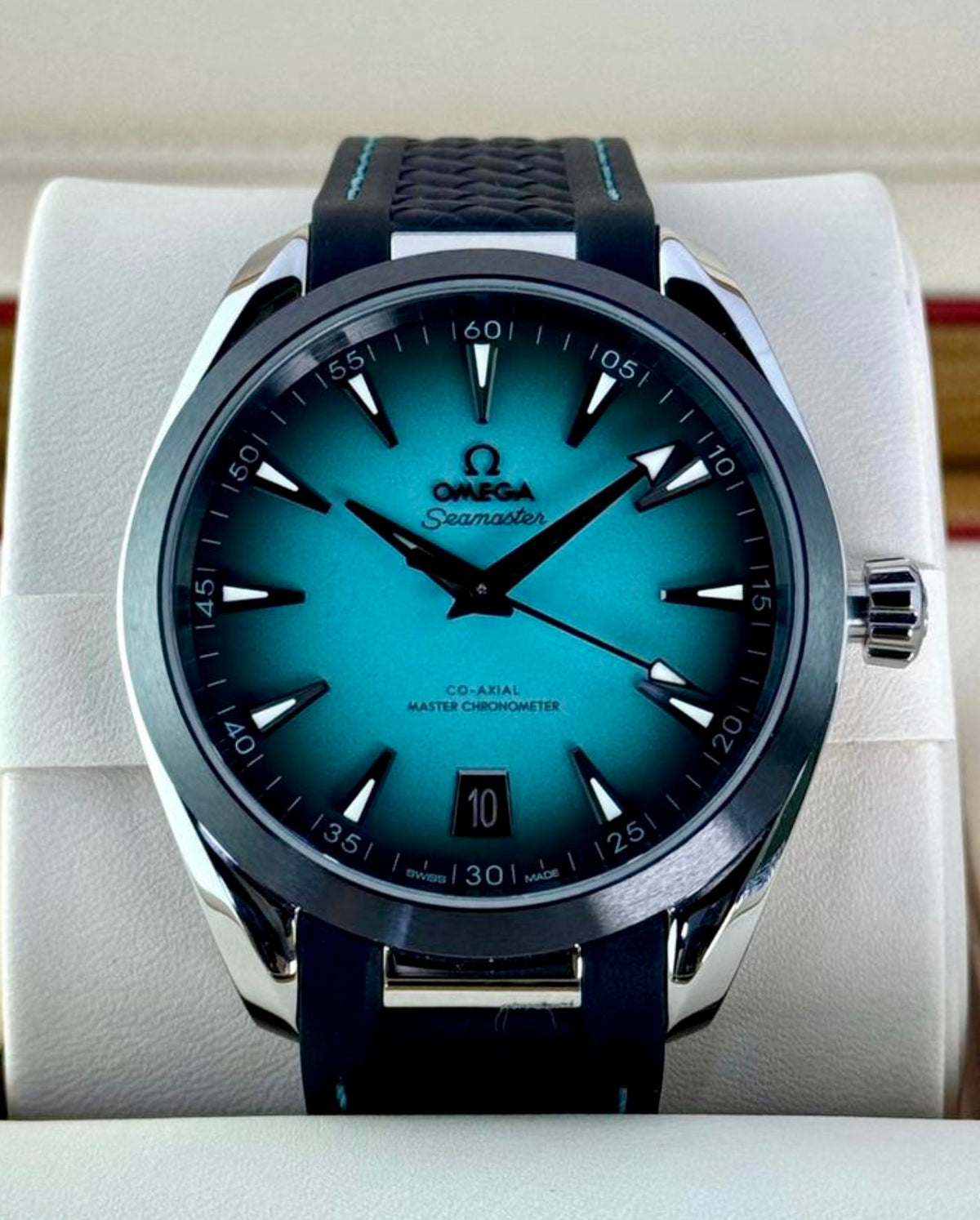
The Omega Aqua Terra is OMEGA's most complete everyday watch. It combines the water resistance and durability expected of the Seamaster family with the restrained profile of a watch that can move from office, travel and formal wear to swimming and ordinary daily use.
Quick Answer: Which Omega Aqua Terra Should You Buy?
- Choose 30 mm for deliberately compact proportions, jewelry-like presence and the newest purpose-built calibres 8750 or 8751.
- Choose 34 mm for a small but clearly legible everyday watch, especially when color, polish and a refined wrist profile matter.
- Choose 38 mm for the most balanced unisex size, calibre 8800 architecture and a versatile alternative to a Rolex Datejust 36 or Oyster Perpetual 36.
- Choose 41 mm for stronger wrist presence, calibre 8900, a longer reserve and an independently adjustable local-hour hand useful for travel.
- Choose the 43 mm Worldtimer when the map dial, multi-time-zone display and statement scale are central to the purchase.
- Buy the exact reference, not merely the size. Dial opening, bracelet, case material, bezel, movement, link count and strap geometry can materially change fit and weight.
This guide brings together the Aqua Terra questions buyers ask about fit, movements, materials, value and everyday ownership. Specifications are tied to individual references, while assessments of comfort, value and ownership are identified as independent Buying Desk judgments.
Omega Aqua Terra Buying Guide Contents
- Quick chooser by buyer type
- What the Aqua Terra actually is
- History and generations
- Current collection map
- Current examples with photos
- 30 mm buying guide
- 34 mm buying guide
- 38 mm buying guide
- 41 mm buying guide
- 43 mm Worldtimer
- 30 vs. 34 vs. 38 vs. 41
- Wrist-size and fit guide
- Diameter, thickness and lug-to-lug
- Weight and balance
- Dial and date-window guide
- Teak pattern explained
- Aqua Terra Shades
- Turquoise ceramic-bezel models
- Steel, two-tone and full gold
- Moonshine Gold and Sedna Gold
- Bracelet generations and fit
- Integrated rubber straps
- Leather, NATO and aftermarket straps
- Clasp and comfort adjustment
- Movement and calibre map
- Calibres 8750 and 8751
- Calibres 8800 and 8801
- Calibres 8900 and 8901
- Calibres 8938 and 8939
- Older 2500, 8500 and quartz models
- Co-Axial escapement
- Silicon balance spring
- Master Chronometer and METAS
- Magnetic resistance
- Power reserve and hour setting
- 150 m water resistance
- Small Seconds models
- Aqua Terra Ultra Light
- Discontinued and special models
- Best first Omega and one-watch collection
- Aqua Terra vs. Diver 300M
- Aqua Terra vs. Speedmaster
- Aqua Terra vs. Rolex Datejust
- Aqua Terra vs. Oyster Perpetual
- Worldtimer vs. GMT-Master II
- Aqua Terra vs. Cartier Santos
- Aqua Terra vs. Grand Seiko
- Value, discounts and resale
- New, unworn and pre-owned
- Box, papers and cards
- Authentication checklist
- Service and maintenance
- Common buying mistakes
- Final buying checklist
- Frequently asked questions
- Sources and editorial method
- Related guides and inventory
- Need help choosing
Aqua Terra Size and Buyer Decision Matrix
For most buyers, 38 mm is the safest all-purpose Aqua Terra; 41 mm is better for larger wrists and frequent travelers; 30 or 34 mm is better when compact elegance matters; the 43 mm Worldtimer is a complication-first statement watch.
The correct Aqua Terra is usually identified by five decisions: desired visual scale, preferred movement behavior, bracelet or strap, dial personality and budget. Buyers often begin with color, but size and movement should be settled first. A beautiful dial cannot compensate for a watch that feels too broad, too heavy, too small or too tall on the wrist.
The 38 mm model has the broadest crossover appeal because it is neither overtly compact nor assertively large. The 41 mm model offers a more architectural dial and the practical independent-hour feature of the 8900 family. The 30 and 34 mm watches are not simply reduced men's watches: their proportions, dials, bracelet integration and movement choices make them independent categories. The Worldtimer should be bought because the owner wants the map and complication, not because it is assumed to be a normal 41 mm Aqua Terra with extra information.
| Buyer priority | Best starting point | Why | What to verify |
|---|---|---|---|
| One watch for work, travel and weekends | 38 mm steel on bracelet | Balanced proportions, 150 m rating, calibre 8800 | Exact lug-to-lug, clasp, dial legibility |
| Larger wrist or stronger presence | 41 mm steel or rubber | Wider dial, calibre 8900 and independent hour hand | Thickness, weight, cuff clearance |
| Compact luxury watch | 30 mm | Purpose-built 8750/8751 and current bracelet system | 30 mm visual scale; verify strap width on the exact reference |
| Small but sporty everyday watch | 34 mm | More dial area than 30 mm while remaining compact | Polished case, bracelet fit, dial color |
| Color-driven purchase | Shades 34 or 38 mm | Distinctive lacquered/sun-brushed palette | Color in daylight, resale expectations |
| Frequent multi-zone travel | 41 mm or Worldtimer 43 mm | Independent local hour or full world-time display | Whether two zones or global overview is actually needed |
| Lowest wrist mass | Ultra Light | 55 g official weight on sporty strap | Special crown, material and service considerations |
| Precious-metal daily watch | 30, 34, 38 or 41 mm gold reference | Gold with sports-watch water resistance | Weight, bracelet sizing, polish, insurance |
What the Omega Aqua Terra Actually Is
The Aqua Terra is the refined, bezel-free branch of the Seamaster family: a 150-metre sports watch designed to look appropriate in settings where a conventional dive watch can feel too technical.
The name combines two environments—water and land—and the design deliberately sits between categories. It normally has a fixed polished or brushed bezel, luminous hands and markers, a screw-in crown, a sapphire crystal, a date display on many references and an automatic movement visible through the caseback. That combination allows it to function as a daily sports watch while presenting more like a conventional round luxury watch than a diver.
This hybrid identity is why buyers compare it with unusually different rivals. It can be cross-shopped against a Rolex Datejust, Oyster Perpetual, Cartier Santos, Grand Seiko, IWC Mark series, Tudor Black Bay 36/39/41 or even OMEGA's own Diver 300M and Speedmaster. No single comparison captures the whole collection.
OMEGA positions Aqua Terra at the surface end of the Seamaster spectrum. The family keeps the Seamaster's water-oriented engineering but omits a rotating dive bezel and saturation-diving hardware. For most owners, that makes it easier to wear every day without sacrificing meaningful water capability.
Water capability: screw-in crown, 150 m rating on modern references and Seamaster lineage.
Land versatility: restrained bezel, polished finishing, bracelets and straps suited to ordinary daily wear.
The nominal water-resistance rating of the core collection; actual water use depends on current seals and pressure testing.
OMEGA's current high-level whole-watch certification framework with METAS testing on applicable models.
Omega Aqua Terra History and Generations
The Aqua Terra debuted in 2002 and has evolved through Co-Axial calibre 2500, in-house 8500-series and current Master Chronometer generations; the safest way to buy is by exact reference and calibre rather than by an informal generation label alone.
The original Aqua Terra appeared in 2002 as a clean Seamaster designed for both land and water. Early examples often used the Co-Axial calibre 2500 family and can be attractive because of their thinner cases, conservative dials and relatively accessible secondary-market pricing. Their appeal is strongest when service history is clear and the buyer understands the specific calibre revision.
The next major phase brought OMEGA's 8500-series architecture, broader cases and the teak-inspired dial pattern that became the collection's visual signature. These watches established the Aqua Terra as a serious technical alternative to established everyday-luxury models rather than merely a dressier Seamaster.
Later Master Co-Axial and Master Chronometer generations moved magnetic resistance away from a protective inner cage and into the movement's materials. Current families use calibres such as 8800, 8900 and their precious-metal or complication variants. In 2025, OMEGA expanded downward with a purpose-built 30 mm line powered by new 8750/8751 movements. The Worldtimer, Shades, Small Seconds, Ultra Light and special color/material releases now make the Aqua Terra a collection rather than a single model.
Clean Seamaster design, early Co-Axial movements and traditional proportions.
New movement architecture, stronger case presence and teak-dial identity.
15,000-gauss resistance and whole-watch certification on current mechanical models.
Global-time complication becomes a major Aqua Terra subfamily.
Color-driven 34/38 mm range and new titanium/steel Worldtimer executions.
New 8750/8751 movements and ceramic-bezel turquoise 38/41 mm models.
Generation warning: sellers sometimes group watches by dial orientation, date position or movement and call the result “first,” “second” or “third generation.” Those labels are useful shortcuts but are not always consistent. Verify reference, calibre, case dimensions, bracelet and production period.
Complete Aqua Terra Collection Map
The collection can be understood as five core sizes—30, 34, 38, 41 and 43 mm—plus special branches such as Small Seconds, Shades, Worldtimer, Ultra Light, annual-calendar, GMT and discontinued quartz models.
| Family | Typical size | Core movement family | Buyer identity | Main trade-off |
|---|---|---|---|---|
| Aqua Terra 30 mm | 30 mm | 8750 / 8751 | Compact luxury and smaller wrists | Small visual scale; newest line |
| Aqua Terra 34 mm | 34 mm | 8800 / precious-metal counterpart | Refined everyday watch, colorful dials | Highly polished presence |
| Aqua Terra 38 mm | 38 mm | 8800 / 8801 | Balanced unisex all-rounder | No independent local-hour hand |
| Aqua Terra 41 mm | 41 mm | 8900 / 8901 | Larger daily watch and traveler | More thickness and weight |
| Aqua Terra Worldtimer | 43 mm | 8938 / 8939 | Complication and travel buyer | Large, visually dense dial |
| Aqua Terra Small Seconds | Often 38 or 41 mm depending reference | 8802/8803 or 8916/8917 families | Dressier subdial architecture | More specialized look |
| Aqua Terra Shades | 34 and 38 mm | Master Chronometer movements | Color-first buyer | Polished cases show marks |
| Aqua Terra Ultra Light | Specialist large titanium format | Titanium calibre family | Performance and low mass | Price and specialized construction |
| Earlier Aqua Terra | Multiple sizes | 2500, 8500/8508 and others | Value, thinness, discontinued designs | Age, service and reference complexity |
| Quartz Aqua Terra | Multiple discontinued sizes | Quartz | Accuracy and low-maintenance buyer | Less movement theatre and collector demand |
There are also material and decorative branches that cut across those families: stainless steel, steel-and-gold, full Moonshine Gold, full Sedna Gold, diamond-set bezels and markers, mother-of-pearl dials, integrated rubber straps, traditional leather, bracelet references and limited or special releases. The collection map should therefore be read as a decision tree, not a complete list of every SKU.
Current Omega Aqua Terra Watches: 18 Exact References
Eighteen real Superlative Watch Co. examples, ordered from core 38 and 41 mm daily configurations through Small Seconds, Shades and Worldtimer references. Each photograph and CTA goes directly to the watch’s clean individual product page.
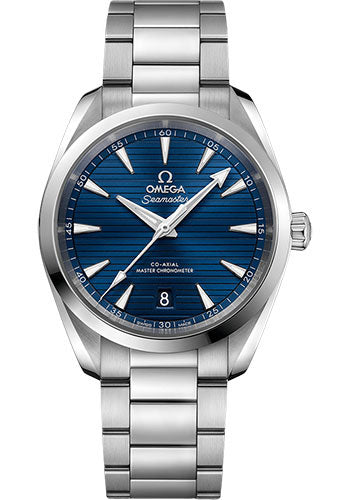
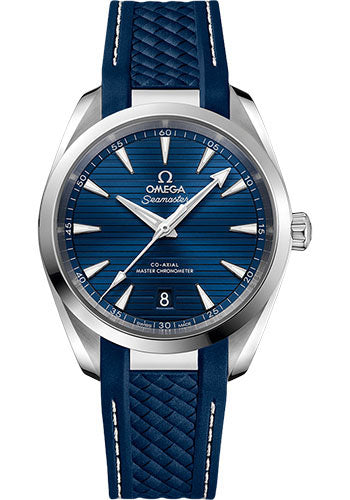
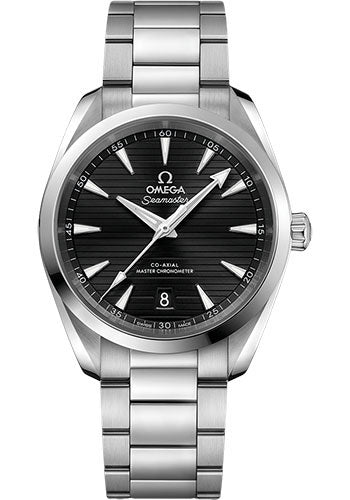
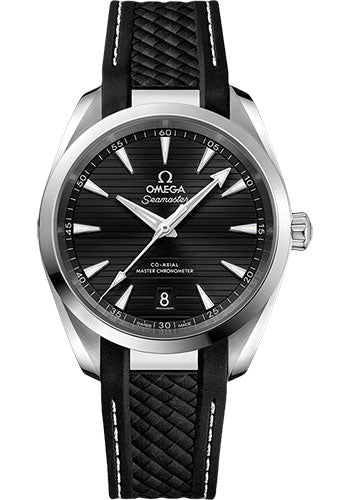
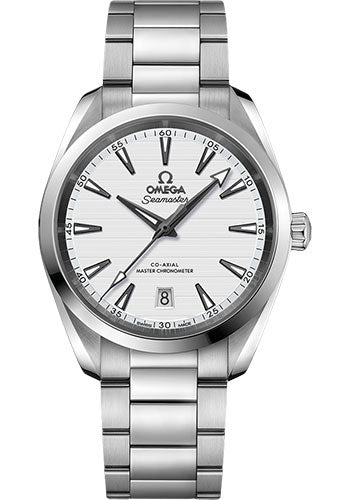
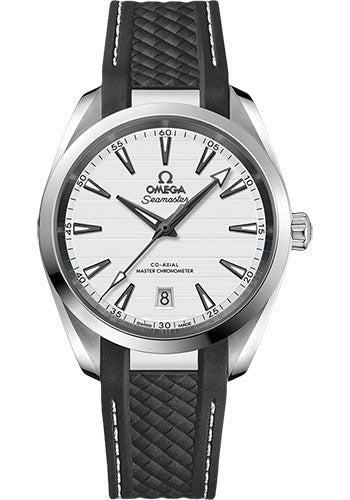
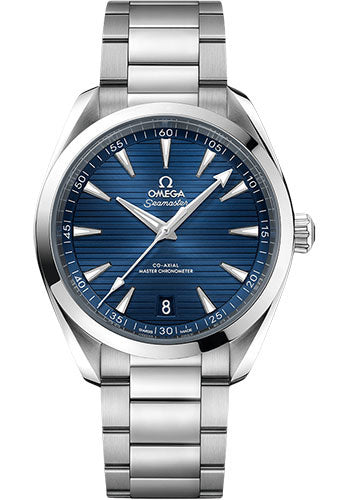
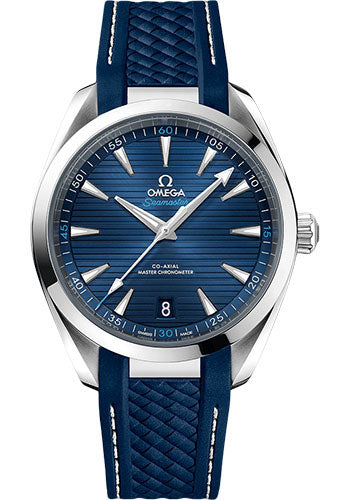
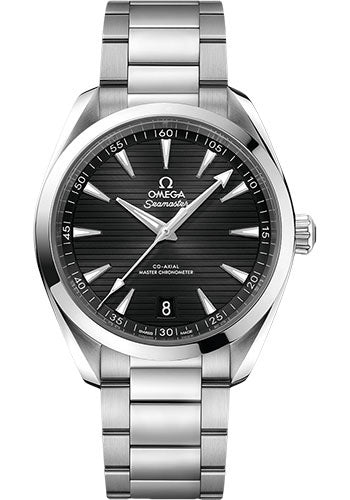
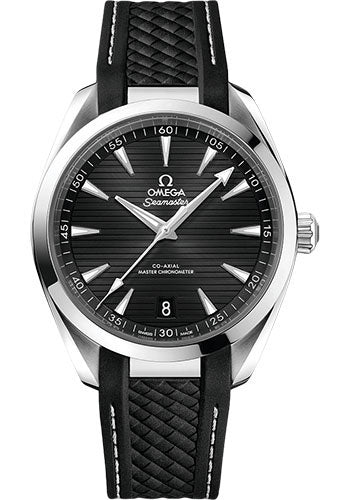
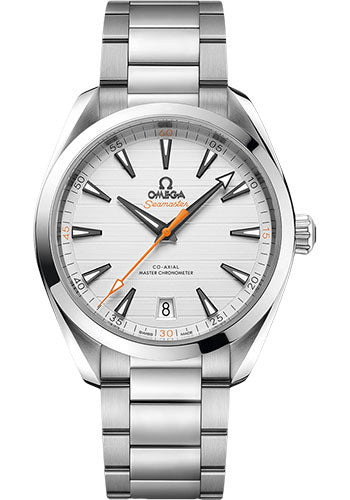
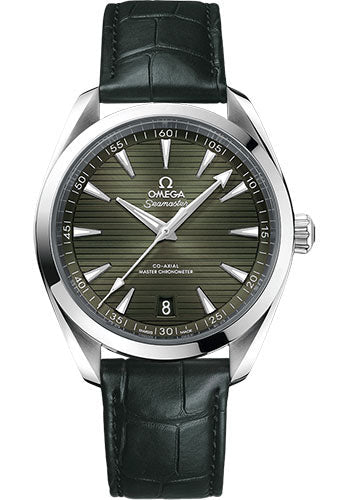
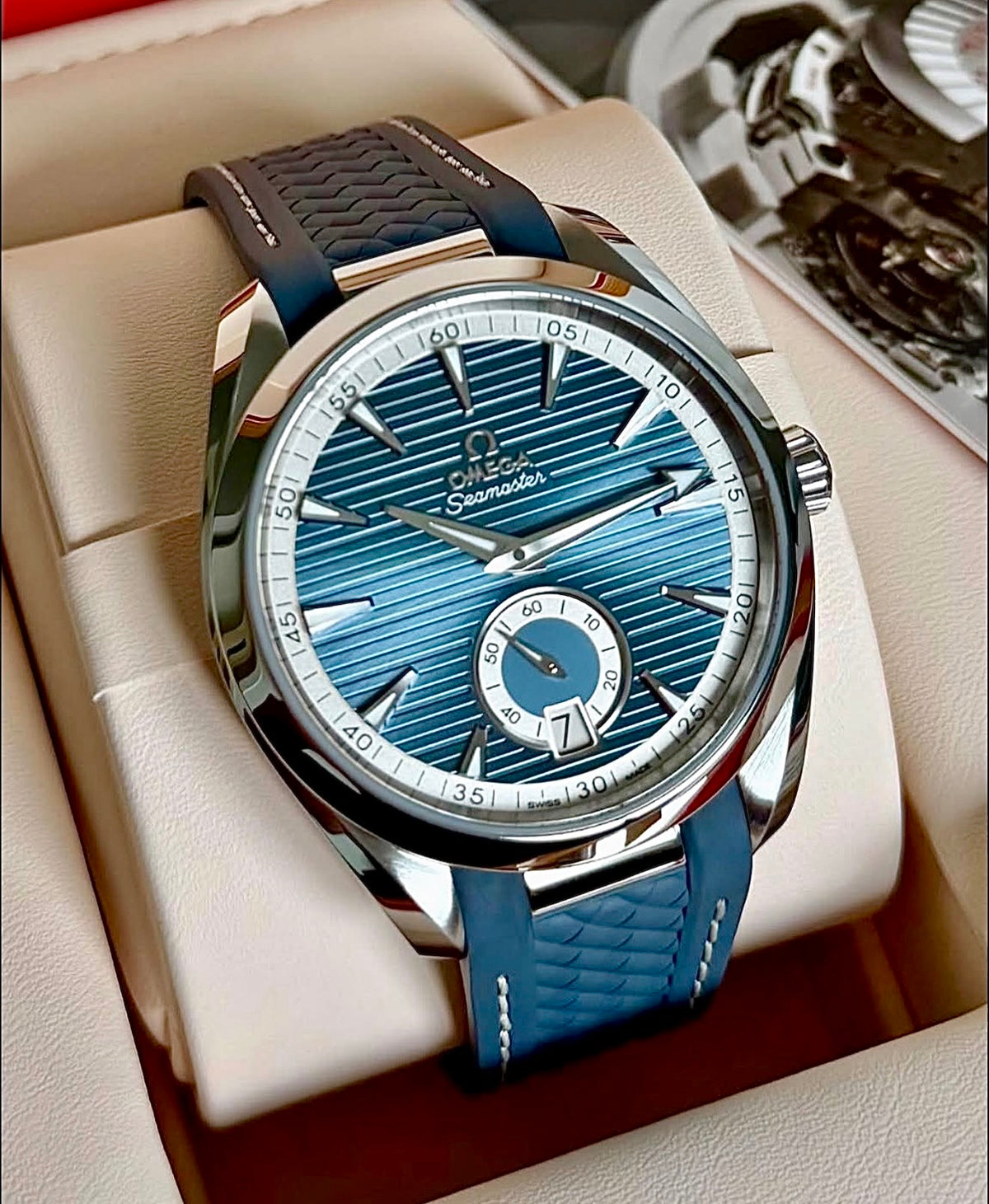
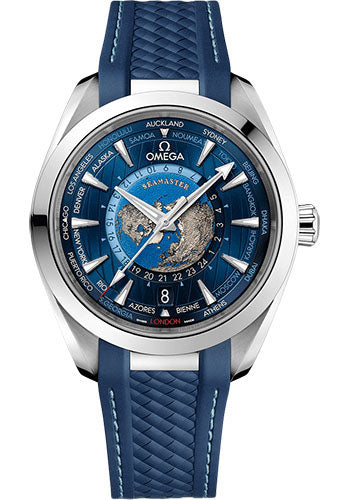
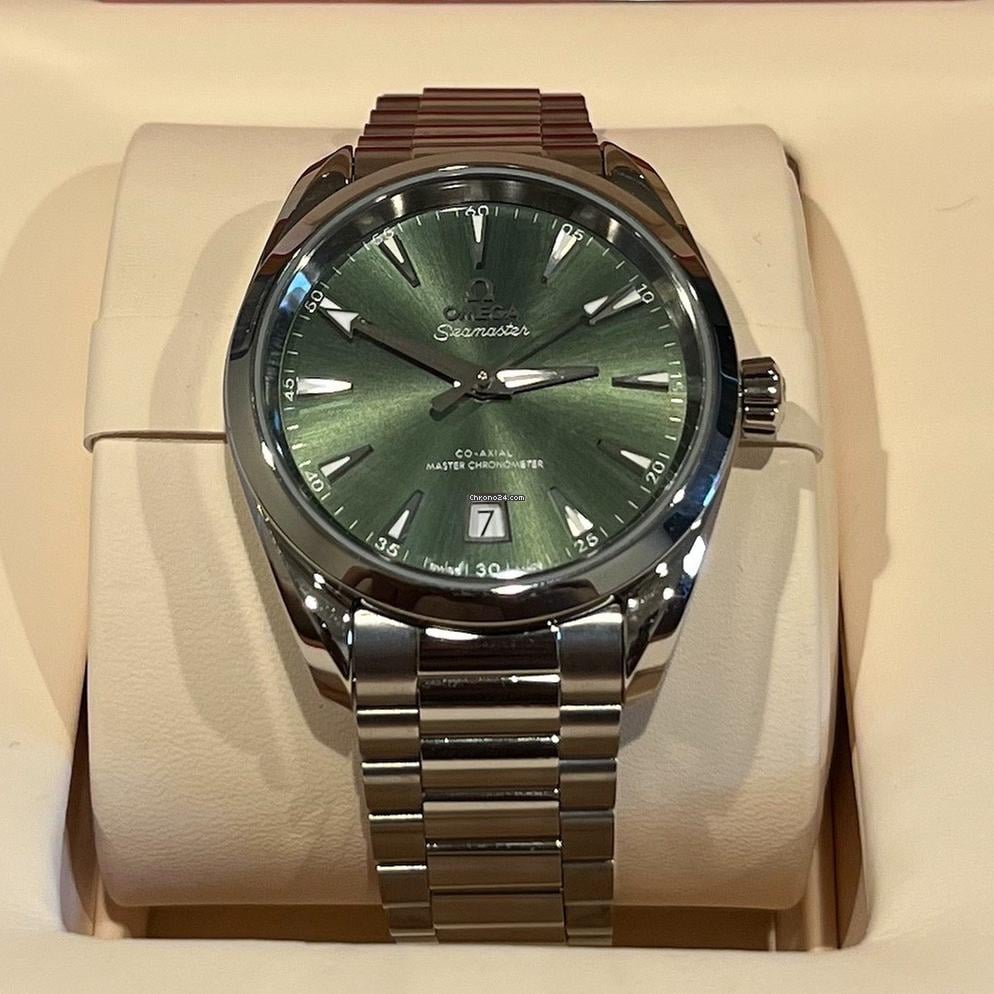
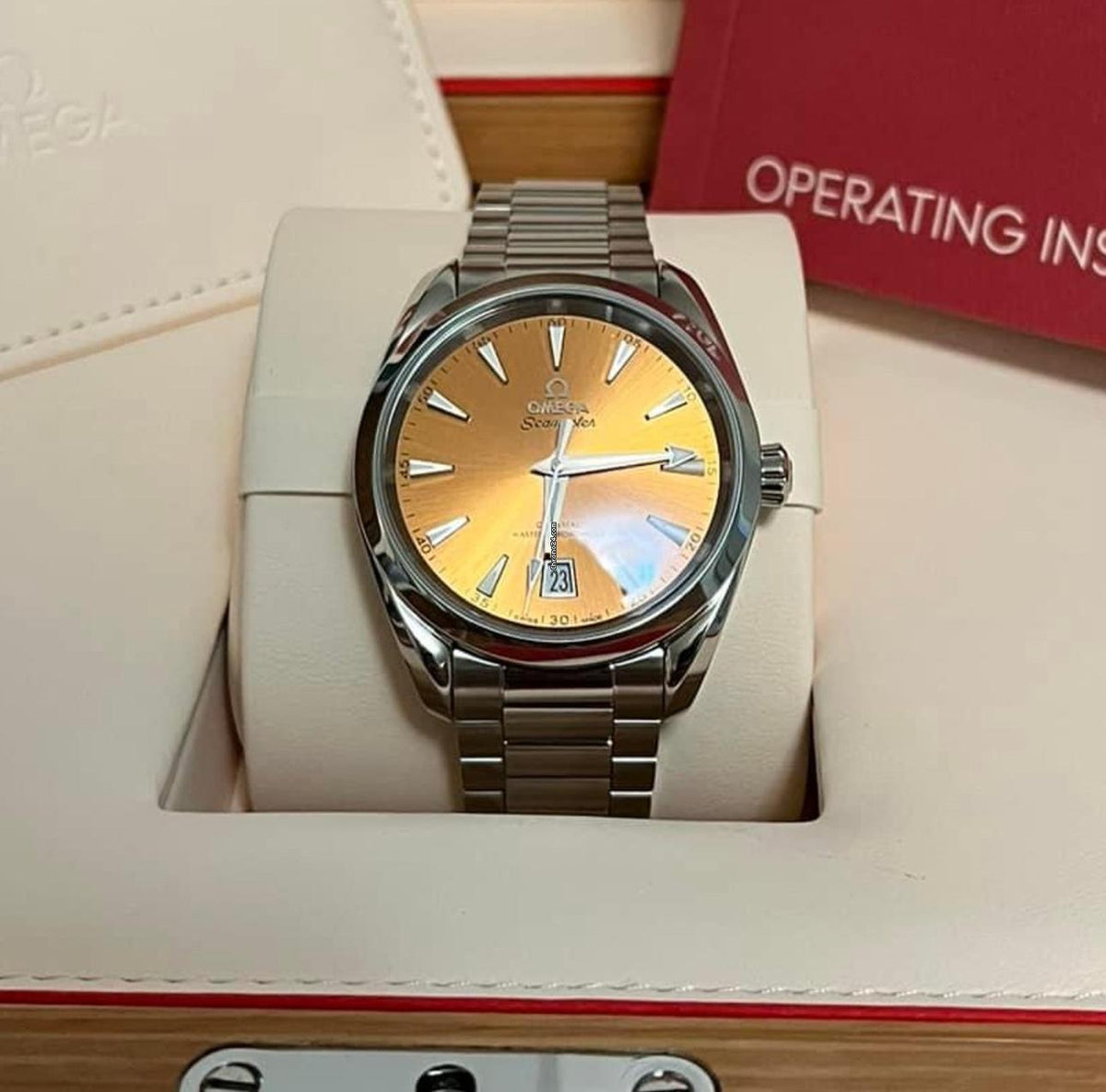
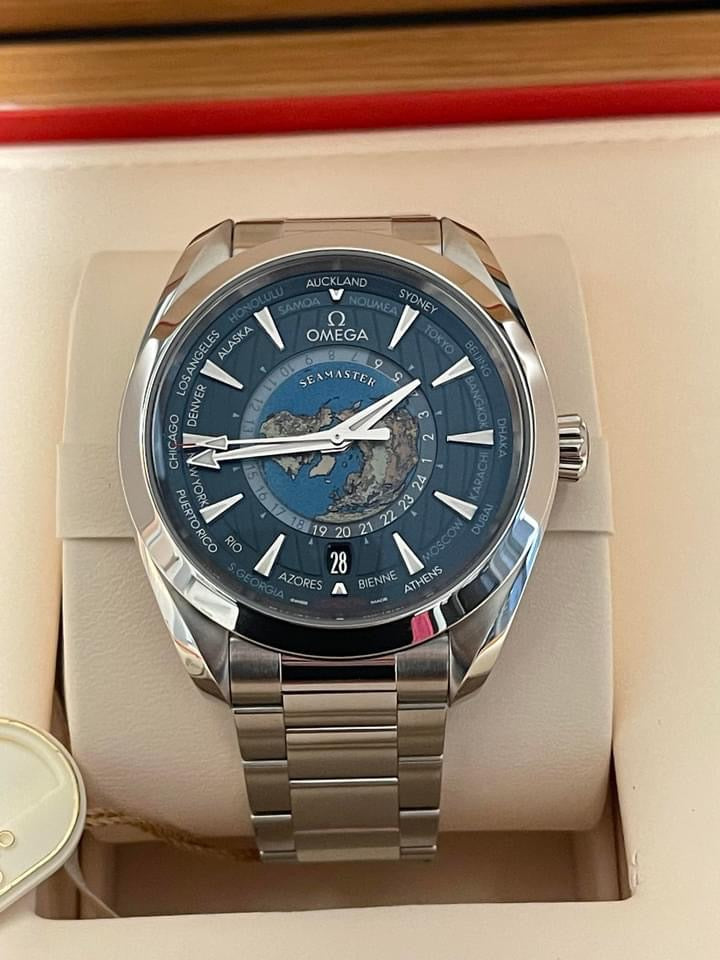
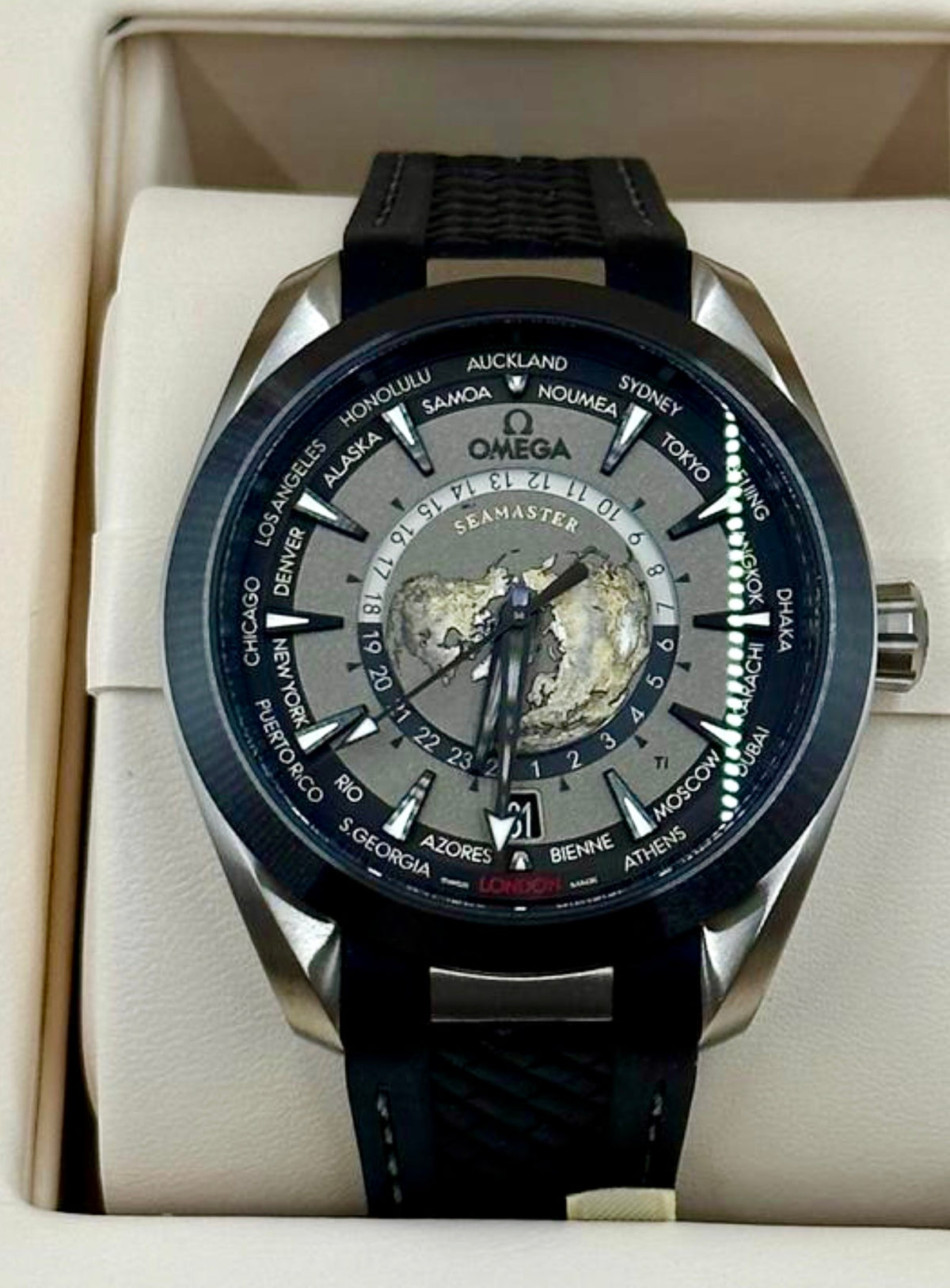
Check each linked watch listing for its current price and availability. No active 30 mm watch was available in the inventory reviewed for this guide; if that size suits you, ask the Buying Desk about sourcing your preferred configuration.
| Watch | Reference | Configuration | Current page |
|---|---|---|---|
| Omega Aqua Terra 38 mm blue — steel braceletOmega Aqua Terra 150M Co-Axial Master Chronometer Watch - 38 mm Steel Case - Blue Dial - Brushed And Polished Steel Bracelet - 220.10.38.20.03.001 | 220.10.38.20.03.001 | 38 mm blue — steel bracelet | View watch |
| Omega Aqua Terra 38 mm blue — blue rubberOmega Aqua Terra 150M Co-Axial Master Chronometer Watch - 38 mm Steel Case - Blue Dial - Blue Structured Rubber Strap - 220.12.38.20.03.001 | 220.12.38.20.03.001 | 38 mm blue — blue rubber | View watch |
| Omega Aqua Terra 38 mm black — steel braceletOmega Aqua Terra 150M Co-Axial Master Chronometer Watch - 38 mm Steel Case - Black Dial - Brushed And Polished Steel Bracelet - 220.10.38.20.01.001 | 220.10.38.20.01.001 | 38 mm black — steel bracelet | View watch |
| Omega Aqua Terra 38 mm black — black rubberOmega Aqua Terra 150M Co-Axial Master Chronometer Watch - 38 mm Steel Case - Black Dial - Black Structured Rubber Strap - 220.12.38.20.01.001 | 220.12.38.20.01.001 | 38 mm black — black rubber | View watch |
| Omega Aqua Terra 38 mm silver — steel braceletOmega Aqua Terra 150M Co-Axial Master Chronometer Watch - 38 mm Steel Case - Silvery Dial - Brushed And Polished Steel Bracelet - 220.10.38.20.02.001 | 220.10.38.20.02.001 | 38 mm silver — steel bracelet | View watch |
| Omega Aqua Terra 38 mm silver — grey rubberOmega Aqua Terra 150M Co-Axial Master Chronometer Watch - 38 mm Steel Case - Silvery Dial - Grey Structured Rubber Strap - 220.12.38.20.02.001 | 220.12.38.20.02.001 | 38 mm silver — grey rubber | View watch |
| Omega Aqua Terra 41 mm blue — steel braceletOmega Seamaster Aqua Terra 150M OMEGA Co-Axial Master Chronometer - 41 mm Steel Case - Blue Dial - 220.10.41.21.03.004 | 220.10.41.21.03.004 | 41 mm blue — steel bracelet | View watch |
| Omega Aqua Terra 41 mm blue — blue rubberOmega Aqua Terra 150M Co-Axial Master Chronometer Watch - 41 mm Steel Case - Blue Dial - Blue Structured Rubber Strap - 220.12.41.21.03.001 | 220.12.41.21.03.001 | 41 mm blue — blue rubber | View watch |
| Omega Aqua Terra 41 mm black — steel braceletOmega Aqua Terra 150M Co-Axial Master Chronometer Watch - 41 mm Steel Case - Black Dial - Brushed And Polished Steel Bracelet - 220.10.41.21.01.001 | 220.10.41.21.01.001 | 41 mm black — steel bracelet | View watch |
| Omega Aqua Terra 41 mm black — black rubberOmega Aqua Terra 150M Co-Axial Master Chronometer Watch - 41 mm Steel Case - Black Dial - Black Structured Rubber Strap - 220.12.41.21.01.001 | 220.12.41.21.01.001 | 41 mm black — black rubber | View watch |
| Omega Aqua Terra 41 mm silver — steel braceletOmega Aqua Terra 150M Co-Axial Master Chronometer Watch - 41 mm Steel Case - Silvery Dial - Brushed And Polished Steel Bracelet - 220.10.41.21.02.001 | 220.10.41.21.02.001 | 41 mm silver — steel bracelet | View watch |
| Omega Aqua Terra 41 mm green — green leatherOmega Seamaster Aqua Terra 150M OMEGA Co-Axial Master Chronometer - 41 mm Steel Case - Green Dial - Green Leather Strap - 220.13.41.21.10.001 | 220.13.41.21.10.001 | 41 mm green — green leather | View watch |
| Omega Aqua Terra 41 mm Small Seconds — blue rubberOmega Seamaster Aqua Terra Small Seconds 220.12.41.21.03.005 UNWORN 2026 | 220.12.41.21.03.005 | 41 mm Small Seconds — blue rubber | View watch |
| Omega Aqua Terra 43 mm steel Worldtimer — blue rubberOmega Seamaster Aqua Terra 150M Omega Co-Axial Master Chronometer GMT Worldtimer - 43 mm Steel Case - Blue Dial - Blue Rubber Strap - 220.12.43.22.03.001 | 220.12.43.22.03.001 | 43 mm steel Worldtimer — blue rubber | View watch |
| Omega Aqua Terra 38 mm green — steel braceletOmega Seamaster Aqua Terra 150M GREEN UNWORN 2026 | 220.10.38.20.10.002 | 38 mm green — steel bracelet | View watch |
| Omega Aqua Terra 38 mm Shades saffron — steel braceletOmega Seamaster Aqua Terra 150M SAFFRON UNWORN 2026 | 220.10.38.20.12.001 | 38 mm Shades saffron — steel bracelet | View watch |
| Omega Aqua Terra 43 mm steel Worldtimer — braceletOmega Aqua Terra GMT Worldtimer 220.10.43.22.03.001 UNWORN 2026 | 220.10.43.22.03.001 | 43 mm steel Worldtimer — bracelet | View watch |
| Omega Aqua Terra 43 mm titanium WorldtimerOmega Seamaster Aqua Terra Aqua Terra 150M Co‑Axial Master Chronometer GMT Worldtimer 43 mm TITANIUM UNWORN 2026 | 220.92.43.22.99.001 | 43 mm titanium Worldtimer | View watch |
Omega Aqua Terra 30 mm Buying Guide
Current inventory note: No active 30 mm Aqua Terra appeared in the verified 18-watch storefront set on August 14, 2026. The size is covered editorially below; use the sourcing desk for an exact 30 mm reference rather than treating a non-existent tile as live stock.
Choose the 30 mm Aqua Terra when compact proportions are the goal—not as a compromise—and when the buyer wants current Master Chronometer engineering in the smallest modern Aqua Terra format.
OMEGA introduced the current 30 mm collection in 2025 with twelve references spanning stainless steel, two-tone combinations, 18K Moonshine Gold and 18K Sedna Gold. The launch matters because OMEGA did not simply place an existing movement inside a smaller case. It developed calibres 8750 and 8751 specifically for the scale.
A 30 mm round watch can look meaningfully larger or smaller depending on dial opening, bezel width, marker length, bracelet integration and wrist shape. The Aqua Terra's strong hour markers, luminous hands and open dial prevent it from reading like a tiny jewelry watch, but buyers accustomed to 36–41 mm sports watches should try it before assuming the size will feel familiar.
The 30 mm line is especially compelling for buyers who previously had to choose between small quartz watches and larger mechanical models. OMEGA identifies calibre 8750 for current steel and two-tone references and calibre 8751 for full-gold references. Verify the exact OMEGA technical sheet for water resistance, certification, winding behavior, magnetic testing and power reserve before purchase.
Matrix fields: Strength / Why it matters / Potential concern / Inspection point
Purpose-built movement — Why it matters: 8750/8751 were designed for the compact case; Potential concern: Newer architecture has less long-term service history than older families; Inspection point: Confirm calibre and card/reference match. Compact dimensions — Why it matters: Works on smaller wrists and under sleeves; Potential concern: May look intentionally small on broad wrists; Inspection point: Try at normal viewing distance, not only close-up. Water rating — Why it matters: The exact OMEGA reference determines water-use capability; Potential concern: A rating is not permanent without seal condition; Inspection point: Verify the reference sheet and request a current pressure test. Integrated bracelet appearance — Why it matters: Creates a continuous jewelry-like line; Potential concern: Butterfly clasps offer less on-the-fly range than some sport clasps; Inspection point: Confirm clasp architecture, adjustment behavior and all links on the exact reference.
Gold and diamond options — Why it matters: High-luxury execution without large scale; Potential concern: Weight, polish and replacement cost rise quickly; Inspection point: Inspect bezel, bracelet and clasp for refinishing. Date at six — Why it matters: Symmetrical and practical; Potential concern: Small aperture may be harder to read for some owners; Inspection point: Check contrast and date alignment.
Who should buy the 30 mm?
It is best for buyers with smaller wrists, buyers who intentionally prefer traditional compact watches, and buyers seeking a technically serious women's luxury watch without moving to a larger nominal size. It can also suit men who appreciate vintage-scale watches, but the current marketing, bracelet proportions and dial treatments are clearly oriented toward compact luxury rather than mid-century tool-watch minimalism.
30 mm steel or gold?
Steel is the easiest entry point, the easiest material to live with and the least expensive to refinish or replace. Two-tone adds warmth without the total mass and cost of a full-gold bracelet. Full gold is a different ownership proposition: the watch becomes substantially heavier, more vulnerable to visible surface wear and more expensive to size incorrectly. A full-gold example should be evaluated for link count, stretch, clasp condition, refinishing and insurance value before purchase.
Buying verdict: the 30 mm is the strongest modern Aqua Terra for a buyer who wants genuinely small proportions without giving up the technical features associated with OMEGA’s larger mechanical watches. Do not buy it merely because a retailer labels it “women’s”; buy it because the dimensions and visual scale are correct.
Omega Aqua Terra 34 mm Buying Guide
The 34 mm Aqua Terra is the sweet spot for buyers who want a compact watch that still reads clearly as a sports-luxury timepiece rather than a deliberately tiny watch.
The 34 mm format offers more dial area and wrist presence than the 30 mm while remaining visibly smaller than the 38 mm. It is often the best choice for wrists that find 30 mm too delicate and 38 mm too assertive. Current color-rich Shades references have made this size especially relevant.
Many 34 mm models use the calibre 8800 family or a corresponding precious-metal-finished variant. That architecture typically provides a 55-hour reserve, a date function and Master Chronometer performance on current references. Exact movements, case thickness and diamond configurations vary, so the reference must be verified.
The 34 mm often looks more polished and jewelry-forward than the standard 38 or 41 mm Aqua Terra. That can be an advantage in formal settings, but it also means the case and bracelet may show hairlines more readily. Dial color changes perceived size: a bright or sun-brushed dial can feel larger, while darker gradient dials can visually contract.
Matrix fields: Choose 34 mm when... / Choose 30 mm instead when... / Choose 38 mm instead when...
You want compact but not miniature proportions — Choose 30 mm instead when...: You want the smallest current mechanical Aqua Terra; Choose 38 mm instead when...: You prefer a stronger unisex sports-watch presence. You value the Shades color palette — Choose 30 mm instead when...: You prioritize the newest 8750/8751 architecture; Choose 38 mm instead when...: You want broader secondary-market recognition. Your wrist is small-to-medium and you like polished finishing — Choose 30 mm instead when...: A 34 mm dial still feels too wide; Choose 38 mm instead when...: A 34 mm case disappears visually on your wrist. You want a refined alternative to a Datejust 31 or 34 mm watch — Choose 30 mm instead when...: Jewelry-like scale is desirable; Choose 38 mm instead when...: You compare primarily with Datejust 36 or OP 36.
Fit advice: compare 30, 34 and 38 mm in the same session if possible. Photos shot close to the wrist exaggerate case size, while wide-angle phone lenses can distort proportions. Use a mirror and a normal standing distance.
Omega Aqua Terra 38 mm Buying Guide
The 38 mm Aqua Terra is the default recommendation for the widest range of wrists because it combines useful dial area, compact lug span and the calibre 8800 family without the extra bulk of the 41 mm case.
For many buyers, 38 mm is where the Aqua Terra concept is most coherent. It is large enough to feel contemporary, small enough to slide under a cuff and neutral enough to be shared across conventional men's and women's categories. It is also the size most often compared with the Rolex Datejust 36, Oyster Perpetual 36, Cartier Santos Medium and many Grand Seiko references.
Current 38 mm steel references commonly use calibre 8800, with 55 hours of reserve, a single barrel, central seconds and date. The local hour hand is not independently adjustable in the same way as the 41 mm calibre 8900, so frequent travelers should decide whether that function matters.
The 38 mm Shades collection changes the normal Aqua Terra character. Entirely polished cases and highly colored dials emphasize design and reflection more than the mixed polished/brushed tool-luxury look of many standard references. The newer turquoise ceramic-bezel 38 mm also changes the visual balance by adding a dark fixed bezel and integrated rubber strap.
| Category | 38 mm behavior | Buyer implication |
|---|---|---|
| Visual scale | Balanced, neither obviously small nor oversized | Strong first Aqua Terra choice |
| Movement | Commonly calibre 8800 / 55-hour architecture | Technically advanced but no independent local-hour jump |
| Cuff fit | Generally easier than 41 mm or Worldtimer | Good office and travel watch |
| Bracelet weight | Noticeably lighter than 41 mm equivalents | Better for buyers sensitive to wrist mass |
| Dial color | Large effect on perceived size | Try the exact color, not only a neutral reference |
| Resale | Broadest cross-wrist demand in many markets | Still configuration-dependent; no guarantee |
Most useful rule: if a buyer is undecided between 38 and 41 mm and does not specifically need the independent-hour feature, start with 38 mm. A watch that feels slightly compact often becomes easier to live with than one that feels slightly too large.
Omega Aqua Terra 41 mm Buying Guide
Choose 41 mm when you want more dial presence, a stronger case, a 60-hour reserve and the independent local-hour hand of calibre 8900 on common current references.
The 41 mm Aqua Terra is not merely a 38 mm watch enlarged by three millimetres. The movement architecture, case height, dial aperture and overall mass produce a more substantial ownership experience. On average-to-large wrists it can look balanced; on smaller or flatter wrists the broad dial and long visual line may dominate.
Calibre 8900 uses twin barrels and typically offers 60 hours of reserve. Its independently adjustable hour hand can move forward or backward in one-hour steps without stopping the seconds, which is genuinely useful when crossing time zones or adjusting daylight-saving time. The date follows the local hour movement, making travel setting more convenient.
The 41 mm size also supports stronger dial treatments, rubber-strap integrations and precious-metal configurations. However, the bracelet and case can feel top-heavy if the bracelet is sized too loose. A correct fit usually positions the clasp centrally and limits case migration without compressing the wrist.
| Feature | Strength | Trade-off |
|---|---|---|
| Calibre 8900 | 60-hour reserve, twin barrels, independent local hour | More movement and case volume |
| Dial area | Excellent legibility and visual impact | Can look broad on narrow wrists |
| Bracelet | Substantial luxury feel | Greater weight and surface area for scratches |
| Rubber integration | Sporty and comfortable on many references | Reference-specific end-link and clasp costs |
| Gold versions | Strong presence and movement finishing | High mass, cost and insurance exposure |
| Travel use | Fast local-hour adjustment | Not a GMT display unless a specific GMT/Worldtimer model |
Buying verdict: the 41 mm is the technically richer everyday travel choice, but the movement advantage should not override fit. If the case overhangs, rotates or feels thick under a cuff, the 38 mm is the better watch for that owner.
Omega Aqua Terra Worldtimer 43 mm Buying Guide
Buy the 43 mm Aqua Terra Worldtimer for its map dial and simultaneous global-time display; do not buy it expecting the same quiet versatility or compact fit as a standard Aqua Terra.
The Worldtimer is the most visually and mechanically distinctive mainstream Aqua Terra. Its central map views Earth from above the North Pole, surrounded by a 24-hour day/night indication and a city ring. It allows the wearer to understand time across the world at a glance once the display is learned.
OMEGA's 2023 expansion added a titanium model and two steel versions. The titanium execution uses a black and grey laser-ablated dial, black ceramic bezel and integrated black rubber strap. The steel versions use green dials and green ceramic bezels, with either a bracelet or integrated rubber. OMEGA identifies calibre 8938 as the movement and rates these models to 150 m.
The Worldtimer's 43 mm diameter understates its visual presence because the dial is dense and the case must accommodate the complication. Buyers should evaluate lug span, thickness, crown clearance and whether the city ring remains readable on their wrist. Titanium reduces mass dramatically compared with an equivalent steel case, but it does not reduce visual size.
| Question | Practical answer |
|---|---|
| Is it a GMT watch? | It displays global time through a city ring and 24-hour scale; it is more information-dense than a conventional dual-time GMT. |
| Steel or titanium? | Steel feels more traditional and substantial; titanium is lighter and more technical. |
| Bracelet or rubber? | Bracelet emphasizes luxury and continuity; rubber reduces mass and increases sport character. |
| Is 43 mm too large? | Not automatically, but the dial and case are visually dominant. Try it in a mirror and under a cuff. |
| Does it replace a standard Aqua Terra? | Only if the owner enjoys the complication. It is less restrained and less universally dressy. |
| Is the map fragile? | The display is protected under sapphire, but dial damage or replacement would be specialized and potentially costly. |
| What must be checked pre-owned? | Correct city ring, map condition, date/time synchronization, crown setting, calibre function, strap/clasp and full-set accessories. |
Worldtimer setting warning: do not force the crown or adjust calendar functions blindly. Follow the exact OMEGA instructions for the reference. A complicated dial does not imply a fragile watch, but misuse can create avoidable service expense.
Aqua Terra 30 vs. 34 vs. 38 vs. 41 mm
The most important difference is not the diameter number—it is how case span, dial opening, thickness, bracelet width and movement architecture combine on the specific wrist.
| Size | Visual character | Common current movement | Power reserve | Best for | Watch-out |
|---|---|---|---|---|---|
| 30 mm | Deliberately compact and jewelry-refined | 8750 / 8751 | Reference-specific; verify | Small wrists, compact luxury, current women’s engineering | May feel very small to sports-watch buyers |
| 34 mm | Compact but clearly watch-like | 8800 family on many refs | About 55 h on common refs | Small-to-medium wrists and color buyers | Polished cases can show wear |
| 38 mm | Balanced unisex proportion | 8800 / 8801 | About 55 h | Most buyers, office-to-water versatility | No independent local-hour jump on standard 8800 |
| 41 mm | Strong contemporary presence | 8900 / 8901 | About 60 h | Larger wrists and frequent travel | More thickness and mass |
| 43 mm Worldtimer | Statement complication | 8938 / 8939 | Reference-specific; commonly around 60 h | Travel enthusiasts and complication buyers | Dense dial, large case |
A buyer should also compare the 34 and 38 mm Shades cases separately from standard brushed-and-polished Aqua Terras. Fully polished surfaces make the watch appear more jewel-like and can visually enlarge the case under bright light. Conversely, a dark dial with a black bezel can make a 41 mm watch appear more contained from a distance.
Gender labels are poor sizing tools. Wrist circumference, wrist width, preferred historical scale and wardrobe matter more. A 34 mm watch can be ideal on a man's wrist; a 41 mm watch can be ideal on a woman's wrist. The correct test is whether the watch remains centered, the lugs do not extend awkwardly, the bracelet articulates cleanly and the owner likes the visual proportion.
Aqua Terra Wrist-Size and Fit Guide
Use wrist circumference as a starting point, then verify wrist width and case span; two wrists with the same circumference can wear the same Aqua Terra very differently.
| Wrist circumference | Start with | Also try | Usually approach cautiously |
|---|---|---|---|
| Under 6.0 in / 15.2 cm | 30 or 34 mm | 38 mm if wrist is flat and wearer likes presence | 41 mm and Worldtimer without a try-on |
| 6.0–6.5 in / 15.2–16.5 cm | 34 or 38 mm | 30 mm for traditional scale; 41 mm for bold preference | 43 mm Worldtimer unless case sits flat |
| 6.5–7.0 in / 16.5–17.8 cm | 38 mm | 34 mm for compact style; 41 mm for presence | None by number alone |
| 7.0–7.5 in / 17.8–19.1 cm | 38 or 41 mm | Worldtimer 43; 34 mm for vintage-scale taste | 30 mm unless intentionally compact |
| Over 7.5 in / 19.1 cm | 41 mm or Worldtimer | 38 mm for restrained style | 30 mm unless deliberately small |
Wrist width matters
A flat wrist can support a longer case than a round wrist with the same circumference. Place a ruler across the top of the wrist where the watch sits. Case span should remain comfortably inside that platform if the buyer wants a conventional fit. Slight overhang can be a style choice, but it often increases movement and discomfort.
Bracelet sizing changes the experience
An Aqua Terra worn too loose may feel larger and heavier because the case migrates toward the outside of the wrist. Worn too tight, polished center links and clasp edges can create pressure. Correct sizing distributes weight across the bracelet and keeps the crown from digging into the hand.
Photographs can mislead
Close-up wrist shots exaggerate watches. Use a mirror, full-arm photograph or normal viewing distance. Evaluate the watch with the sleeves and clothing it will actually accompany.
Diameter, Thickness, Lug-to-Lug and Why Numbers Mislead
Diameter describes only one axis; lug-to-lug controls wrist span, thickness controls cuff clearance, and dial opening controls perceived size.
Reference-specific dimensions should be verified on the exact OMEGA specification sheet or by measurement. Aqua Terra dimensions can change between generations even when the advertised diameter remains the same. Curved casebacks, domed crystals and bracelet end-link shape also alter how a watch sits.
The 30 mm current line is notably compact and relatively thin for a 150 m automatic watch. The 38 mm generally offers the easiest balance of span and thickness. The 41 mm adds height and visual breadth to house the larger 8900 architecture. Worldtimer models add complication depth and a 43 mm case.
Matrix fields: Measurement / What it controls / Why buyers miss it
Diameter — What it controls: Horizontal visual scale; Why buyers miss it: A narrow bezel can make a smaller watch look larger. Lug-to-lug — What it controls: Actual top-of-wrist span; Why buyers miss it: Often omitted from listings. Thickness — What it controls: Cuff fit and center of gravity; Why buyers miss it: Domed crystals and casebacks may be measured differently. Lug width — What it controls: Strap availability and visual taper; Why buyers miss it: 30 mm uses a much narrower strap interface than larger models. Bracelet first-link articulation — What it controls: How quickly bracelet turns down; Why buyers miss it: Male end links can extend effective span. Dial opening — What it controls: Perceived size and legibility; Why buyers miss it: Bright dials appear larger; dense dials appear smaller. Crown profile — What it controls: Comfort against hand; Why buyers miss it: Screw-in crown size differs across generations.
Measurement protocol: when comparing two references, use measurements from the same source and method. Manufacturer, retailer and enthusiast measurements can differ by fractions of a millimetre because they include or exclude crystal, protruding caseback or fixed end links.
Aqua Terra Weight, Balance and Wrist Mass
Weight varies more by bracelet and case material than by diameter alone; use published figures as reference-specific examples, not universal Aqua Terra weights.
A steel Aqua Terra on a full bracelet will feel substantially heavier than the same case on rubber or leather. Full-gold bracelets add another step in mass. Titanium can reduce weight dramatically while preserving a large visual footprint. Link removal changes total weight, so a catalog figure and a sized watch are not identical.
Representative steel 30 mm watches often fall around the low-80-gram range when fully linked, 34 mm steel models commonly occupy a roughly 90–105 gram band, 38 mm bracelet models often sit around 120–135 grams, and 41 mm bracelet models commonly reach roughly 140–155 grams. These are editorial orientation ranges assembled from reference-specific product data, not OMEGA-wide specifications. Verify the exact reference.
A full-gold 30 mm example can exceed 120 grams despite its small diameter because the bracelet contributes most of the mass. At the opposite extreme, OMEGA states that the Aqua Terra Ultra Light weighs just 55 grams on its sporty strap. This illustrates why material and bracelet matter more than the number on the dial.
Matrix fields: Configuration / Typical sensation / Buyer implication
30 mm steel bracelet — Typical sensation: Compact, dense but not heavy; Buyer implication: Comfortable for most; small clasp and narrow bracelet. 30 mm full gold — Typical sensation: Surprisingly substantial for size; Buyer implication: Check link count, insurance and bracelet condition. 34 mm steel bracelet — Typical sensation: Light-to-moderate; Buyer implication: Good all-day wear; polished surfaces remain visible. 38 mm steel bracelet — Typical sensation: Moderate sports-luxury weight; Buyer implication: Balanced for most wrists when sized correctly. 41 mm steel bracelet — Typical sensation: Substantial; Buyer implication: Can become top-heavy if loose. 38/41 mm rubber — Typical sensation: Lower mass, more secure in heat; Buyer implication: Sportier appearance and reference-specific strap cost. Worldtimer titanium — Typical sensation: Large visually, light materially; Buyer implication: Size remains even when mass drops.
Ultra Light — Typical sensation: Officially 55 g on sporty strap; Buyer implication: Specialist engineering and price.
Weight caution: do not compare an unsized manufacturer figure with a bracelet that has had several links removed. Precious-metal watches should be weighed only as one part of authentication; correct weight does not prove authenticity, and incorrect weight can reflect missing links rather than a counterfeit.
Aqua Terra Dial, Hands and Date-Window Guide
Choose the dial for legibility and long-term wear, not only for novelty; color, finish, marker contrast and date placement can matter more after six months than they do in a showroom.
Aqua Terra dials range from restrained silver, black and blue to lacquered color, gradient turquoise, mother-of-pearl, diamond-set configurations and the cartographic Worldtimer display. Each changes the identity of the same basic case. A blue teak dial on bracelet reads as a traditional OMEGA daily watch; a Terracotta or Saffron Shades dial reads as design-led; a diamond mother-of-pearl 30 mm reads as jewelry; the Worldtimer reads as a complication.
Applied markers and broad luminous hands give the standard Aqua Terra strong low-light function compared with many dress watches. However, polished hands can disappear against reflective dials at certain angles. Contrast should be tested in natural light, indoor light and low light.
Date placement varies across eras and sizes. Current standard models commonly place the date at six, creating vertical symmetry. Earlier references may place it at three. Small Seconds references integrate the date differently. Neither position is inherently better, but dial balance, date-wheel color and aperture size affect the visual result.
Matrix fields: Dial type / Strength / Trade-off / Best buyer
Black lacquer or sun-brushed black — Strength: Maximum versatility and strong contrast; Trade-off: Shows dust and reflections; Best buyer: One-watch collection. Blue teak — Strength: Classic Aqua Terra identity; Trade-off: Many versions exist; exact shade matters; Best buyer: Traditional Omega buyer. Silver / white — Strength: Formal, bright and easy under cuffs; Trade-off: Polished hands may lose contrast; Best buyer: Office and dress crossover. Shades color — Strength: Distinctive and emotionally engaging; Trade-off: More taste-dependent resale; Best buyer: Color-first buyer. Turquoise gradient — Strength: Modern, high-impact, dark ceramic frame; Trade-off: Less traditional and more trend-sensitive; Best buyer: Buyer wanting a contemporary statement. Mother-of-pearl / diamonds — Strength: Jewelry character and visual depth; Trade-off: Higher replacement cost and narrower market; Best buyer: Precious compact luxury.
Small Seconds — Strength: Architectural, dressier dial hierarchy; Trade-off: Less minimal than central seconds; Best buyer: Buyer wanting a distinct subfamily. Worldtimer map — Strength: Mechanical and visual theatre; Trade-off: Dense and larger; Best buyer: Complication-first traveler.
What the Aqua Terra “Teak” Dial Means
The teak pattern is a deck-inspired texture associated with the Aqua Terra’s maritime identity; its orientation and execution can help identify an era, but it should not be used alone to date or authenticate a watch.
OMEGA's teak concept references the wooden decks of luxury sailboats. Depending on generation, grooves may run vertically or horizontally, and some dials use subtle sun-brushing or printed texture rather than a strongly carved pattern. Collectors often use the direction as a shorthand for generation, but references, movements and case details must be checked together.
Texture changes with lighting. A dial that looks flat in a product image may show pronounced channels in sunlight. Dark teak dials can appear technical; silver teak dials can appear almost formal. The date aperture and minute track also change how busy the dial feels.
When inspecting a pre-owned watch, look for consistent printing, even marker alignment, correct finish, clean aperture edges and hands that match the reference. Redialing is less common on modern Aqua Terras than on vintage watches, but service dials, damaged dials and incorrect component combinations are possible.
Omega Aqua Terra Shades Buying Guide
Aqua Terra Shades models are the best choice when color is central to the purchase; choose between 34 and 38 mm based on fit, then judge the exact dial in natural light.
OMEGA introduced the Shades collection in 34 and 38 mm polished steel cases, with colors inspired by ocean and earth. Official examples include Atlantic Blue, Lagoon Green and Terracotta, along with other tones that vary by size and release. The collection also includes precious-metal executions.
Shades watches differ from many standard Aqua Terras in two ways. First, the fully polished case creates more visual shine and is more likely to show hairlines. Second, the dial is the primary identity, which makes color accuracy in photography especially important. White balance, screen settings and retailer lighting can materially change how a dial appears online.
The 38 mm Saffron reference is a useful example: it pairs an orange-toned dial with a steel case and bracelet, calibre 8800 architecture, 55-hour reserve and 150 m rating. The same watch can look golden, peach, orange or brown under different light.
Matrix fields: Step / What to do / Why
1. Fix the size — What to do: Choose 34 or 38 mm before choosing color; Why: Fit should not be sacrificed for a favorite photograph. 2. View daylight images — What to do: Use neutral outdoor light; Why: Retail LEDs can exaggerate saturation. 3. Check marker contrast — What to do: Read time from an angle; Why: Polished hands can disappear on some colors. 4. Consider wardrobe — What to do: Identify colors worn weekly; Why: A statement dial must still integrate with real use. 5. Accept market variability — What to do: Buy for enjoyment, not assumed premium; Why: Color trends and supply can change. 6. Inspect polished surfaces — What to do: Look at bezel, lugs, clasp and center links; Why: Shades cases reveal refinishing and hairlines.
Aqua Terra Turquoise 38 mm and 41 mm Models
The turquoise ceramic-bezel Aqua Terras are sportier and visually darker than traditional bezel-free Aqua Terras; choose 38 mm for balance and 41 mm for presence and the calibre 8900 travel feature.
The 2025 turquoise models combine a varnished turquoise dial with a black gradient, matte black ceramic bezel and integrated black rubber strap with turquoise stitching. The dark bezel visually contains the dial and gives the watch a more assertive sports-watch frame.
OMEGA states that the 38 mm uses calibre 8800 with 55 hours of reserve, while the 41 mm uses calibre 8900 with 60 hours. Both retain a screw-in crown, domed sapphire crystal, 150 m water resistance, METAS certification and resistance to 15,000 gauss.
The key choice is therefore not color—it is movement and fit. The 41 mm adds an independently adjustable local-hour hand and greater mass. The 38 mm offers the same visual theme in a more compact package. Buyers should also decide whether the fixed ceramic bezel makes the watch less formal than a conventional polished-steel Aqua Terra.
| Feature | 38 mm | 41 mm |
|---|---|---|
| Movement | Calibre 8800 | Calibre 8900 |
| Power reserve | 55 hours | 60 hours |
| Local-hour adjustment | Conventional setting | Independent one-hour jumps |
| Visual presence | Balanced and compact | Broader and stronger |
| Weight | Lower | Higher |
| Best buyer | Everyday color watch | Travel-oriented or larger-wrist buyer |
Aqua Terra Case Materials: Steel, Two-Tone, Gold and Titanium
Stainless steel is the most practical Aqua Terra material; two-tone adds warmth with moderate cost and mass; full gold transforms the watch into a heavier, higher-maintenance luxury object; titanium is chosen primarily for low weight.
Material affects more than price. It changes weight, scratch visibility, finishing, insurance needs, bracelet feel and the size of the potential buyer pool. A 30 mm full-gold Aqua Terra can weigh more than a much larger titanium Worldtimer because the bracelet contributes so much mass.
Steel tolerates daily use well and is comparatively straightforward to refinish, although repeated polishing can soften edges. Two-tone models create visual contrast and often suit buyers who wear mixed-metal jewelry. Full-gold bracelets require careful link accounting and should be evaluated for stretch, previous laser work, replaced components and clasp integrity.
Titanium is used in specialist models such as the Worldtimer and Ultra Light. It reduces weight and is corrosion resistant, but it has a different color and tactile feel from steel. Surface treatment and grade matter; refinishing may require specialist knowledge.
Matrix fields: Material / Advantages / Ownership concerns / Best use
Stainless steel — Advantages: Durable, liquid, versatile, lower replacement cost; Ownership concerns: Hairlines and polishing history; Best use: Daily wear and first Aqua Terra. Steel + Moonshine Gold — Advantages: Warm yellow-gold contrast; Ownership concerns: Two finishing systems and higher link cost; Best use: Mixed-metal jewelry and dress crossover. Steel + Sedna Gold — Advantages: Rose-gold warmth and modern appearance; Ownership concerns: Taste-dependent resale and visible wear; Best use: Dressier daily use. Full Moonshine Gold — Advantages: High-luxury yellow-gold statement; Ownership concerns: High weight, price, insurance and bracelet cost; Best use: Collector or precious-metal daily watch. Full Sedna Gold — Advantages: Rich rose tone and luxury finishing; Ownership concerns: Same full-gold ownership burden; Best use: Buyer preferring rose gold. Titanium — Advantages: Low mass and technical character; Ownership concerns: Different scratch behavior and specialist finishing; Best use: Travel, sport and weight-sensitive use.
Diamond-set — Advantages: Jewelry impact; Ownership concerns: Stone security, service and narrower resale; Best use: Formal luxury and personal style.
Moonshine Gold, Sedna Gold and Two-Tone Aqua Terras
Buy a gold Aqua Terra for the material experience and design—not because it is assumed to appreciate—and inspect bracelet completeness and refinishing more carefully than on steel.
OMEGA's Moonshine Gold is the brand's proprietary pale-yellow gold alloy, while Sedna Gold is its proprietary rose-gold alloy. The Aqua Terra uses both in full-gold and mixed-metal configurations, often with corresponding hands, markers, bezels and bracelet components.
Precious-metal movement variants frequently add luxury finishing, such as gold rotor and balance bridge components, rather than changing the basic timekeeping purpose. For the current 30 mm collection, OMEGA uses calibre 8750 in steel and two-tone watches and calibre 8751 in full-gold models. In larger families, 8801, 8901 or 8939 can serve as precious-metal counterparts to steel-model movements, depending on reference.
Gold bracelets are expensive to restore and replace. Ensure that every removable link is included and that the clasp closes positively. Look for uneven brushing, rounded case transitions, thin lugs, excessive bracelet play, filled hallmarks or inconsistent color that could indicate aggressive refinishing or replacement components.
Matrix fields: Inspection / Why it matters
Full reference and metal code — Why it matters: Confirms steel, two-tone, Moonshine or Sedna configuration. Gross weight and link count — Why it matters: Missing links can explain low weight and cost thousands to replace. Hallmarks and engravings — Why it matters: Must be clean, correctly placed and consistent. Case geometry — Why it matters: Over-polishing removes metal and softens original transitions. Bracelet articulation — Why it matters: Stretch or damaged pins can create security risk. Clasp closure — Why it matters: A worn precious-metal clasp is expensive and important. Movement variant — Why it matters: Confirms expected 8751/8801/8901/8939-type execution where applicable. Insurance value — Why it matters: Market and replacement values can differ materially.
Dealer perspective: on a full-gold Aqua Terra, condition and bracelet completeness can matter more than a small difference in asking price. The cheapest example can become the most expensive once links, clasp work or case restoration are considered.
Aqua Terra Bracelet Generations, Taper and Comfort
The bracelet is a major part of the Aqua Terra experience; compare link articulation, taper, clasp, comfort adjustment and surface finishing on the exact reference.
Aqua Terra bracelets have changed across generations. Some older examples use more conventional links and clasps; current models may use integrated-looking end links, butterfly clasps and improved comfort systems. A bracelet can make a 38 mm watch feel formal and dense, while rubber can make the same case feel lighter and sportier.
Butterfly clasps create a clean appearance but traditionally offer less immediate adjustment than dive-style clasps. Adjustment architecture varies by exact Aqua Terra reference, so confirm the clasp, link set and available comfort range on the watch being considered rather than assuming a collection-wide system.
Polished center surfaces show desk wear quickly. That is normal and not necessarily a condition problem, but deep gouges, uneven refinishing, stretched links or a clasp that fails to lock deserve attention.
Matrix fields: Feature / Good sign / Concern
End-link fit — Good sign: Flush, stable integration with case; Concern: Gaps, movement or incorrect end link. Link articulation — Good sign: Smooth movement without binding; Concern: Stiff, twisted or loose links. Clasp — Good sign: Positive closure and centered fit; Concern: Weak pushers, incomplete lock or off-center sizing. Comfort adjustment — Good sign: Operates cleanly where specified; Concern: Missing or jammed mechanism. Finishing — Good sign: Even polish and brushing; Concern: Rounded edges or inconsistent grain. Screw/pin system — Good sign: Correct, secure hardware; Concern: Damaged screw heads or improvised pins. Link count — Good sign: All original links supplied; Concern: Expensive replacement need. Bracelet reference — Good sign: Matches watch generation; Concern: Period-incorrect or aftermarket bracelet.
Aqua Terra Integrated Rubber Straps
OMEGA’s fitted rubber straps can improve comfort and reduce weight, but they are reference-specific components whose replacement cost and clasp compatibility should be checked before purchase.
Integrated rubber changes the Aqua Terra from polished sports-luxury watch to more overtly athletic daily watch. The fit against the case is visually clean, and rubber is often more stable in heat or water than leather. It also reduces the wrist mass of 41 mm and Worldtimer models.
Not all Aqua Terra rubber straps interchange. Case size, generation, end-link geometry, decorative links and clasp width can differ. A strap that appears visually compatible may not fit safely. Original deployant clasps and metal inserts can be expensive.
Inspect for cracking near the spring-bar or clasp, stretching at holes or folds, discoloration, odor, surface stickiness and incorrect cutting. A replacement strap should be priced into the purchase rather than treated as a minor accessory.
| Question | Bracelet | Rubber |
|---|---|---|
| Visual identity | More traditional luxury | Sportier and more contemporary |
| Weight | Higher | Lower |
| Heat and water | Can feel heavy but durable | Often comfortable and secure |
| Cuff use | More formal | More casual |
| Replacement cost | High, but often supports resale | Reference-specific and still costly |
| Resale flexibility | Factory bracelet usually broadens demand | Best when original bracelet is also included |
Leather, NATO and Aftermarket Straps
Leather can make an Aqua Terra dressier, while NATO and textile straps emphasize its field-watch side; preserve the original bracelet or strap because it usually matters at resale.
The bezel-free case adapts unusually well to straps. Smooth calf or alligator-style leather can make a silver or blue Aqua Terra look formal. Textured leather creates a casual vintage tone. NATO and textile straps reduce concern about bracelet scratches but add material under the case, increasing effective height.
Water-resistant watch does not mean water-resistant leather. Swimming on leather can damage the strap and create hygiene issues. Rubber or bracelet is the better water choice.
Aftermarket fit must be precise. Confirm lug width, spring-bar diameter, case clearance and whether the strap rubs against the case. Quick-release bars are convenient but must engage fully. Keep all original parts, buckles and clasps.
Clasp Adjustment and Daily Comfort
A properly sized Aqua Terra should remain centered without squeezing the wrist; use available comfort adjustment and balanced link removal rather than accepting a loose, rotating case.
Bracelet fit changes throughout the day as the wrist expands. A clasp with no meaningful adjustment can be comfortable in the morning and tight in heat. Newer comfort systems help, but their range is smaller than a professional dive clasp.
When sizing, remove links from both sides so the clasp remains centered under the wrist. On some wrists, an asymmetrical link count is necessary. The goal is balance, not identical numbers. A competent watchmaker or dealer should avoid damaging polished screw heads and should return every removed link.
On rubber deployant straps, sizing may involve selecting a hole or cutting system depending on reference. Never cut before confirming the correct wrist position and buckle orientation.
Omega Aqua Terra Movement and Calibre Map
The movement family often explains the size, reserve, travel function and service profile better than the dial does; always match calibre to the exact reference.
| Calibre family | Common role | Key traits | Buyer note |
|---|---|---|---|
| 8750 | Current 30 mm steel and two-tone | OMEGA-assigned compact calibre; verify exact technical specifications | Purpose-built for 30 mm |
| 8751 | Current 30 mm full gold | Luxury-finished counterpart to 8750 | Confirm precious-metal reference and finishing |
| 8800 | Current 34/38 mm steel on many refs | 55 h, date, Master Chronometer, 15,000 gauss | No independent jumping local hour |
| 8801 | Precious-metal counterpart on selected refs | Gold rotor/bridge treatment, similar core function | Reference-specific |
| 8900 | Current 41 mm steel on many refs | 60 h twin barrels, independent local hour | Excellent travel convenience |
| 8901 | Precious-metal counterpart on selected refs | Luxury finishing and 8900-style function | Reference-specific |
| 8916 / 8917 | Small Seconds 41 mm family | 60 h, small seconds and date | Different dial architecture |
| 8938 | Worldtimer steel/titanium | World-time display, Master Chronometer | Complex display and larger case |
| 8939 | Precious-metal Worldtimer counterpart | Luxury finishing with world-time function | Higher service and purchase cost |
| 2500 family | Early Co-Axial Aqua Terras | Thinner, older architecture | Calibre revision and service history matter |
| 8500 / 8508 family | Earlier in-house generation | Twin barrels; anti-magnetic variants on later models | Often larger/heavier cases |
| Quartz families | Discontinued simple models | High accuracy and low daily interaction | Battery, seals and lower collector interest |
Calibre numbers should not be treated as a ranking. The 8800 is not inferior simply because 8900 is higher. It is smaller and suited to smaller cases. The 8900 adds twin barrels and independent local-hour setting at the cost of more volume. The 8750/8751 family solves a different engineering problem: delivering modern OMEGA performance inside a 30 mm watch.
OMEGA Calibres 8750 and 8751
Calibres 8750 and 8751 are compact Master Chronometer automatics developed for the 30 mm Aqua Terra; 8750 serves steel and two-tone references, while 8751 serves full-gold references.
OMEGA introduced calibres 8750 and 8751 for the 30 mm Aqua Terra, assigning 8750 to current steel and two-tone references and 8751 to full-gold references. Movement specifications beyond those assignments—including reserve, winding behavior and magnetic testing—should be confirmed on the exact OMEGA reference sheet.
The functional difference for the buyer is primarily finishing and reference application. Calibre 8751 is used in full Moonshine Gold and Sedna Gold watches and receives precious-metal-oriented movement finishing. The timekeeping purpose remains hours, minutes, central seconds and date.
A new movement family should be evaluated realistically. Modern certification and engineering are strong positives, but a movement launched in 2025 cannot have the same decades-long field history as the 2500 or 8500 families. That is not a reason to avoid it; it is a reason to keep warranty, service documentation and exact reference information.
Matrix fields: Feature / 8750 / 8751
Case application — 8750: Steel and two-tone 30 mm; 8751: Full-gold 30 mm. OMEGA assignment — 8750: Purpose-built compact calibre; 8751: Full-gold counterpart. Verification — 8750: Confirm exact technical sheet; 8751: Confirm exact technical sheet. Buyer difference — 8750: Lower material cost; 8751: Precious-metal movement finishing and watch construction.
OMEGA Calibres 8800 and 8801
Calibre 8800 is the core current movement for many 34 and 38 mm Aqua Terras, providing a 55-hour reserve, date, Master Chronometer certification and strong anti-magnetic performance.
The 8800 family is compact enough for smaller contemporary cases and has become one of OMEGA's most widely used modern movement architectures. It uses a single barrel and does not provide the independent local-hour adjustment associated with the 8900.
For most owners, this is not a practical disadvantage. The watch stops during conventional time setting, and the date is adjusted through the crown according to the movement's system. Buyers who cross time zones frequently may prefer 8900; buyers who value a slimmer, smaller case may prefer 8800.
Calibre 8801 is the precious-metal-finished counterpart used in selected gold references. Verify the exact watch rather than assuming every gold 38 mm uses the same movement.
8800 buyer translation: smaller case, 55-hour reserve, excellent magnetic resistance and no traveler-style hour jump. It is the practical movement behind the 38 mm recommendation.
OMEGA Calibres 8900 and 8901
Calibre 8900 is the typical current 41 mm Aqua Terra movement and is especially useful for travel because its local hour hand can jump independently without stopping the seconds.
The 8900 family uses twin barrels in series and typically offers 60 hours of reserve. The independently adjustable local-hour hand is often called a “traveler” feature, although the watch does not display a second time zone by itself. The owner can change local time quickly while retaining accurate minutes and seconds.
This feature is also convenient for daylight-saving changes and date correction. Moving the hour hand through midnight advances or reverses the date according to the movement's design. Users should still follow the manual rather than forcing calendar changes.
Calibre 8901 is the precious-metal-finished counterpart used in selected gold references. As with 8801, the primary buyer difference is finishing and application, not a fundamentally different time-display purpose.
| Category | 8800 | 8900 |
|---|---|---|
| Common size | 34/38 mm | 41 mm |
| Reserve | 55 hours | 60 hours |
| Barrels | Single | Twin in series |
| Local hour | Conventional setting | Independent one-hour jumps |
| Case impact | Allows smaller case | Requires larger movement/case |
| Best buyer | Size and balance focused | Travel and presence focused |
OMEGA Calibres 8938 and 8939: Worldtimer Movements
Calibre 8938 powers steel and titanium Aqua Terra Worldtimers, while 8939 is the precious-metal counterpart; both are chosen for the world-time complication rather than simplicity.
The movement coordinates local time, date, city ring and the 24-hour day/night display. The world map is part of the dial construction rather than a movement bridge, but the movement must drive and synchronize the global-time information.
Worldtimer ownership is rewarding when the owner understands the display. It can be less satisfying if bought only for appearance and never set correctly. Ask the seller to demonstrate crown positions, independent-hour behavior, date change and world-time alignment.
Service should be entrusted to a qualified watchmaker familiar with the complication or to OMEGA. Dial and map components can be specialized. Before buying pre-owned, confirm that the map, city ring, 24-hour ring and hands are correctly aligned.
Older Aqua Terra Movements: 2500, 8500, Anti-Magnetic and Quartz
Older Aqua Terras can offer excellent value and thinner or discontinued designs, but the exact calibre revision, service history and component condition matter more than age alone.
Early calibre 2500 Aqua Terras are attractive to buyers who prefer compact cases and traditional proportions. The 2500 family evolved through revisions, and internet discussion often oversimplifies reliability. A documented, correctly serviced example can be a better purchase than an unserviced watch chosen only because it has a favored suffix.
The 8500-series era brought larger in-house architecture, twin barrels and the modern teak-dial identity. Later anti-magnetic variants used non-ferrous movement components to resist magnetism without a soft-iron inner cage. These watches helped lead to the current Master Chronometer approach.
Quartz Aqua Terras are often ignored by enthusiasts but can be rational purchases. They are accurate, slim, simple to operate and can cost less. Battery replacement should include seal inspection, and any history of leakage or moisture must be taken seriously. Quartz does not mean maintenance-free.
Other discontinued branches include GMT, annual-calendar, day-date, chronograph and specialized editions. Reference research is essential because dial and function names do not always reveal the movement architecture.
Matrix fields: Question / Why it matters
What is the exact calibre? — Why it matters: Determines architecture, setting method and service conversation. When was it serviced? — Why it matters: Co-Axial does not eliminate lubrication and wear. Was the case polished? — Why it matters: Older sharp cases are increasingly desirable. Is the bracelet complete? — Why it matters: Discontinued links can be expensive or unavailable. Is the dial original? — Why it matters: Service dials and incorrect hands affect value. Does the date change correctly? — Why it matters: Calendar faults can reveal service needs. Does it pass pressure testing? — Why it matters: Age alone reduces confidence in seals. Are box and cards consistent? — Why it matters: Useful for provenance but not proof of authenticity.
What OMEGA Co-Axial Actually Means
Co-Axial describes the escapement geometry used to reduce sliding friction at the impulse surfaces; it does not make a watch maintenance-free or automatically more accurate than every conventional Swiss-lever watch.
The escapement regulates the release of energy from the movement to the balance. OMEGA's Co-Axial system separates impulse functions across different surfaces and reduces the sliding action associated with a conventional Swiss lever. In theory and practice, this can support stable long-term rate performance and different lubrication demands.
Marketing language sometimes leads buyers to believe Co-Axial watches never need service. They still contain oils, gears, bearings, automatic winding parts, seals and calendar components. Service need depends on condition, performance and use.
From a buying standpoint, the relevant questions are whether the movement is running within an acceptable range, whether reserve is healthy, whether winding feels smooth, whether the date and hour-setting functions operate correctly and whether there is documented service or remaining factory warranty.
Silicon Balance Spring and Free-Sprung Balance
The silicon Si14 balance spring improves resistance to magnetism and environmental variation, while the free-sprung balance is regulated through balance screws rather than a conventional index.
A balance spring is one of the movement's most sensitive regulating components. Traditional metallic hairsprings can be influenced by magnetism, shock and temperature. Silicon is naturally non-magnetic and can be manufactured with precise geometry.
OMEGA's current movement architecture combines silicon balance springs with other non-ferrous components to allow the complete watch to operate after exposure to 15,000 gauss in Master Chronometer testing. This is more useful in modern life than buyers sometimes realize: magnetic fields can come from speakers, tablet covers, handbag clasps, induction cooktops and electronic equipment.
The component should not be treated as user-serviceable. A damaged silicon spring is replaced, not traditionally reshaped like a metallic spring. Service availability and parts policy should therefore be part of long-term ownership planning.
Plain-English answer: silicon is one reason a modern Aqua Terra is difficult to magnetize in ordinary life. It is not a guarantee against every fault, shock or service need.
Master Chronometer and METAS Explained
Master Chronometer is a whole-watch testing standard developed with METAS that evaluates precision, magnetic resistance, reserve and water resistance after the movement has already achieved chronometer certification.
OMEGA introduced Master Chronometer certification in 2015. According to OMEGA, testing covers the complete watch, including exposure to 15,000 gauss, water resistance, power reserve, temperature changes and performance in multiple positions. The commonly cited accuracy window for current mechanical Master Chronometer watches is 0 to +5 seconds per day under the specified test framework, though exact calibre documentation should be checked.
The certificate is meaningful because it tests the cased watch rather than only an uncased movement. It does not mean every used watch will remain in original test condition indefinitely. Shock, service quality, wear and damage can change performance.
Owners can often access reference-specific test results through OMEGA's certification system using information supplied with the watch. When buying pre-owned, confirm that the correct card or credentials are present where applicable.
Matrix fields: It does mean / It does not mean
The watch passed defined tests when certified — It does not mean: The used watch cannot now need service. Strong resistance to 15,000-gauss exposure — It does not mean: Unlimited resistance to every magnetic or physical event. Whole-watch performance was evaluated — It does not mean: Every watch will run at exactly the same daily rate on every wrist. Water resistance was tested during certification — It does not mean: Seals remain perfect forever. Reserve and positional performance were tested — It does not mean: The owner never needs to monitor reserve or accuracy. Independent METAS involvement in the framework — It does not mean: A marketplace listing is automatically accurate.
Aqua Terra Magnetic Resistance in Real Life
A current Master Chronometer Aqua Terra is designed to withstand 15,000 gauss, making ordinary household and office magnetism far less concerning than it is for many traditional mechanical watches.
A magnetized conventional watch often runs dramatically fast because coils of the hairspring stick together. OMEGA's approach uses non-magnetic movement materials rather than relying only on a protective cage. That allows a display caseback while preserving high resistance.
Magnetic resistance is not impact resistance. Dropping the watch, damaging the balance, introducing moisture or forcing the crown can still affect performance. Likewise, a vintage or early Aqua Terra should not be assumed to share current 15,000-gauss capability.
If a modern Aqua Terra suddenly gains or loses substantial time, test rate, amplitude, beat error and power reserve rather than assuming magnetism. A qualified watchmaker can diagnose the cause.
Power Reserve, Winding and Independent Hour Setting
Power reserve is reference-specific. OMEGA supports about 55 hours for cited calibre 8800 models and about 60 hours for cited calibre 8900 models; verify every other calibre on the exact technical sheet and test reserve on a used watch.
Power reserve determines how long a fully wound watch runs off the wrist. A 55-hour watch can usually survive one night and the next day; a 60-hour watch offers slightly more weekend flexibility. More reserve is convenient but should not outweigh fit or condition.
Automatic watches can be hand-wound through the crown. A watch that has stopped should receive an adequate manual wind before accuracy is judged. Winding should feel consistent, without grinding, slipping or unusual resistance.
The 8900 family's independent hour hand is especially useful for travel. It adjusts local time in one-hour increments while the minute and seconds indications continue. It is not the same as a dedicated second-zone hand. Worldtimer models provide broader multi-zone information.
Matrix fields: Family / Reserve / Setting distinction
8750 / 8751 — Reserve: Reference-specific; verify exact OMEGA technical sheet; Setting distinction: Confirm setting behavior for the exact reference. 8800 / 8801 — Reserve: 55 hours; Setting distinction: Conventional setting; central date models. 8900 / 8901 — Reserve: 60 hours; Setting distinction: Independent local-hour jumps. 8916 / 8917 — Reserve: 60 hours; Setting distinction: Small Seconds architecture. 8938 / 8939 — Reserve: Reference-specific, commonly around 60 hours; Setting distinction: World-time display and local-hour adjustment. Older 2500 — Reserve: Reference-specific, often around two days; Setting distinction: Older Co-Axial architecture. Quartz — Reserve: Battery-dependent; Setting distinction: No winding; periodic battery and seal service.
Can You Swim With an Omega Aqua Terra?
A current Aqua Terra rated to 150 m is designed for meaningful water use, including swimming, when the crown is secured and the watch has passed a recent pressure test.
Water resistance is a tested condition, not a permanent substance inside the watch. Gaskets age, crowns wear and casebacks can be opened incorrectly. A new watch under warranty and a fifteen-year-old untested watch with the same dial rating should not be treated identically.
Before regular swimming, request a dry and/or wet pressure test from a qualified watchmaker. Ensure the crown is fully screwed in. Do not operate the crown underwater. Rinse salt or chlorine with fresh water and dry the bracelet or rubber strap.
Leather straps should be kept out of water even when the watch head is rated to 150 m. Vintage Aqua Terras and older serviced watches require reference-specific judgment. A passed pressure test is more useful than a verbal assurance.
Matrix fields: Before water / During water / After water
Confirm exact rating and current pressure test — During water: Crown fully secured; After water: Rinse salt/chlorine with fresh water. Inspect crystal, crown and caseback — During water: Do not adjust crown underwater; After water: Dry bracelet, clasp and skin-contact areas. Use bracelet or suitable rubber — During water: Avoid high-impact water if not covered by guidance; After water: Re-test after service, impact or crown concern. Do not rely on age-old paperwork — During water: Treat hot tubs/steam cautiously due to temperature; After water: Investigate condensation immediately.
Safety note: this guide is buyer education, not diving or water-safety instruction. Follow OMEGA guidance for the exact reference and use appropriate instruments for professional or hazardous activity.
Omega Aqua Terra Small Seconds Buying Guide
Small Seconds Aqua Terras are dressier and more architectural than standard central-seconds models; buy them for the dial layout, not because the subdial is technically superior.
Moving seconds to a subdial changes the visual hierarchy. The main dial becomes calmer, while the subdial adds detail and depth. Current and recent references exist in different sizes, materials and movement families, including 41 mm models powered by calibre 8916 or precious-metal counterpart 8917.
The Small Seconds layout can also integrate the date into the subdial or nearby architecture depending on reference. This makes alignment and printing particularly important. Inspect the subdial hand, date aperture, applied rings and markers under magnification.
Compared with a standard 41 mm Aqua Terra, the Small Seconds model feels more formal and less like a generic sports watch. It is a strong choice for a buyer who finds the central-seconds model too plain but does not want a chronograph or Worldtimer.
| Category | Central seconds | Small Seconds |
|---|---|---|
| Dial | Cleaner and more traditional | More layered and dress-oriented |
| Movement | 8800/8900 family depending size | 8802/8803 or 8916/8917 family depending reference |
| Legibility | Immediate seconds sweep | Subdial requires closer glance |
| Market | Broader familiarity | More specialized demand |
| Best buyer | First Aqua Terra and all-purpose use | Buyer seeking distinction and dial architecture |
Omega Aqua Terra Ultra Light Buying Guide
The Aqua Terra Ultra Light is a specialist performance watch made from lightweight titanium alloys, officially weighing 55 grams on its sporty strap; it is not the default Aqua Terra for value-focused buyers.
The Ultra Light demonstrates what the Aqua Terra concept becomes when low mass and athletic use drive engineering. OMEGA describes Gamma Titanium construction, a telescopic crown that can be stored inside the case and the brand's first movement built from titanium.
Its 55-gram official weight is extraordinary relative to conventional steel bracelet Aqua Terras. The watch can still be visually large, so low weight should not be confused with small dimensions. Some buyers love the “barely there” sensation; others expect a luxury watch to feel substantial.
Specialist materials and crown architecture increase service and replacement considerations. Purchase through a seller able to verify the exact reference, movement, crown operation, strap, buckle, box and accessories. Market liquidity can be lower than for a standard 38 or 41 mm steel model.
Matrix fields: Buy because... / Pause because...
55 g official weight is a genuine engineering advantage — Pause because...: Price is high relative to standard Aqua Terra models. Gamma Titanium and titanium movement are technically distinctive — Pause because...: Specialist parts and service may be less ordinary. Telescopic crown improves athletic ergonomics — Pause because...: The crown system is more complex than a standard screw-in crown. Large watch can feel unusually light — Pause because...: Visual size remains large. It has a clear niche and story — Pause because...: Secondary-market buyer pool is narrower.
Discontinued, GMT, Annual Calendar, Golf and Special Aqua Terras
Discontinued Aqua Terras can offer exceptional value and functions unavailable in the core line, but reference research and service planning become more important as complexity and age increase.
The Aqua Terra archive includes quartz models, GMTs, annual calendars, day-date displays, chronographs, golf editions, Olympic or sporting associations, special dials and unusual material combinations. Some were produced for short periods and can be difficult to identify from a seller's title alone.
Function should be demonstrated before purchase. On an annual calendar, confirm month and date advancement. On a GMT, confirm local and reference time setting. On a chronograph, check start, stop, reset and hand alignment. On quartz, inspect battery history and any corrosion.
Discontinued does not automatically mean collectible. Value depends on design appeal, rarity, condition, completeness, serviceability and buyer demand. A common discontinued 2500 model can be an excellent daily watch without being an investment.
Matrix fields: Model type / Extra check
Calibre 2500 three-hand — Extra check: Calibre revision, service record, crown and date. 8500-era three-hand — Extra check: Case thickness, independent-hour function, bracelet. GMT — Extra check: 24-hour display alignment and local-hour setting. Annual Calendar — Extra check: Month/date operation and service cost. Chronograph — Extra check: Pusher feel, reset alignment and movement service. Quartz — Extra check: Battery leakage, moisture and correct movement. Golf / special dial — Extra check: Original dial, hands, caseback and accessories. Precious-metal discontinued — Extra check: Weight, links, hallmarks and refinishing.
Is the Aqua Terra the Best First Omega or One-Watch Collection?
For a buyer who wants one automatic Omega for work, travel, weekends and water, the Aqua Terra is usually the strongest first-Omega choice; the Speedmaster wins when history and chronograph ritual matter more, and the Diver 300M wins when dive-watch identity matters more.
The Aqua Terra's strength is not extreme specialization. It is the absence of a major weakness. It has meaningful water resistance, automatic winding, luminous hands, modern anti-magnetism, a date on most references, a display caseback and a design that does not depend on a rotating bezel or chronograph.
As a one-watch collection, 38 mm steel on bracelet is the safest recommendation. A second strap can change the watch's character. The 41 mm is better when the owner values travel setting and stronger presence. A bright Shades dial is more expressive but less neutral.
A first luxury watch should also be easy to sell, service and explain. Standard blue, black or silver steel references generally have broader demand than unusual full-gold, diamond, Worldtimer or Ultra Light configurations. That does not make the unusual watch wrong—it makes the standard watch more flexible.
Matrix fields: Priority / Best starting point
One-watch versatility — Best starting point: Aqua Terra 38 mm steel. Larger wrist and travel — Best starting point: Aqua Terra 41 mm steel. Chronograph and Moon history — Best starting point: Speedmaster Moonwatch. Dive-watch design and bracelet/rubber choice — Best starting point: Seamaster Diver 300M. Compact current luxury — Best starting point: Aqua Terra 30 or 34 mm. Color and personality — Best starting point: Aqua Terra Shades. Global-time complication — Best starting point: Aqua Terra Worldtimer. Lowest weight / performance engineering — Best starting point: Aqua Terra Ultra Light.
Omega Aqua Terra vs. Seamaster Diver 300M
Choose the Aqua Terra for quieter design, easier cuff wear and all-purpose versatility; choose the Diver 300M for a rotating bezel, 300 m rating and unmistakable modern dive-watch identity.
Matrix fields: Category / Aqua Terra / Diver 300M
Core identity — Aqua Terra: Everyday sports-luxury watch; Diver 300M: Modern professional-style diver. Water resistance — Aqua Terra: 150 m on current core models; Diver 300M: 300 m on core models. Bezel — Aqua Terra: Fixed or absent; some decorative ceramic fixed bezels; Diver 300M: Unidirectional dive bezel. Helium valve — Aqua Terra: No; Diver 300M: Yes on standard Diver 300M architecture. Cuff fit — Aqua Terra: Generally easier; Diver 300M: 42 mm models are more technical and broad. Bracelet — Aqua Terra: Dress-sport designs; Diver 300M: Distinctive multi-link diver bracelet or mesh/rubber. Dial — Aqua Terra: Teak, lacquer, color, worldtime; Diver 300M: Wave dial, skeleton hands, dive scale. Best use — Aqua Terra: Office, travel, daily wear, swimming; Diver 300M: Water, sport, dive-watch preference. Rolex comparison — Aqua Terra: Datejust / Oyster Perpetual; Diver 300M: Submariner.
The Diver 300M is not automatically more durable for ordinary life. Both are modern, robust watches. The Diver adds specialized underwater features; the Aqua Terra removes them to gain visual versatility. A buyer who never uses a dive bezel may still prefer its look. A buyer who wears a suit daily may still prefer the Diver. Function narrows the choice, but personal design response completes it.
Omega Aqua Terra vs. Speedmaster
Choose the Aqua Terra for automatic winding, date, water resistance and everyday convenience; choose the Speedmaster for chronograph function, manual-wind engagement and space-history identity.
Matrix fields: Category / Aqua Terra / Speedmaster Moonwatch
Movement routine — Aqua Terra: Automatic; Speedmaster Moonwatch: Manual winding. Primary function — Aqua Terra: Time/date; travel or worldtime on selected models; Speedmaster Moonwatch: Chronograph and tachymeter. Water use — Aqua Terra: 150 m current core models when tested; Speedmaster Moonwatch: Lower rating; not the default water choice. History — Aqua Terra: Maritime/everyday Seamaster lineage; Speedmaster Moonwatch: NASA and Moonwatch history. Dial — Aqua Terra: Clean, color and date variety; Speedmaster Moonwatch: Chronograph subdials and tachymeter. Caseback — Aqua Terra: Display back common; Speedmaster Moonwatch: Hesalite solid back or sapphire display depending model. First watch — Aqua Terra: Best for convenience; Speedmaster Moonwatch: Best for history and ritual. Pairing — Aqua Terra: Can be the daily automatic complement; Speedmaster Moonwatch: Can be the chronograph complement.
These watches make an excellent two-watch Omega collection because they overlap less than many buyers assume. A 38 mm Aqua Terra and a Moonwatch cover automatic versus manual, water versus chronograph, date versus no date and refined versus instrument design.
Omega Aqua Terra vs. Rolex Datejust
The Aqua Terra offers more visible movement technology, magnetic resistance and easier market access; the Datejust offers stronger brand liquidity, a more established bracelet/bezel language and generally better resale retention.
| Category | Omega Aqua Terra | Rolex Datejust |
|---|---|---|
| Design | Sporty fixed bezel, teak/lacquer/color range | Fluted or smooth bezel, Jubilee or Oyster identity |
| Common comparison sizes | 34/38/41 mm | 31/36/41 mm |
| Movement display | Sapphire display caseback common | Closed caseback |
| Magnetism | 15,000-gauss Master Chronometer on current models | Rolex movement materials and testing; lower public numeric emphasis |
| Water resistance | 150 m core current models | 100 m current Datejust |
| Availability | Generally easier to buy | Can vary by configuration and dealer relationship |
| Secondary pricing | Often below retail, creating value entry | Usually stronger retention and liquidity |
| Bracelet/clasp | Butterfly or model-specific systems | Oyster/Jubilee with Easylink on current refs |
| Best buyer | Technology, value, variety | Brand recognition, classic Rolex design, resale |
The comparison should be made at actual transaction price, not retail price alone. An Aqua Terra purchased well below retail can offer exceptional value even if its resale percentage is lower. A Datejust purchased at or above retail may retain a higher percentage but require more capital.
Fit also differs. A 38 mm Aqua Terra does not wear exactly like a Datejust 36, and a 41 mm Aqua Terra can feel larger and heavier than a Datejust 41. Bracelet articulation and dial opening matter.
Balanced verdict: buy Aqua Terra for engineering visibility, anti-magnetism, 150 m capability and value; buy Datejust for Rolex design language, bracelet/clasp execution and stronger market liquidity. Neither is objectively superior for every owner.
Omega Aqua Terra vs. Rolex Oyster Perpetual
The Aqua Terra is more feature-rich, with date, display caseback and greater model variety; the Oyster Perpetual is simpler, cleaner and often stronger in resale.
Matrix fields: Category / Aqua Terra / Oyster Perpetual
Date — Aqua Terra: Usually yes; Oyster Perpetual: No. Water resistance — Aqua Terra: 150 m core current models; Oyster Perpetual: 100 m current models. Movement view — Aqua Terra: Display back; Oyster Perpetual: Closed back. Sizing — Aqua Terra: 30, 34, 38, 41 and Worldtimer branches; Oyster Perpetual: Current 28, 31, 34, 36 and 41 mm. Dial variety — Aqua Terra: Teak, Shades, turquoise, precious, Worldtimer; Oyster Perpetual: Clean lacquer/sunray colors depending year. Travel function — Aqua Terra: 41 mm independent hour; Worldtimer option; Oyster Perpetual: No dedicated independent local-hour feature. Simplicity — Aqua Terra: More technical and detailed; Oyster Perpetual: Cleaner three-hand design. Value proposition — Aqua Terra: Strong at secondary-market discount; Oyster Perpetual: Stronger brand retention, often constrained supply.
The Oyster Perpetual is the better choice for buyers who want minimalism and no date. The Aqua Terra is the better choice for buyers who want more complication, water rating and visible movement. In 36-ish sizing, compare OP 36 with Aqua Terra 34 and 38 rather than assuming one direct equivalent.
Omega Aqua Terra Worldtimer vs. Rolex GMT-Master II
The Aqua Terra Worldtimer displays global time across city and 24-hour rings; the GMT-Master II is a more legible dual-time travel watch with a rotating 24-hour bezel and stronger market liquidity.
Matrix fields: Category / Aqua Terra Worldtimer / Rolex GMT-Master II
Time-zone concept — Aqua Terra Worldtimer: World time across many zones; Rolex GMT-Master II: Local time plus one or more referenced zones. Dial — Aqua Terra Worldtimer: Map, city ring, 24-hour day/night ring; Rolex GMT-Master II: Conventional dial plus GMT hand. Case — Aqua Terra Worldtimer: 43 mm on the cited OMEGA family; Rolex GMT-Master II: Reference-specific case dimensions. Water resistance — Aqua Terra Worldtimer: 150 m on the cited OMEGA family; Rolex GMT-Master II: Reference-specific water resistance. Movement view — Aqua Terra Worldtimer: Display caseback; Rolex GMT-Master II: Closed caseback. Legibility — Aqua Terra Worldtimer: Information-rich; Rolex GMT-Master II: Immediate and simple. Market access — Aqua Terra Worldtimer: Generally easier; Rolex GMT-Master II: Often constrained and premium-priced. Best buyer — Aqua Terra Worldtimer: Complication, art and global overview; Rolex GMT-Master II: Frequent traveler wanting fast clarity and liquidity.
These are not substitutes in the strict technical sense. A Worldtimer answers “what time is it around the world?” while a GMT answers “what time is it here and at home?” The buyer should choose the information architecture, then compare brand, size and price.
Omega Aqua Terra vs. Cartier Santos
Choose Aqua Terra for movement technology, anti-magnetism and 150 m water capability; choose Santos for iconic square design, bracelet interchangeability and jewelry-driven presence.
Matrix fields: Category / Aqua Terra / Cartier Santos
Shape — Aqua Terra: Round; Cartier Santos: Square with exposed screws. Identity — Aqua Terra: Seamaster sports-luxury; Cartier Santos: Aviation history and jewelry design. Water resistance — Aqua Terra: 150 m core current models; Cartier Santos: Reference-specific; verify the exact Cartier model. Movement — Aqua Terra: Co-Axial Master Chronometer on many refs; Cartier Santos: Automatic Cartier movement; reference-specific. Bracelet system — Aqua Terra: Reference-specific links and clasps; Cartier Santos: QuickSwitch/SmartLink on many current models. Fit — Aqua Terra: Measured by round diameter and lug span; Cartier Santos: Square case wears larger than width suggests. Best buyer — Aqua Terra: Technical everyday watch; Cartier Santos: Design icon and quick style changes.
Omega Aqua Terra vs. Grand Seiko
Aqua Terra usually offers stronger brand recognition, water-ready versatility and anti-magnetic certification; Grand Seiko often emphasizes dial craft, case polishing and Spring Drive or high-beat movement character.
Matrix fields: Category / Aqua Terra / Grand Seiko
Movement options — Aqua Terra: Co-Axial automatic, Master Chronometer; Grand Seiko: Spring Drive, high-beat mechanical, quartz depending model. Dial finishing — Aqua Terra: Teak, lacquer, color, map; Grand Seiko: Textured nature-inspired dials and refined indices. Case finishing — Aqua Terra: Mixed polish/brush, sporty; Grand Seiko: Zaratsu and model-specific geometry. Water use — Aqua Terra: 150 m core current models; Grand Seiko: Reference-specific; many sport models 100 m or more. Magnetism — Aqua Terra: 15,000 gauss current Master Chronometer; Grand Seiko: Reference-specific. Market recognition — Aqua Terra: Broader mainstream luxury recognition; Grand Seiko: Strong enthusiast respect, variable general recognition. Resale — Aqua Terra: Often discounted but liquid in core refs; Grand Seiko: Model-specific and often discounted. Best buyer — Aqua Terra: One-watch versatility and brand/service network; Grand Seiko: Finishing, movement novelty and dial artistry.
This comparison is especially sensitive to reference choice. A Spring Drive sports watch, a high-beat dress watch and an Aqua Terra Shades are different products. Compare actual dimensions, bracelet, service access and transaction price.
Do Omega Aqua Terras Hold Value? Discounts, Resale and Market Pricing
Most standard Aqua Terras should be bought as watches, not investments; they often trade below retail, which can make an unworn or pre-owned example an excellent value even when resale retention is weaker than Rolex.
Value retention and value for money are different. A watch can lose a larger percentage from retail yet be the better purchase at the actual secondary-market price. Aqua Terra buyers often benefit from this distinction because OMEGA produces a broad range and dealer discounts or unworn-market pricing can be meaningful.
Core blue, black and silver steel models generally have the broadest buyer pool. Distinctive Shades dials can be easier or harder to sell depending on color demand. Worldtimer, Ultra Light, full-gold and diamond models have higher purchase prices and narrower markets. Limited supply does not guarantee strong resale if demand is limited too.
Condition, completeness and purchase basis matter. A lightly worn full set bought at a rational secondary price can retain value better in dollars than a brand-new watch purchased at full retail and sold quickly. Taxes, service, dealer spread, shipping and marketplace fees should be included in the ownership calculation.
Matrix fields: Factor / Usually helps / Usually hurts
Reference demand — Usually helps: Classic 38/41 steel, recognizable dial; Usually hurts: Highly niche configuration. Purchase price — Usually helps: Below-retail or fair pre-owned basis; Usually hurts: Full retail followed by quick resale. Condition — Usually helps: Sharp case, clean crystal, complete bracelet; Usually hurts: Over-polishing, damage, missing links. Documentation — Usually helps: Box, cards, manuals, service history; Usually hurts: No provenance or mismatched papers. Material — Usually helps: Steel has broad demand; Usually hurts: Full gold requires more capital and narrower buyer. Dial — Usually helps: Popular neutral or desirable color; Usually hurts: Taste-dependent or difficult-to-read dial. Service — Usually helps: Recent documented appropriate service; Usually hurts: Unknown function or imminent repair. Sales channel — Usually helps: Trusted dealer and clear return protections; Usually hurts: Unverified seller or high friction.
Why are Aqua Terras discounted?
Broad production, many configurations, authorized-retailer discounting in some markets, model turnover and strong competition can create a gap between retail and secondary pricing. That gap is not proof of poor quality. It is a market-structure issue.
Which Aqua Terras may be more collectible?
Distinctive discontinued dials, unusual complications, early references in exceptional condition, full sets, special editions and low-production materials can attract collectors. “Collectible” should describe observed demand and scarcity, not a sales promise. Future prices are uncertain.
Financial disclaimer: watches are illiquid consumer goods with dealer spreads, service costs and changing demand. This guide does not provide investment advice or predict future prices.
New, Unworn and Pre-Owned Aqua Terra Watches
Condition terms are not universal; inspect the actual watch and ask what “new,” “unworn,” “like new” or “pre-owned” means to the seller.
A watch may be called unworn even if it has been sized, stickered, handled, displayed or transported through multiple dealers. “New” may refer to condition rather than an authorized-retailer sale. Warranty start date, seller warranty and manufacturer warranty are separate questions.
On polished Aqua Terra cases, even brief handling can create hairlines. That does not necessarily make the watch undesirable, but photographs should reflect reality. On bracelets, inspect clasp, removable links, end links and screw heads. On rubber, inspect edges and deployant contact points.
A well-kept pre-owned watch with documented service can be safer than an “unworn” watch stored for years without testing. Mechanical condition, water resistance and seller protection matter alongside cosmetics.
Matrix fields: Seller term / Questions to ask
New — Questions to ask: Was it sold by an authorized retailer? Is factory warranty active? Has it been sized? Unworn — Questions to ask: Were stickers removed? Was bracelet sized? Are there handling marks? Like new — Questions to ask: What marks exist under magnification? Has it been polished? Pre-owned — Questions to ask: How long was it worn? Service history? Pressure test? Dealer display — Questions to ask: Was it handled, tried on or moved between locations? Special order — Questions to ask: Is the exact serial-controlled watch owned, located and available now?
Aqua Terra Box, Papers, Warranty Cards and Accessories
Box and papers support provenance and resale but do not authenticate an Aqua Terra; reference, serial, movement, components and seller must still be verified.
A modern full set may include outer and inner boxes, warranty card, pictogram or Master Chronometer information, manuals, card holder, hang tags and spare links. Contents vary by year, market and reference. Worldtimers, special editions and precious-metal models may include additional presentation materials.
Cards should be consistent with the reference and serial. Altered, blank or replacement cards need explanation. Digital warranty information and country/dealer data can change how a set appears.
Boxes deteriorate and can be replaced. A perfect box with an incorrect watch is not a positive. Conversely, a watch without a box can still be authentic and excellent, but the price should reflect the incomplete set and future resale friction.
Matrix fields: Item / Value to buyer / Limitation
Warranty card — Value to buyer: Reference/serial context and warranty date; Limitation: Can be forged or mismatched. Master Chronometer data — Value to buyer: Access to certification results where applicable; Limitation: Does not prove current condition. Inner/outer box — Value to buyer: Completeness and storage; Limitation: Replaceable and prone to deterioration. Manuals/card holder — Value to buyer: Completeness; Limitation: Low authentication value. Spare links — Value to buyer: Essential for bracelet sizing and resale; Limitation: Often omitted despite high replacement cost. Service papers — Value to buyer: Evidence of work and parts; Limitation: Must match serial and provider. Hang tags/stickers — Value to buyer: Collector completeness; Limitation: Easy to move between watches.
How to Authenticate an Omega Aqua Terra
Authentication requires the complete watch: reference, serial, case, dial, hands, crown, crystal, bracelet, clasp, movement and documentation must agree; no single card, weight or online serial check is enough.
Modern high-quality counterfeits can reproduce superficial details. A competent inspection compares typography, applied marker construction, lume, date aperture, case geometry, crown, caseback engraving, movement architecture and finishing. The movement should not merely carry OMEGA markings; it must be the correct calibre and construction for the reference.
Aqua Terra-specific checks include teak orientation, dial color code, date position, wave-edged caseback, movement variant, bracelet reference and whether the case material matches hallmarks. Worldtimer maps and city rings require careful comparison. Gold watches should be weighed with link count documented, but weight is only corroborating evidence.
Water resistance and timekeeping are condition tests, not authenticity tests. A genuine watch can fail both. A counterfeit can run and pass a superficial pressure check. Use a reputable seller, written invoice, return terms and independent authentication when appropriate.
Matrix fields: Area / What to verify
Reference and serial — What to verify: Consistent format, placement and paperwork. Dial — What to verify: Correct color, texture, printing, markers, date position and lume. Hands — What to verify: Correct shape, finish, length and lume. Case — What to verify: Dimensions, polish/brush pattern, crown guards or lack thereof, wave caseback. Crystal — What to verify: Correct sapphire profile and anti-reflective appearance. Crown — What to verify: Correct logo, screw engagement and setting positions. Movement — What to verify: Correct calibre architecture, rotor, bridges, finishing and serial. Bracelet/strap — What to verify: Correct reference, end links, clasp, links and hardware. Gold/titanium — What to verify: Hallmarks, color, weight context and material finishing. Function — What to verify: Date, local-hour jump, small seconds or Worldtimer alignment. Documentation — What to verify: Serial/reference consistency; not treated as proof alone. Seller — What to verify: Identity, reputation, invoice, payment verification and return policy.
Counterfeit warning: photographs and AI image analysis cannot conclusively authenticate a modern luxury watch. Final authentication may require opening the case and inspecting the movement and components in person.
Aqua Terra Service, Accuracy and Long-Term Maintenance
Service need should be based on age, use, rate, amplitude, reserve, winding, calendar behavior and water resistance—not a single universal interval.
OMEGA publishes service guidance, but actual need varies. A daily-worn swimming watch, a safe-kept full-gold watch and an occasional Worldtimer have different exposure. Watch for reduced reserve, erratic rate, rough winding, crown problems, moisture, date malfunction or failed pressure testing.
A full service may include movement disassembly, cleaning, worn-part replacement, lubrication, regulation, gasket replacement and water testing. Refinishing should be authorized separately. Collectors may prefer to preserve original case geometry and accept normal wear.
Co-Axial movements require competent service procedures. Independent watchmakers may provide excellent work, but parts access and warranty should be discussed. Complications and specialist models can cost more and take longer.
After any case opening, request pressure testing if water use is planned. A timegrapher result at one position is not a complete diagnosis. Evaluate rate across positions, amplitude, beat error and reserve.
Matrix fields: Symptom / Possible implication / Next step
Runs very fast — Possible implication: Magnetism, balance issue or service need; Next step: Professional diagnostic. Low reserve — Possible implication: Automatic winding, mainspring or service issue; Next step: Fully wind and test; then inspect. Rough crown — Possible implication: Thread, stem or winding issue; Next step: Stop forcing and inspect. Date fails or changes at odd time — Possible implication: Calendar alignment or user-setting issue; Next step: Demonstrate correct setting; service if persistent. Condensation — Possible implication: Moisture ingress; Next step: Immediate professional attention. Bracelet/clasp opens — Possible implication: Hardware wear or sizing problem; Next step: Stop wearing until secured. Failed pressure test — Possible implication: Seal/case/crown issue; Next step: Repair and retest before water use. Worldtimer misalignment — Possible implication: Setting error or complication issue; Next step: Reset per manual, then inspect.
Common Omega Aqua Terra Buying Mistakes
The most common mistake is choosing color first and discovering later that the size, weight, clasp or movement behavior is wrong.
Ignoring lug span, thickness, dial opening and bracelet articulation.
Movement, date, case, clasp and water-test status vary by reference and era.
Many references trade below retail; actual transaction price matters.
Missing steel or gold links can be expensive and hurt resale.
Documentation supports provenance but can be mismatched or forged.
Water resistance requires current seals and testing.
Incorrect setting can damage or confuse calendar functions.
The 43 mm complication must be readable, wearable and useful to the owner.
Sharp geometry and original finishing matter.
Rarity without demand does not guarantee value.
Final Omega Aqua Terra Buying Checklist
Before paying, confirm exact reference, calibre, dimensions, condition, bracelet completeness, documentation, service status, water test, seller identity and payment instructions.
Matrix fields: Category / Confirm before purchase
Identity — Confirm before purchase: Exact model name, full reference and serial-controlled watch. Size — Confirm before purchase: Diameter, lug-to-lug, thickness, lug width and fit on your wrist. Movement — Confirm before purchase: Correct calibre, setting method, reserve and functions. Condition — Confirm before purchase: Case geometry, crystal, dial, hands, crown, caseback and refinishing. Bracelet/strap — Confirm before purchase: Correct reference, all links, clasp function, rubber condition. Timekeeping — Confirm before purchase: Rate, reserve, winding and date behavior. Water — Confirm before purchase: Current pressure test if water use is intended. Documentation — Confirm before purchase: Cards, box, manuals, tags, links and service papers. Seller — Confirm before purchase: Legal name, reputation, physical contact, invoice and return terms. Payment — Confirm before purchase: Verified instructions confirmed independently; beware changed wire details.
Shipping — Confirm before purchase: Full insurance, signature, declared terms and import responsibility. Price — Confirm before purchase: Compare actual reference, condition, set and transaction protections. Exit plan — Confirm before purchase: Understand likely dealer spread and resale demand. Personal fit — Confirm before purchase: Use mirror, cuff, daylight and normal viewing distance.
Final buying rule: the best Aqua Terra is not the rarest or most expensive. It is the reference whose proportions, movement, dial and ownership costs remain satisfying after the initial excitement of the purchase.
Frequently Asked Questions
Which Omega Aqua Terra should I buy first?
For most buyers, start with a 38 mm steel Aqua Terra on bracelet in blue, black or silver. Choose 41 mm for stronger wrist presence and the travel-friendly local-hour setting found in appropriate calibre 8900 references; choose 30 or 34 mm when compact proportions are intentional.
What is the best Omega Aqua Terra size?
There is no universal best size. Thirty millimetres is deliberately compact, 34 mm is refined, 38 mm is the broadest all-purpose choice, 41 mm adds presence, and the 43 mm Worldtimer is a complication-first statement watch.
Should I buy the Aqua Terra 38 mm or 41 mm?
Choose 38 mm for balanced proportions and lower mass. Choose 41 mm for a broader dial, a 60-hour reserve on the cited calibre 8900 family and an independently adjustable local-hour hand; fit should decide if the travel function is not essential.
Should I buy the Aqua Terra 30 mm or 34 mm?
Choose 30 mm when you want a deliberately small, jewelry-like current mechanical watch with the purpose-built 8750/8751 family. Choose 34 mm for more dial area and wrist presence while remaining visibly compact.
Is the Aqua Terra a dress watch or a sports watch?
It is a sports-luxury watch with dress-friendly styling. Its fixed-bezel design looks restrained, while current core models pair Seamaster construction with a nominal 150 m water-resistance rating.
Is the Aqua Terra part of the Seamaster collection?
Yes. The Aqua Terra is the refined land-and-water branch of the OMEGA Seamaster family, without the rotating dive bezel and helium valve used by professional-style divers.
What movements are used in the 30 mm Aqua Terra?
OMEGA states that current 30 mm steel and two-tone models use Master Chronometer calibre 8750, while full 18K Sedna Gold and Moonshine Gold models use calibre 8751. Verify the exact reference because materials and movement assignments are reference-specific.
What is the difference between OMEGA calibres 8800 and 8900?
The cited 8800 family is used in selected 34 and 38 mm Aqua Terras and provides about 55 hours of reserve. The cited 8900 family is used in selected 41 mm models, provides about 60 hours and includes an independently adjustable local-hour hand.
What does Master Chronometer mean?
OMEGA describes Master Chronometer as a whole-watch testing framework developed with METAS that covers precision, magnetic resistance, power reserve, temperature behavior and water resistance. It applies only to models that carry the certification.
Are Omega Aqua Terras anti-magnetic?
Current Master Chronometer Aqua Terras cited by OMEGA are tested for exposure to 15,000 gauss. Older Aqua Terra references vary and should not be assumed to meet the same standard.
Can I swim with an Omega Aqua Terra?
A current Aqua Terra rated to 150 m can be suitable for swimming when its crown is secured and the watch has passed a recent pressure test. Water resistance depends on seals and condition, so older or recently opened watches should be tested first.
Is the Aqua Terra bracelet or rubber strap better?
Choose the bracelet for the most traditional all-purpose look and maximum resale completeness. Choose integrated rubber for lower mass, a sportier appearance and easy water use; confirm the exact buckle, end-link geometry and replacement cost.
What are Omega Aqua Terra Shades models?
Shades models are color-led 34 and 38 mm Aqua Terras with polished cases and nature-inspired dials including Atlantic Blue, Lagoon Green and Terracotta. View the dial in natural light before choosing because polished and sun-brushed colors change dramatically.
What are the turquoise Aqua Terra models?
OMEGA introduced turquoise-gradient Aqua Terras in 38 and 41 mm with fixed black ceramic bezels and integrated black rubber straps. The cited 38 mm model uses calibre 8800, while the 41 mm model uses calibre 8900.
What is the Omega Aqua Terra Worldtimer?
It is a 43 mm Aqua Terra with a central map, city ring and a 24-hour day/night display for reading global time zones. The cited steel and titanium 2023 models use Co-Axial Master Chronometer calibre 8938 and are rated to 150 m.
Is the Aqua Terra Worldtimer too large?
At 43 mm with a dense dial, the Worldtimer has substantial visual presence. Titanium reduces mass but not diameter, so check lug span, thickness, city-ring legibility and case rotation on your own wrist.
Is the Aqua Terra Worldtimer the same as a GMT watch?
No. A conventional GMT emphasizes one additional time zone with a 24-hour hand, while the Aqua Terra Worldtimer displays many zones through a city ring and day/night scale. The Worldtimer is broader in scope but visually denser.
Omega Aqua Terra or Rolex Datejust?
Choose the Aqua Terra for Master Chronometer engineering, 150 m capability, a display caseback and often lower secondary-market transaction prices. Choose the Datejust for Rolex bracelet and bezel identity, the Cyclops date display and generally stronger market liquidity. Neither watch offers guaranteed value retention.
Omega Aqua Terra or Rolex Oyster Perpetual?
Choose the Aqua Terra for a date, display caseback, broader movement choices and a higher nominal water-resistance rating on current core models. Choose the Oyster Perpetual for a simpler no-date design and Rolex market recognition.
Omega Aqua Terra or Seamaster Diver 300M?
Choose the Aqua Terra for quieter fixed-bezel styling and easier office-to-weekend wear. Choose the Diver 300M for a rotating dive bezel, helium valve, 300 m rating and stronger professional-diver identity.
Is an Omega Aqua Terra a good first luxury watch?
Yes. It combines automatic winding, a date on many references, meaningful water resistance, strong anti-magnetic engineering and versatile styling. A steel 38 mm example is one of the easiest one-watch starting points in the OMEGA catalog.
Does the Omega Aqua Terra hold its value?
Value retention varies by reference, purchase price, condition and market cycle. Aqua Terras often trade below retail, which can create strong transaction value for a buyer, but resale should not be treated as a predictable financial outcome.
Should I buy a new, unworn or pre-owned Aqua Terra?
Buy the best combination of condition, warranty, service history, set completeness and transaction price. A documented pre-owned watch can be safer than an older unworn example that has not been pressure-tested or inspected recently.
How do I authenticate an Omega Aqua Terra?
Verify the reference, serial, case, dial, hands, crown, caseback, movement, bracelet, clasp and documentation together. High-quality counterfeits can require in-person movement inspection by a qualified watchmaker or OMEGA service professional.
Manufacturer Sources and Editorial Method
This guide prioritizes OMEGA primary materials for current model launches, movement assignments, water resistance, magnetic resistance and official collection descriptions, with Rolex primary pages used only for cited Rolex comparisons. Superlative Watch Co. inventory pages are used only for current examples and dealer-facing context. Fit, value, resale, condition and ownership conclusions are editorial judgments informed by transaction experience and should not be read as manufacturer claims.
- Aqua Terra 30 mm launch — current 30 mm collection and calibre 8750/8751 assignment.
- Aqua Terra black dial in three sizes — 34, 38 and 41 mm launch distinctions.
- Aqua Terra Shades — 34 and 38 mm color-led collection.
- Aqua Terra turquoise 38 and 41 mm — ceramic bezel, rubber strap and 8800/8900 distinctions.
- Aqua Terra Worldtimer 2023 — 43 mm steel/titanium family, global display and calibre 8938.
- Ten years of Master Chronometer — OMEGA and METAS testing framework.
- Seamaster Diver 300M in orange — official Diver 300M comparison architecture.
- Aqua Terra Ultra Light — official Ultra Light model context; no external image is embedded.
- Rolex Datejust 36 — official Datejust size, water resistance, calibre and reserve.
- Rolex Oyster Perpetual 36 — official Oyster Perpetual size, no-date architecture and reserve.
Reference discipline: OMEGA changes case dimensions, clasps, movements, dial names and catalog availability over time. Model-family statements describe common architecture; the exact watch must be verified by full reference. Approximate weight bands are orientation ranges from reference-specific product data and are not universal factory specifications.
Related Omega Guides, Inventory and Verification Resources
For a wider comparison, use the Omega guide to explore the brand’s collections, the Seamaster guide to compare its water-oriented watches, and the Speedmaster guide for chronographs and space-history models.
Need Help Choosing an Omega Aqua Terra?
Send the Buying Desk your wrist circumference and approximate wrist width, preferred case size, dial colors, bracelet or strap preference, budget, desired condition and exact references under consideration. A useful comparison should include fit, movement, reserve, local-hour setting, weight, bracelet completeness, service history, pressure testing, box and papers, current market price and transaction protections.
For 30, 34, 38 and 41 mm comparisons, wrist photographs should be taken at normal distance and in a mirror. For Worldtimer or gold models, include tolerance for visual size, weight and future service cost.
OMEGA image and trademark credit: OMEGA press and product imagery displayed in this guide is © OMEGA SA. OMEGA, Seamaster, Aqua Terra, Co-Axial, Master Chronometer, Moonshine Gold, Sedna Gold and related marks belong to their respective owner. Images are linked to official OMEGA source pages and are presented for editorial identification, criticism and buyer education.
Rights notice: attribution does not itself grant a reproduction license. The publisher should confirm that the intended commercial-site use complies with OMEGA's media terms or written permission, or replace the images with publisher-owned photography before permanent publication. Superlative Watch Co. is independent and is not affiliated with or authorized by OMEGA unless expressly stated.
This guide is for buyer education and is not financial, investment, legal, diving or safety advice. OMEGA specifications, references, catalog availability, prices, warranty terms and service guidance can change. Always evaluate the exact watch, reference, calibre, condition, documentation, seller, payment instructions, shipping insurance and transaction details before purchasing. Water use requires a current pressure test and compliance with manufacturer guidance.