
Omega vs. Rolex: The Definitive 2026 Comparison and Buying Guide
Quick verdict: OMEGA vs. Rolex
- Choose Rolex for maximum recognition, more consistent bracelet and clasp execution, stronger resale liquidity, compact case engineering and the prestige of obtaining a scarce reference.
- Choose OMEGA for broader technical choices, widespread Master Chronometer anti-magnetism, full-ceramic cases, display backs, distinctive dials, more obtainable inventory and lower entry prices on many current references.
- For dive watches: Submariner is cleaner, thinner-feeling and more liquid on resale; Diver 300M is more expressive, more anti-magnetic on paper and commonly less expensive.
- For chronographs: Daytona is more compact, prestigious and scarce; Speedmaster offers deeper space history, more configurations, easier access and a lower acquisition cost.
- For daily watches: Datejust emphasizes bracelet, polish and recognition; Aqua Terra emphasizes 150 m versatility, movement visibility and value.
- Best factual conclusion: Rolex is usually the stronger luxury-market product. OMEGA is often the stronger engineering-value proposition. The better watch depends on the reference, wrist, price paid and ownership goal.
 Rolex
VIEW WATCHView this exact reference — 310.30.42.50.01.004
Rolex
VIEW WATCHView this exact reference — 310.30.42.50.01.004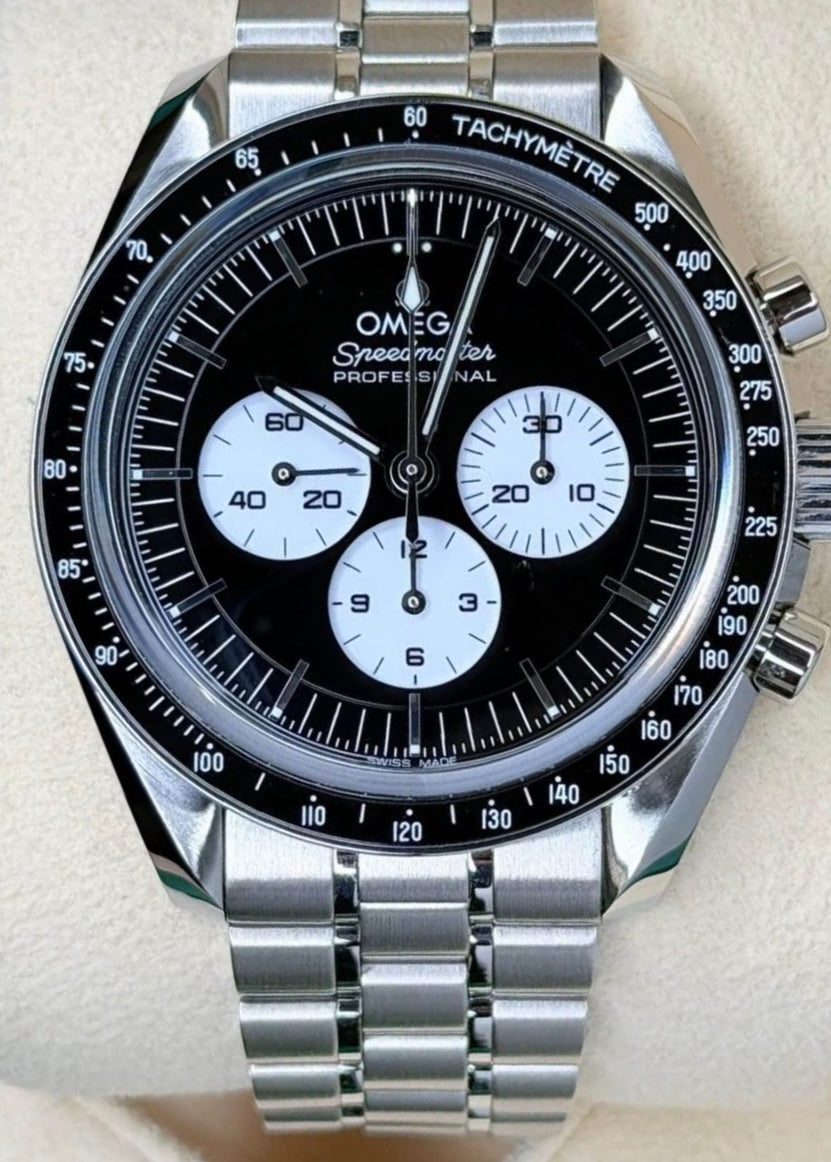 OMEGA
OMEGA
OMEGA versus Rolex is not a contest between a good watch and a bad watch. It is a choice between two different systems of luxury: Rolex concentrates on controlled evolution, recognizable design, robust ownership and market power; OMEGA offers broader engineering experiments, more open availability, more reference variety and frequently stronger value for the money actually spent.
The OMEGA Models Buyers Actually Cross-Shop With Rolex
In our Buying Desk experience, the commercial center of OMEGA is much narrower than the full catalog: Seamaster Diver 300M for the Submariner buyer, Speedmaster Professional Moonwatch for the Daytona buyer, and Aqua Terra for the Datejust or Oyster Perpetual buyer.
That is an editorial conclusion drawn from roughly two decades of buyer conversations, sourcing and ownership questions—not a claim about OMEGA factory production or global market share. Within those three families, the meaningful choices are configuration-specific: steel or full ceramic, black/blue/green dive-watch color, black or white Moonwatch execution, and 38 mm or 41 mm Aqua Terra fit.
OMEGA’s own current materials continue to treat the Diver 300M, Moonwatch and Aqua Terra as distinct core systems; the inventory below uses exact, active 2026 listings rather than generic model-family claims.[14][12][15]
OMEGA vs. Rolex: Decision Map
- Which Brand Is Better?
- One-Minute Decision Table
- Quality, Prestige and Design
- Movements, Accuracy and Certification
- Warranty, Service and Ownership
- Materials, Cases and Dials
- Bracelets, Clasps and Straps
- Weight, Dimensions and Wrist Fit
- Submariner vs. Diver 300M
- Daytona vs. Moonwatch
- Datejust vs. Aqua Terra
- Current 2026 Watches
- Availability and Purchase Channels
- Dated July 2026 Market Snapshot
- Final Decision Matrix
- 20-Point Buying Checklist
- Deep Buyer FAQ
- Sources and Editorial Method
OMEGA vs. Rolex: Which Brand Is Better?
Rolex is generally the stronger choice for prestige, bracelet and clasp consistency, compact case engineering, scarcity, resale liquidity and instant recognition. OMEGA is generally the stronger choice for technical variety, anti-magnetic specifications, full-ceramic construction, visible movement finishing, design range, availability and value at the price buyers actually pay.
The correct answer is not “Rolex is better” or “OMEGA is better.” The correct answer begins with better for what? A buyer who wants a globally recognizable status object, a tightly controlled catalog, a bracelet that feels engineered as one continuous object and a comparatively easy resale exit will often prefer Rolex. A buyer who wants to compare multiple movements, case materials, dial techniques, complications and price points without enduring an allocation process will often prefer OMEGA.
At the level of basic construction, both companies make legitimate high-end Swiss watches. Both produce chronometer-capable movements, proprietary alloys, professional dive watches, travel watches, precious-metal models and robust daily wearers. Neither brand is “cheap” in any meaningful sense. The differences appear in priorities: Rolex relentlessly refines a smaller number of recognizable forms, while OMEGA is more willing to create multiple technical and aesthetic answers to the same use case.
Rolex wins most often when the buyer values
- Prestige and social recognition
- Bracelet, clasp and case integration
- Compact dimensions relative to capability
- Controlled model evolution
- Strong secondary-market demand
- Simple, robust ownership and resale
OMEGA wins most often when the buyer values
- Technical breadth and visible specifications
- 15,000-gauss Master Chronometer testing on many models
- Full ceramic, titanium and unusual material choices
- Display casebacks and decorated movements
- More accessible inventory and pricing
- A wider range of design personalities
Editorial position: “Rolex wins” and “OMEGA wins” in this guide are Buying Desk judgments tied to a defined criterion. They are not universal facts. A specific reference can reverse the brand-level conclusion.
The One-Minute Decision Table
For most buyers, Rolex is the safer luxury-market decision; OMEGA is the more flexible enthusiast and value decision. Use the table below to identify which advantage actually matters to you.
| Decision factor | Rolex | OMEGA | Practical winner |
|---|---|---|---|
| Brand prestige | Among the most recognized luxury-watch names in the world | Strong global prestige, but usually below Rolex in status recognition | Rolex |
| Bracelet and clasp | Exceptionally consistent integration, articulation and adjustment by collection | Ranges from excellent to merely adequate; newer designs are improving quickly | Rolex |
| Movement variety | Focused architecture with controlled deployment across families | Broad mix of automatic, manual-wind, chronograph, world-time and specialty calibres | OMEGA |
| Anti-magnetism | Strong materials and engineering; specification varies by calibre | Many Master Chronometers tested as complete watches to 15,000 gauss | OMEGA |
| Accuracy claim | Typically -2/+2 seconds per day after casing for current Rolex models | Typically 0/+5 seconds per day for many Master Chronometers; 0/+2 on Spirate models | Different tests |
| Case materials | Excellent proprietary steel, gold, platinum and growing titanium use | Steel, multiple gold alloys, titanium, Bronze Gold and broad full-ceramic execution | OMEGA breadth |
| Case compactness | Often thinner and more compact than capability suggests | Some models wear larger or thicker; titanium and redesigned cases can change this | Rolex |
| Dial experimentation | Increasingly adventurous, but still controlled and scarce | Broad use of ceramic, enamel, meteorite, aventurine, laser ablation and color | OMEGA |
| Availability | Popular references can require waiting, allocation or secondary-market purchase | Most core references can be purchased or sourced without a long relationship | OMEGA |
| Transaction price | Many popular steel models trade at or above retail | Many standard models can be acquired below retail through the secondary market | OMEGA value |
| Value retention | Generally stronger and more liquid across the catalog | Reference-dependent; standard models often depreciate more from retail | Rolex |
| Choice for one watch | Datejust, Submariner and GMT-Master II are highly universal | Aqua Terra, Diver 300M and Speedmaster cover more personalities | Reference-specific |
The practical mistake is buying the abstract “winning brand” rather than the right reference. A Submariner can be the wrong purchase for a buyer who dislikes cyclops lenses and wants a display caseback. An Aqua Terra can be the wrong purchase for someone who expects the resale speed and prestige signaling of a Datejust. Brand-level comparisons narrow the field; reference-level comparisons make the decision.
How This Guide Separates Fact, Experience and Market Data
This guide labels factory specifications, Buying Desk observations and market snapshots separately so that a preference is not presented as a technical fact and a temporary price is not presented as permanent value.
OMEGA-versus-Rolex discussions often collapse because participants mix three different categories of evidence:
- Factory facts: dimensions, materials, stated precision, water resistance, movement architecture, power reserve, certification and dated product releases.
- Handling observations: how a clasp feels, how a polished surface catches light, whether a case feels top-heavy, how easily a bracelet shows marks and which dial is easier to read.
- Market behavior: retail price, actual transaction price, wait-list friction, discounting, resale spread and the speed at which a reference finds a buyer.
A factory fact can be cited. A handling observation should be identified as judgment. Market behavior must be time-stamped, because a watch trading above retail today can trade below retail later. This framework matters to both readers and answer engines: structured, attributed claims are easier to retrieve than a single long opinion presented as certainty.
Are OMEGA and Rolex the Same Quality?
OMEGA and Rolex are comparable in the sense that both manufacture serious luxury watches, but they do not allocate quality in the same way. Rolex concentrates heavily on tactile consistency, case-and-bracelet integration and controlled finishing; OMEGA often spends more of the product budget on movement display, anti-magnetic testing, materials and reference variety.
“Quality” is not one measurement. It includes movement performance, water resistance, surface finishing, bracelet engineering, clasp tolerances, dial execution, serviceability, durability, consistency between examples and the ability to hold those qualities after years of use. On some of these dimensions Rolex has the advantage; on others OMEGA does.
Rolex frequently creates the more cohesive object. The bezel action, crown engagement, end-link fit, clasp closure, bracelet articulation and transitions between brushed and polished surfaces tend to feel as though they were developed together. That coherence is a major part of why a modern Rolex often feels expensive before the buyer knows the reference number.
OMEGA frequently creates the more technically demonstrative object. A sapphire caseback may reveal arabesque Geneva waves; a movement may carry a published 15,000-gauss whole-watch test; a ceramic case can be finished in multiple textures; a Worldtimer dial may use laser ablation and layered materials. The experience can be more visually and mechanically expressive, although bracelet execution varies more by model and generation.
At comparable transaction prices, OMEGA can deliver extraordinary hardware. At comparable retail prices, Rolex often protects perceived value better. Those are different questions, and a credible comparison must answer both.
Which Brand Has More Prestige?
Rolex has greater mainstream prestige, recognition and status signaling. OMEGA has deep historical and technical prestige, especially among enthusiasts, but it does not generally carry the same immediate social recognition or scarcity premium.
Prestige has at least four layers: public recognition, historical credibility, technical credibility and exclusivity. Rolex leads the first and usually the fourth. OMEGA is highly competitive in the second and third.
- Public recognition: A non-collector is more likely to recognize a Rolex crown, Submariner silhouette or Datejust fluted bezel.
- Historical credibility: Both brands have extensive records—Rolex in waterproof cases, self-winding architecture, professional watches and brand-building; OMEGA in chronometry, Olympic timing, ocean exploration and spaceflight.
- Technical credibility: OMEGA’s Master Chronometer platform and materials experimentation make it especially credible to specification-oriented buyers.
- Exclusivity: Rolex’s production-and-allocation environment creates stronger acquisition friction around popular references. OMEGA limits certain editions, but its core catalog is generally obtainable.
Prestige is therefore not the same as quality. A buyer can rationally conclude that an OMEGA offers more technology per dollar while still acknowledging that a Rolex carries more market prestige. Denying either side weakens the comparison.
Design Philosophy: Evolution vs. Experimentation
Rolex protects recognizable forms through slow evolution; OMEGA treats its catalog as a broader laboratory for materials, dials, case construction, heritage reinterpretation and complications.
Rolex designs are built around continuity. A modern Submariner remains visibly related to earlier Submariners. A Datejust still communicates fluted bezel, date magnifier and Jubilee or Oyster bracelet. Changes can be technically significant while remaining visually restrained. This protects recognition, simplifies the catalog story and helps old references remain legible as Rolexes.
OMEGA is more pluralistic. The Speedmaster family can include a traditional Hesalite Moonwatch, a sapphire model, a white-dial release, a two-register racing chronograph, a full-ceramic Dark Side of the Moon and precious-metal interpretations. The Seamaster name covers Aqua Terra, Diver 300M, Planet Ocean, Ultra Deep, Seamaster 300, Railmaster and Ploprof. That breadth is exciting, but it can overwhelm a first-time buyer and can create uneven market performance.
Neither philosophy is inherently superior. Controlled evolution creates a stronger icon and often stronger resale. Experimentation creates more chances for a buyer to find a watch that feels personal. The most important question is whether the buyer wants to join a recognizable design language or choose among many technical and aesthetic branches.
Who Should Buy Rolex?
Buy Rolex when the ownership goal includes prestige, easy recognition, strong bracelet execution, compact robustness, long-term market liquidity and a design that changes slowly.
Rolex is especially persuasive for the buyer who wants one watch to operate across business, travel, casual clothing and formal situations. The Datejust, Submariner, GMT-Master II, Explorer and Oyster Perpetual are unusually easy to understand and easy to wear. Their visual identities are strong without requiring the owner to explain the movement or material.
Rolex also suits the buyer who values the secondary market as part of ownership. That does not mean every Rolex appreciates. It means many references have deep global buyer pools, clear price discovery and recognizable configurations. A seller is less likely to explain what the watch is before discussing what it is worth.
Rolex is usually the better fit for: the prestige-conscious buyer, the one-watch collector, the frequent reseller, the person who values bracelet feel above display-back decoration, and the buyer who prefers a smaller number of proven choices.
Who Should Buy OMEGA?
Buy OMEGA when the ownership goal includes technical variety, measurable anti-magnetism, distinctive materials, visible movements, easier availability and a stronger specification-to-price ratio.
OMEGA rewards a buyer willing to learn the reference. The catalog contains more case sizes, strap choices, dial colors, movement architectures and specialist models. That can produce a more personal result: a titanium Bond Seamaster, a 38 mm Aqua Terra, a manual-wind Moonwatch, a ceramic Speedmaster, a 600 m Planet Ocean or a laser-ablated Worldtimer are all meaningfully different ownership experiences.
OMEGA also suits buyers who dislike artificial purchase friction. Core references can usually be bought, ordered or sourced without years of purchase history. That availability is not a sign of inferior watchmaking; it is a different distribution and demand environment. It can also create better secondary-market entry points for buyers who understand that retail price and fair transaction price are not always the same.
OMEGA is usually the better fit for: the specification-oriented buyer, the enthusiast who wants variety, the buyer seeking full ceramic or titanium, the person who wants a display back, and the value shopper comfortable buying unworn or pre-owned.
Which Is Better as a First Luxury Watch?
Rolex is the simpler first luxury watch; OMEGA is the more educational first luxury watch. Choose Rolex for certainty and market recognition, or OMEGA for choice and technical discovery.
A first luxury watch should survive changing taste. Rolex excels here because the core models are culturally stable. A black Submariner, steel Datejust or Oyster Perpetual rarely becomes difficult to understand. The buyer pays for that clarity, and on some references must also navigate scarcity or a secondary-market premium.
OMEGA can be the more rewarding first purchase for someone who enjoys researching. A buyer can choose manual or automatic winding, steel or titanium, dive bezel or smooth bezel, bracelet or rubber, closed or display back, heritage styling or contemporary ceramic. The risk is analysis paralysis and buying the wrong size or configuration simply because it was discounted.
For a first watch, we recommend choosing the model before choosing the deal. A good price on a 44.25 mm ceramic Speedmaster is not a good purchase for a buyer who needs a discreet 38 mm daily watch. A hard-to-get Rolex is not automatically right merely because access was offered.
Rolex and OMEGA: A Buyer-Relevant Timeline
History matters when it explains why a watch looks or functions the way it does. Rolex history centers on waterproofness, automatic winding and professional icons; OMEGA history centers on precision, sporting timekeeping, diving, spaceflight and a broader family of technical watches.
| Year | Rolex | OMEGA | Why buyers still care |
|---|---|---|---|
| 1910s–1930s | Early wristwatch chronometer certification; Oyster waterproof case; Perpetual rotor | Precision observatory work and growing sports-timekeeping role | Established each brand’s technical identity |
| 1945–1948 | Datejust consolidates automatic date-watch architecture | Seamaster launches as a robust everyday watch | Created two durable daily-watch lineages |
| 1953–1957 | Submariner, Explorer, GMT-Master and Day-Date establish Professional and Classic icons | Speedmaster, Seamaster 300 and Railmaster form the 1957 Professional trilogy | Modern model families still descend from these designs |
| 1962–1969 | Professional chronographs and travel watches expand; personal Rolexes appear in aviation and exploration | Schirra wears a Speedmaster in space; NASA qualifies Speedmaster; Moon landing | Space history becomes a central OMEGA differentiator |
| 1967–1970s | Sea-Dweller and helium escape valve support saturation diving | Ploprof and professional diving development broaden Seamaster identity | Deep-diving tool credentials on both sides |
| 1980s–1990s | Modern sapphire, automatic and bracelet evolution; Daytona becomes automatic | OMEGA revitalizes mechanical catalog; Diver 300M arrives in 1993 | The basis of today’s most compared sports watches |
| 2000s–2010s | Cerachrom, Parachrom, new-generation calibres and modern clasps | Co-Axial expansion, in-house calibre families and Master Chronometer era | Current ownership experience takes shape |
| 2020s | RLX titanium, display backs on select models, Land-Dweller and Dynapulse | Spirate, broader ceramic/titanium use, redesigned Planet Ocean and new Aqua Terra sizes | Both brands are innovating, but in different ways |
The Rolex Milestones That Still Matter
The Rolex milestones most relevant to a modern buyer are the Oyster case, Perpetual rotor, Datejust architecture, professional sports-watch families, helium escape valve, proprietary materials, modern clasps and increasingly advanced new-generation movements.
Rolex’s historical strength is not that it invented every watchmaking feature. It is that it repeatedly converted technical ideas into durable, recognizable commercial systems. The Oyster case made water resistance central to the brand. The Perpetual rotor made automatic winding part of Rolex identity. The Datejust connected automatic winding, date display and a recognizable bracelet-and-bezel language. Professional models then specialized that platform for diving, travel, exploration and racing.[36][37]
The Submariner’s 1953 launch, GMT-Master’s 1955 travel function, Day-Date’s 1956 full day display and Sea-Dweller’s 1967 saturation-diving architecture remain visible in current products. Rolex’s modern advantage is cumulative refinement: Triplock crowns, ceramic bezels, solid bracelets, machined clasps, Parachrom or Syloxi oscillators, long power reserves and consistent after-casing precision sit inside forms buyers already recognize.[37][40]
The 2025 Land-Dweller is important because it demonstrates that Rolex is not technically frozen. Calibre 7135 introduced a 5 Hz frequency, Dynapulse escapement, silicon components, an integrated Flat Jubilee bracelet and a display back—features that complicate the lazy claim that Rolex merely changes dial colors.[38][41]
The OMEGA Milestones That Still Matter
OMEGA’s buyer-relevant milestones include precision timing, the 1957 Professional trilogy, NASA qualification of the Speedmaster, long-running dive-watch development, Co-Axial industrialization, Master Chronometer certification and broad use of ceramic, titanium and specialized dial technology.
OMEGA’s modern catalog makes more sense when viewed as several technical lineages rather than one uniform design language. The Speedmaster represents chronograph and spaceflight identity. Seamaster represents a wide spectrum from the Aqua Terra to saturation-diving tools. Constellation and De Ville carry precision and dress-watch histories. OMEGA has often allowed these families to evolve with distinct cases, bracelets and movements.
The brand’s most consequential modern shift was not one watch but a movement strategy: large-scale use of the Co-Axial escapement, followed by anti-magnetic movement construction and Master Chronometer testing of complete watches. This gave buyers a published technical framework that could be explained across many collections rather than only on a halo model.
OMEGA’s material breadth is another durable milestone. Full ceramic cases, Grade 2 and Grade 5 titanium, Bronze Gold, Sedna Gold, Moonshine Gold and Canopus Gold allow the company to produce genuinely different wrist experiences rather than merely different dial colors. The trade-off is a catalog that requires more education and can produce more uneven resale behavior.
OMEGA, Rolex and Space: What Is Actually True?
The Speedmaster was not the first wristwatch ever taken into space, and automatic watches can wind in microgravity. What is true is that Wally Schirra wore his personal Speedmaster in 1962, NASA qualified the Speedmaster for manned missions in 1965, and it became the first watch worn on the Moon in 1969.
Space-watch discussions accumulate myths because several “firsts” are compressed into one statement. Wally Schirra wore a personal OMEGA Speedmaster CK 2998 during the Sigma 7 mission in 1962, making it the first OMEGA in space—not necessarily the first wristwatch in space overall.[19] NASA later subjected chronographs from competing brands to qualification testing; the Speedmaster was selected for manned missions and became the watch worn on the lunar surface during Apollo 11.[20]
The Speedmaster’s manual-wind movement is historically correct, but the common explanation that an automatic rotor cannot wind in zero gravity is wrong. An automatic rotor responds to inertia and wrist motion, not simply to gravity. Automatic watches can wind in microgravity when the wearer moves. Manual winding was appropriate to the qualified Speedmaster architecture; it was not a universal requirement imposed by the absence of gravity.
Likewise, Hesalite should be explained precisely. The qualified Moonwatch used an acrylic crystal. Acrylic can scratch more easily than sapphire but tends not to fracture into hard shards in the same way. This material became part of the Moonwatch identity. It is reasonable to discuss its operational advantages; it is not responsible to reduce NASA’s multi-factor qualification process to a single dramatic story about puncturing a spacesuit.
Dive-Watch Heritage: Oyster, Seamaster and Professional Tools
Rolex built a tighter, more continuous commercial dive-watch lineage around the Submariner, Sea-Dweller and Deepsea. OMEGA built a broader dive ecosystem ranging from vintage-inspired Seamaster 300 models to the Diver 300M, Planet Ocean, Ultra Deep and Ploprof.
Rolex’s current dive hierarchy is simple. The Submariner is the universal professional diver; Sea-Dweller adds saturation-diving architecture and greater depth; Deepsea and Deepsea Challenge extend the engineering envelope. The Submariner launched in 1953 as a 100 m diver, and the Sea-Dweller arrived in 1967 with a helium escape valve for saturation diving.[37][40]
OMEGA’s hierarchy is more diverse. The Diver 300M, introduced in 1993, is the recognizable modern Seamaster with wave dial, skeletonized hands and helium valve. Planet Ocean is the heavier 600 m line. Ultra Deep pushes specialist depth capability. Seamaster 300 interprets mid-century dive-watch design. Ploprof is unapologetically professional and asymmetric. This breadth means there is no single OMEGA diver that maps perfectly to the Submariner.[14][39]
Rolex generally wins on icon clarity and compact execution. OMEGA wins on choice, materials and the ability to select a diver by personality rather than only by depth rating.
What Changed in 2025–2026?
By 2026, both brands had moved beyond the stale comparison of “conservative Rolex versus innovative OMEGA.” Rolex introduced major movement and bracelet engineering through Land-Dweller, while OMEGA refreshed core Seamaster and Speedmaster families and expanded precision, material and dial choices.
Rolex’s Land-Dweller, introduced in 2025, brought calibre 7135, a 5 Hz frequency, Dynapulse escapement, silicon components, a transparent back and an integrated Flat Jubilee bracelet. Rolex’s 2026 communication also emphasized exceptional materials and strengthened testing, including technically ambitious dials and precious-metal executions.[1][2][38]
OMEGA entered 2026 with a redesigned fourth-generation Planet Ocean, a broadened no-date Diver 300M direction, the return of Railmaster, new Aqua Terra sizes and colors, new Moonwatch expressions, expanded ceramic Speedmasters and specialty precision systems such as Spirate. The company’s catalog remains more changeable, but it also gives buyers more current answers across size, material and price.[11][12][13][14][15][16][17]
The current comparison is therefore between two active manufacturers. Rolex innovates selectively and then protects the architecture. OMEGA innovates across more collections and makes the experimentation more visible.
How Rolex and OMEGA Are Manufactured
Rolex is a highly integrated independent manufacturer with unusually tight control over movements, cases, bracelets, dials and precious-metal production. OMEGA operates as a flagship Swatch Group manufacture with major internal capabilities and access to a vertically integrated group ecosystem.
Rolex’s independence and concentration create a consistent product language. Its proprietary foundry, movement facilities, case-and-bracelet production, dial work and testing systems are organized around Rolex products. The company can carry one tolerance philosophy from case to end link to clasp, and it can protect a small set of materials and processes over long periods.
OMEGA is not merely an assembler buying generic components. It develops and industrializes its own calibre families and proprietary materials, and its highest-volume modern movements are deeply integrated into the brand. At the same time, Swatch Group owns extensive capabilities across movements, hairsprings, escapements, cases, dials, ceramics and other components. That group structure can create manufacturing scale and technical resources that an independent brand would need to build alone.
The correct inference is not that an OMEGA contains “Blancpain technology” or that every group brand shares the same parts. It is that OMEGA benefits from a corporate ecosystem with upstream expertise and industrial capacity, while maintaining brand-specific movements, design, specifications and finishing.
What Swatch Group Ownership Means for OMEGA
Swatch Group ownership gives OMEGA access to deep industrial resources and sister-company expertise, but OMEGA’s movements and product decisions should still be evaluated as OMEGA-specific implementations—not as borrowed prestige from another group brand.
Swatch Group spans brands at multiple price levels and owns component and production companies that support the broader organization.[21] This matters because modern watchmaking depends on more than a movement drawing. It requires metallurgy, silicon fabrication, hairsprings, ceramic processing, cases, dials, testing equipment and scalable quality control.
OMEGA has used that environment to industrialize Co-Axial escapements, anti-magnetic movement construction, ceramic case production and broad Master Chronometer certification. The advantages are scale and access. The potential disadvantages are catalog complexity and the perception that the brand is one part of a large portfolio rather than an isolated manufacture.
Rolex’s model is different: the company’s identity, manufacturing investment and distribution strategy are concentrated on one watch brand and its sister Tudor relationship. Buyers should not interpret either structure as automatically better. They should ask which structure produced the stronger watch at the price being considered.
Movement Philosophy: Rolex vs. OMEGA
Rolex movements prioritize compact durability, long service life, efficient automatic winding and consistent operation behind mostly closed casebacks. OMEGA movements prioritize visible architecture, Co-Axial escapements, anti-magnetism, collection-specific functionality and transparent certification.
Rolex often asks, “How can this movement make the whole watch more dependable and easier to own?” OMEGA often asks, “How can the movement demonstrate a measurable technical idea?” Those are generalizations, but they explain much of the catalog.
A modern Rolex movement is normally hidden. Decoration exists, but the owner’s experience is expressed through winding, setting, accuracy, power reserve and the way the movement fits inside a relatively compact case. The current generation commonly uses efficient escapements, free-sprung balances, proprietary hairsprings, bidirectional automatic winding and approximately three-day reserves.
OMEGA frequently shows the movement. Bridges are shaped for visibility, rotors are decorated, and the movement can be a major reason to choose one reference over another. The company publishes anti-magnetic testing, power-reserve verification and rate-performance windows under Master Chronometer certification. It also maintains both manual-wind and automatic chronograph architectures and multiple travel-time systems.
Neither approach makes the other obsolete. A closed-back Submariner can be more satisfying as a daily tool; a sapphire-back Moonwatch can be more satisfying as a mechanical object.
Important Modern Rolex Calibres
The most important current Rolex movements are the 32xx automatic family, calibre 4131 chronograph, calibre 9002 annual-calendar architecture, calibre 7140 in the 1908 and the 5 Hz calibre 7135 with Dynapulse in the Land-Dweller.
| Calibre | Typical models | Architecture / reserve | What the buyer should know |
|---|---|---|---|
| 3230 | No-date Submariner, Oyster Perpetual, Explorer | Automatic, time only, about 70 hours | Simple current workhorse; no date mechanism; strong weekend autonomy |
| 3235 | Submariner Date, Datejust, Sea-Dweller and others | Automatic, date, about 70 hours | Core modern date calibre with quickset date and broad service familiarity |
| 3285 | GMT-Master II | Automatic GMT, about 70 hours | Independent local-hour setting makes travel adjustment practical |
| 4131 | Cosmograph Daytona | Automatic column-wheel chronograph, about 72 hours | Compact integrated chronograph, vertical clutch and current-generation finishing |
| 9002 | Sky-Dweller | Automatic annual calendar and dual time, about 72 hours | Ring Command interaction simplifies a mechanically complex calendar/travel watch |
| 7140 | Perpetual 1908 | Automatic small seconds, about 66 hours | Dress-oriented architecture with transparent caseback and visible decoration |
| 7135 | Land-Dweller | Automatic, 5 Hz, about 66 hours | Dynapulse escapement, Syloxi hairspring and a materially different new-generation platform |
Rolex does not update every collection at once. Two watches sold in the same year can therefore use very different movement generations. The reference number matters more than the brand name alone. Calibre 7135 is particularly significant because its 5 Hz frequency and Dynapulse escapement demonstrate that Rolex is willing to depart from the conventional Swiss lever architecture when the company believes the system is mature enough.[3][38]
Important Modern OMEGA Calibres
OMEGA’s key modern calibres include the 8800/8806 family for compact automatic watches, 8900/8912 for larger twin-barrel watches and independent-hour setting, 3861 for the Moonwatch, 9900 for automatic chronographs, 8938 for Worldtimer and newer specialty movements such as Spirate-equipped calibres.
| Calibre | Typical models | Architecture / reserve | What the buyer should know |
|---|---|---|---|
| 8800 / 8806 | Diver 300M, Aqua Terra 38 and related models | Automatic, about 55 hours; date or no date | Compact Master Chronometer platform with 15,000-gauss testing on certified models |
| 8900 / 8912 | Aqua Terra 41, Planet Ocean and related models | Automatic twin barrels, about 60 hours | Independent local-hour hand; convenient travel setting; larger movement footprint |
| 3861 | Speedmaster Moonwatch Professional | Manual-wind chronograph, about 50 hours | Co-Axial Master Chronometer evolution of the Moonwatch architecture |
| 9900 family | Speedmaster Racing and Seamaster chronographs | Automatic integrated chronograph, about 60 hours | Column wheel, vertical clutch, two-register display with combined hour/minute totalizer |
| 8938 | Aqua Terra Worldtimer | Automatic world time, about 60 hours | Travel display and decorative dial architecture; larger case and more visual information |
| 8750 / 8751 | Aqua Terra 30 mm | Automatic, over 48 hours | Purpose-built compact Master Chronometer movements, including precious-metal execution |
| Spirate-equipped 9920 family | Speedmaster Super Racing and related precision models | Automatic chronograph, adjustable silicon system | OMEGA’s 0/+2-second precision platform on designated references |
OMEGA calibre numbers can appear intimidating, but the decision usually reduces to four questions: manual or automatic; date or no date; standard time setting or independent local hour; and whether the case size required by the movement fits the buyer’s wrist.
Chronergy, Dynapulse and Co-Axial Escapements
Rolex’s Chronergy is an optimized Swiss lever system used widely in current calibres; Dynapulse is a newer high-efficiency escapement introduced on calibre 7135; OMEGA’s Co-Axial uses a different impulse geometry intended to reduce sliding friction and support stable long-term performance.
The escapement meters energy from the gear train to the oscillator. It is important, but it is not the entire movement. A theoretically advanced escapement can still be placed in a watch with poor regulation, weak shock protection or inconvenient service support.
Chronergy retains the familiar lever-escapement concept but changes geometry and materials to improve efficiency. It supports the approximately 70-hour reserves common in the Rolex 32xx family.[44] Dynapulse is a more radical Rolex development using silicon components and a sequential distribution architecture; it debuted with the 5 Hz calibre 7135 after nearly a decade of development.[3][38]
Co-Axial separates impulses across different pallet surfaces and reduces the sliding friction associated with the traditional lever escapement. OMEGA turned the concept into a large-scale industrial platform. Its importance to the buyer is not that the watch becomes maintenance-free; it is that the escapement is part of a complete movement-and-certification strategy emphasizing rate stability, anti-magnetism and longer service performance.
A buyer should not choose solely by escapement name. Choose the reference whose complete movement, case, service history and price make sense.
Parachrom, Syloxi and Silicon Balance Springs
Rolex uses Parachrom metallic hairsprings in many calibres and Syloxi silicon hairsprings in others; OMEGA uses silicon balance springs widely across Master Chronometer movements. All are designed to reduce sensitivity to magnetism, temperature and disturbance, but the complete oscillator and testing standard matter more than the material name alone.
The hairspring governs the oscillator’s breathing motion. Changes in geometry, temperature response, magnetism and shock can affect rate. Rolex’s blue Parachrom alloy is paramagnetic and designed for stability, while Syloxi uses silicon and patented geometry.[45] The newer Land-Dweller calibre 7135 combines a Syloxi hairspring with other anti-magnetic components and high-frequency operation.[3][38]
OMEGA’s widespread silicon use is integrated into its anti-magnetic movement architecture. Instead of relying on a soft-iron inner cage that hides the movement and limits certain functions, OMEGA designs the movement components themselves to resist magnetic influence. This supports display backs and the published 15,000-gauss testing associated with Master Chronometer models.[10]
Silicon has advantages but is not infinitely repairable in the traditional sense; damaged silicon components are generally replaced. Metallic hairsprings can be manipulated by a skilled watchmaker, but proprietary modern components may still require replacement. Service availability matters as much as theory.
Which Brand Is More Anti-Magnetic?
OMEGA wins the published anti-magnetism comparison because many Master Chronometer watches are tested as complete watches at 15,000 gauss. Rolex uses strongly anti-magnetic materials and engineering, but generally does not publish the same catalog-wide whole-watch benchmark.
Magnetism is one of the clearest areas where OMEGA provides the easier answer. METAS-linked Master Chronometer testing exposes the movement and complete watch to a 15,000-gauss field and verifies function and rate afterward.[10] This is far beyond common household exposure and makes the specification easy for a buyer or answer engine to understand.
Rolex’s Parachrom, Syloxi, nickel-phosphorus and ceramic components reduce magnetic vulnerability, and newer architectures such as calibre 7135 explicitly use materials selected for resistance to strong fields.[3][38] A modern Rolex is not magnetically fragile. The difference is transparency and standardized published magnitude.
For daily life, both are usually sufficient. For a buyer who works around medical imaging, laboratory equipment, industrial motors or powerful speakers—or simply wants the strongest measurable claim—OMEGA’s 15,000-gauss platform is the more compelling specification.
Superlative Chronometer vs. Master Chronometer
Rolex Superlative Chronometer certification emphasizes a narrow -2/+2-second daily tolerance after casing and internal performance tests. OMEGA Master Chronometer certification emphasizes independent METAS oversight, 0/+5-second performance on many models, 15,000-gauss testing, water resistance and power-reserve verification.[43]
| Test dimension | Rolex Superlative Chronometer | OMEGA Master Chronometer | How to interpret it |
|---|---|---|---|
| Rate window | Typically -2/+2 sec/day after casing | Typically 0/+5 sec/day across defined tests; designated Spirate models 0/+2 | Rolex window is numerically narrower on standard models; OMEGA avoids a slow-running target and tests under a different protocol |
| External oversight | Rolex internal certification after COSC movement certification | METAS-supervised Master Chronometer process after qualifying movement certification | Different governance models; neither number should be compared without context |
| Magnetism | Anti-magnetic components and internal testing; no broad 15,000-gauss catalog claim | Complete-watch exposure to 15,000 gauss on certified models | OMEGA provides the stronger public magnetic benchmark |
| Water resistance | Rolex tests completed watches to its standards | Water resistance verified within Master Chronometer protocol | Both require reference-specific depth ratings |
| Power reserve | Movement/reference specification and internal testing | Power reserve is verified in the certification process | OMEGA makes the test path more visible to the customer |
| Customer access | Model specifications and brand statements | Many watches allow access to individual results through OMEGA systems | OMEGA offers more test transparency |
Rolex’s -2/+2 figure and OMEGA’s 0/+5 figure are not a simple scoreboard. A watch running +3 seconds per day can satisfy OMEGA’s standard but miss Rolex’s numerical window; a watch running -1 second per day can satisfy Rolex’s standard but conflict with OMEGA’s positive-only target. Test positions, states of wind, magnetism and averaging differ.[2][10]
OMEGA’s Spirate system adds fine rate adjustment and supports a 0/+2-second claim on designated models, demonstrating that the company can pursue a narrower window when the movement is built around that system.[11]
Which Brand Is More Accurate?
On paper, standard modern Rolex offers the narrower everyday rate tolerance, while OMEGA offers the more transparent multi-condition and anti-magnetic certification. In actual ownership, an individual watch’s regulation, position, state of wind and service condition matter more than the logo.
A rate specification is a range, not a promise that every watch will run at the center of the range on every wrist. Wearing pattern changes the amount of power in the mainspring. Resting position overnight can alter the average. Magnetism, impact, lubrication and temperature can change performance over time.
Rolex often produces excellent real-world rate consistency with minimal owner attention. OMEGA’s Master Chronometer system provides unusually useful evidence about how the watch behaved across specific tests. A buyer choosing between two used watches should therefore value a recent timing trace and pressure test more than a theoretical brand victory.
For obsessive precision, a quartz watch or synchronized electronic device will outperform both. Mechanical accuracy should be understood as a quality of engineering and regulation, not as the only reason to buy a luxury watch.
Power Reserve and Real-World Autonomy
Many current Rolex automatics provide roughly 66–72 hours, while common OMEGA movements range from about 48 to 60 hours. Rolex therefore often has the practical weekend advantage, though OMEGA twin-barrel and specialty movements can provide stable delivery and useful travel functions.
A three-day reserve means a watch removed Friday evening may still be running Monday morning. That convenience matters to owners who rotate watches. Rolex’s 32xx family at approximately 70 hours is especially effective in simple daily models. OMEGA’s 55- and 60-hour reserves are sufficient for most daily wear but can expire during a longer rotation.
Reserve duration is not the only metric. Torque stability, amplitude across the reserve and how the movement performs near depletion also matter. Twin-barrel OMEGA movements can distribute energy differently, while high-frequency Rolex calibre 7135 balances a 5 Hz rate with approximately 66 hours.
Manual-wind Speedmaster owners often enjoy the daily interaction and do not consider a 50-hour reserve a defect. Convenience is use-case dependent.
Automatic Winding, Manual Winding and Setting Feel
Rolex offers exceptionally consistent crown action and automatic-winding convenience across most of its catalog. OMEGA offers more variety, including manual-wind Moonwatches, independent-hour travel movements and automatic calibres with different crown and date-setting behaviors.
Rolex crowns often feel dense, precise and highly repeatable. Twinlock and Triplock systems provide multiple sealing interfaces, and the tactile transition between winding, setting and screwing down the crown is a meaningful part of ownership. The brand’s catalog consistency makes it easy to move from one Rolex to another.
OMEGA crown feel varies more by collection. A manual-wind Moonwatch invites daily engagement. Calibre 8900-family watches allow the local hour to jump in one-hour increments without stopping the movement—a benefit for travel, though it changes how the date is corrected. Smaller 8800-family movements use a more conventional architecture.
The right answer depends on habit. A buyer who wants “set it and forget it” may prefer a Rolex automatic. A buyer who treats winding as part of the ritual may prefer the Moonwatch. A traveler may value OMEGA’s independent hour even if the case is larger.
Chronograph Engineering: Daytona vs. Speedmaster Architecture
The Daytona is the more compact, scarce and market-prestigious automatic chronograph. The Speedmaster family offers greater historical depth, movement visibility, manual-wind character, ceramic options and price accessibility.
The current Daytona calibre 4131 is an integrated automatic chronograph with column wheel and vertical clutch. The watch wears compactly, its screw-down pushers reinforce water resistance and its Oyster or Oysterflex integration is exceptionally polished. The practical disadvantages are access, price and the need to unscrew pushers before timing.
The Moonwatch calibre 3861 is manual-wind and uses a horizontally coupled chronograph architecture descended from the Moonwatch lineage. The owner can see the mechanism on sapphire-back versions. Pushers are immediately available, but water resistance and daily-wear versatility differ from Daytona. OMEGA’s automatic 9900-family chronographs provide a different comparison: column wheel, vertical clutch, twin-register layout and substantial case presence.
“Daytona vs. Speedmaster” therefore contains multiple decisions: automatic versus manual, compact versus historically faithful, scarce versus obtainable, closed versus display back, and high resale value versus lower acquisition cost.
GMT, World Time and Annual Calendar Functions
Rolex makes the cleaner travel tools through GMT-Master II and Sky-Dweller; OMEGA offers more visually ambitious world-time and travel displays, especially through Aqua Terra Worldtimer and independent-hour 8900-family movements.
The GMT-Master II is exceptionally intuitive: a 24-hour hand, rotating 24-hour bezel and independently adjustable local hour. It supports rapid time-zone changes without stopping the movement. Its main limitation is availability and secondary-market price on popular configurations.
OMEGA’s Aqua Terra Worldtimer displays global time with a city ring, 24-hour indication and decorative world map. It is more informative and visually complex, but larger and less discreet. Many OMEGA 8900-family watches offer an independent local hour even without a GMT hand, making them surprisingly useful for travel.
The Sky-Dweller combines dual time with an annual calendar and Ring Command bezel interface. OMEGA offers annual calendars and world-time complications in other families, but there is no direct one-to-one counterpart. Compare the function actually needed, not the complication count.
Movement Decoration and Display Casebacks
OMEGA usually provides more visible movement decoration and more display casebacks across its catalog. Rolex finishing is highly controlled and technically clean, but most movements remain hidden; display backs are limited to selected modern families and precious-metal Daytonas.
OMEGA’s arabesque Geneva waves, blackened screws, shaped bridges and open rotor views are part of the product experience. A sapphire Moonwatch or Aqua Terra invites the owner to inspect the calibre. That visibility can make a watch feel more mechanically special even when the finishing is industrial rather than hand-finished haute horlogerie.
Rolex historically treated the Oyster caseback as part of a sealed instrument. Modern exceptions—including the 1908, Land-Dweller and certain platinum Daytonas—show that the brand can decorate and display movements when it chooses. Rolex Côtes de Genève, gold rotors and refined bridge treatment are increasingly visible, but the catalog still prioritizes closed-back robustness.
Neither brand should be confused with top-level hand-finished independents. The comparison is about high-volume luxury finishing: OMEGA is more demonstrative; Rolex is more restrained and consistent with its instrument philosophy.
Warranty, Service Intervals and Long-Term Ownership
Both brands offer five-year international warranties on qualifying new watches. Rolex recommends service roughly every ten years depending on model and use; OMEGA service timing is condition- and use-dependent, and water-resistance testing should be more frequent than a full overhaul for watches used in water.
Rolex’s five-year guarantee and global service network support the brand’s ownership proposition.[7] Rolex states that service frequency depends on the model and real-life use, with approximately ten years as a general recommendation for many watches.[8] That is not permission to ignore water resistance, impact or poor timing.
OMEGA also provides a five-year international warranty for qualifying watches, subject to its terms.[24] Co-Axial marketing sometimes leads owners to assume the movement never needs service. That is false. Oils age, seals compress, crowns wear and impacts occur. The proper interval depends on rate, amplitude, water use, environment and the manufacturer’s current guidance.
For either brand, a pressure test is inexpensive compared with water damage. A watch used for swimming or diving should be tested periodically and after crown, crystal or case work. A full service should be based on condition—not only on the calendar.
Oystersteel vs. OMEGA Stainless Steel and O-MEGASTEEL
Rolex uses Oystersteel, a 904L-family alloy chosen for corrosion resistance and polish. OMEGA uses conventional watchmaking stainless steels across much of the catalog and O-MEGASTEEL on selected models for enhanced strength, corrosion resistance and a brighter appearance.
Rolex moved broadly to 904L-family steel and now markets its version as Oystersteel. The alloy can take a highly reflective polish and resists corrosion well, but it is not scratch-proof. In daily use, polished center links and clasp surfaces can mark quickly regardless of alloy.[4]
OMEGA’s common steel references should be judged by geometry and finish rather than dismissed because they do not use the Rolex alloy. Brushed lugs, polished bevels and ceramic bezels can create a sophisticated surface architecture. O-MEGASTEEL appears on selected deep-diving and specialty references, where OMEGA emphasizes higher strength and corrosion resistance.
For most owners, the visible differences come from finish placement, bracelet design and case shape—not laboratory alloy data. A brushed Submariner bracelet can look cleaner after wear than a polished-center-link Datejust. An OMEGA with broad polished flanks may show fingerprints and hairlines faster than a satin-finished tool model.
Gold Alloys: Everose, Moonshine, Sedna, Canopus and More
Rolex offers exceptionally consistent proprietary 18-karat yellow, white and Everose gold produced under tight internal control. OMEGA offers a broader named-alloy palette, including Sedna, Moonshine, Canopus and Bronze Gold, creating more color and material choices.
Rolex gold watches often communicate density and finish before color nuance. Everose is engineered to resist fading, white gold provides stealth weight, and yellow gold supports the classic Day-Date, Daytona and Submariner language. Rolex’s internal foundry and bracelet execution make a full-gold Oyster or President bracelet one of the strongest tactile statements in mainstream luxury watches.
OMEGA differentiates gold by hue and application. Sedna Gold is a warmer rose tone, Moonshine Gold is a paler yellow interpretation, and Canopus Gold is a white alloy with substantial heft. Bronze Gold blends a gold-rich proprietary formulation with the visual warmth of bronze while aiming for more stable aging than conventional bronze.[22]
At the same retail tier, Rolex precious-metal references often carry greater prestige and resale support. OMEGA precious-metal watches can provide more unusual colors, display-back movements and stronger secondary-market discounts. The value opportunity can be extraordinary, but the exit market is thinner.
Titanium: RLX Titanium vs. OMEGA Titanium
OMEGA offers more titanium references and more varied titanium experiences. Rolex uses RLX titanium selectively, with meticulous finishing and strong engineering, but its titanium catalog remains narrower.
Titanium changes a watch more than a spec sheet suggests. It reduces mass, feels warmer against skin and can make a large case surprisingly wearable. It also shows surface marks differently from steel and can be more difficult to refinish correctly.
Rolex’s RLX titanium appears in specialist and newer references, including the Yacht-Master 42 and Deepsea Challenge. Rolex applies clearly defined satin and polished details, preserving the brand’s surface discipline even in a lightweight material. Availability and price remain significant barriers.
OMEGA has broader experience across Seamaster, Speedmaster and Aqua Terra applications. Grade 2 titanium can feel darker and more tool-like; Grade 5 titanium can support brighter polish and more complex finishing. The No Time To Die Diver 300M is one of the clearest demonstrations: the 42 mm case feels radically lighter than a steel Diver 300M and changes the entire perception of size.
Ceramic Cases and Bezels
OMEGA leads in full-ceramic case breadth, while both brands use ceramic effectively for bezels. Rolex’s Cerachrom system is exceptionally consistent and integrated; OMEGA is more willing to construct entire cases, crowns, pushers and dials from ceramic.
Rolex Cerachrom bezels are highly scratch-resistant, color-stable and precisely integrated with bezel action and engraved scales. On the Submariner, GMT-Master II, Daytona and Yacht-Master, ceramic supports an existing icon rather than becoming the entire identity of the watch.
OMEGA uses ceramic as both component and architecture. Dark Side of the Moon cases, ceramic Seamaster cases, ceramic dials and ceramic pushers create watches with deep color and unusual surface continuity. The advantage is scratch resistance and visual drama. The risk is impact: ceramic is hard but can fracture, and case replacement is far more serious than refinishing steel.
Buyers should distinguish cosmetic durability from structural indestructibility. Ceramic resists hairlines brilliantly, but a sharp impact on a hard edge is a different failure mode. Insurance, careful strap changes and condition inspection matter.
Meteorite, Aventurine, Enamel, Lacquer and Ceramic Dials
Rolex offers highly controlled luxury dials with exceptional color consistency, applied markers and increasingly adventurous natural or decorative materials. OMEGA offers a broader catalog of visible dial technologies, including aventurine, meteorite, ceramic, enamel, laser ablation and layered world maps.
Rolex dial execution is often underestimated because the designs are familiar. Marker alignment, hand finishing, lacquer depth, sunburst consistency, applied coronets and the interaction with fluted or ceramic bezels are held to a high production standard. Current exceptional references include stone, meteorite, aventurine, enamel and specialized decorative processes.[9][2]
OMEGA is more likely to make the dial the technical story. Ceramic dials can be laser engraved; Worldtimer maps can be laser ablated; aventurine can create a star-field effect; meteorite can be used across Speedmaster and Constellation references; enamel and galvanic processes appear in both heritage and modern designs.
Natural materials vary. Meteorite pattern, stone color and aventurine distribution can make two nominally identical references look different. Buyers should inspect the actual watch, not only a catalog render. Replacement dials and service changes can materially affect collectibility.
Case Architecture and Finishing Philosophy
Rolex case finishing is usually more cohesive and tensioned, with subtle radii, crisp transitions and surfaces designed to flow into the bracelet. OMEGA case finishing is often more expressive, with twisted lugs, polished bevels, ceramic planes and collection-specific shapes.
Rolex finishing is less about obvious hand-applied decoration than about controlled geometry. Look at the curve from lug to end link, the crown-guard transition, the radius around a clasp edge and the way a polished case flank appears slightly inflated rather than flat. These small relationships create the impression of surface tension that experienced handlers associate with Rolex.
OMEGA uses more visible contrast. Speedmaster lyre lugs twist polished and brushed planes. Aqua Terra cases can combine broad polished surfaces with satin sides. Diver 300M cases use scalloped bezels and twisted lugs. Planet Ocean cases emphasize strength and depth. Full ceramic models create polished and brushed effects in a material that cannot be treated like steel.
Rolex often feels more resolved as one object. OMEGA often offers more interesting individual surfaces. The better result depends on whether the buyer values seamless integration or visual complexity.
Polishing Quality, Surface Tension and Edge Definition
Rolex generally has the stronger reputation for repeatable factory polishing and subtle surface geometry. OMEGA can be equally impressive on a specific case, but its broader catalog produces more variation in edge treatment, bevels and refinishing difficulty.
The phrase “Rolex polishing” should not mean mirror brightness alone. The important details are preserved lug shape, consistent brushing direction, rounded-but-controlled edges, the transition into crown guards, and the radiused surfaces around bracelet and clasp components. A heavily refinished Rolex can lose these qualities even if it looks shiny.
OMEGA’s lyre lugs and mixed finishes can be difficult to restore because the watchmaker must preserve the twist, bevel width and meeting point between brushed and polished planes. Ceramic cases require specialized replacement or refinishing pathways. Vintage Speedmasters and Seamasters can lose substantial character through aggressive case work.
For either brand, “recently polished” is not automatically positive. Ask who performed the work, whether edges remain symmetrical, whether laser welding was used, and whether the case dimensions have changed. Factory-quality refinishing is a skill, not a cleaning step.
Bracelet Quality: Does Rolex Really Win?
As a brand-level conclusion, Rolex usually wins bracelet and clasp consistency. OMEGA can equal or exceed Rolex in specific areas—mesh, titanium options, quick-release straps and some modern clasps—but its quality and ergonomics vary more by collection and generation.
Rolex bracelets feel expensive because multiple systems align: solid end links, controlled lateral play, consistent link finishing, secure clasps, well-integrated adjustment and proportions matched to the case. The bracelet is not an accessory added after the watch head; it is part of the architecture.
OMEGA’s best bracelets are excellent, but the catalog contains very different philosophies. A Moonwatch bracelet is light, tapered and vintage-influenced. A Diver 300M bracelet is robust and recognizable but relatively broad and less tapered. Planet Ocean bracelets prioritize strength. Aqua Terra bracelets range from older polished-center designs to newer, more refined tapers. Milanese mesh creates a completely different feel.
The correct statement is therefore not “OMEGA bracelets are bad.” It is that Rolex provides a more predictable premium bracelet experience across models. OMEGA requires reference-specific evaluation.
Oyster, Jubilee, President and Oysterflex
Rolex offers four highly differentiated bracelet systems: Oyster for robust three-link versatility, Jubilee for flexible five-link comfort, President for precious-metal prestige and Oysterflex for a structured elastomer experience over a metal blade.
Oyster: The three-link standard. It can be fully brushed on tool watches or combine polished center links on dressier and travel models. It feels substantial and is easy to understand.
Jubilee: Five-piece links create greater articulation and visual texture. Modern solid construction avoids the loose feel associated with heavily worn vintage examples. On GMT-Master II and Datejust, it can be more comfortable than Oyster but visually dressier.
President: Reserved for specific precious-metal families and associated most strongly with Day-Date. The semi-circular three-piece links create density and fluidity. It is both jewelry and engineering.
Oysterflex: Not simply a rubber strap. A flexible metal blade is overmoulded with elastomer, and internal cushions stabilize the strap. It combines moisture resistance and sporty comfort with a Rolex clasp and precious-metal case.[5]
OMEGA Bracelets by Collection
OMEGA bracelets must be judged by collection. Moonwatch, Diver 300M, Planet Ocean, Aqua Terra, Constellation and mesh systems have different tapers, weights, articulation and adjustment.
Moonwatch: The modern bracelet is one of OMEGA’s strongest. It tapers, articulates well and matches the twisted-lug case. Hesalite and sapphire versions can have different polished details.
Diver 300M: The nine-link visual design is iconic and extremely robust, but some buyers find it broad, heavy and insufficiently tapered. Newer mesh options change the character completely.
Planet Ocean: Built for a heavier watch head, often with substantial clasp and dive adjustment. Weight can become the central wrist-fit issue.
Aqua Terra: Generation matters. Some older bracelets use polished center links and limited adjustment; newer designs improve taper and visual integration. Rubber straps can be more comfortable than bracelets on larger references.
Constellation: Integrated bracelet design is central to the watch. It should be sized and inspected carefully because links, wear and replacement cost matter.
OMEGA’s quick-change systems and strap ecosystem can be superior for owners who switch configurations frequently. Rolex offers less variety but greater consistency.
Clasp Security and Micro-Adjustment
Rolex generally provides the more intuitive and refined clasp experience, especially Glidelock and Easylink. OMEGA’s dive clasps can offer substantial adjustment, but clasp size and collection-specific execution vary more.
Rolex Glidelock allows tool-free incremental adjustment over a meaningful range and is one reason the Submariner wears comfortably through temperature changes. Easylink provides a quick extension on many non-dive models. Fliplock on selected deep divers adds wetsuit extension. The mechanisms are easy to understand and integrated into the clasp profile.
OMEGA’s modern dive clasps can provide push-button micro-adjustment and diver extension. They are functional, but some are physically large. Moonwatch adjustment has improved across recent bracelet revisions. Aqua Terra remains reference-dependent, and buyers should confirm whether the exact clasp offers micro-adjustment rather than assuming from the model family.
A clasp that fits the wrist is more important than a theoretical adjustment range. On smaller wrists, a long folding blade can create a flat spot under the wrist even when the bracelet length is correct.
Rubber, Mesh, Leather and NATO Straps
OMEGA provides the broader factory strap ecosystem, including integrated rubber, Milanese mesh, leather and NATO options. Rolex provides fewer alternatives but executes Oysterflex at a very high level.
OMEGA treats straps as part of collection identity. Diver 300M rubber can reduce top-heaviness. Mesh creates vintage military character. Aqua Terra rubber integrates into the case and can improve comfort. Speedmaster leather and NATO options emphasize history. Quick-change systems on selected references make swapping easier.
Rolex Oysterflex is more engineered than a conventional rubber strap, but sizing requires care because blade lengths are selected rather than cut continuously. The clasp remains a major advantage. Conventional leather appears mainly in dress-oriented or precious-metal contexts.
Aftermarket straps can improve fit but may reduce water confidence if spring bars or end-link interfaces are wrong. Heavy watches need secure hardware. Precious-metal cases can be scratched during repeated strap changes.
Scratches, Polishing and Refinishing Risk
Rolex and OMEGA both scratch. Rolex polished center links and clasps show hairlines quickly; OMEGA’s broad polished surfaces, twisted lugs and ceramic components create different maintenance risks. Correct refinishing is reference-specific.
Owners often mistake scratch resistance for durability. Steel scratches but can often be refinished. Ceramic resists scratches but can chip or fracture. Titanium is light but develops its own surface patina. Gold marks easily and loses material with every aggressive polish.
Rolex’s market places heavy emphasis on case shape, especially on collectible sports references. Rounded lugs, softened crown guards and distorted brushing can reduce value. OMEGA collectors similarly care about preserved lyre-lug geometry, caseback medallions, bezel condition and correct factory finish.
The safest strategy is to tolerate normal wear, document significant impacts and use a specialist when refinishing is truly necessary. A watch does not need to look new to be well cared for.
OMEGA vs. Rolex Weight Guide
Rolex usually delivers lower or better-balanced mass for a given capability, while many steel OMEGA sports watches feel heavier and broader. Titanium OMEGAs can reverse the comparison dramatically. Exact weight depends on reference, bracelet, strap and the number of links installed.
| Watch / configuration | Representative weight | Wrist impression | Data caution |
|---|---|---|---|
| Rolex Datejust 36 steel on Jubilee | about 125–135 g | Dense but compact; weight distributed across flexible links | Varies by reference, bracelet and links |
| Rolex Submariner Date 126610 | about 155–165 g | Substantial without feeling excessively top-heavy | Full bracelet and link count matter |
| Rolex GMT-Master II steel | about 140–150 g | Compact case with bracelet-centered balance | Oyster vs. Jubilee changes feel |
| Rolex Daytona steel | about 140–150 g | Low, compact and unexpectedly comfortable for a chronograph | Configuration and link count vary |
| Rolex Sea-Dweller steel | about 190–200 g | Noticeably taller and denser than Submariner | Not a small-wrist substitute for Submariner |
| OMEGA Moonwatch steel bracelet | about 135–145 g | Broad 42 mm footprint but relatively balanced and tapered | Hesalite/sapphire and bracelet generation vary |
| OMEGA Diver 300M steel bracelet | about 190–205 g | Dense, broad and visually substantial | Bracelet, chronograph and material change weight |
| OMEGA Aqua Terra 38 steel bracelet | about 125–140 g | Comparable daily-wear mass to Datejust, often with larger dial opening | Generation and bracelet vary |
| OMEGA Planet Ocean 42 steel bracelet | roughly 175–195 g | Deep case and tool-watch mass; fit depends on wrist shape | Generation-specific; verify exact reference |
| OMEGA No Time To Die titanium | about 93–100 g | Extremely light for a 42 mm diver; may feel almost strap-like | Mesh vs. NATO and sizing change total |
Weight methodology: Rolex and OMEGA do not consistently publish ready-to-wear weights for every configuration. These are representative Buying Desk and market-observed ranges, not factory specifications. Removed links can change weight materially. Always weigh the actual watch when precision matters.
Weight is not quality. Some buyers associate heft with luxury; others experience it as fatigue. Balance matters more than the number. A 200 g watch spread across a well-fitted bracelet can feel better than a 160 g watch with a tall head and loose strap.
Diameter, Lug-to-Lug, Thickness and Dial Opening
Case diameter alone is an unreliable predictor of fit. Rolex often wears smaller than its nominal size because of compact lug-to-lug dimensions and controlled dial openings; OMEGA can wear larger because of twisted lugs, wider dials, thicker movements or longer bracelet end links.
A 41 mm Datejust does not wear like a 41 mm Aqua Terra. A 42 mm Moonwatch does not wear like a 42 mm Planet Ocean. A 40 mm GMT-Master II can have more presence than a 41 mm smooth-bezel watch because the bezel, color and bracelet change the visual footprint.
- Diameter describes width, usually excluding crown.
- Lug-to-lug describes the longitudinal footprint across the wrist.
- Thickness affects cuff clearance and top-heavy sensation.
- Dial opening changes perceived size; a thin bezel makes a watch look larger.
- End-link projection can extend the effective lug-to-lug beyond the case measurement.
- Caseback shape determines whether the watch settles into or sits above the wrist.
Try the actual reference with the bracelet correctly sized. Photographs taken close to the wrist exaggerate size. Mirror-distance photographs and a side profile provide better evidence.
Best OMEGA and Rolex Watches for Smaller Wrists
For smaller wrists, Rolex offers more consistently compact options across 31, 34, 36 and 37 mm sizes. OMEGA offers excellent small choices—especially Aqua Terra 30/34/38, Speedmaster 38 and selected vintage-inspired models—but requires more attention to lug length and thickness.
| Buyer goal | Rolex starting point | OMEGA starting point | Fit note |
|---|---|---|---|
| Simple daily watch | Oyster Perpetual 34 or 36 | Aqua Terra 34 or 38 | OMEGA dial can read larger; Rolex case often feels more compact |
| Date watch | Datejust 31 or 36 | Aqua Terra 30/34/38 | Datejust bracelet and bezel can add visual presence |
| Sports watch | Explorer 36 or Yacht-Master 37 | Speedmaster 38 or smaller Seamaster options | Check thickness and end-link projection |
| Chronograph | Daytona 40 | Speedmaster 38 or Moonwatch with careful fit | Daytona usually wears smaller than its label suggests |
| Luxury / precious metal | Day-Date 36 | Aqua Terra 30/34 in gold or Constellation | Weight can make a small gold watch feel substantial |
A smaller wrist does not require a small watch, but it benefits from curved lugs, a short clasp blade and a bracelet that articulates immediately. Rolex is usually easier to fit without experimentation.
Best OMEGA and Rolex Watches for Larger Wrists
OMEGA offers more naturally large and visually substantial models, while Rolex offers fewer but highly focused large references such as Sea-Dweller, Deepsea, Sky-Dweller and 42 mm Yacht-Master.
Large wrists can support Planet Ocean, Ultra Deep, Dark Side of the Moon, Worldtimer and larger Seamaster chronographs without the watch dominating. OMEGA’s catalog provides more diameter, thickness and strap combinations, which can be an advantage for buyers who find a 40–41 mm Rolex visually restrained.
Rolex’s large models often preserve familiar proportions while adding depth or width. Sea-Dweller and Deepsea are serious tools; Sky-Dweller creates dial complexity and case presence; Yacht-Master 42 offers lighter titanium or precious-metal Oysterflex choices.
Do not assume a larger wrist needs the largest available watch. Bracelet taper and dial opening can make a 41 mm watch look sufficiently substantial. Oversizing can still create crown pressure and poor clasp placement.
Which Brand Is More Comfortable Every Day?
Rolex wins daily comfort more consistently because its cases, bracelets and clasps are usually engineered as one compact system. OMEGA can be equally comfortable in the right reference—especially titanium, tapered Moonwatch bracelets and correctly sized Aqua Terras—but varies more.
Comfort is where specifications become physical. Rolex casebacks are often low and smooth, lugs curve predictably, and clasps are sized to the bracelet. Glidelock and Easylink help with swelling. This makes many Rolex models easy to wear for twelve hours without adjustment.
OMEGA comfort depends heavily on configuration. A Diver 300M on steel can feel broad and dense; on rubber or titanium mesh it becomes a different watch. A Planet Ocean can be top-heavy if worn loose. A Moonwatch’s tapered bracelet can be excellent. An Aqua Terra on rubber can settle more naturally than the same head on an older bracelet.
The fit rule is simple: the watch head should not rotate, the clasp should center under the wrist, and the bracelet should allow normal swelling without leaving the watch loose enough to strike the wrist bone.
Legibility, Lume, Water Resistance and Tool Use
Rolex generally produces cleaner, faster-reading dials and exceptionally intuitive tool-watch interfaces. OMEGA often offers stronger specification variety and more dramatic lume or dial treatments, but skeletonized hands and busy displays can reduce instant legibility for some buyers.
The Submariner’s hour plots, Mercedes hand, minute track and bezel are designed for immediate recognition. The GMT-Master II separates local and reference time clearly. Explorer is intentionally simple. Rolex often sacrifices decorative complexity to preserve a stable visual hierarchy.
OMEGA’s Diver 300M has strong lume and clear minute timing, but its skeletonized hands, wave dial and helium valve create more visual information. Planet Ocean is typically easier to read. Speedmaster chronographs are information-dense but historically coherent. Aqua Terra balances broad arrow hands and applied markers with dressier surfaces.
Water resistance must be read by reference, not brand. A Moonwatch and Daytona are both chronographs but have different depth ratings and pusher behavior. A Submariner and Diver 300M are both real dive watches. A screw-down crown is not permission to enter water without current seals and pressure testing.
Rolex Submariner vs. OMEGA Seamaster Diver 300M
Choose the Submariner for cleaner design, bracelet and clasp superiority, compact balance, prestige and resale. Choose the Diver 300M for lower acquisition cost, stronger published anti-magnetism, display-back movement, more materials and a more expressive design.
| Category | Rolex Submariner Date 126610 | OMEGA Diver 300M 42 mm | Buying interpretation |
|---|---|---|---|
| Design | Minimal, highly recognizable, restrained | Wave dial, skeleton hands, scalloped bezel, helium valve | Rolex is quieter; OMEGA is more distinctive |
| Bracelet | Oyster with Glidelock | Nine-link steel, mesh or rubber depending reference | Rolex steel system is more universally praised; OMEGA offers more personalities |
| Movement | Calibre 3235, about 70 h | Calibre 8800 family, about 55 h | Rolex has reserve advantage; OMEGA has visible movement and 15,000-gauss certification |
| Water use | 300 m, Triplock crown | 300 m, screw-down crown and helium valve | Both are serious divers; helium valve matters mainly in saturation context |
| Wrist feel | Compact, balanced, about 41 mm nominal | Broader, heavier in steel, more visual width | Rolex often fits more wrists; OMEGA titanium/rubber can transform fit |
| Access | Often allocated or bought above retail | Generally obtainable and often discounted on secondary market | OMEGA is easier and less expensive to acquire |
| Resale | Deep global market and strong liquidity | More depreciation from retail on many standard references | Rolex is safer for exit value |
The Submariner is the better universal object. The Diver 300M is the better choice for a buyer who wants personality, visible mechanics or value. Neither is a lesser dive watch; they solve the luxury-diver brief differently.
Rolex Daytona vs. OMEGA Speedmaster Moonwatch
Choose the Daytona for automatic winding, compact wear, water-resistant everyday versatility, prestige and resale. Choose the Moonwatch for authentic spaceflight lineage, manual-wind interaction, movement visibility, easier access and dramatically lower acquisition cost.
| Category | Rolex Daytona | OMEGA Speedmaster Moonwatch | Buying interpretation |
|---|---|---|---|
| Historical identity | Motor racing and Daytona association | NASA qualification and lunar-surface history[42] | OMEGA has the stronger documented space narrative; Rolex has stronger luxury-market prestige |
| Movement | Automatic calibre 4131 | Manual-wind calibre 3861 | Rolex is more convenient; OMEGA is more interactive and visible on sapphire models |
| Case / fit | Nominal 40 mm, compact and low wearing | 42 mm with lyre lugs; wears smaller than number but broader than Daytona | Daytona fits more wrists effortlessly |
| Crystal choices | Sapphire | Hesalite or sapphire depending reference | OMEGA lets buyer choose historical character or scratch resistance |
| Water / pushers | Screw-down pushers and stronger daily-water confidence | 50 m class Moonwatch architecture; pushers immediately available | Rolex is more versatile; OMEGA is simpler to operate for casual timing |
| Price / access | High demand, allocation and premiums on popular versions | Core models generally available, with secondary-market discounts | OMEGA is the accessible enthusiast chronograph |
| Resale | Exceptionally liquid | Strong within OMEGA, but usually below Rolex retention | Rolex wins market value |
A buyer should resist treating these watches as substitutes only because both are famous chronographs. The Daytona is a luxury sports watch with chronograph capability. The Moonwatch is a historically defined chronograph whose manual winding, crystal and caseback choices are part of the purchase.
Rolex Datejust vs. OMEGA Aqua Terra
Choose Datejust for prestige, bracelet and bezel variety, compact fit and resale. Choose Aqua Terra for quieter branding, 150 m versatility, display-back movements, anti-magnetism, color and stronger secondary-market value.
| Category | Rolex Datejust | OMEGA Aqua Terra | Buyer question |
|---|---|---|---|
| Core identity | Classic date watch and social icon | Luxury all-purpose sports watch inside Seamaster family | Do you want recognizable tradition or understated technical versatility? |
| Sizes | 31, 36 and 41 mm among current core choices | 30, 34, 38, 41 and 43 mm Worldtimer branches | OMEGA offers more size and complication variety |
| Water resistance | 100 m on current Oyster cases | 150 m on standard Aqua Terra models | Both work for daily water use when properly maintained |
| Movement | Rolex 32xx family depending size/reference | OMEGA 8750/8751, 8800 or 8900 families depending size | OMEGA exposes more movement variety; Rolex is simpler to navigate |
| Bracelet | Oyster or Jubilee, multiple bezels | Collection-specific bracelet, rubber and leather | Rolex wins consistency; OMEGA offers more strap identities |
| Market behavior | Popular configurations can trade near or above retail | Many standard references trade below retail | OMEGA can be the stronger transaction-price value |
The Datejust is often the better luxury object; the Aqua Terra is often the better specification package. The 38 mm Aqua Terra and 36 mm Datejust are not exact size equivalents because dial opening and lug geometry change visual presence.
Rolex Oyster Perpetual vs. OMEGA Railmaster
Choose Oyster Perpetual for simplicity, polish, compact sizes, color-led collectibility and resale. Choose Railmaster for anti-magnetic tool-watch history, a more understated aesthetic, easier access and lower acquisition cost.
The Oyster Perpetual is Rolex reduced to essentials: automatic winding, time only, Oyster case and bracelet. Its simplicity makes dial color and size central. It can move from casual to formal settings without looking like a specialist instrument.
The Railmaster is more explicitly utilitarian. It descends from OMEGA’s anti-magnetic professional-watch concept and uses a cleaner field-watch vocabulary. Current and recent versions are less socially recognizable, which is a benefit for buyers who want understatement and a disadvantage for buyers who want prestige.
Oyster Perpetual is the safer purchase for brand power. Railmaster is the more individual purchase for someone who values tool-watch history and does not need a date or dive bezel.
Rolex GMT-Master II vs. OMEGA Aqua Terra Worldtimer
Choose GMT-Master II for compact travel functionality, bezel-based legibility, prestige and resale. Choose Aqua Terra Worldtimer for a true global display, technical dial construction, titanium or steel choices and easier access.
The GMT-Master II tracks multiple time zones through a 24-hour hand and rotating bezel. It is fast to read, relatively compact and easy to operate while traveling. Its two-color bezels have also become cultural identifiers, which drives demand beyond the function.
The Aqua Terra Worldtimer displays a world map, city ring and 24-hour scale. It communicates the entire world-time concept at a glance after the owner learns the display. The watch is larger and more decorative, and it carries less resale liquidity. Titanium can reduce mass dramatically.
GMT-Master II is the better travel tool for most wrists. Worldtimer is the better mechanical conversation piece and can provide more complication per dollar.
Rolex Sea-Dweller vs. OMEGA Planet Ocean
Choose Sea-Dweller for compact professional-dive execution relative to capability, Rolex bracelet integration and resale. Choose Planet Ocean for more materials, dial choices, movement visibility, anti-magnetism and a lower market entry point.
Sea-Dweller extends the Submariner architecture with greater depth, helium escape functionality and a more substantial case. It remains visually restrained and is easy to understand. The primary fit question is whether the buyer needs or tolerates the added thickness and weight.
Planet Ocean is a full family rather than one answer. Generations vary in diameter, thickness, bracelet, movement and dial design. The fourth generation redesigned case and bracelet architecture while retaining 600 m identity. OMEGA also offers titanium, chronograph, GMT and specialty variations.
Rolex provides the cleaner professional tool and stronger market. OMEGA provides the richer configuration map. A used Planet Ocean can be one of the strongest high-specification dive-watch values, provided the buyer chooses the right generation and size.
Rolex Yacht-Master vs. OMEGA Seamaster
Yacht-Master is a luxury-nautical Rolex rather than a direct professional-diver equivalent. It compares best with lighter or more lifestyle-oriented Seamaster configurations, not with the entire Seamaster family.
Yacht-Master combines bidirectional timing bezels, precious materials, polished surfaces and Oyster or Oysterflex systems. It is intentionally more luxurious and less purely instrumental than Submariner. Sizes and materials create very different experiences, from 37 mm to 42 mm and from steel/platinum combinations to gold or RLX titanium.
“Seamaster” can mean Aqua Terra, Diver 300M, Seamaster 300, Planet Ocean, Ultra Deep, Railmaster or Ploprof. The closest comparisons depend on intent: Yacht-Master 42 titanium can be considered beside titanium Diver 300M; gold Oysterflex Yacht-Master can be considered beside precious-metal Seamaster; steel/platinum Yacht-Master 40 can be considered beside a polished lifestyle diver.
Rolex wins prestige and bracelet integration. OMEGA wins the ability to choose exactly how nautical, technical or experimental the watch should be.
Rolex Explorer vs. OMEGA Railmaster
Explorer is the stronger universal field-style luxury watch; Railmaster is the more niche anti-magnetic enthusiast choice. Rolex wins recognition, fit and resale, while OMEGA wins price accessibility and technical transparency.
Explorer’s 3-6-9 dial and compact case are instantly legible. It has no external timing scale or date, and that restraint makes it one of the most durable Rolex designs. Current sizing gives buyers a choice between historically compact and more contemporary presence.
Railmaster is similarly simple but carries less cultural weight. Its typography, lume, anti-magnetic narrative and bracelet/strap choices can feel more industrial. It is often available at a substantial discount relative to Explorer.
Buy Explorer if the watch must serve as a recognizable one-watch collection. Buy Railmaster if understatement, price and OMEGA engineering matter more than market prestige.
Rolex Day-Date vs. OMEGA Constellation and Globemaster
Day-Date dominates prestige, precious-metal bracelet execution and resale recognition. OMEGA Constellation and Globemaster can offer chronometric history, distinctive design and major value, but they occupy a much smaller collector and resale market.
The Day-Date is available only in precious metals and pairs the full day display with the President bracelet. Its social meaning is inseparable from the product. Weight, dial choice, bezel and bracelet finishing create a level of presence that few mainstream watches match.
Constellation covers multiple design eras, including integrated-bracelet Manhattan forms and newer Observatory models. Globemaster uses a fluted-bezel and pie-pan-dial language with Master Chronometer credibility. These watches can be technically excellent and heavily discounted on the secondary market.
A buyer seeking status, liquidity and a universally understood full-gold watch should choose Day-Date. A buyer seeking unusual design, precision history and value can find more watch per dollar in OMEGA—but should accept a narrower resale audience.
Rolex 1908 vs. OMEGA De Ville
Rolex 1908 is the more prestigious and tightly curated modern dress watch. OMEGA De Ville offers more complications, sizes and price points, but the family is less culturally visible and more reference-dependent.
The 1908 represents Rolex’s current dress-watch reset: slim proportions, small seconds, precious metals, a transparent back and restrained finishing. It carries Rolex recognition but does not have the same secondary-market depth as Submariner or Daytona.
De Ville can include simple dress models, annual calendars, tourbillons, central tourbillons and heritage-influenced pieces. That breadth makes “De Ville vs. 1908” too broad without a reference. At the standard luxury-dress level, OMEGA may offer more complication and stronger discounts. Rolex offers a more coherent identity and better brand-level liquidity.
Neither is the automatic choice for a buyer who wants only one watch. Dress watches are more sensitive to lifestyle, wrist size and resale expectations.
OMEGA vs. Rolex for Women and Smaller Sizes
Rolex offers the more established women’s luxury-watch market through Lady-Datejust, Datejust 31, Oyster Perpetual and smaller precious-metal models. OMEGA offers stronger technical and color variety through Aqua Terra 30/34, Constellation, Speedmaster 38 and selected Seamaster references.
Women’s watch buying should not be reduced to diamonds and small diameters. Many buyers choose 34–38 mm watches, and wrist shape matters more than gender labels. Rolex has an advantage in recognition and a long-developed market for 28, 31 and 36 mm configurations. Bracelet and dial combinations are extensive, and resale demand is easier to understand.
OMEGA’s Aqua Terra 30 mm introduced dedicated Master Chronometer movements rather than simply placing a reduced dial over an old architecture. Aqua Terra 34 and 38 provide more unisex options. Constellation offers integrated-bracelet identity, and Speedmaster 38 offers a compact automatic chronograph.
Rolex is usually the safer gift and status purchase. OMEGA is often the better self-selected purchase for a buyer who wants a particular color, movement, strap or less obvious brand signal.
Dark Side of the Moon and Full-Ceramic OMEGA vs. Rolex
OMEGA has the clear advantage in full-ceramic watch construction. Rolex uses ceramic extensively for bezels and selected components, but does not offer the same breadth of complete ceramic cases across its core catalog.
Dark Side of the Moon demonstrates OMEGA’s willingness to build the case, bezel, dial, crown and pushers around a ceramic concept. The result is a coherent monochromatic watch with strong scratch resistance and a distinct tactile character. Apollo 8 and other variants add movement and dial treatments that turn the material into a storytelling platform.[18]
Rolex Cerachrom bezels are arguably more universally integrated into everyday icons. They provide color stability, scratch resistance and crisp scales without asking the owner to accept a full ceramic case’s fracture risk or large visual presence.
Choose OMEGA for a ceramic watch as the central design. Choose Rolex when ceramic should serve the bezel and preserve a familiar metal-case architecture.
Current 2026 Inventory: OMEGA’s Commercial Core vs. Rolex Counterpoints
This is a live, exact-reference comparison layer—not a generic gallery. OMEGA leads the set eight watches to three because the commercial purpose is to show the Diver 300M, Moonwatch and Aqua Terra configurations buyers actually compare with Rolex.
Dive watches: Diver 300M vs. Submariner
Four commercially central OMEGA dive configurations—black, blue, green and full ceramic—against the exact Rolex benchmark.
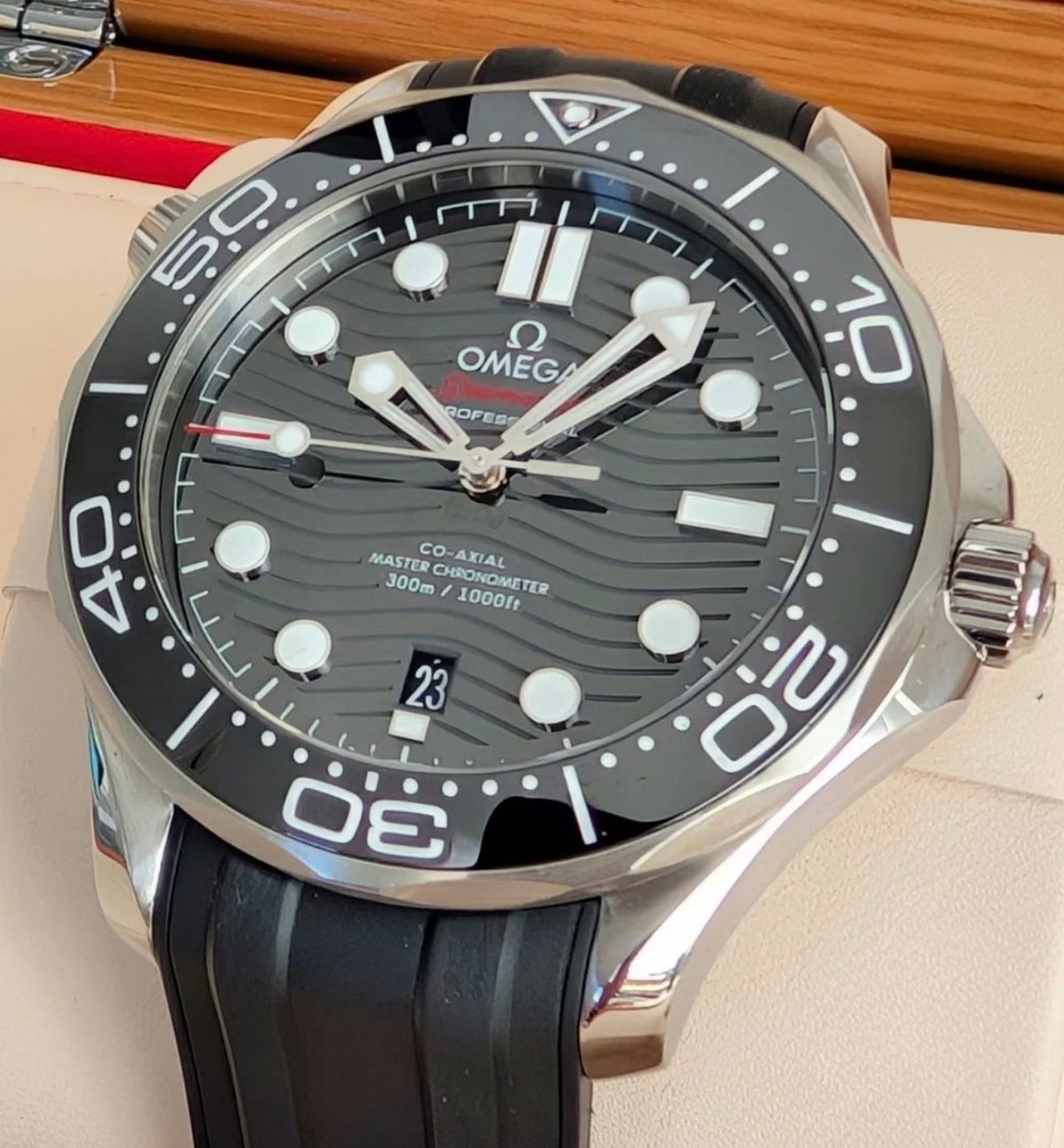
Stainless steel, black ceramic wave dial and black rubber: the clearest value-led alternative to a black Submariner.
$5,650Available nowVIEW EXACT WATCH →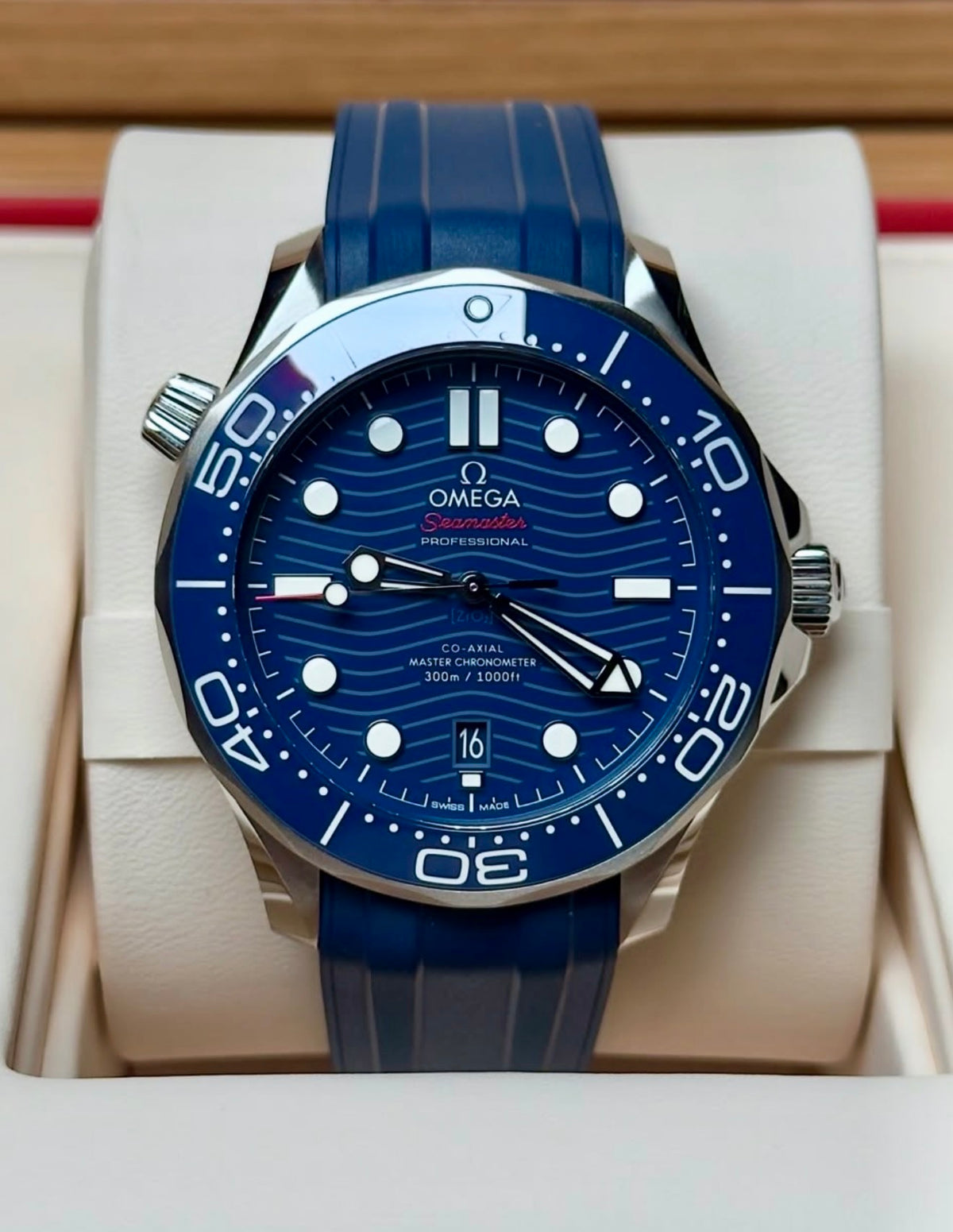
Blue ceramic dial and bezel on blue rubber: the most overtly nautical steel Diver 300M in this current set.
$5,750Available nowVIEW EXACT WATCH →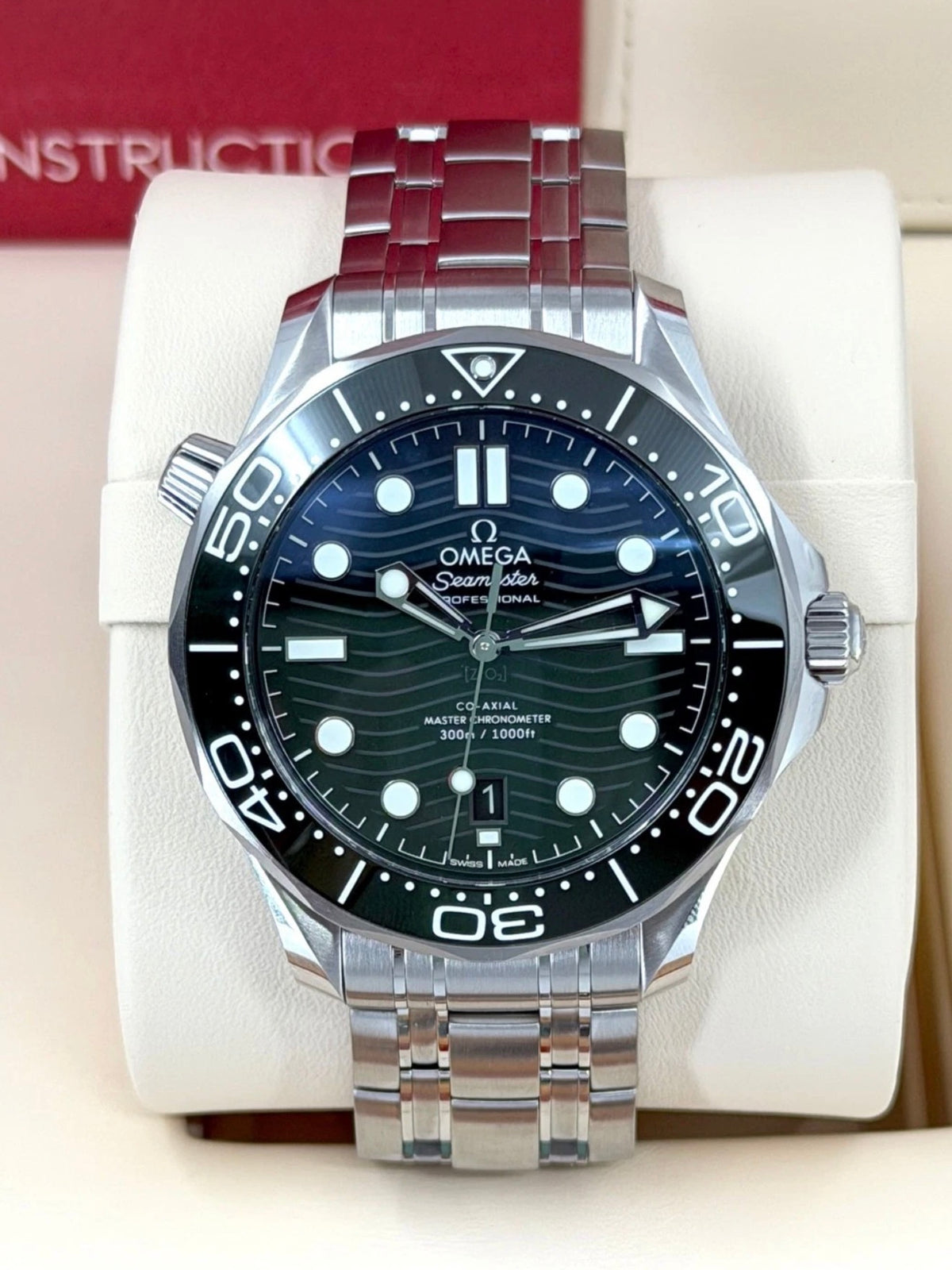
Green ceramic with a steel bracelet: the strongest color-led Diver 300M counterpoint to Rolex’s conservative dive-watch palette.
$5,500Available nowVIEW EXACT WATCH →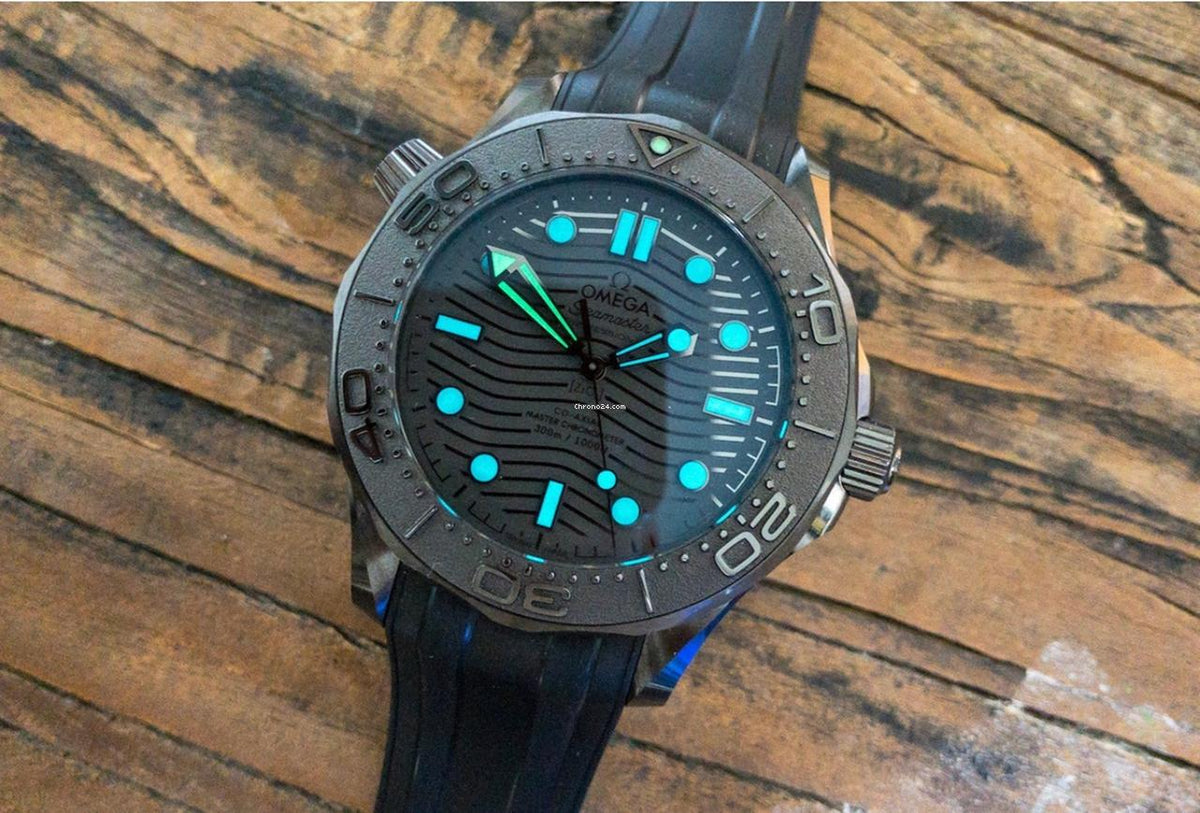
A full black ceramic case and dial—not merely a ceramic bezel—for the buyer who wants OMEGA’s materials program to define the watch.
$7,999Available nowVIEW EXACT WATCH →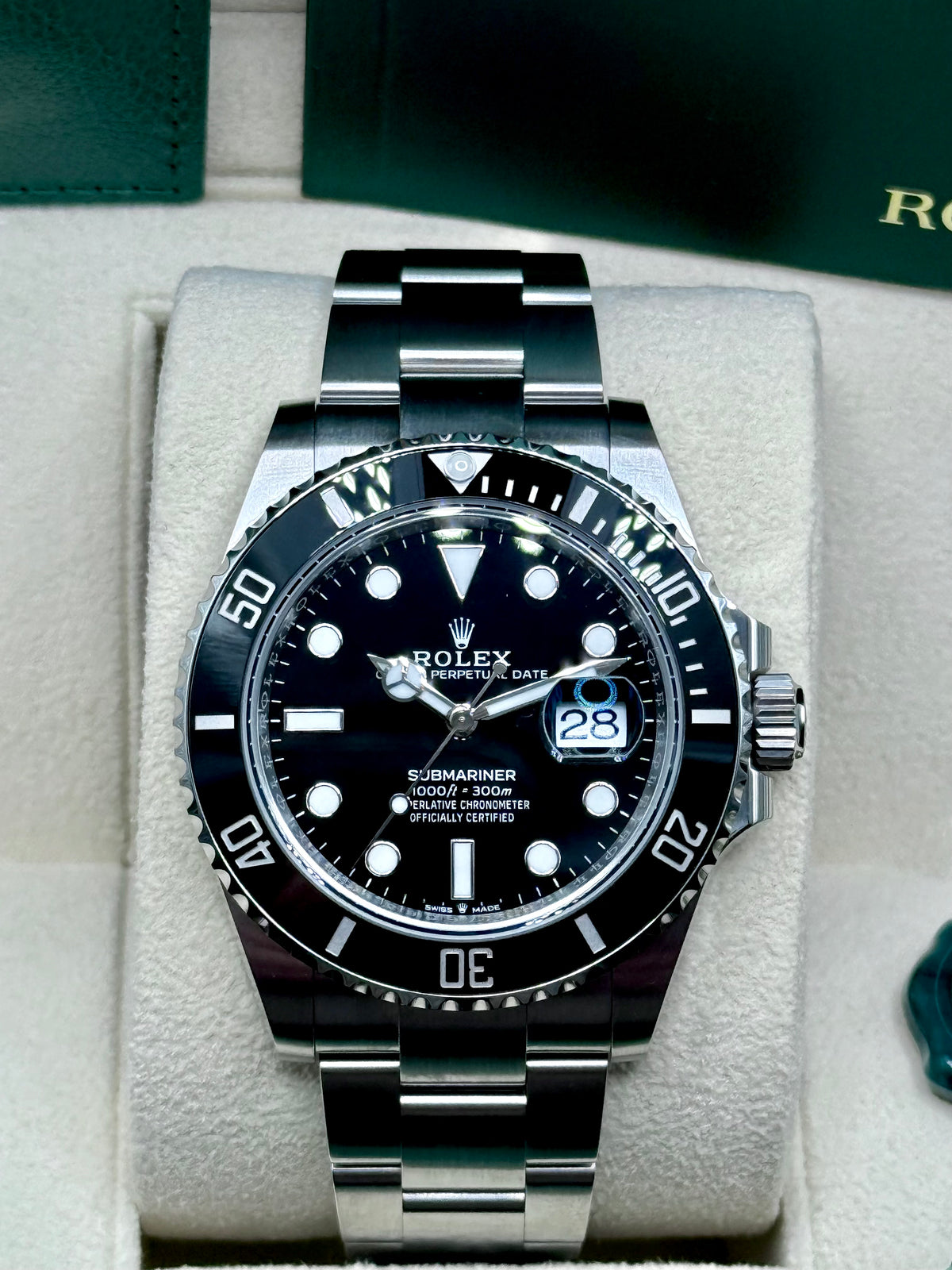
The Rolex dive-watch benchmark: compact wearing, Glidelock-equipped and exceptionally liquid relative to most luxury divers.
$15,950Available nowVIEW EXACT WATCH →Chronographs: Moonwatch vs. Daytona
Two current Moonwatch executions against the current steel Daytona benchmark.
The current inverted black lacquer dial with white counters, calibre 3861 and the essential manual-wind Moonwatch architecture.
$9,999Available nowVIEW EXACT WATCH →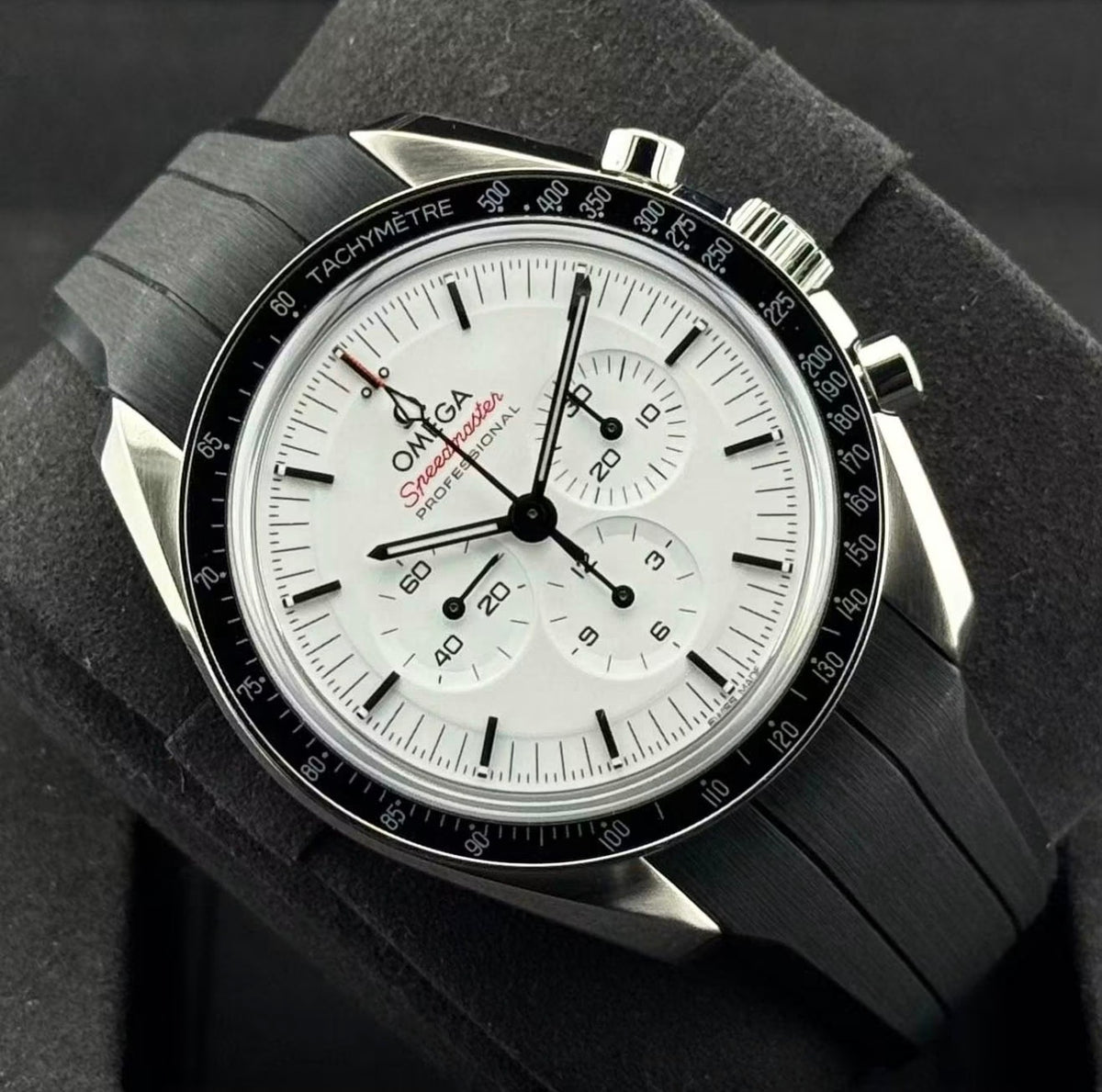
A bright white-dial Moonwatch on black perforated leather for buyers who want the core chronograph in a sharper, higher-contrast form.
$7,500Available nowVIEW EXACT WATCH →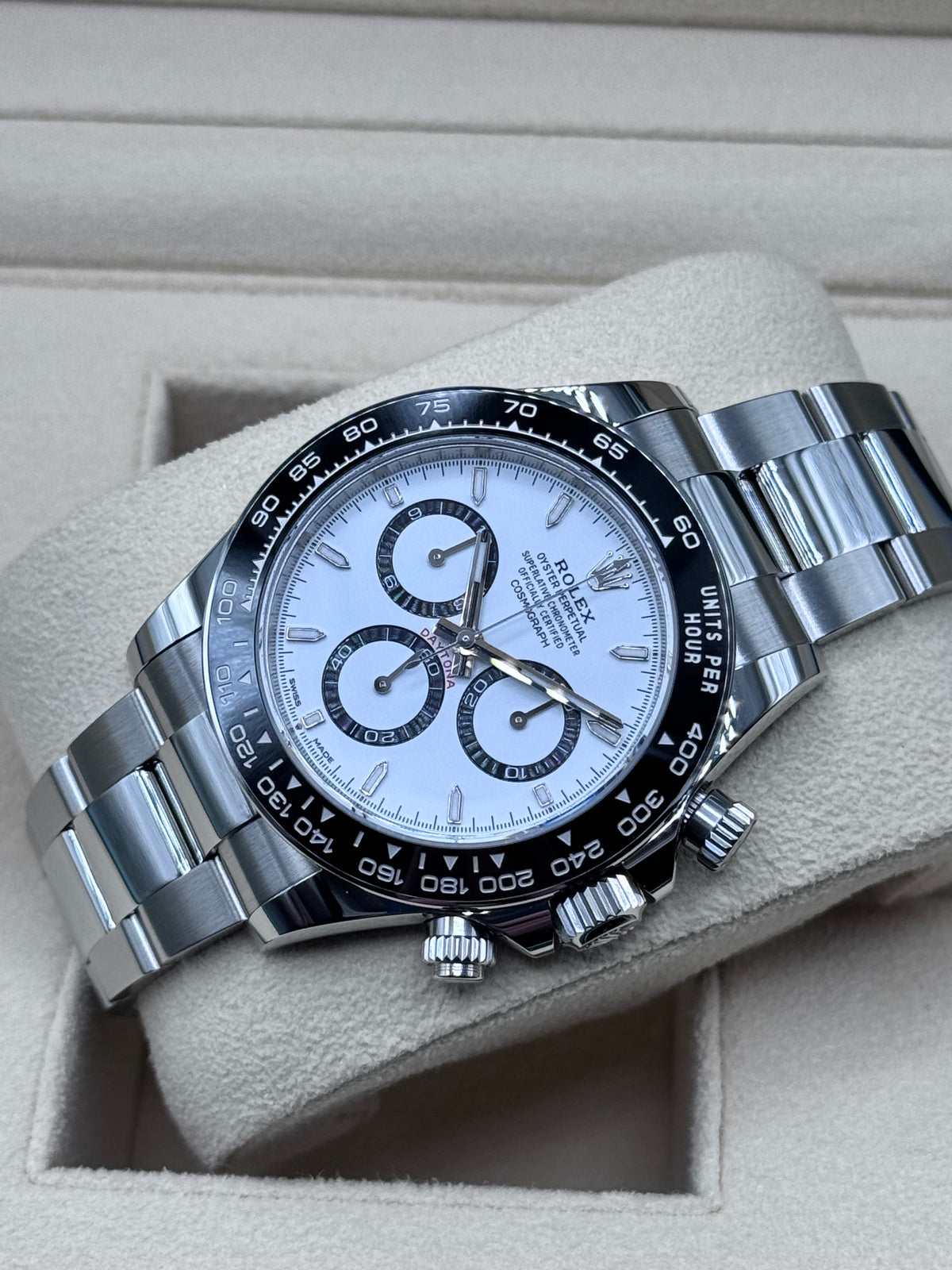
The high-demand Rolex chronograph counterpoint: automatic, compact on wrist and far more expensive to acquire in the current market.
$38,500Available nowVIEW EXACT WATCH →Everyday watches: Aqua Terra vs. Datejust
Two commercially relevant Aqua Terra sizes and colors against the blue-dial Datejust 41.
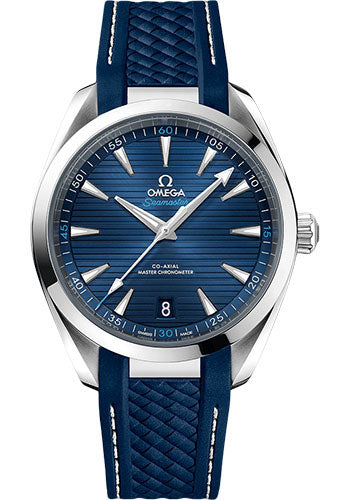
Blue dial and fitted blue rubber with 150 m versatility: the sportier everyday Aqua Terra against Datejust.
$5,450Available nowVIEW EXACT WATCH →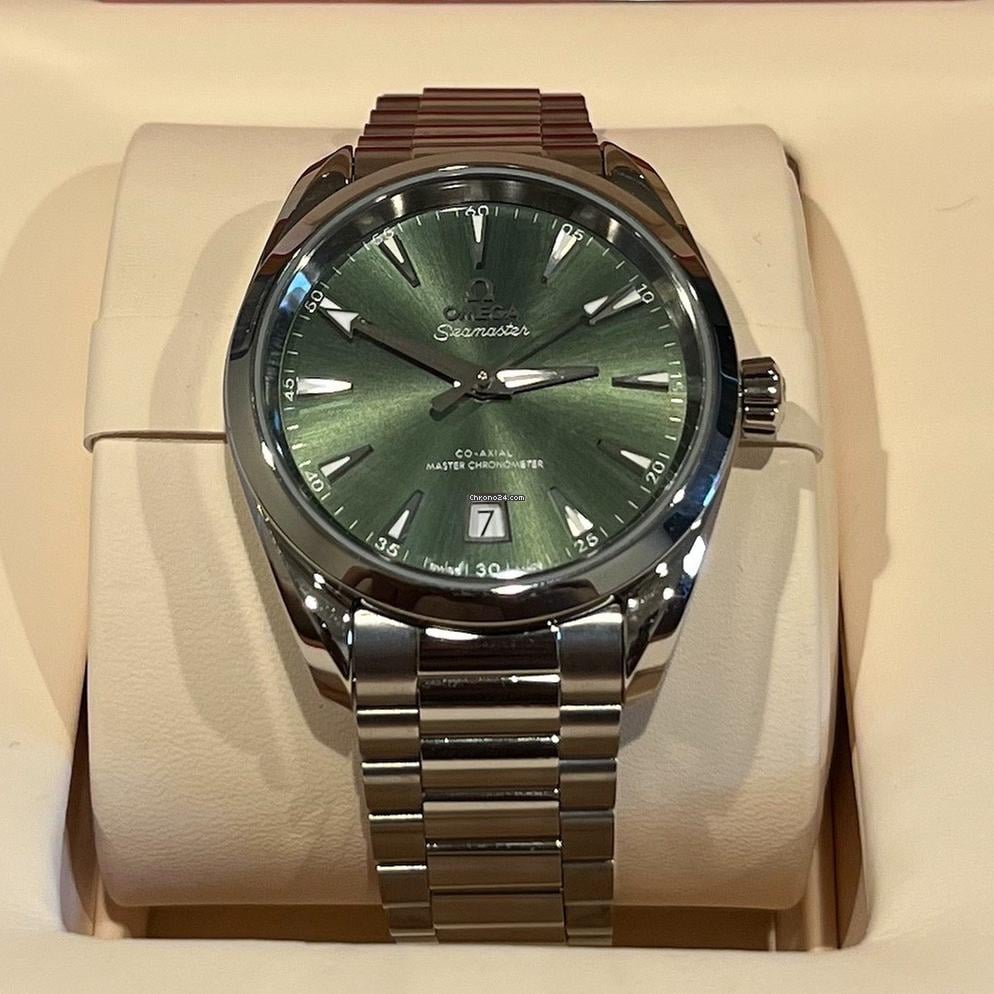
A compact green-dial all-purpose watch on steel, combining quiet luxury, practical sizing and current OMEGA movement visibility.
$6,500Available nowVIEW EXACT WATCH →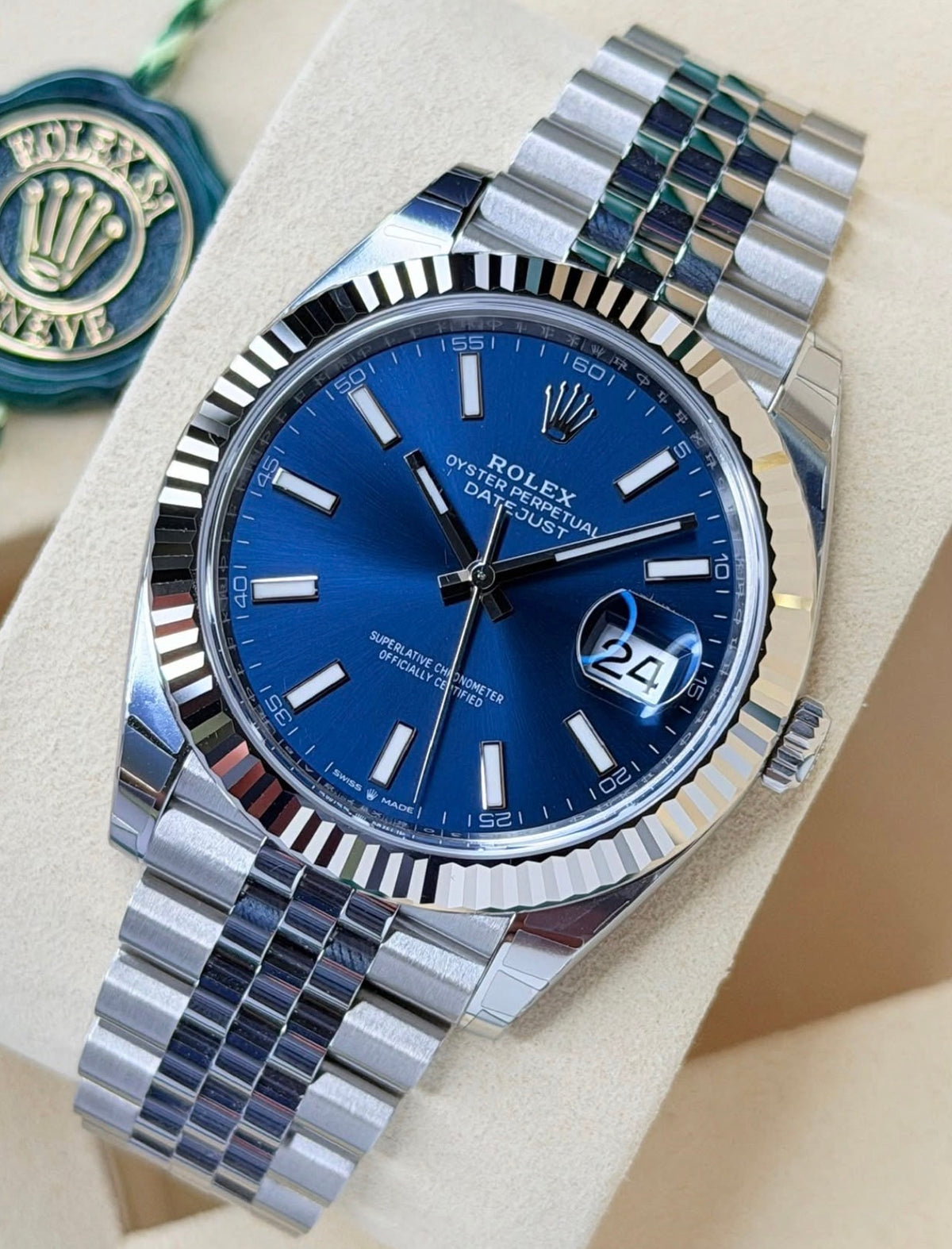
The recognizable Rolex everyday benchmark: blue index dial, fluted bezel and Jubilee bracelet with stronger status and resale signaling.
$17,999Available nowVIEW EXACT WATCH →These are direct current listings, not stock photography or redirected legacy cards. Product identity, price, condition and availability remain controlled by each exact product page. This educational guide uses ItemList semantics only; Product and Offer schema remain owned by the product pages.
Availability: Why Rolex Is Harder to Buy
Popular Rolex references are harder to buy because demand exceeds the inventory that individual authorized retailers can allocate. OMEGA core references are generally more available through boutiques, authorized dealers and independent channels.
Rolex publicly states that demand can exceed production capacity and that official jewelers independently manage allocation and sales to customers.[6] This is important: a retailer’s client-selection practice is not the same as a universal corporate rule that every buyer must spend a fixed amount before receiving a watch.
Scarcity is uneven. A stainless-steel Daytona, GMT-Master II or popular Submariner configuration can be difficult to obtain at retail. A two-tone Datejust or less demanded configuration may be accessible. Geography, retailer inventory, client relationship and timing all matter.
OMEGA generally maintains a conventional retail environment. Many core Moonwatch, Diver 300M, Aqua Terra and Planet Ocean references can be viewed, ordered or sourced. Limited editions and very new releases can still sell out, but acquisition friction is usually lower.
Availability affects psychology. A difficult Rolex can feel more rewarding to obtain, but scarcity can also push buyers into the wrong model or a premium they later regret. OMEGA’s access lets the buyer compare more calmly, but can reduce urgency and resale support.
Rolex Purchase History and Allocation Explained
“Purchase history” is a retailer relationship practice, not a single published Rolex rule. Some official jewelers prioritize established clients for scarce references; others use local criteria, wait lists, lotteries or manager discretion.
Retailers have limited quantities of popular models and more interested buyers than watches. They therefore decide how to allocate. A customer who has purchased jewelry, less scarce watches or other products may be easier for a retailer to prioritize because the relationship is documented. That does not create a legally guaranteed queue or a universal spending formula.
Buyers should be cautious about purchasing unwanted merchandise solely to “earn” a watch. Add the total cost and opportunity cost. A secondary-market premium can be cheaper than years of unrelated purchases, while a genuine long-term authorized-dealer relationship can be valuable if the buyer likes multiple products and values retail provenance.
Ask direct questions: Is the request recorded? Is there a realistic time range? Does the retailer expect additional purchases? Is the configuration flexible? No ethical retailer should promise a specific scarce watch in exchange for vague, unlimited spending.
OMEGA Discounts, Rolex Premiums and Actual Transaction Price
Many standard OMEGA references can be purchased below retail, especially unworn or pre-owned; many popular Rolex sports references trade above retail. The comparison should use actual transaction price—not only manufacturer suggested retail price.
Retail price is useful for positioning but can mislead value comparisons. A $9,000 OMEGA available for $6,500 is not economically competing with a $10,000 Rolex that costs $14,000 in the market. The real decision is between the amounts the buyer must transfer today for comparable condition, completeness and warranty.
OMEGA discounting varies by model. Moonwatch, special editions, titanium references and new releases can behave differently from standard steel models. Authorized dealers may discount selectively; boutiques may protect retail but offer experience or access; independent dealers may source unworn watches at market prices.
Rolex premiums also vary. Not every Rolex is above retail. Precious-metal, two-tone, diamond-set and less demanded references can trade below retail. Popularity, dial, bracelet, size, condition and current production status matter.
Value rule: Compare the exact reference at the exact condition and acquisition channel. “OMEGA is discounted” and “Rolex is above retail” are tendencies—not universal truths.
Dated July 2026 Market Snapshot: Retail vs. Secondary Market
A July 2026 snapshot shows the pattern clearly: selected popular Rolex steel references trade above retail, while selected standard OMEGA steel references trade below retail. These figures are dated examples, not forecasts.
| Reference | Approx. U.S. retail | Approx. market price | Market vs. retail | Interpretation |
|---|---|---|---|---|
| Rolex Submariner Date 126610 | $11,350 | $13,643 | +20.2% | Popular professional Rolex with broad demand |
| Rolex Datejust 41 126334 | $11,650 | $14,221 | +22.1% | Configuration-sensitive; popular steel/white-gold family |
| Rolex GMT-Master II 126710BLNR | $11,800 | $17,186 | +45.6% | Scarcity and recognizable bezel/bracelet drive premium |
| OMEGA Diver 300M 210.30.42.20.01.001 | $6,700 | $4,131 | -38.3% | Strong secondary-market value for buyer; weaker retail retention |
| OMEGA Speedmaster 310.30.42.50.01.002 | $9,000 | $6,450 | -28.3% | Core icon with meaningful used/unworn savings |
| OMEGA Aqua Terra 38 220.10.38.20.10.002 | $7,400 | $5,093 | -31.2% | Daily-watch specification at reduced market entry |
Data date: July 2026. Rolex examples from WatchCharts reference pages.[25][26][27] OMEGA examples from corresponding WatchCharts reference pages.[28][29][30]
Limitations: Market estimates can differ from completed transaction prices. Condition, year, warranty, bracelet links, seller, tax, region and dial configuration change value. The table is educational and is not an appraisal, offer or investment projection.
This snapshot explains why two buyers can both be correct. A retail Rolex client may obtain extraordinary embedded value at purchase. A secondary-market OMEGA buyer may obtain extraordinary mechanical value because the first owner absorbed depreciation.
Which Brand Holds Value Better?
Rolex holds value better across the brand in most current market conditions. OMEGA value retention is more reference-dependent and improves materially when the buyer enters below retail.
Rolex retention is supported by global recognition, controlled product evolution, deep buyer pools and scarcity in popular references. The strongest performers tend to be recognizable steel sports watches and certain scarce dials or discontinued references. This does not eliminate downside: market cycles, condition, overpayment and fashion can reduce value.
OMEGA often depreciates more from retail because supply is accessible and discounting establishes a lower transaction baseline. That depreciation is not necessarily a defect for the second buyer. Buying an unworn or excellent pre-owned OMEGA after the initial drop can produce a stable ownership cost relative to the technology received.
Value retention should be measured as purchase price to sale price, not retail price to a theoretical market quote. A buyer who pays 25% below retail and sells 10% below that purchase price may have had a better ownership outcome than someone who paid a 40% premium for a Rolex and sold after the premium compressed.
Is Rolex or OMEGA a Better Investment?
Rolex has historically offered stronger value retention and occasional appreciation, but neither brand should be treated as a guaranteed investment. Watches have spreads, service costs, insurance, authenticity risk and market cycles.
A watch produces no cash flow. Return depends on selling to another buyer at a higher net price after dealer margin, auction fees, shipping, insurance, tax and service. A reference that appears to appreciate 10% can still generate a loss after transaction costs.
Rolex is more investable only in the limited sense that market depth and scarcity have supported stronger prices. The best-performing references are also the easiest to overpay for. OMEGA limited editions and historically important references can appreciate, but the catalog contains many variations and reissues that fragment demand.
Buy a watch primarily because it fits the wrist, use and budget. Treat retained value as risk reduction. Collecting knowledge can improve purchase discipline; it cannot remove market risk.
Resale Liquidity and Ease of Exit
Rolex is generally easier and faster to resell because buyers, dealers and pricing data are deeper. OMEGA can be liquid in core references, but unusual materials, precious metals and niche editions may require more time or a larger discount.
Liquidity is not the same as value. A watch may be worth a high amount but take months to find the right buyer. Rolex Submariner, GMT-Master II, Datejust and Daytona have broad recognition and standardized configuration knowledge. Dealers can quote them quickly.
OMEGA Moonwatch and Diver 300M also have deep markets, but reference proliferation creates more comparison work. A buyer may distinguish Hesalite from sapphire, bracelet generation, limited-edition set completeness and calibre. Precious-metal OMEGAs can be exceptional watches with thin resale markets.
For owners who change watches frequently, Rolex’s liquidity is a meaningful quality. For long-term owners who buy OMEGA at a disciplined price, slower resale may be irrelevant.
Limited Editions, Special Editions and Scarcity
Rolex creates scarcity mainly through controlled production, allocation and limited configuration, rarely through numbered limited editions. OMEGA uses both standard production and numerous limited or special editions, creating more variety but more collectibility risk.
Rolex does not need a “1 of 2,000” caseback to create scarcity. A dial may be produced briefly, a reference may be difficult to allocate, or a configuration may become desirable after discontinuation. This keeps the catalog cleaner but can make market prices highly sensitive to rumors and supply.
OMEGA has used anniversaries, missions, ambassadors, Olympic timing, Bond collaborations and material experiments to create special models. Some become enduring collector pieces; others compete with later releases and trade below retail. Completeness can matter greatly when a special box, patch, booklet, loupe, strap or accessory is part of the original set.
Do not buy the word “limited.” Ask whether the design is important, the production number is truly restrictive, the set is complete and long-term demand exists beyond the launch story.
New, Unworn and Pre-Owned: What Changes the Decision?
Condition changes price, warranty, originality and resale. “New,” “unworn” and “pre-owned” are not interchangeable legal or market terms, so the watch must be described specifically.
| Term | What it should mean | Questions to ask | Common risk |
|---|---|---|---|
| New from authorized retailer | Sold by an authorized point with manufacturer warranty activated through that sale | Who is the retailer? When does warranty begin? Is the buyer named where applicable? | Assuming every “new” listing has identical factory-backed coverage |
| Unworn | Not meaningfully worn, often sourced outside the original retail transaction | Has it been sized? Are stickers removed? When was warranty activated? Any handling marks? | Paying retail-level money for aged warranty or unclear provenance |
| Pre-owned excellent | Worn but carefully preserved, with condition disclosed | Polished? Service history? Pressure test? Timing? Full links? | Marketing language hides refinishing or missing components |
| Vintage / collectible | Older watch where originality may matter more than cosmetic perfection | Correct dial, hands, bezel, bracelet, movement and service parts? | Over-restoration or assembled examples |
Rolex market pricing can make an unworn secondary-market watch more expensive than retail. OMEGA market pricing can make an unworn secondary-market watch materially less expensive than retail. The condition label therefore interacts with the brand’s distribution environment.
Box, Papers, Warranty Cards and Accessories
Box and papers support provenance, completeness and resale, but they do not authenticate a watch. Their value is greater on scarce, special-edition, precious-metal and collector references.
For modern Rolex, the warranty card, correct box era, booklets, tags and full bracelet links improve marketability. On a high-value reference, missing documents can create a meaningful price gap. For OMEGA special editions, the accessory set can be even more elaborate and replacement can be difficult.
Cards can be stolen, altered or paired with the wrong watch. Serial consistency is only one check. Boxes are widely traded independently. A complete set with an incorrect watch is less valuable than an authentic, correct watch without a box.
Buy the watch first. Then price completeness rationally. A daily-wear standard reference may justify a discount for missing packaging. A numbered special edition with a distinctive presentation set should be evaluated more strictly.
Authentication and Counterfeit Risk
Rolex attracts more counterfeit attention because of demand and recognition, but OMEGA is also counterfeited and can be assembled from mixed or incorrect parts. Authentication requires the complete watch—not a serial lookup or photo of a card.
Modern counterfeit Rolex watches can imitate case shape, rehaut engraving, ceramic color, bracelet markings and even movement appearance. Super-clone discussions create false confidence because visual similarity is not mechanical correctness. OMEGA counterfeits may target Seamaster and Speedmaster icons, while vintage examples can contain service, aftermarket or donor components.
A serious inspection considers reference architecture, serial and movement data, dial printing, hand stack, bezel action, crown, case geometry, bracelet, clasp, movement construction, timing, magnetic behavior where relevant and seller provenance. Opening a watch should be performed by a qualified professional with correct tools and resealing procedures.
No online article can authenticate a specific watch. Use education to identify risk, then use an experienced dealer or watchmaker to inspect the actual example.
Service Cost, Parts and Restoration Decisions
Service cost is driven more by complication, material, condition and parts than by the brand logo alone. Chronographs, ceramic cases, precious-metal bracelets and water damage can make either brand expensive to restore.
A routine three-hand service is different from a chronograph overhaul. A Moonwatch, Daytona, Planet Ocean chronograph or Sky-Dweller requires more labor and can involve higher parts cost. Ceramic case damage may require replacement rather than conventional refinishing. Precious-metal bracelet repair can be specialized.
Rolex service can replace worn or damaged parts and restore water resistance, but collectors should state in writing which original components must be retained. OMEGA service may similarly replace dials, hands, bezels or crowns. On vintage watches, functional improvement can conflict with originality and market value.
Before purchase, ask for timing, amplitude, beat error, pressure test, service invoice and a description of replaced parts. A cheap watch with deferred service can be more expensive than a correctly priced serviced example.
Authorized Dealer, Boutique, Grey Market or Independent Dealer?
Authorized dealers provide direct manufacturer warranty and retail provenance; boutiques offer the most brand-controlled experience; independent dealers can provide access, sourcing, comparative advice and market pricing. The best channel depends on reference scarcity and total cost.
| Channel | Strengths | Trade-offs | Best use |
|---|---|---|---|
| Rolex official jeweler | Retail price, direct provenance, factory guarantee | Allocation uncertainty and relationship friction on scarce models | Buyer with patience and genuine long-term retail relationship |
| OMEGA boutique | Full current catalog experience, factory relationship, access to boutique releases | Often less price flexibility than secondary market | Buyer prioritizing experience, new release and direct support |
| Authorized multi-brand dealer | Manufacturer warranty, potential OMEGA negotiation, side-by-side brands | Inventory and discount vary; scarce Rolex still allocated | Buyer who values retail support and multiple brands |
| Independent dealer | Immediate access, sourcing, trade-ins, market pricing and comparative expertise | Must evaluate dealer reputation, warranty and description | Buyer prioritizing exact reference, speed or below-retail OMEGA value |
| Private seller | Potential lowest price | Highest burden for authentication, title, condition and recourse | Experienced buyer with professional inspection |
The label “grey market” covers very different businesses. Evaluate legal title, physical possession, insurance, return terms, warranty, payment method, reputation and the accuracy of condition descriptions.
Can Superlative Watch Co. Source Any OMEGA or Rolex?
Superlative Watch Co. can use its dealer network and authorized-dealer relationships to source many current and discontinued OMEGA and Rolex references, but availability, price and timing must be confirmed for the exact watch.
OMEGA’s broader retail availability often allows current references to be sourced efficiently, sometimes at pricing below manufacturer retail depending on model and channel. Rolex sourcing depends more heavily on market supply, configuration, condition and current premiums.
A useful sourcing request includes brand, reference, dial, bracelet or strap, condition, desired year, box-and-papers requirement, budget, timing and whether the buyer will consider comparable alternatives. The more precise the request, the more meaningful the quote.
No responsible dealer should promise static availability in an educational article. Our Buying Desk confirms the actual watch, seller, condition and transaction terms before invoicing.
Which Brand Wins a One-Watch Collection?
Rolex wins the one-watch-collection question more often because its core models combine recognition, durability, bracelet quality, compact fit and resale. OMEGA can win when the buyer’s priorities are technical individuality, lower cost or a specific complication.
The strongest Rolex one-watch candidates are Datejust, Submariner, GMT-Master II, Explorer and Oyster Perpetual. Each can move through work, travel and casual settings with minimal explanation. The strongest OMEGA candidates are Aqua Terra, Diver 300M, Planet Ocean for larger wrists and Speedmaster for buyers who accept chronograph-specific water and winding considerations.
Aqua Terra is arguably OMEGA’s best answer because it combines 150 m water resistance, anti-magnetic Master Chronometer movements, multiple sizes and bracelet/strap versatility. Datejust remains the stronger prestige and resale choice. Submariner is the stronger universal sports icon; Diver 300M provides more expression and value.
The final decision should be based on the buyer’s most common day, not an imaginary extreme. A Worldtimer is unnecessary for a person who never travels; a Submariner is not automatically better for someone who never uses a timing bezel and wants a dressier dial.
Best Brand by Buyer and Collector Profile
Rolex is strongest for prestige-focused, liquidity-focused and minimalist collectors. OMEGA is strongest for technical, historical, material-focused and value-focused collectors.
| Buyer profile | Better starting brand | Why | References to compare |
|---|---|---|---|
| Prestige-first buyer | Rolex | Recognition, scarcity and social signaling | Datejust, Submariner, GMT-Master II, Day-Date |
| Technical-specification buyer | OMEGA | 15,000-gauss Master Chronometer platform, material and movement variety | Aqua Terra, Diver 300M, Planet Ocean, Spirate models |
| Space-history collector | OMEGA | NASA qualification and Moonwatch lineage | Speedmaster Moonwatch and historically informed variants |
| Bracelet-focused buyer | Rolex | More consistent case, end-link, clasp and adjustment integration | Submariner, GMT-Master II, Datejust, Day-Date |
| Value-focused buyer | OMEGA | Strong secondary-market discounts on many standard references | Moonwatch, Aqua Terra, Diver 300M, Planet Ocean |
| Frequent trader | Rolex | Deeper liquidity and simpler price discovery | Popular steel professional references |
| Material experimenter | OMEGA | Full ceramic, broad titanium and named gold alloys | Dark Side, titanium Seamasters, Bronze Gold |
| Understated buyer | OMEGA or low-key Rolex | OMEGA offers less obvious status; Rolex Explorer/OP can remain restrained | Railmaster, Aqua Terra, Explorer, Oyster Perpetual |
| One-watch buyer | Rolex slight edge | Compact durability, recognition and resale | Datejust or Submariner vs. Aqua Terra or Diver 300M |
Final OMEGA vs. Rolex Decision Matrix
Rolex is the default winner for prestige, bracelet, compactness, scarcity and resale. OMEGA is the default winner for technical variety, materials, anti-magnetism, availability and transaction-price value.
Scoring note: These are Buying Desk editorial scores intended to summarize the analysis, not laboratory measurements. A specific reference can outperform its brand-level score.
Final 20-Point Buying Checklist
Before buying either brand, confirm the exact reference, transaction price, fit, condition, authenticity, warranty, service needs and exit expectations.
- Write down the exact reference number—not only the model family.
- Confirm case size, lug-to-lug, thickness and effective end-link span.
- Try the watch with the bracelet properly sized.
- Compare actual transaction price with current retail and market data.
- Decide whether prestige, technology, value or resale is the primary goal.
- Confirm movement calibre, power reserve and setting behavior.
- Verify water-resistance rating and obtain a recent pressure test when relevant.
- Inspect case geometry, brushing, polished edges and evidence of refinishing.
- Inspect bracelet stretch, link count, clasp operation and micro-adjustment.
- Confirm dial, hands, bezel, crown and bracelet are correct for the reference.
- Review timing, amplitude, beat error and service history.
- Check box, warranty card, accessories and special-edition components.
- Understand the seller’s return period, warranty and authentication process.
- Insure shipping and payment; verify legal title and physical possession.
- Do not buy unwanted products solely to chase a speculative allocation.
- Do not treat a discount as proof that a watch fits your wrist or taste.
- Calculate resale spread and dealer margin before calling a watch an investment.
- Budget for service, insurance, tax, straps and missing links.
- Compare at least one direct rival reference from the other brand.
- Buy the watch you would still want if its market price stopped moving.
Final Verdict: OMEGA or Rolex?
Rolex is the stronger overall luxury-market proposition; OMEGA is the stronger overall technical-value proposition. The best purchase is the reference that aligns those strengths with the buyer’s wrist, use, budget and ownership horizon.
Rolex deserves its position. The brand’s bracelets, clasps, case integration, polish, compact engineering, catalog discipline, prestige and resale depth are real. Scarcity amplifies those qualities, but does not create them from nothing.
OMEGA also deserves more than the role of “the cheaper alternative.” Its Co-Axial and Master Chronometer platforms, anti-magnetism, ceramic-case expertise, material range, dial engineering, space history and wide choice are substantive. The ability to buy a technically advanced watch below retail can be a positive for an informed owner, not evidence of inferiority.
For the buyer who asks only, “Which logo is more prestigious?” choose Rolex. For the buyer who asks, “Which watch gives me the most engineering and individuality for my money?” OMEGA may win. For the buyer who wants the best watch, stop comparing logos and compare the exact two references on the same wrist at the prices actually available.
Rolex: prestige, bracelet, compactness, controlled design, scarcity and liquidity.
OMEGA: technology, materials, visible mechanics, variety, access and value.
Overall: Rolex is easier to recommend without knowing the buyer. OMEGA can be the better recommendation once the buyer’s priorities are known.
OMEGA vs. Rolex Frequently Asked Questions
These 67 reference-level questions preserve the guide’s depth without forcing a 67-answer wall of text. Open only the exact ownership, model, market or sourcing question you need.
Is Omega or Rolex better?
Rolex is generally better for prestige, bracelet consistency, compact case engineering, scarcity and resale liquidity. OMEGA is generally better for technical variety, anti-magnetic specifications, full-ceramic construction, display backs, availability and value at common transaction prices. The better watch depends on the exact references and the buyer's priorities.
Are Omega and Rolex the same quality?
They are comparable high-end Swiss manufacturers, but they allocate quality differently. Rolex tends to concentrate on tactile consistency, case-and-bracelet integration and controlled finishing. OMEGA tends to emphasize movement visibility, anti-magnetism, materials, complications and reference variety.
Which brand is more prestigious, Omega or Rolex?
Rolex has greater mainstream prestige, recognition and status signaling. OMEGA has substantial historical and technical prestige, especially among enthusiasts, but usually does not carry the same acquisition scarcity or immediate social recognition.
Which brand makes the better bracelet?
Rolex generally makes the more consistently refined bracelet and clasp system across its catalog. OMEGA has excellent bracelets on models such as the current Moonwatch and strong dive clasps and mesh options, but execution varies more by collection and generation.
Why do Rolex bracelets feel more expensive?
Rolex integrates case geometry, end links, link articulation, finishing, clasp closure and tool-free adjustment as one system. Subtle radii and controlled tolerances make the bracelet feel like part of the watch rather than a separate accessory.
Are Omega movements better than Rolex movements?
OMEGA movements often offer more visible technology, anti-magnetic certification, display backs and variety. Rolex movements often offer compact packaging, long reserve, consistent automatic winding and simple ownership. Neither is universally better; the calibre and use case decide.
Which is more accurate, Omega or Rolex?
Current Rolex models commonly state a minus 2 to plus 2 second daily tolerance after casing. Many OMEGA Master Chronometers use a 0 to plus 5 second framework, while designated Spirate models target 0 to plus 2. These are different test protocols, and the individual watch's regulation and condition still matter.
Which is more anti-magnetic, Omega or Rolex?
OMEGA has the stronger published benchmark because many Master Chronometer watches are tested as complete watches at 15,000 gauss. Rolex uses highly anti-magnetic components and engineering, but generally does not publish the same catalog-wide whole-watch figure.
What is the difference between Master Chronometer and Superlative Chronometer?
Rolex Superlative Chronometer emphasizes a narrow after-casing rate tolerance and internal performance testing. OMEGA Master Chronometer adds METAS-supervised whole-watch tests covering rate, magnetic exposure, water resistance and reserve. The figures should not be compared as though the protocols were identical.
Does Omega use silicon hairsprings?
Yes. Silicon balance springs are widely used in modern OMEGA Master Chronometer movements and form part of the brand's anti-magnetic architecture. Rolex also uses silicon Syloxi hairsprings in selected calibres and Parachrom alloy hairsprings in others.
What is the Co-Axial escapement?
The Co-Axial escapement is OMEGA's alternative impulse system designed to reduce sliding friction compared with a conventional Swiss lever. It supports stable long-term performance but does not make the watch maintenance-free.
What is Rolex Chronergy?
Chronergy is Rolex's optimized version of the Swiss lever escapement, using revised geometry and materials to improve efficiency. It is used across many current-generation Rolex calibres and contributes to their longer power reserves.
What is Rolex Dynapulse?
Dynapulse is a high-efficiency Rolex escapement introduced in 2025 on the 5 Hz calibre 7135 in the Land-Dweller. It uses silicon components and a different impulse architecture from the conventional Swiss lever.
Which brand has the longer power reserve?
Many current Rolex automatics provide about 66 to 72 hours, while common OMEGA movements provide about 48 to 60 hours. Rolex therefore often has the weekend-autonomy advantage, although reserve is only one part of movement performance.
Is Omega part of Swatch Group?
Yes. OMEGA is a flagship Swatch Group brand and benefits from the group's broad industrial and component resources. That does not mean OMEGA simply uses another sister brand's movements or that all group technologies are interchangeable.
Does Omega share technology with Blancpain?
OMEGA and Blancpain operate within the same industrial group and can benefit from common upstream expertise, but specific movements, components and implementations should be evaluated by reference. It is inaccurate to assume that an OMEGA automatically contains Blancpain technology.
Which brand uses better steel?
Rolex uses Oystersteel, a 904L-family alloy chosen for corrosion resistance and polish. OMEGA uses high-quality stainless steels and O-MEGASTEEL on selected references. In ordinary ownership, finish placement, case geometry and bracelet design are usually more visible than the alloy name.
Does Omega make full ceramic watches?
Yes. OMEGA offers multiple full-ceramic cases, especially in Dark Side of the Moon and selected Seamaster families. Rolex uses ceramic extensively for bezels but does not offer the same breadth of complete ceramic cases.
Is ceramic better than steel?
Ceramic resists scratches and preserves color extremely well, but it can chip or fracture under sharp impact and is not refinished like steel. Steel scratches more easily but can usually be repaired or refinished by a qualified specialist.
Which brand makes better titanium watches?
OMEGA offers more titanium references and more varied titanium use across collections. Rolex's RLX titanium watches are carefully finished and engineered but remain a narrower part of the catalog.
Which brand has better gold alloys?
Rolex has exceptional consistency in yellow, white and Everose gold and strong full-gold bracelet execution. OMEGA offers more named-alloy variety through Sedna, Moonshine, Canopus and Bronze Gold. The better choice depends on color, weight, market value and reference.
Does Omega use meteorite and aventurine dials?
Yes. OMEGA uses meteorite, aventurine, ceramic, enamel and laser-processed dials across several families. Rolex also uses meteorite, aventurine, lacquer, enamel and stone, but usually in a more tightly controlled and scarce catalog.
Which brand has better case finishing?
Rolex generally has more consistent case-and-bracelet integration, subtle radii and factory surface control. OMEGA often has more visually complex finishing, including twisted lugs, polished bevels and ceramic surfaces. The exact reference matters.
Why do people say Rolex polishing is better?
Rolex finishing often preserves a sense of surface tension through controlled curves, crisp transitions and consistent brushing. The effect is subtle and can be destroyed by aggressive refinishing, which is why original case geometry matters.
Do Omega watches wear larger than Rolex?
Many OMEGA sports watches wear larger because of broader dial openings, longer lugs, thicker movements or heavier bracelets. Rolex often packages comparable capability more compactly. Titanium and redesigned OMEGA cases can reverse the weight comparison.
Which brand is better for small wrists?
Rolex has more consistently compact choices across 31, 34, 36 and 37 mm sizes. OMEGA also has excellent small options, especially Aqua Terra 30, 34 and 38, Speedmaster 38 and selected Constellation references, but lug length and thickness require closer checking.
Which brand is better for large wrists?
OMEGA offers more naturally large options such as Planet Ocean, Ultra Deep, Worldtimer and Dark Side of the Moon. Rolex offers focused large models including Sea-Dweller, Deepsea, Sky-Dweller and Yacht-Master 42.
Which brand is more comfortable?
Rolex wins comfort more consistently because its cases, bracelets and clasps are tightly integrated. OMEGA can be equally comfortable in the right reference, especially on titanium, rubber, mesh or the modern tapered Moonwatch bracelet.
How much does a Rolex weigh compared with an Omega?
Weight depends on reference and configuration. A steel Submariner is often around the mid-150 to mid-160 gram range, while a steel Diver 300M can approach or exceed 190 grams. A titanium OMEGA such as the No Time To Die Seamaster can be far lighter than both.
Is a heavier watch higher quality?
No. Weight reflects material, bracelet and construction, not quality by itself. Precious metal feels dense, titanium feels light and ceramic feels different again. Balance and fit matter more than raw grams.
Rolex Submariner or Omega Seamaster Diver 300M?
Choose Submariner for cleaner design, Glidelock bracelet, compact balance, prestige and resale. Choose Diver 300M for lower acquisition cost, 15,000-gauss Master Chronometer testing, display-back movement, more materials and a more expressive design.
Rolex Daytona or Omega Speedmaster?
Choose Daytona for automatic winding, compact wear, prestige, water-oriented everyday versatility and resale. Choose Speedmaster for documented spaceflight history, manual-wind character, movement visibility, broad configurations and easier access.
Rolex Datejust or Omega Aqua Terra?
Choose Datejust for prestige, bracelet and bezel choices, compact fit and resale. Choose Aqua Terra for 150 m water resistance, display-back movement, anti-magnetism, quieter branding and stronger value at common secondary-market prices.
Rolex GMT-Master II or Omega Worldtimer?
Choose GMT-Master II for compact, intuitive travel use, prestige and resale. Choose Aqua Terra Worldtimer for a true global display, decorative dial construction, titanium options and easier access.
Rolex Sea-Dweller or Omega Planet Ocean?
Choose Sea-Dweller for Rolex bracelet integration, clean professional identity and resale. Choose Planet Ocean for more sizes, materials, movement visibility, anti-magnetism and a lower market entry price.
Rolex Explorer or Omega Railmaster?
Choose Explorer for a compact, recognized one-watch design and stronger resale. Choose Railmaster for understatement, anti-magnetic tool-watch history and a lower acquisition cost.
Rolex Day-Date or Omega Constellation?
Choose Day-Date for precious-metal prestige, President bracelet and market recognition. Choose Constellation or Globemaster for design variety, chronometric history and strong value, while accepting a smaller resale audience.
Is the Speedmaster the first watch in space?
No. The accurate claim is that Wally Schirra wore his personal Speedmaster in 1962, making it the first OMEGA in space. NASA qualified the Speedmaster in 1965, and it became the first watch worn on the Moon in 1969.
Can an automatic watch wind in zero gravity?
Yes. An automatic rotor responds to inertia and wrist motion, not only to gravity. Microgravity changes the environment but does not make automatic winding physically impossible.
Why did the Moonwatch use Hesalite?
The NASA-qualified Moonwatch used an acrylic crystal that is light and tends not to fracture into hard shards like mineral or sapphire. Hesalite also produces the warm distortion associated with the historical Moonwatch, but it scratches more easily.
Which brand has better dive-watch history?
Rolex has the tighter commercial lineage through Submariner, Sea-Dweller and Deepsea. OMEGA has the broader ecosystem through Seamaster 300, Diver 300M, Planet Ocean, Ultra Deep and Ploprof. Both have genuine professional-diving history.
Why are Rolex watches hard to buy?
Demand for popular references exceeds the inventory official jewelers receive, and retailers independently manage allocation. Scarcity varies by model, configuration, region and retailer.
Is Rolex purchase history an official requirement?
No single universal Rolex spending rule is published. Purchase history is a retailer relationship practice used by some official jewelers when allocating scarce inventory. Buyers should not purchase unwanted items without understanding the total cost and realistic outcome.
Can most Omega watches be bought immediately?
Most core OMEGA references are substantially easier to view, order or source than popular Rolex sports models. Very new, limited or special releases can still be scarce.
Can Omega be purchased below retail?
Many standard OMEGA references can be acquired below retail through authorized negotiation, unworn inventory or the secondary market. The size of the discount depends on reference, demand, condition, warranty and timing.
Does every Rolex trade above retail?
No. Popular steel sports references often trade above retail, but many two-tone, precious-metal, diamond-set or less demanded configurations can trade at or below retail. Always check the exact reference.
Which brand holds value better?
Rolex generally holds value better and is more liquid across the catalog. OMEGA retention is more reference-dependent, but buying below retail can materially improve the ownership cost.
Is Rolex a good investment?
Rolex can retain value well and some references appreciate, but it is not guaranteed. Dealer spreads, service, insurance, tax and market cycles can turn an apparent gain into a loss. Buy primarily for ownership, not projected return.
Is Omega a bad investment?
Not necessarily, but many standard OMEGAs depreciate from retail. A disciplined buyer who enters at an unworn or pre-owned market price can own significant watchmaking with less remaining downside. Special editions remain highly reference-dependent.
Which brand is easier to resell?
Rolex is generally easier and faster to resell because pricing data and buyer demand are deeper. Core OMEGA models are also liquid, but niche materials, precious-metal versions and special editions may require more time or a larger discount.
Should I buy Rolex from an authorized dealer or secondary market?
Use an authorized dealer when retail access, direct provenance and the factory guarantee justify the wait. Use a reputable secondary-market dealer when the exact reference and immediate access matter more than paying retail.
Should I buy Omega from a boutique or independent dealer?
Use a boutique for the most direct brand experience, new releases and factory relationship. Use a reputable independent dealer when transaction price, discontinued references, trades or immediate sourcing are more important.
What does unworn mean?
Unworn should mean the watch has not been meaningfully worn, but it may have been handled, sized or previously sold. Confirm warranty activation, stickers, handling marks, bracelet links and provenance rather than relying on the word alone.
Do box and papers authenticate a Rolex or Omega?
No. Boxes and cards can be separated from watches, altered or counterfeited. They support provenance and resale, but authentication requires the complete watch and, when needed, movement inspection.
Which brand is counterfeited more?
Rolex attracts more counterfeit attention because of recognition and market value, but OMEGA is also counterfeited and vintage examples can contain mixed or incorrect parts. Both require reference-specific inspection.
How often should Rolex be serviced?
Rolex states that service need depends on the model and real-life use and gives roughly ten years as a general recommendation for many watches. Water resistance, timing or damage can require attention sooner.
How often should Omega be serviced?
OMEGA service timing depends on movement, use, water exposure and condition. Co-Axial does not mean maintenance-free. Pressure testing should be performed more frequently than a full overhaul when the watch is used in water.
Which brand has the better warranty?
Both brands offer five-year international warranties on qualifying new watches, subject to their current terms. Purchase channel, activation date and excluded damage still matter.
Which brand is better as a first luxury watch?
Rolex is the simpler first purchase because the catalog, prestige and resale are easier to understand. OMEGA is the more educational first purchase because it offers more movement, material, size and design choices at a lower typical entry price.
Which brand is better for a one-watch collection?
Rolex wins slightly for most buyers through Datejust, Submariner, GMT-Master II, Explorer and Oyster Perpetual. OMEGA can win through Aqua Terra or Diver 300M when technical value, availability or a less obvious brand signal matters.
Which Omega is closest to a Rolex Datejust?
The Aqua Terra is the closest functional rival because it combines a fixed bezel, date, automatic movement and everyday water resistance. It is sportier and more anti-magnetic, while Datejust offers stronger bracelet identity and prestige.
Which Omega is closest to a Rolex Submariner?
The Diver 300M is the most common price and lifestyle comparison, while Planet Ocean is closer in deep-dive robustness. Neither maps perfectly because OMEGA divides the dive category across multiple families.
Which Rolex is closest to an Omega Speedmaster?
The Daytona is the obvious chronograph rival, but it is automatic, more compact, more water-oriented and much more scarce. The Moonwatch is manual-wind and defined by space history, so the ownership experiences are different.
Which brand is more innovative in 2026?
OMEGA innovates across more visible products and materials, including ceramic cases, Master Chronometer, Spirate and multiple specialty movements. Rolex innovates more selectively, but Land-Dweller calibre 7135, Dynapulse and 5 Hz operation show substantial current engineering.
Can Superlative Watch Co. source any Omega?
Superlative Watch Co. can source many current and discontinued OMEGA models through dealer and authorized-dealer relationships, often including models not presently listed online. Exact availability, discount, condition and timing must be confirmed.
Can Superlative Watch Co. source a Rolex?
Superlative Watch Co. can source many current and discontinued Rolex references through its network. Price and timing depend on reference, dial, bracelet, year, condition, completeness and current market supply.
What information should I send for a watch comparison?
Send the two exact reference numbers, wrist size, preferred condition, budget, bracelet or strap preference, intended use, box-and-papers requirement and whether resale or long-term ownership matters more. That allows a reference-level answer rather than a brand-level slogan.
Sources, Data Notes and Editorial Method
This guide prioritizes official Rolex, OMEGA, Swatch Group and manufacturer materials for specifications, movement architecture, certification, dated releases and historical claims. Time-stamped market examples use reference-specific WatchCharts pages. Superlative Watch Co. pages provide internal guide relationships and inventory context. Wrist feel, finishing, bracelet behavior and recommendations are Buying Desk editorial judgments.
Manufacturer language is not repeated as independent proof of superiority. Market estimates are not appraisals. Weight ranges are orientation figures derived from reference-specific handling and market observations where factory weights are not consistently published.
- Rolex, New Watches 2026
- Rolex, Exceptional Watches and strengthened 2026 Superlative Chronometer certification
- Rolex, Dynapulse escapement architecture
- Rolex, Oystersteel material and finishing
- Rolex, Oysterflex bracelet construction
- Rolex, Terms of Use: production capacity and independent retailer allocation
- Rolex, Five-year international guarantee
- Rolex, Service frequency FAQ
- Rolex, Technical dial materials and processes
- OMEGA, Ten years of Master Chronometer certification
- OMEGA, Spirate system and 0/+2-second certification
- OMEGA, 2026 Speedmaster Moonwatch black-and-white release
- OMEGA, fourth-generation Planet Ocean
- OMEGA, revised Seamaster Diver 300M range
- OMEGA, Aqua Terra turquoise 38 mm and 41 mm models
- OMEGA, return of the Railmaster
- OMEGA, Constellation Observatory and acoustic precision testing
- OMEGA, Dark Side of the Moon Apollo 8 ceramic construction
- OMEGA, First OMEGA in Space and Wally Schirra
- OMEGA, NASA qualification and Apollo lunar history
- Swatch Group, brands and component-production structure
- OMEGA, Bronze Gold composition
- OMEGA, 007 First Light Diver 300M Chronograph
- OMEGA, international five-year warranty example user manual
- WatchCharts, Rolex Submariner Date 126610 market snapshot
- WatchCharts, Rolex Datejust 41 126334 market snapshot
- WatchCharts, Rolex GMT-Master II 126710BLNR market snapshot
- WatchCharts, OMEGA Seamaster Diver 300M 210.30.42.20.01.001 market snapshot
- WatchCharts, OMEGA Speedmaster Moonwatch 310.30.42.50.01.002 market snapshot
- WatchCharts, OMEGA Aqua Terra 38 220.10.38.20.10.002 market snapshot
- Superlative Watch Co., Rolex Buying Guide
- Superlative Watch Co., OMEGA Buying Guide
- Superlative Watch Co., OMEGA Seamaster Buying Guide
- Superlative Watch Co., OMEGA Speedmaster Buying Guide
- Superlative Watch Co., OMEGA Aqua Terra Buying Guide
- Rolex, History 1926–1945: Oyster, Perpetual rotor and Datejust
- Rolex, History 1953–1967: Submariner, GMT-Master, Day-Date and Sea-Dweller
- Rolex, Land-Dweller and calibre 7135 with Dynapulse escapement
- OMEGA, current Seamaster collection architecture
- Rolex, helium escape valve and saturation-diving case system
- Rolex, Land-Dweller watchmaking features and 5 Hz calibre 7135
- Smithsonian National Air and Space Museum, Neil Armstrong’s NASA-issued Apollo 11 OMEGA Speedmaster
- Swiss Federal Institute of Metrology (METAS), independent Master Chronometer certification scope
- Rolex, calibre 3230 Chronergy, Parachrom and Paraflex architecture
- Rolex, Syloxi silicon hairspring and Superlative Chronometer overview
Related Superlative Watch Co. Guides
This page is the comparison pillar connecting the Rolex and OMEGA authority clusters. Use the specialist guides below for model-family detail, then return to this page for brand-level purchase decisions.
Availability language in this guide is intentionally non-transactional. Our Buying Desk confirms current possession, dealer sourcing, condition and payment terms before preparing an invoice. Product cards are educational examples and can change as inventory changes.