
IWC TOP GUN vs. Steel Pilot’s Watch
A reference-aware comparison of IWC TOP GUN ceramic and Ceratanium Pilot’s Watches with stainless-steel Pilot’s Watches, including scratches, impact behavior, weight, color, size, calibre, water resistance, straps, bracelets, service exposure, condition and value.
Which should you buy?
| Buyer priority | Better starting point | Why | Main caution |
|---|---|---|---|
| First IWC and one-watch versatility | Steel Pilot’s Watch | Traditional material, bracelet or strap choices and broad casual-to-business use. | Inspect polishing, dents, scratches and missing bracelet links. |
| Stealthy black aviation watch | Black ceramic TOP GUN | Matte technical appearance and strong resistance to ordinary surface scratching. | Inspect edges, lugs and openings for impact damage or replaced components. |
| Distinctive white, green, blue or sand-colored case | Colors of TOP GUN | The case color is integral to the ceramic and defines the watch’s identity. | Color-matched straps, dials and replacement parts are reference-specific. |
| Lightweight dark technical material without a conventional ceramic case | Ceratanium | Titanium-based construction with a dark ceramic-like surface and reduced weight. | Do not describe or refinish it as ordinary coated steel. |
| Bracelet-led daily chronograph | Steel Pilot’s Watch Chronograph 41 | Current-generation bracelet options, fine adjustment and a familiar metal feel. | Confirm every link, clasp function and whether the case has been over-polished. |
| Large color statement | 44.5 mm Lake Tahoe or Woodland path | Highly recognizable monochromatic ceramic and traditional large TOP GUN presence. | Visual size remains substantial even when the case feels lighter than steel. |
| Compact modern ceramic chronograph | 41 mm TOP GUN chronograph | More wearable proportions than the 44.5 mm generation with the same technical-material focus. | Movement, water rating, strap system and production status vary by reference. |
What IWC TOP GUN actually means
TOP GUN is a specialized branch of IWC’s Pilot’s Watches, not one single case, movement, size or complication. The line began with black ceramic aviation watches and has expanded into colored zirconium-oxide ceramic, Ceratanium, chronographs, automatics, Big Pilot models, perpetual calendars and travel complications.
Black ceramic
Jet Black zirconium-oxide ceramic gives TOP GUN its best-known matte, technical identity. Pushers, crown and case back may use titanium, steel or Ceratanium depending on the exact reference.
Colors of TOP GUN
Lake Tahoe, Woodland, Mojave Desert, Oceana and Miramar use reference-specific ceramic colors coordinated with dials, hands, lume and straps.
Ceratanium
A titanium-alloy material whose surface changes during heat treatment, producing a dark diffusion layer with ceramic-like properties rather than a conventional applied paint layer.
Standard Pilot’s Watch
Steel remains the benchmark for a traditional Pilot’s Watch, especially when bracelet ownership, familiar case wear and straightforward visual assessment matter most.
Automatic and travel watches
TOP GUN also includes simpler automatics, Big Pilot references and Timezoner models. Do not assume that every TOP GUN has the same 69000-family chronograph movement.
41, 44.5 and 46.5 mm paths
The ownership experience ranges from wearable 41 mm chronographs to large 44.5 mm color editions and 46.5 mm perpetual-calendar statements.
A buyer should therefore say “I want reference IW389105” or “I want a 41 mm black ceramic chronograph,” not simply “I want a TOP GUN.” The exact reference determines the case components, calibre, water resistance, strap system, dimensions, production context and service exposure.
This page owns IWC technical material versus steel intent
It compares scratch behavior, impact risk, weight, color, bracelet availability, refinishing, service and value for TOP GUN ceramic or Ceratanium and steel Pilot’s Watches.
Prepared by the Superlative Watch Co. Buying Desk under the published Editorial Standards. Manufacturer facts and Buying Desk observations are identified separately.
Ceramic vs. steel: hardness, toughness and visible wear
The most common buying mistake is to treat scratch resistance and overall durability as the same property. They are not. IWC describes its zirconium-oxide ceramic as extremely hard and highly scratch-resistant. That makes ceramic excellent at resisting the hairlines and desk wear that appear quickly on polished or brushed steel. It does not make ceramic immune to a hard point impact.
| Ownership factor | IWC ceramic | Stainless steel | What the buyer should do |
|---|---|---|---|
| Ordinary surface scratches | Highly resistant; normal cuff and desk contact is less likely to leave visible marks. | Hairlines and scratches appear more readily, especially on polished surfaces and clasp areas. | Do not use the absence of scratches as proof that a ceramic watch was rarely worn. |
| Point impact | A severe impact can chip an edge or damage a ceramic component. | Steel is more likely to scratch or dent progressively than to suffer a brittle-looking edge failure. | Ask for angled macro images of lugs, bezel, crown side, pusher openings and case back. |
| Refinishing | Ordinary steel polishing is not an appropriate restoration method. | Professional refinishing may be possible, but repeated polishing removes metal and softens geometry. | Prefer honest, accurately disclosed condition over indiscriminate cosmetic work. |
| Color | Color is created within the ceramic formulation, not simply painted onto a finished steel case. | Natural metal color; coatings or treatments, where present, must be evaluated separately. | Confirm that replacement components match the exact reference and ceramic shade. |
| Weight and feel | Often feels lighter and warmer or more neutral than an equivalent steel case. | Heavier and more conventionally metallic; a bracelet can make it feel especially planted. | Judge the complete watch with its actual strap or bracelet, not bare-case assumptions. |
| Condition visibility | A clean surface can hide the watch’s service needs; impact marks may be localized. | Wear is more visible and can reveal how the watch was used or refinished. | Separate case cosmetics from movement, seal and chronograph condition. |
Buy ceramic for its identity
Buy it because you want the matte finish, integrated color and technical-material character. Scratch resistance is a meaningful benefit, but it should not be the sole reason for choosing the watch.
Buy steel for flexibility
Buy it when bracelet use, familiar aging, broad styling and easier comparison among pre-owned examples matter more than having an advanced-material case.
Neither material is “maintenance free.” A nearly unmarked ceramic case can still require chronograph service, pressure testing or replacement of aging seals. A scratched steel case can contain a healthy, recently serviced movement. Evaluate case condition and mechanical condition separately.
Ceratanium vs. ceramic vs. steel
Ceratanium is not black-painted steel and it is not the same material as a zirconium-oxide ceramic case. IWC machines the case components from a titanium alloy and then heat-treats them so that a ceramic-like diffusion layer develops at the surface. IWC states that Ceratanium is approximately one-third lighter than steel and particularly resilient and scratch-resistant.
| Material | Core construction | Visual character | Representative IWC path | Inspection priority |
|---|---|---|---|---|
| Zirconium-oxide ceramic | High-performance ceramic with color integrated during production. | Matte black or reference-specific white, green, blue or sand-colored execution. | IW389401, IW389404, IW389105, IW389106, IW389402, IW389409. | Edges, lugs, case openings, matched components and impact history. |
| Ceratanium | Heat-treated titanium alloy with a ceramic-like surface diffusion layer. | Dark, slightly metallic matte appearance with low weight. | IW388106 and IW388306. | Uniform surface, correct crown/pushers/buckle, impact marks and replacement history. |
| Stainless steel | Conventional metal case and, on selected references, bracelet. | Brushed and polished silver-colored metal. | IW388101, IW388102, IW388103, IW388104, IW388113. | Polishing, dents, scratches, bezel/lug geometry, bracelet completeness. |
| Titanium | Lightweight metal without the Ceratanium surface transformation. | Grey technical finish. | Selected AMG and Pilot’s Watch references. | Reference-correct finish, scratches, refinishing and component matching. |
The Ceratanium Pilot’s Watch Chronograph 41 IW388106 uses a 41 mm case, crown and pushers in Ceratanium and the calibre 69385. The Performance Chronograph 41 IW388306 also uses Ceratanium, adding a ceramic tachymeter bezel and a more motorsport-oriented design. These are related technical-material choices, but they are not the same watch and should not be grouped together solely because both are dark and lightweight.
IWC TOP GUN colors and reference families
The ceramic color is not a decorative afterthought. IWC mixes zirconium oxide with selected metallic oxides in controlled proportions, and the color changes during sintering. The dial, hands, lume, rubber and textile components then have to be coordinated with the finished ceramic. That is why a complete, reference-correct color watch deserves a different inspection from a conventional black-dial steel watch.
41 mm TOP GUN chronographs
| Reference | Case and identity | Movement context | Buyer profile |
|---|---|---|---|
| IW389401 | 41 mm Jet Black black ceramic TOP GUN chronograph. | IWC-manufactured calibre 69380; titanium pushers and case back; quick-change strap system. | Buyer wanting the core black TOP GUN look in a more wearable modern diameter. |
| IW389404 | 41 mm Oceana blue ceramic with matching blue dial and strap. | IWC-manufactured calibre 69380; titanium pushers and case back. | Buyer who wants monochromatic blue ceramic rather than a traditional black technical watch. |
| IW389402 | 41 mm Mojave Desert sand-colored ceramic. | 69000-family chronograph architecture; verify the full reference specification and supplied strap. | Buyer attracted to warm sand and khaki tones and a less conventional military palette. |
| IW389409 | 41 mm TOP GUN Miramar light-blue ceramic, limited to 1,000 pieces. | 69000-family manufacture chronograph with a published 46-hour reserve. | Collector prioritizing a distinctive later color, production context and full-set completeness. |
44.5 mm traditional large TOP GUN chronographs
| Reference | Case and components | Published technical points | What changes on the wrist |
|---|---|---|---|
| IW389101 | Black ceramic 44.5 mm TOP GUN chronograph. | Representative black-ceramic entry with calibre 69380 and the larger traditional TOP GUN format. | More dial, more crown and pusher presence, and a stronger aviation-instrument statement. |
| IW389105 Lake Tahoe | White ceramic 44.5 mm case, steel crown and pushers, titanium case back, white rubber strap. | Calibre 69380, soft-iron inner case, crystal secured against pressure drops and 6-bar water resistance. | The bright case appears very large and makes edge condition especially easy to notice. |
| IW389106 Woodland | Green ceramic 44.5 mm case and dial with matte-black Ceratanium crown, pushers and case back. | Calibre 69380, soft-iron inner case, secured crystal and 6-bar water resistance. | Monochromatic dark green wears quieter than Lake Tahoe but remains a substantial watch. |
Automatic, travel and high-complication TOP GUN
IW326901
A black-ceramic Pilot’s Watch Automatic TOP GUN path for the buyer who wants the material and aviation design without chronograph pushers or chronograph service exposure.
IW395601 Timezoner Woodland
Dark-green ceramic with Ceratanium components and IWC’s bezel-controlled Timezoner function. It uses calibre 82760 and adds specialized setting and service considerations.
IW503008 Lake Tahoe
A 46.5 mm white-ceramic Big Pilot perpetual calendar powered by calibre 52615. It combines a striking case with seven-day movement architecture and materially higher service exposure.
IW388106
A 41 mm full-Ceratanium TOP GUN chronograph with calibre 69385, dark sapphire case back and matte-black technical identity.
IW388306
A 41 mm Ceratanium performance chronograph with ceramic tachymeter bezel, calibre 69385 and 10-bar water resistance.
Earlier TOP GUN generations
Double chronographs, SFTI references and earlier large black-ceramic watches can differ significantly in movement, dimensions, limited-production context and supplied accessories.
Steel Pilot’s Watch references for a fair comparison
A fair comparison uses the steel watch closest in size and function. Comparing a 44.5 mm ceramic chronograph with a simple 40 mm steel automatic confuses material differences with size and complication differences.
| Steel reference path | Configuration | Why it is useful | Closest buyer question |
|---|---|---|---|
| IW388101 | 41 mm blue-dial steel chronograph on calfskin. | Shows the lighter, strap-led form of the steel Chronograph 41. | Do I want steel but not the mass of a full bracelet? |
| IW388102 | 41 mm blue-dial steel chronograph on bracelet. | Direct bracelet-led daily-wear benchmark with fine adjustment. | Is bracelet versatility more important than a ceramic case? |
| IW388103 / IW388104 | Green-dial steel Chronograph 41 on strap or bracelet. | Separates dial color preference from case-material preference. | Do I want color on the dial rather than throughout the case? |
| IW388113 | Black-dial steel Chronograph 41, commonly considered against black technical-material watches. | Provides a dark-dial steel alternative without committing to ceramic. | Is the TOP GUN case itself essential, or is a black dial enough? |
| IW388117 | Steel Chronograph 41 with TOP GUN Miramar color on dial and strap. | Shows how IWC can bring a TOP GUN color into steel without using a ceramic case. | Do I want the color story but prefer conventional steel? |
IWC’s reworked steel Chronograph 41 generation uses calibre 69385, a display case back, a 10-bar case and EasX-CHANGE compatibility on representative references. That makes it an unusually strong all-purpose benchmark. Representative 41 mm ceramic TOP GUN chronographs such as IW389401 and IW389404 use calibre 69380 and different case-component architecture; the similar diameter does not make the watches mechanically identical.
Size, weight, color and wrist presence
Technical materials can reduce perceived weight, but they do not reduce visual size. A 44.5 mm Lake Tahoe remains a very large white watch even if it feels less dense than a comparable steel watch. A 41 mm Jet Black chronograph can look smaller because its dark case visually recedes, while a light-blue Miramar or white Lake Tahoe case attracts the eye to the full outline of the watch.
Most wearable TOP GUN chronograph path
Better suited to buyers who want ceramic without the full visual and physical scale of the traditional 44.5 mm chronographs.
Traditional large statement
Substantial dial, crown and pusher presence. The case color can make the same dimensions look dramatically different.
More mass, more stability
The bracelet adds weight but can distribute it well when sized correctly. The first rigid links and clasp adjustment matter.
Low-weight dark technical feel
A useful middle path for the buyer who wants a dark integrated material without conventional zirconium-oxide ceramic construction.
Collection-scale object
A Big Pilot perpetual calendar should be treated as a deliberately oversized complication, not simply a larger version of a daily chronograph.
Wear it long enough
Test whether the crown or pushers contact the back of the hand. A lighter case can still be uncomfortable when its geometry does not suit the wrist.
- Measure lug coverage: the lugs should not project awkwardly beyond the usable flat area of the wrist.
- Check thickness: chronograph and perpetual-calendar cases can sit high even when their diameter sounds manageable.
- Test strap break: a stiff rubber or textile insert can initially force the watch to sit above the wrist.
- Judge color at distance: bright ceramic can dominate clothing and wrist; black ceramic usually recedes.
- Do not gender the size: use wrist geometry, desired presence and comfort rather than labels.
Straps, bracelets and EasX-CHANGE
Steel has the strongest bracelet path. Selected steel Pilot’s Watch Chronograph 41 references were designed around interchangeable calfskin, rubber and steel-bracelet options, with fine adjustment on the bracelet. TOP GUN is more commonly strap-led, though the exact quick-change system and compatible hardware vary by reference.
| Choice | Advantage | Risk or cost | Inspection |
|---|---|---|---|
| Steel bracelet | All-weather feel, strong case balance and fine sizing on current systems. | Missing links, worn clasp components and refinishing can be expensive or value-sensitive. | Count links, test clasp and micro-adjustment, inspect end-link fit and confirm quick-change hardware. |
| Rubber strap | Works naturally with ceramic, moisture and monochromatic color executions. | Color-matched replacement straps can be reference-specific and costly. | Check cracking, stiffness, keeper condition, buckle material and exact color match. |
| Textile or textile-inlay strap | Strengthens the aviation identity and can reduce visual formality. | Edges, adhesive, stitching and inserts can age differently from plain rubber. | Inspect both sides, attachment points and original buckle. |
| Leather strap | Softens the tool-watch appearance and makes steel more versatile for business wear. | Perspiration and water shorten life; an old strap can conceal poor fit. | Check bend points, lining, buckle, width and whether the strap is reference-correct. |
Do not value a strap-led TOP GUN as though a missing steel bracelet were irrelevant to every IWC. Conversely, do not assume that adding an aftermarket bracelet to a ceramic reference is appropriate. The case, spring-bar or quick-change architecture, end-link geometry and official compatibility must all match.
Movements, water resistance and functional differences
The case material does not determine the movement. Steel, ceramic and Ceratanium references can use different calibre variants even when the cases share a 41 mm diameter.
| Reference family | Representative calibre | Published reserve | Functional and ownership point |
|---|---|---|---|
| Steel Pilot’s Watch Chronograph 41 | 69385 | Approximately 46 hours | Chronograph hours/minutes, running seconds and day/date; display back and 10-bar construction on representative references. |
| 41 mm Jet Black and Oceana ceramic chronographs | 69380 | Approximately 46 hours | Reference-specific ceramic case and titanium components; verify water rating and strap system for the exact watch. |
| 44.5 mm Lake Tahoe and Woodland | 69380 | Approximately 46 hours | Soft-iron inner case, secured crystal and published 6-bar water resistance. |
| Ceratanium TOP GUN Chronograph 41 | 69385 | Approximately 46 hours | Full Ceratanium case-component execution with display-back context. |
| Performance Chronograph 41 IW388306 | 69385 | Approximately 46 hours | Ceratanium case, ceramic tachymeter bezel and 10-bar construction. |
| Timezoner Woodland IW395601 | 82760 | Approximately 60 hours | Bezel-controlled time-zone setting; more specialized testing and service considerations. |
| Big Pilot Perpetual Calendar Lake Tahoe IW503008 | 52615 | Seven days | Perpetual calendar, double moonphase and materially greater setting and service exposure. |
Water resistance is reference-specific and condition-specific. The steel Chronograph 41 generation’s 10-bar rating does not mean every steel Pilot’s Watch is 10 bar. The 6-bar Lake Tahoe and Woodland specification does not mean every ceramic TOP GUN is 6 bar. A historical rating also does not establish that an individual pre-owned watch is currently safe in water.
How to inspect an IWC TOP GUN or steel Pilot’s Watch
The inspection must change with the material. A generic request for “more photos” is not enough. Ask for specific angles and functions.
Ceramic and colored-ceramic inspection
- Request straight-on and angled macro images of all four lugs, the bezel edge, crown side, opposite case side, pusher openings and case-back perimeter.
- Use changing light angles to distinguish dust, reflections and transferred material from an actual chip or edge loss.
- Check that crown, pushers, case back, buckle and strap match the exact reference. A Lake Tahoe does not use the same component palette as a Woodland.
- Inspect the dial, hands, lume and strap color together. Mismatched replacement components can be more conspicuous on a monochromatic watch.
- Ask whether IWC or another service provider replaced any ceramic, Ceratanium, titanium or steel case component after impact.
Ceratanium inspection
- Confirm that the listing identifies Ceratanium rather than calling it ceramic, coated titanium or black steel.
- Inspect high-contact areas such as crown, pusher tips, buckle, case-back edge and lug ends for inconsistent wear or replaced parts.
- Look for uniformity across components. The case, crown, pushers and buckle may all be integral to the intended dark technical appearance.
- Do not assume that ordinary polishing, refinishing or recoating is an appropriate restoration path.
Steel inspection
- Review lug thickness, bevels, brushed grain, polished transitions and bezel geometry for evidence of aggressive refinishing.
- Inspect dents separately from scratches. A highly polished watch can conceal wear while having lost original case form.
- Count bracelet links, test clasp and fine adjustment, and confirm that the end links seat correctly.
- Check crown and pusher alignment, crystal condition and any marks around prior case opening.
Mechanical and functional inspection for every material
- Start, stop and reset the chronograph repeatedly. The central hand should return cleanly and the registers should advance as intended.
- Check winding, time setting, day/date change and power-reserve behavior.
- On Timezoner and calendar models, test the complete setting sequence using the correct instructions and safe setting windows.
- Request timekeeping results, pressure-test status, service invoices and a parts list where available.
- Separate a movement service from regulation, resealing, pressure testing and cosmetic refinishing. They are not interchangeable claims.
Service, replacement parts and market value
Case material changes the economics of cosmetic damage more than it changes the need for movement maintenance. Steel scratches can sometimes be left alone or professionally refinished. A chipped ceramic case component may require manufacturer assessment and replacement. Colored ceramic adds the need to match the exact reference’s shade and component specification.
| Cost or value factor | TOP GUN / Ceratanium | Steel |
|---|---|---|
| Case damage | Localized impact damage can create a high replacement-cost event. | Scratches and small dents are more familiar; severe damage or over-polishing still matters. |
| Bracelet and strap completeness | Correct color-matched strap and technical-material buckle can be important to the watch’s identity. | Full bracelet links, clasp and end links materially affect usability and resale. |
| Limited or color-specific production | Production context can support collectibility, but it does not override condition or purchase price. | Broader availability can improve price comparison and liquidity. |
| Movement service | Same need for reference-specific chronograph, travel or calendar service. | Same need; steel does not make a complicated movement inexpensive to service. |
| Resale audience | More specialized and sometimes more passionate; color can narrow or strengthen demand. | Broader conventional audience, especially for steel Chronograph 41 references. |
Do not use one brand-wide retention percentage. A black ceramic automatic, a Lake Tahoe chronograph, a Ceratanium performance watch, a steel bracelet chronograph and a perpetual calendar have different buyer pools and service exposure. Compare sold or transactable examples of the exact reference in similar condition and completeness.
Final IWC TOP GUN vs. steel decision
| When the buyer says… | Best starting point |
|---|---|
| “I want the easiest first IWC to wear everywhere.” | Steel Pilot’s Watch or steel Pilot’s Watch Chronograph 41. |
| “I want the classic black TOP GUN look but not a 44.5 mm case.” | 41 mm Jet Black ceramic chronograph or an appropriately sized black-ceramic automatic. |
| “I specifically want the white or green ceramic statement.” | Lake Tahoe IW389105 or Woodland IW389106 after a full edge and component inspection. |
| “I want a dark lightweight material but not a conventional ceramic case.” | Ceratanium IW388106 or the performance-oriented IW388306. |
| “I need a steel bracelet and frequent daily-use flexibility.” | IW388102, IW388104, IW388113 or another exact bracelet-equipped steel reference. |
| “I want a later collectible color.” | Verify the exact Mojave Desert, Oceana or Miramar reference, production context and full set. |
| “I want the largest, most complicated expression.” | Big Pilot or perpetual-calendar TOP GUN only after accepting size, setting and service exposure. |
TOP GUN is the correct choice when the material is the point
When you would be disappointed every time you looked at a steel case instead of the ceramic or Ceratanium version, buy the technical material—after a stricter condition review.
Steel is the correct choice when ownership flexibility is the point
When bracelet use, familiar wear, broad styling and easier price comparison matter more than advanced-material identity, steel is not the lesser option. It is the more appropriate tool.
Continue through the complete IWC buying guide for collection-level context or compare the design language in the IWC Pilot’s Watch vs. Portugieser guide.
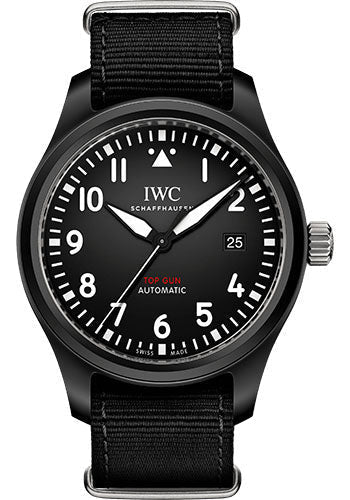
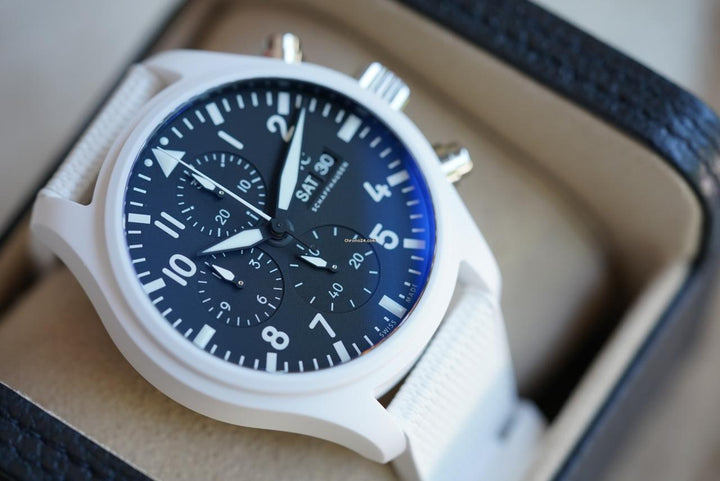
Current IWC TOP GUN, Ceratanium and steel examples
Use current image-bearing watches to compare case color, material, size, strap or bracelet, exact IW reference and individual condition. Availability illustrates configurations; it does not determine the editorial recommendation.



Compare two exact IWC references
Send the Buying Desk the two IW references, wrist size, preferred material, intended use, condition requirement and budget. We can compare current inventory, identify the stronger configuration and source another reference when needed.
Official IWC material and reference sources
Official IWC pages and press material establish case materials, reference dimensions, movements, power reserves, water resistance, production context and strap systems. Superlative Watch Co. separately evaluates fit, condition, service exposure, market behavior and transaction risk.
Editorial boundary: official sources establish manufacturer facts; our Buying Desk applies independent watch-level analysis to condition, wrist fit, service history, completeness, pricing and purchase risk.
IWC TOP GUN vs. steel questions
Does IWC ceramic scratch?
IWC ceramic is extremely hard and highly resistant to ordinary surface scratching, but no watch case is damage-proof. A severe point impact can still damage an edge or component.
Can an IWC ceramic case be polished?
Do not treat ceramic like stainless steel. Ordinary polishing is not the standard restoration path. Damage should be assessed by IWC or a qualified specialist, and a damaged component may require replacement.
Is Ceratanium the same as ceramic?
No. Ceratanium begins as a titanium alloy. During heat treatment, a ceramic-like diffusion layer develops at the surface. It is distinct from a zirconium-oxide ceramic case and from black-coated steel.
Is TOP GUN lighter than steel?
Many ceramic and Ceratanium watches feel lighter than comparable steel watches, but the complete reference, size, movement, strap and bracelet determine the result. Lower weight does not make a large case look smaller.
Which is better for daily wear?
Steel is the lower-friction default because of bracelet availability and familiar wear behavior. TOP GUN is also suitable for regular use when the owner understands impact risk and genuinely prefers the technical material.
Which is better for swimming?
Neither material determines swim suitability. Use the exact reference’s rating, a current pressure test and the correct strap. Representative steel Chronograph 41 references are rated to 10 bar, while Lake Tahoe IW389105 and Woodland IW389106 are rated to 6 bar.
What is the difference between the 41 mm and 44.5 mm TOP GUN chronographs?
The 41 mm generation is more compact and includes Jet Black, Oceana, Mojave Desert and Miramar paths. The 44.5 mm Lake Tahoe, Woodland and black-ceramic references deliver the larger traditional TOP GUN presence. Exact movements, components and ratings still vary.
Does colored ceramic fade or peel like paint?
The ceramic color is created through the material formulation and manufacturing process rather than applied as ordinary surface paint. Other matched components such as dial, lume and strap use different materials and should be inspected separately.
Which holds value better?
There is no universal ceramic-versus-steel winner. Exact reference, price paid, condition, production context, completeness, service history and buyer demand determine the outcome.
What photographs should I request before buying?
Request sharp straight-on and angled images of every lug, bezel edge, crown side, pusher openings, case back, clasp or buckle, strap attachment and all included accessories. For steel, add close views of polishing and bracelet links.
Independent-dealer disclosure: Superlative Watch Co. is an independent luxury-watch dealer and is not an authorized IWC retailer or affiliated with IWC unless expressly stated. Specifications, production status, water resistance and warranty terms vary by exact reference and may change. Official IWC sources establish manufacturer facts; condition, fit, service, market and transaction guidance reflects independent Buying Desk analysis.