
Rolex Submariner vs. GMT-Master II (2026): Which Should You Buy?
The dive watch or the travel watch? Compare wrist fit, bracelet comfort, everyday function and the price of the exact watches available—then choose the Rolex that suits how you live.


Quick verdict: choose the Submariner when you want the cleanest, most substantial and most adjustable modern Rolex sports watch, with 300-meter water resistance, a simple elapsed-time bezel and Glidelock. Choose the GMT-Master II when you want the flatter, slightly more comfortable travel watch, a date, a second time zone and more visual personality—especially on the Jubilee bracelet. The Submariner has greater wrist presence; the GMT usually wears a little easier.
Submariner vs. GMT-Master II Specifications at a Glance
| Category | Rolex Submariner | Rolex GMT-Master II |
|---|---|---|
| Current case size | Rolex publishes 41 mm for current references. | Rolex publishes 40 mm for current references. |
| Water resistance | 300 meters / 1,000 feet. | 100 meters / 330 feet. |
| Primary purpose | Dive watch with unidirectional elapsed-time bezel. | Travel watch with independently adjustable local hour hand and bidirectional 24-hour bezel. |
| Modern movement | Caliber 3235 in Date references; caliber 3230 in the 124060 No-Date. | Caliber 3285. |
| Power reserve | Approximately 70 hours. | Approximately 70 hours. |
| Bracelet | Oyster only on the modern collection. | Oyster or Jubilee on many current steel configurations. |
| Clasp adjustment | Oysterlock safety clasp with Glidelock, allowing incremental adjustment without tools. | Oysterlock safety clasp with approximately 5 mm Easylink extension. No Glidelock. |
| Dealer-measured lug opening | Approximately 21 mm on current 41 mm references. | Approximately 20 mm on current 40 mm references. |
| Wrist character | Broader, thicker-looking and more planted. | Flatter, slightly neater and often more comfortable. |
Published dimensions and technical specifications should always be checked against the exact reference. Dealer measurements can vary slightly by measuring method and are included because they explain how the watches actually feel.
Why the One-Millimeter Difference Is More Noticeable Than It Sounds
On paper, a 41 mm Submariner and a 40 mm GMT-Master II appear almost interchangeable. On the wrist, the distinction is substantial. Case diameter is only one part of the visual equation. Thickness, lug stance, bracelet width, bezel width, dial opening, crystal diameter, rehaut depth and clasp proportions all contribute to perceived size.
The current Submariner looks and feels broader because the architecture carries its width through the lugs and bracelet. Its case also has more vertical mass. That does not make it a large watch in the same category as the 43 mm Sea-Dweller or 44 mm Deepsea. The Submariner remains a wearable, balanced sports watch. It simply occupies more visual space than the GMT-Master II.
The GMT’s flatter profile lets it sit closer to the wrist. Its narrower bracelet architecture and visually wider bezel frame the dial differently, so it reads as a slightly more compact object even though the case diameters are separated by only a millimeter.
More case depth, a broader dial-and-crystal opening, wider lug architecture and a wider clasp make the Submariner feel more substantial.
The GMT-Master II sits closer to the wrist and usually disappears under a cuff more easily, especially on Jubilee.
Lug Width, Bracelet Taper and Clasp: The Difference Buyers Miss
One of the most useful real-world differences is rarely explained in standard comparison articles. In our measurements, the modern Submariner has an approximately 21 mm opening at the lugs, while the modern GMT-Master II is approximately 20 mm. One millimeter sounds insignificant until the bracelet, taper and clasp are viewed as a complete system.
The Submariner begins wider and carries more visual mass into its Oyster bracelet. Although the bracelet tapers, the clasp remains broader than the GMT clasp. That broader clasp helps balance the heavier dive-watch head and creates the planted feeling many Submariner owners love.
The GMT starts narrower. On Oyster, it feels more streamlined; on Jubilee, the five-piece-link construction breaks the width into smaller polished and brushed surfaces, making the bracelet appear even more flexible and refined.
Glidelock versus Easylink
The Submariner’s Glidelock is one of Rolex’s best everyday features. It was designed for dive-wear adjustment, but owners use it constantly for heat, travel, exercise and normal wrist swelling. It provides incremental sizing without a tool.
The GMT-Master II does not have Glidelock. Its Easylink extension adds approximately 5 mm when opened, which is useful, but it is a two-position solution rather than the fine incremental range offered by the Submariner. Buyers who are sensitive to fit often notice this difference immediately.
Clasp verdict: the Submariner has the more capable adjustment system and the wider, more substantial clasp. The GMT has the sleeker clasp and sufficient adjustment for most owners, but it cannot match Glidelock for precision.
Which Is More Comfortable: Submariner or GMT-Master II?
Both watches are comfortable when correctly sized. In our experience—and in feedback we repeatedly hear from customers—the GMT-Master II usually has a slight comfort advantage. Its flatter case helps, but bracelet choice matters even more.
Why the Jubilee often wins on comfort
The Jubilee bracelet contains more individual link elements than the Oyster. Those smaller articulating sections wrap around the wrist differently, distribute pressure across more points and conform more readily to changes in wrist shape. The polished center elements also give the GMT a dressier appearance without turning it into a delicate watch.
The Submariner is not offered on Jubilee. Its Oyster bracelet is exactly right for the model: solid, simple, broad and secure. It feels more like a single structural component supporting the watch head. Some owners prefer that planted sensation; others prefer the softer articulation of the GMT on Jubilee.
| Wearability Question | Likely Winner | Reason |
|---|---|---|
| Most adjustable during the day | Submariner | Glidelock provides fine, tool-free adjustment. |
| Softest wrap around the wrist | GMT on Jubilee | More link articulation and a narrower overall architecture. |
| Most planted sports-watch feel | Submariner | Wider bracelet, broader clasp and heavier visual architecture. |
| Easiest under a cuff | GMT-Master II | Flatter profile and neater case presentation. |
Dial, Crystal, Bezel Width and Rehaut Depth
The Submariner’s stronger wrist presence is not created only by its case. The dial and crystal opening appear broader, while the bezel ring itself looks narrower relative to that opening. On the GMT-Master II, the 24-hour bezel carries more visual information and reads as a wider frame around the dial.
This changes the way light enters the watch. The Submariner also presents a little more apparent depth between the underside of the crystal and the dial. Its rehaut—the angled inner wall engraved repeatedly with “ROLEX”—therefore feels deeper. That angled surface is not merely decorative. It catches and redirects light toward the hands and applied hour markers, helping create the bright, dimensional effect that makes a modern Rolex dial so engaging in person.
The GMT’s shallower-looking dial presentation and flatter case create a more compact visual stack. The difference is easy to miss in photographs and immediately noticeable when the watches are placed side by side.
Dive Timing or Travel Function?
The Submariner and GMT-Master II are not interchangeable complications. The Submariner’s unidirectional 60-minute bezel is designed to measure elapsed time. Outside diving, it is useful for meetings, parking, cooking, exercise and any task where a quick visual timer is helpful.
The GMT-Master II uses an independently adjustable local hour hand, a 24-hour hand and a bidirectional 24-hour bezel. Set normally, it tracks home time while the conventional hour hand shows local time. Rotate the bezel and it can display a third time zone. The date follows the local hour hand, making the watch genuinely useful when crossing midnight during travel.
For many owners, the decision is not about which complication is objectively better. It is about which interaction feels meaningful. The Submariner is immediate and simple. The GMT rewards owners who travel, work across regions or simply enjoy the visual energy of a colored 24-hour bezel and arrow-tipped hand.
Best when you value elapsed-time timing, superior water resistance, uncluttered legibility and minimal setting complexity.
Best when you value a date, second time zone, independently jumping local hour and a more expressive bezel.
Why Rolex Finishing Looks Different in Person
Rolex is often discussed as an industrial manufacturer, but that description can understate the quality of its external finishing. In our handling experience, the polished portions of a modern Rolex often have an unusually taut, distortion-free appearance. Reflections remain clean across the case flank, center links and clasp surfaces.
This is particularly impressive inside the clasp. The polished blades include embossed and recessed details, engraved Rolex branding and contact areas where the clasp closes. Those are difficult places to finish evenly. Yet Rolex repeatedly achieves a mirror-like surface deep into geometry that many brands leave less resolved.
We do not present finishing as a universal league table; collectors value hand-finishing, movement decoration and case craft differently. Our practical observation is narrower: on high-contact external surfaces, Rolex’s consistency is exceptional and can look cleaner than watches carrying much higher retail prices. The clasp architecture introduced during the late-2000s transition to modern solid bracelets remains a benchmark because it combines finish, durability, safety and daily usability.
What Buyers Are Actually Asking For
Market behavior changes, and it does not always follow the old assumption that the Submariner is automatically the dominant Rolex sports watch. In our recent business, we have sold more GMT-Master II watches than Submariners. Buyers respond strongly to recognizable GMT identities—Pepsi, Batman, Batgirl, Sprite, Root Beer and GRNR—and to the choice between Oyster and Jubilee.
The Submariner remains one of the most liquid watches in the world, especially the black 126610LN and 124060. But the GMT category creates more reasons for a collector to own multiple versions. Bezel color, bracelet, metal and crown orientation can produce materially different watches within the same family.
We have also seen a sharp reduction in the number of buyers asking specifically for the blue two-tone Submariner, commonly called the Bluesy, compared with earlier periods. That does not make the Bluesy inferior. In fact, the lower level of casual inquiry can create an opportunity for the buyer who genuinely wants its blue-and-yellow-gold personality rather than the most crowded trade.
Market note: demand, inventory and premiums move. Buy the reference you will enjoy wearing, then evaluate condition, completeness and price. Do not treat a nickname or a short-term asking-price spike as a substitute for due diligence.
Which Is Better as a First Rolex?
The conventional answer is the Submariner, and it remains an excellent one. A black Submariner Date or No-Date is easy to understand, resistant to trends and suitable for almost every casual or business-casual setting. Glidelock makes ownership forgiving, and the watch has broad recognition without requiring explanation.
The GMT-Master II can be the better first Rolex for a buyer who already knows what creates emotional attachment. A Batgirl on Jubilee may be more comfortable. A Pepsi may feel more historically evocative. A Root Beer may suit someone who wants warm precious-metal color. The GMT also offers a date on every modern reference and a complication many owners enjoy even when they are not traveling.
First-watch rule: choose the Submariner when uncertainty is high and you want the safest all-purpose answer. Choose the GMT-Master II when the bracelet, bezel color or travel function already speaks to you strongly. Enthusiasm is more important than following the default recommendation.
Who Should Buy the Submariner—and Who Should Buy the GMT?
| Buyer Priority | Best Fit | Why |
|---|---|---|
| One understated Rolex sports watch for decades | Black Submariner | Simple design, broad demand, strong water resistance and no dependence on color trends. |
| Maximum on-wrist adjustment | Submariner | Glidelock gives the finer sizing system. |
| Most comfortable bracelet option | GMT on Jubilee | Five-piece-link articulation and flatter case. |
| Frequent travel or cross-time-zone work | GMT-Master II | Independent local hour, date and 24-hour display. |
| Stronger, broader wrist presence without moving to an oversized watch | Submariner | 41 mm architecture, wider lug opening, broader crystal/dial presentation and thicker profile. |
| More color and collector variety | GMT-Master II | Pepsi, BLNR, VTNR, CHNR and GRNR families plus Oyster/Jubilee choices. |
| True dive-watch capability | Submariner | 300-meter rating, Triplock crown, elapsed-time bezel and Glidelock. |
| Dress-sport versatility | GMT on Jubilee | Polished center elements and flexible bracelet create a more refined presentation. |
How much more does a GMT-Master II cost?
The extra budget depends on the exact GMT configuration you choose. Compare the watches shown below against the black Submariner Date 126610LN, then decide whether the travel function, bracelet, bezel color or precious metal is worth the difference to you.
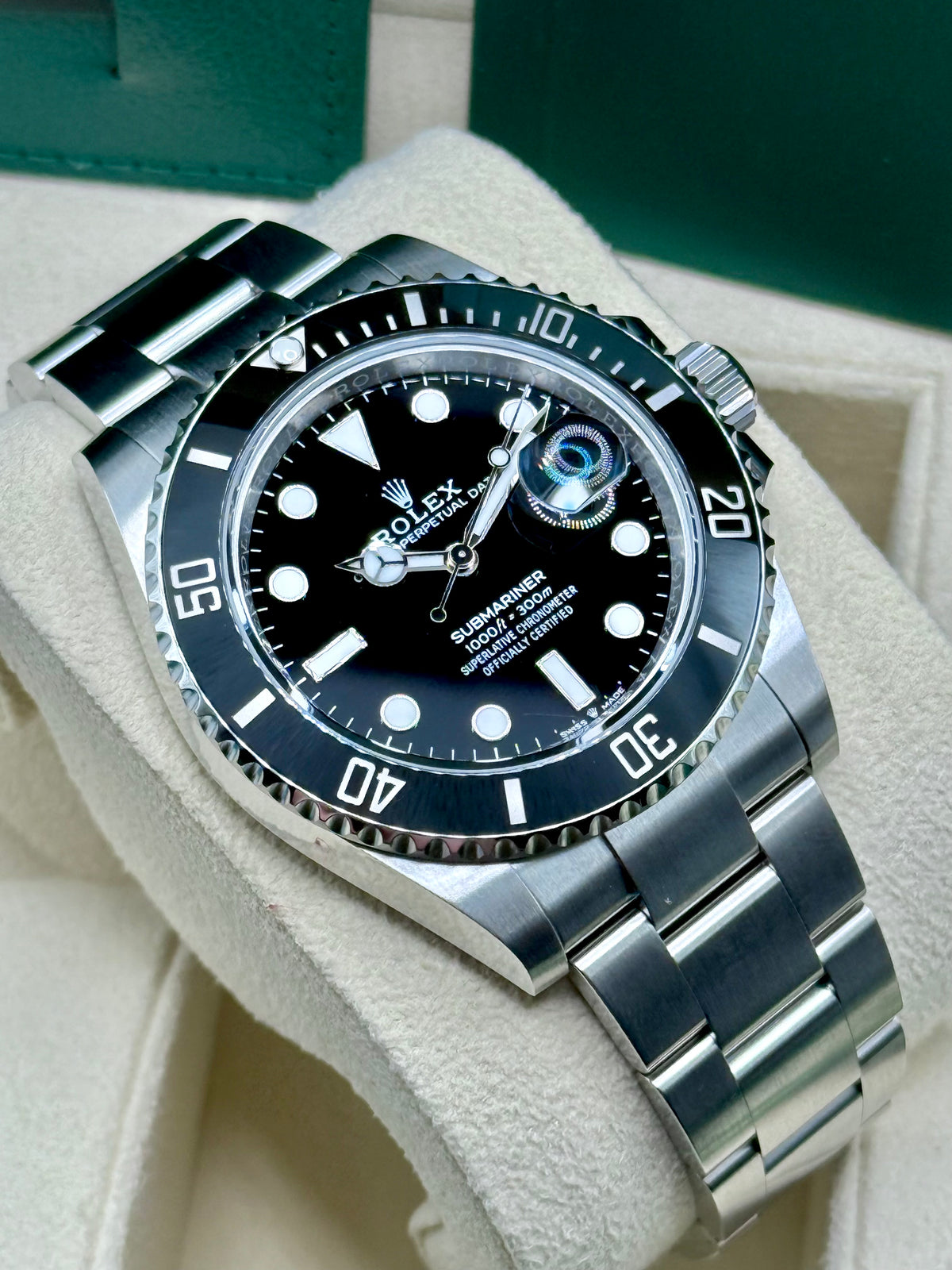
Comparison watch: Rolex Submariner Date 126610LN Black Dial UNWORN 2026 — $15,500.00 USD.
| Exact watch | Current asking price | Difference from the 126610LN |
|---|---|---|
| Rolex Submariner Date 126610LN Black Dial UNWORN 2026 | $15,500.00 USD | Comparison baseline |
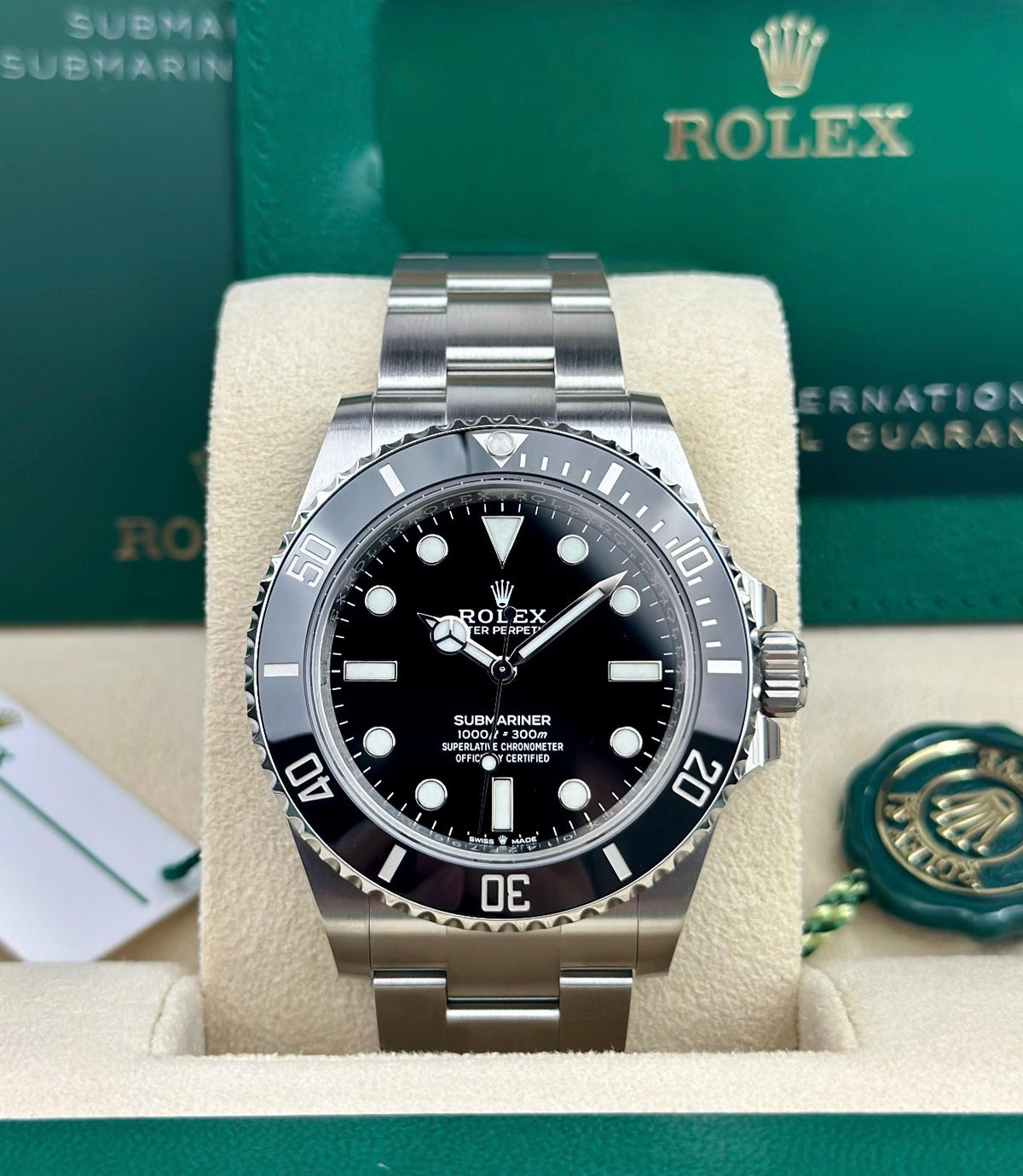
| Rolex Submariner 124060 No Date Oystersteel UNWORN 2026 | $13,500.00 USD | $2,000.00 USD less |
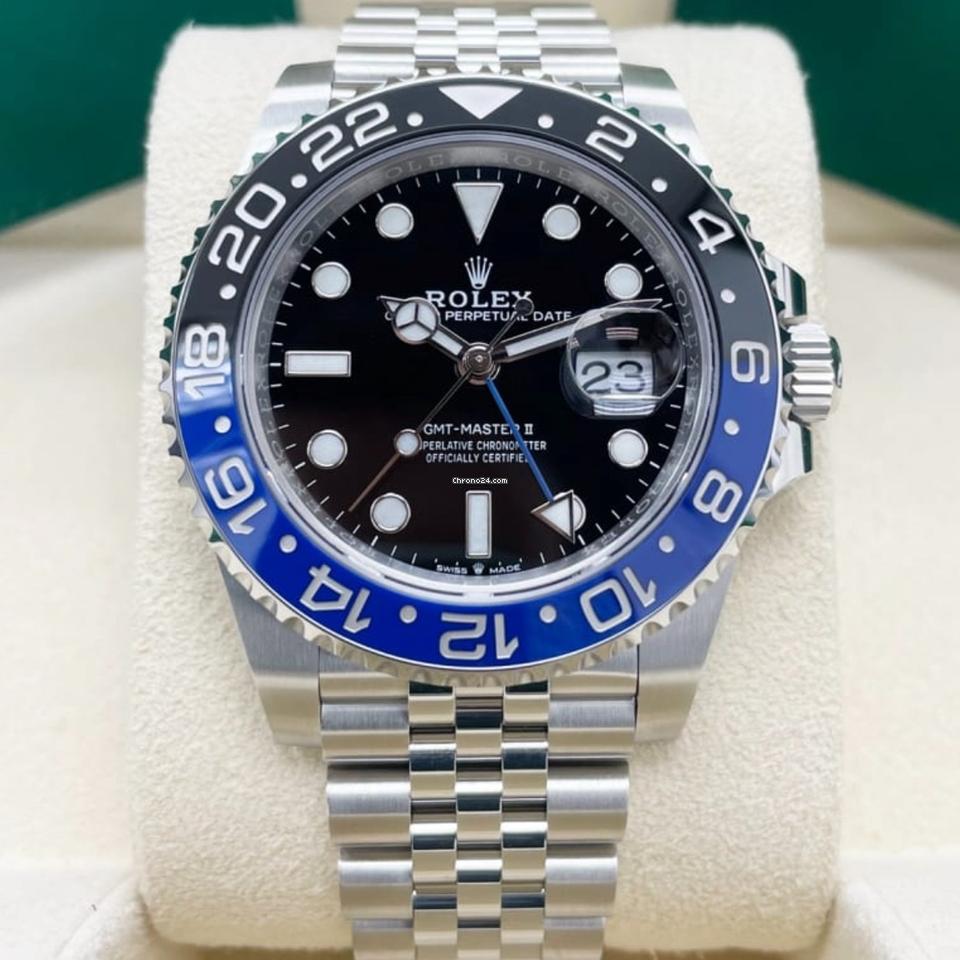
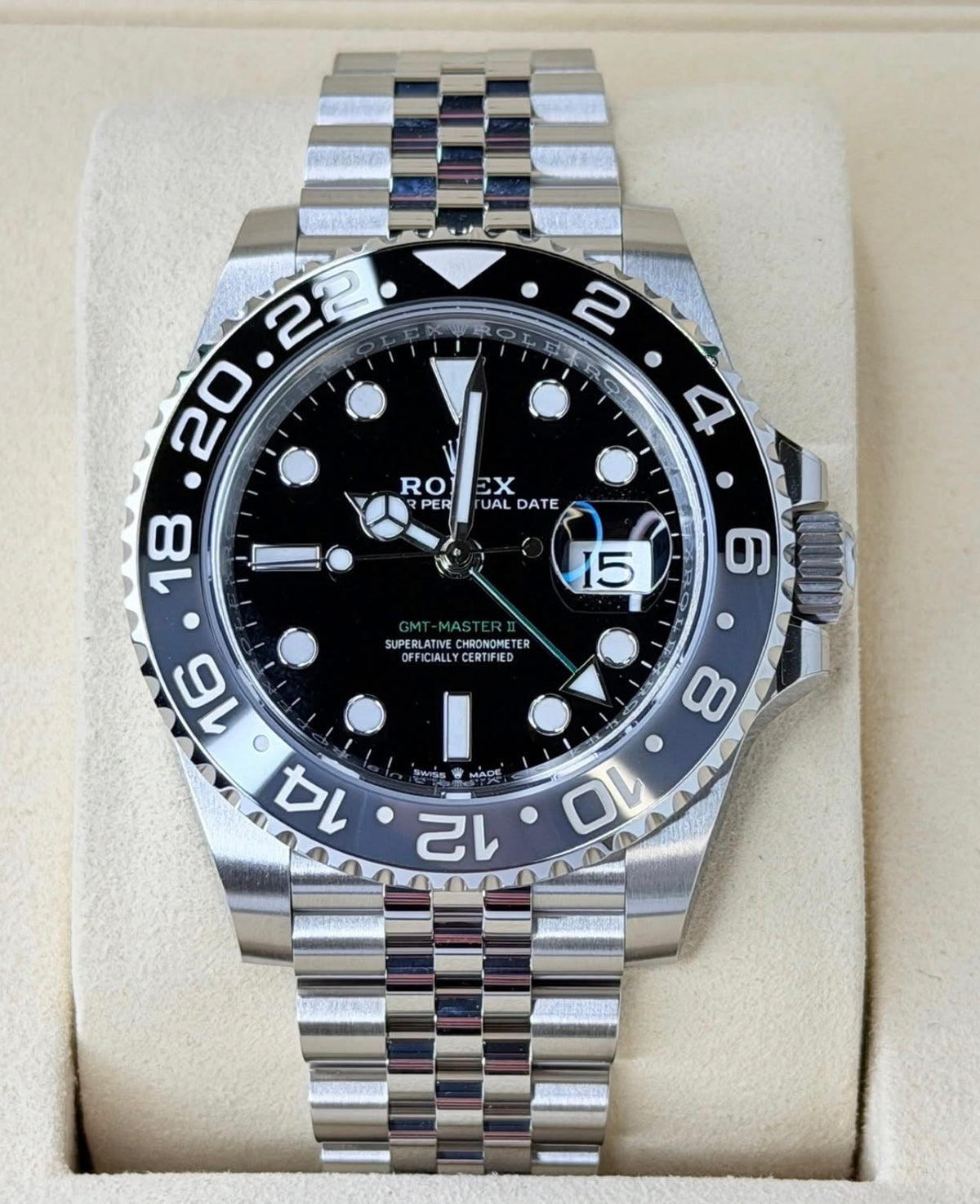
| Rolex GMT-Master II "Batgirl" Jubilee Bracelet 126710BLNR UNWORN 2026 | $20,500.00 USD | $5,000.00 USD more |
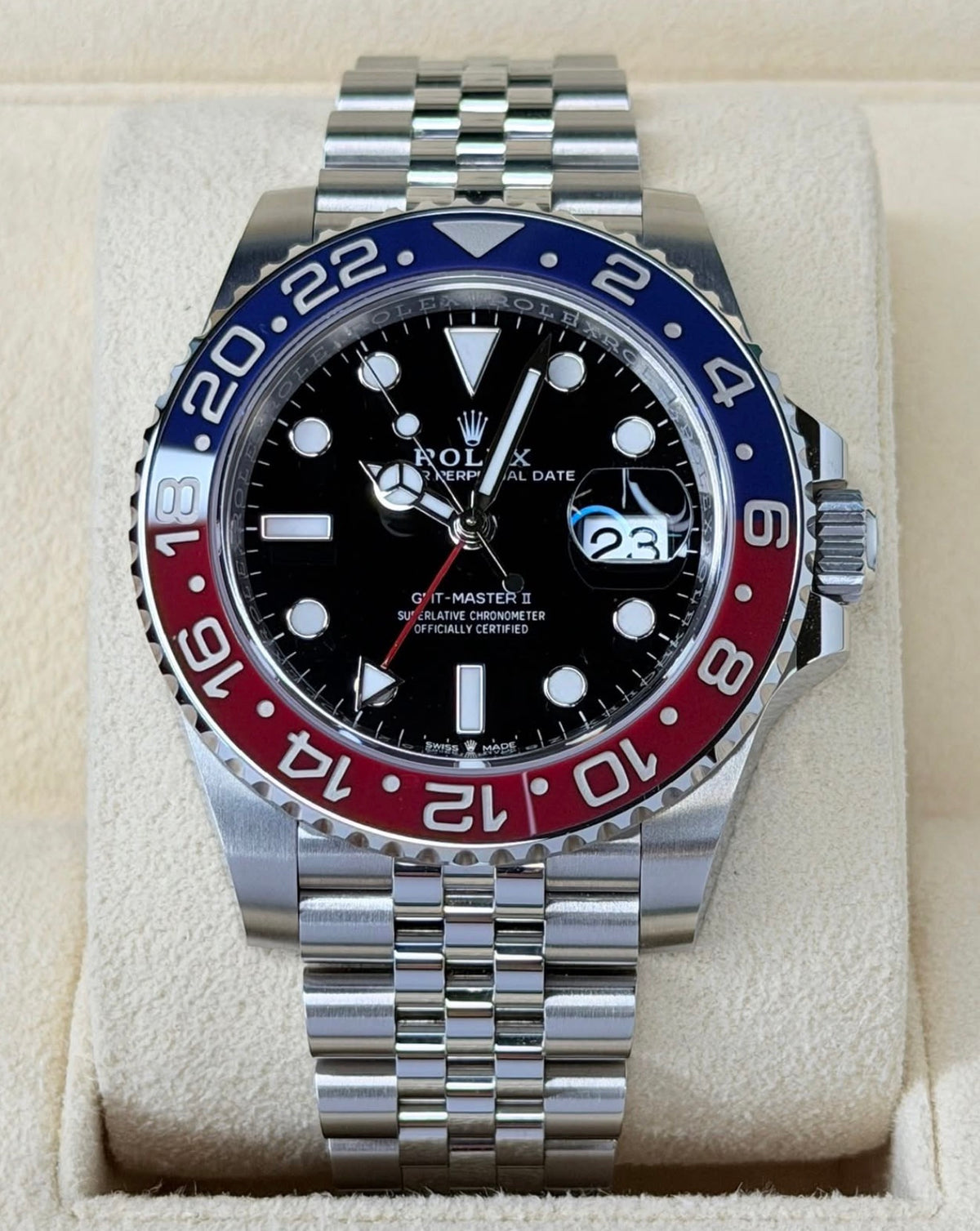
| Rolex GMT-Master II "Pepsi" Jubilee Bracelet 126710BLRO UNWORN 2026 | $27,999.00 USD | $12,499.00 USD more |
| Rolex GMT-Master II "Bruce Wayne" Jubilee Bracelet 126710GRNR UNWORN 2026 | $21,500.00 USD | $6,000.00 USD more |
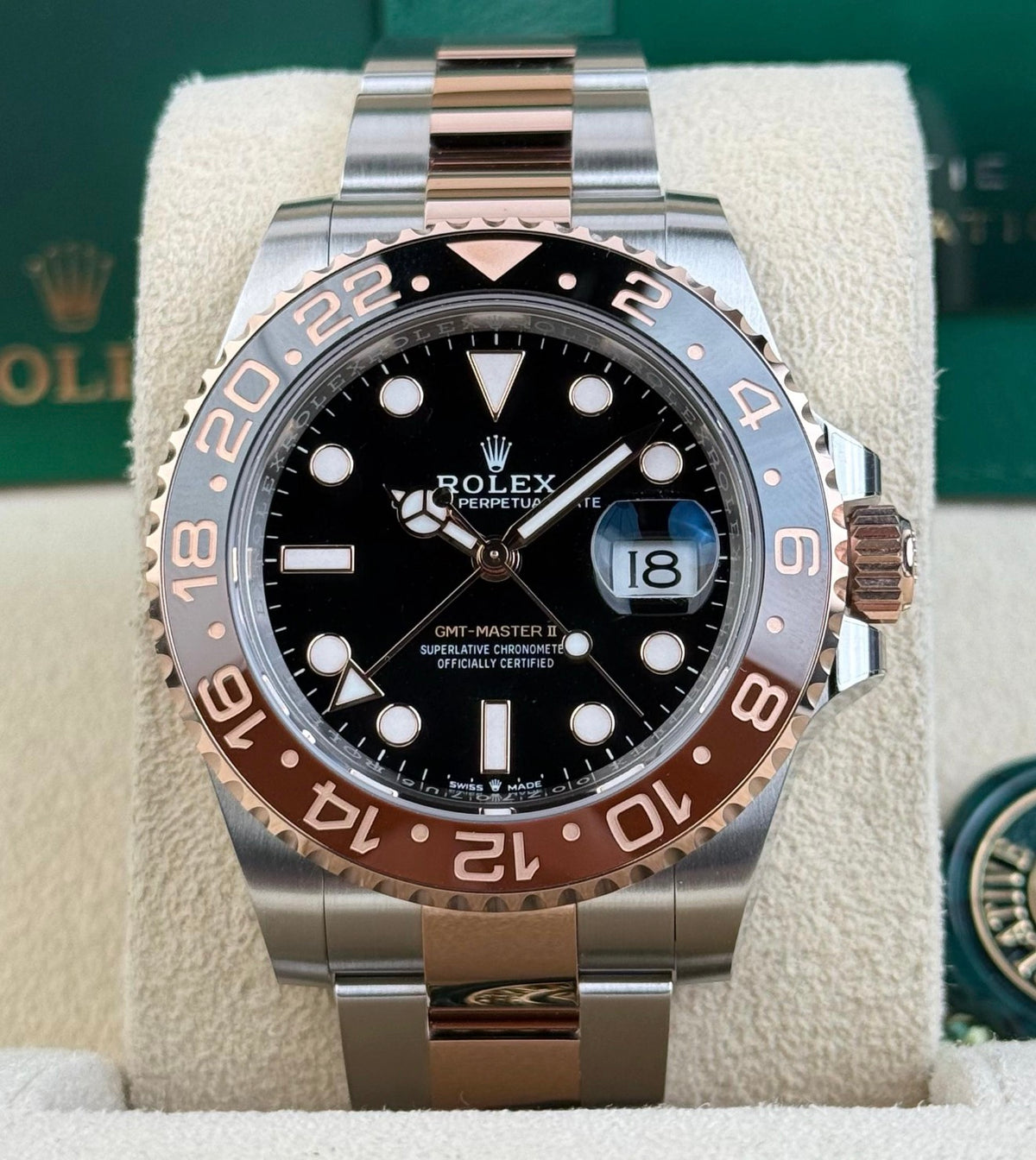
| Rolex GMT-Master II "Root Beer" 126711CHNR Everose Rolesor UNWORN 2026 | $24,850.00 USD | $9,350.00 USD more |
These are our listed asking prices for specific watches, before applicable tax and delivery. The difference is measured against the displayed Submariner Date; it is not a premium over Rolex retail or a market-wide average. Compare condition, warranty-card date, bracelet and included accessories as well as reference. A sourcing or price-on-request watch requires a current quote.
What does the extra budget buy?
A GMT-Master II adds an independently adjustable local hour hand and a second-time-zone display. The steel GMT examples here also offer a Jubilee bracelet and a choice of bezel colors. The Root Beer combines Oystersteel with Everose gold on an Oyster bracelet, so its price difference also includes a change of material. The Submariner retains the stronger water-resistance rating and finer Glidelock bracelet adjustment; a higher asking price does not improve those features.
Buying an available watch gives you access to a specific configuration whose photographs, condition, accessories and price you can review before committing. An authorized-dealer allocation follows a different process and timing. Decide how much that access matters to you, then compare the exact offer. If you have a target budget, our buying desk can help you weigh the configurations that fit it.
Current Examples to Compare
Compare these six watch listings using their photographs, prices and current availability. If one has sold, ask the Buying Desk about sourcing the same reference.
Frequently Asked Questions
Does the Submariner wear much larger than the GMT-Master II?
It wears noticeably larger, but not oversized. The effect comes from more than the 41 mm versus 40 mm case specification: the Submariner has a wider measured lug opening, broader bracelet and clasp, more apparent thickness, a broader dial/crystal opening and a deeper-looking rehaut.
Is the GMT-Master II more comfortable?
For many wrists, yes—especially on Jubilee. The flatter case and greater bracelet articulation allow it to wrap around the wrist more softly. The Submariner can be easier to fine-tune during the day because of Glidelock.
Does the GMT-Master II have Glidelock?
No. Current GMT-Master II bracelets use an Easylink comfort extension of approximately 5 mm. Glidelock is a defining advantage of the modern Submariner clasp.
Why does the Submariner dial look larger?
In side-by-side handling, the Submariner presents a broader crystal and dial opening, while its bezel appears narrower relative to the dial. The GMT’s 24-hour bezel is visually wider and carries more markings, framing the dial more tightly.
Is the Submariner too large for a smaller wrist?
Not automatically. It is far more moderate than a 43 mm Sea-Dweller or 44 mm Deepsea. Fit depends on wrist shape, lug span, bracelet sizing and personal preference. The GMT is the safer choice when a flatter, more compact presentation is the priority.
Which model holds value better?
Both are highly liquid, but performance depends on exact reference, condition, completeness, purchase price and market timing. Certain GMT colorways can command stronger premiums; black Submariners benefit from exceptionally broad demand. Neither should be purchased solely on an assumption of appreciation.
Which is the better one-watch collection?
The black Submariner is the most universal one-watch answer. The GMT-Master II is the more expressive one-watch answer when a date, travel function or Jubilee bracelet matters more.
Should I choose the Submariner Date 126610LN or No Date 124060?
Choose the 126610LN when a date and Cyclops magnifier are useful every day. Choose the 124060 when you prefer a symmetrical dial and the simplest modern Submariner expression. Both use the current 41 mm Submariner architecture, Oyster bracelet and Glidelock clasp.
Can I swim with both watches?
Rolex publishes 300-meter water resistance for the current Submariner and 100 meters for the current GMT-Master II. Actual water resistance depends on the condition of the case, crown, crystal and seals. A pre-owned watch should be pressure-tested before swimming or diving.
Can Superlative Watch Co. source a specific reference?
Yes. We can help locate current, discontinued, unworn and pre-owned Submariner and GMT-Master II references and compare condition, card date, accessories and market price before purchase.
Editorial Notes and Disclosure
Specification note: official case size, water-resistance, movement, power-reserve and bracelet-adjustment descriptions are based on current Rolex-published model information as reviewed for this update. Lug-width, visual-proportion, rehaut-depth, comfort and finishing comments are Superlative Watch Co. observations from handling and wearing the watches.
This independent guide is educational and is not financial advice. Model availability, specifications, condition, pricing and demand change. Inspect the exact watch and transaction details before purchase. Superlative Watch Co. is an independent luxury-watch dealer and is not affiliated with or authorized by Rolex S.A. Brand names and trademarks are used solely to identify the watches discussed.