
IWC Pilot’s Watch Chronograph 41: Strap vs. Bracelet
A reference-specific comparison of the IWC Pilot’s Watch Chronograph 41 on calfskin, rubber or stainless-steel bracelet, including fit, balance, EasX-CHANGE compatibility, water use, completeness, replacement exposure, condition and long-term ownership.
Should you buy the strap or bracelet version?
| Buyer priority | Better starting configuration | Why | What to verify |
|---|---|---|---|
| One complete, all-season configuration | Factory bracelet reference | The bracelet stabilizes the relatively tall chronograph case and can be worn in heat, travel and frequent daily use without the moisture sensitivity of leather. | All removable links, clasp operation, fine adjustment, correct end links and EasX-CHANGE release hardware. |
| Lowest mass on the wrist | Factory strap reference | Calfskin removes the bracelet’s added steel mass and gives the watch a less technical, less visually dense profile. | Correct strap width, buckle or deployant, attachment hardware and strap condition. |
| Frequent swimming or humid-weather wear | Bracelet or compatible rubber | The 10-bar case rating is useful, but leather remains the weak point for regular water exposure. | A current pressure test on the individual watch and correct attachment of the bracelet or rubber strap. |
| Maximum future flexibility | Usually bracelet first | A factory bracelet can be more difficult and more expensive to add later than a strap. Compatible factory straps can then broaden the same watch’s role. | Confirm that the exact bracelet and attachment generation match the exact reference. |
| More traditional aviation appearance | Calfskin strap | Leather gives the cockpit-instrument dial a warmer and more historically familiar Pilot’s Watch character. | Whether the strap is factory, period-correct or an aftermarket replacement. |
| Most integrated modern-sports appearance | Five-link steel bracelet | The articulated bracelet makes the watch read as a complete contemporary sports chronograph rather than a strap-led instrument watch. | Polishing, link wear, clasp scratches, missing links and sizing range. |
Exact reference map: strap and bracelet pairs
The Pilot’s Watch Chronograph 41 is not one generic listing with interchangeable titles. IWC created complete references for the original attachment and dial combination. The blue, green and black steel pairs are the cleanest way to compare the decision.
| Reference | Dial | Original configuration | Reference-specific buying note |
|---|---|---|---|
| IW388101 | Blue | Blue calfskin strap | The core blue strap reference and the clearest lower-mass comparison against IW388102. |
| IW388102 | Blue | Stainless-steel bracelet | The paired blue bracelet reference. Verify full links, clasp adjustment and correct end-link fit. |
| IW388103 | Green | Brown calfskin strap | The warmer, more casual strap execution. Strap color and condition have a strong effect on presentation. |
| IW388104 | Green | Stainless-steel bracelet | The paired green bracelet execution. Do not infer current availability merely because the product page exists. |
| IW388111 | Black | Black calfskin strap | The black-dial strap reference. It should not be represented as IW388113 merely because a bracelet is later fitted. |
| IW388113 | Black | Five-link stainless-steel bracelet | The black-dial bracelet reference and a strong choice for a monochromatic modern tool-watch look. |
These references share the essential 41 mm steel Chronograph 41 platform discussed on this page: IWC-manufactured calibre 69385, automatic winding, a 46-hour published power reserve, day and date, a screw-in crown, sapphire display back, 10-bar water resistance and the EasX-CHANGE attachment system. Buyers should still verify the exact full reference because later materials, limited editions and Performance Chronograph variants can use different cases, bezels, calibres or attachment combinations.
Blue dial comparison: IW388101 on strap vs. IW388102 on bracelet
The blue pair isolates the attachment decision particularly well. The dial, broad case architecture and movement family remain closely comparable, while the strap or bracelet changes the watch’s visual weight, physical balance and use case.
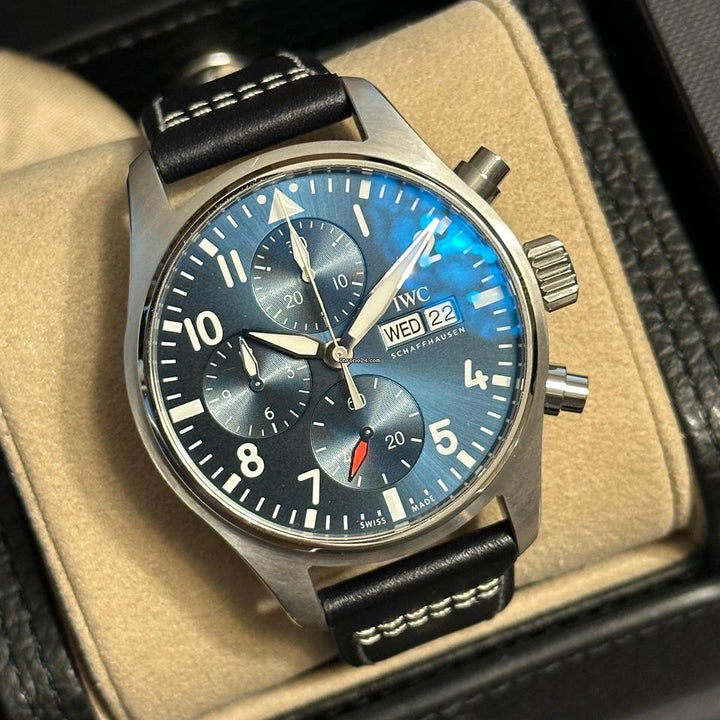

How the 41 mm Chronograph 41 actually wears
The diameter is only the beginning. At 14.5 mm high, this is a substantial automatic chronograph, and the 51.8 mm lug-to-lug measurement matters more than the word “41” suggests. On a flatter wrist, the ends of the case and the first bracelet links can determine comfort. On a more rounded wrist, the same case may settle securely even when the diameter sounds large.
Lighter, but initially higher
A new calfskin strap can be stiff and may hold the case above the wrist until it breaks in. Once curved correctly, it reduces total mass and lets the dial dominate.
Heavier, but more planted
The bracelet adds weight below the case and can reduce top-heavy movement when it is sized closely enough. A loose bracelet can instead let the crown and pushers shift against the wrist.
Test the right side of the wrist
The crown and chronograph pushers add real lateral presence. Buyers should flex the wrist, type and wear the watch for several minutes rather than judging fit from a static photograph.
- Smaller wrists: prioritize lug coverage, crown clearance and the way the first bracelet links leave the case. The strap is not automatically smaller, but it often feels less massive.
- Medium wrists: both configurations can work. The decision usually turns on whether the buyer prefers a planted sports-watch feel or a lighter strap-led feel.
- Larger wrists: the bracelet often gives the case better visual proportion, while a strap can emphasize the broad dial and make the watch appear more instrument-like.
- Cuff use: neither configuration changes the 14.5 mm case height. A strap may look dressier, but it does not turn the watch into a thin chronograph.
This page owns IWC Chronograph 41 strap versus bracelet intent
It resolves the exact configuration decision for steel Pilot’s Watch Chronograph 41 references, including fit, balance, EasX-CHANGE, water use, completeness, total cost and resale without repeating the full IWC collection guide.
Prepared by the Superlative Watch Co. Buying Desk under the published Editorial Standards. Manufacturer facts and Buying Desk observations are identified separately.
What the stainless-steel bracelet changes
The bracelet does more than replace leather with steel. It changes how the chronograph distributes mass, how securely it stays centered, how the watch handles moisture and how much completeness matters in a future transaction.
Why the bracelet can wear better
The case is relatively tall, so weight below the lugs can counterbalance the head of the watch. When sized correctly, the articulated links spread pressure across more of the wrist and reduce the sensation that the case is rotating outward.
Why the bracelet can wear worse
Added steel is still added mass. If the bracelet is too loose, missing the best sizing combination or poorly adjusted, the watch can move more than it would on a fitted strap. Buyers sensitive to weight may prefer calfskin even when the bracelet is technically more versatile.
Bracelet articulation and first-link behavior
The most important fit question is not simply whether the bracelet is “comfortable.” Examine where the first movable link begins, whether the end links sit flush against the case and whether the bracelet can fall naturally around the wrist rather than projecting straight outward. A product photograph taken flat can conceal this behavior.
Fine adjustment
IWC described the steel bracelet introduced with these references as having a fine-adjustment system and a slimmer shape intended to improve ergonomics. That adjustment is useful for heat, travel and normal daily wrist expansion, but it does not replace correct link sizing. Confirm the clasp moves through its intended adjustment range and locks positively at every setting.
Completed-watch weight
IWC does not publish one stable, universally applicable completed-watch weight for every configuration discussed here. This guide therefore does not invent gram figures. The practical test is comparative: try the strap and bracelet on the same wrist, sized correctly, and note whether the watch feels planted or merely heavier after ten to fifteen minutes.
| Inspection point | Why it matters | Evidence to request remotely |
|---|---|---|
| Full removable-link set | Missing links can prevent proper sizing and reduce completeness. | A photograph of the installed bracelet plus all spare links, pins or screws. |
| End-link fit | Incorrect or poorly seated end links can create movement, gaps or case-edge contact. | Close photographs of both case-to-bracelet junctions from above and below. |
| Clasp and fine adjustment | The clasp must close securely and the adjustment system must move and lock correctly. | A short video showing opening, closing and adjustment operation. |
| Link articulation | Stiff, damaged or contaminated links can compromise comfort and indicate poor care. | A side-view video of the bracelet draping naturally under its own weight. |
| Polishing and finish | Heavy refinishing can soften transitions and alter the intended brushed-and-polished contrast. | Diffuse-light photographs rather than only high-contrast showroom images. |
| Scratches versus damage | Normal surface marks differ from deep clasp gouges, bent links or impact deformation. | Macro photographs of clasp edges, first links and the underside. |
Calfskin, rubber and the lighter ownership path
The factory calfskin references are not incomplete versions of the bracelet references. They are deliberate configurations with their own color pairings and visual identity. A strap lets the case and dial remain the focus, reduces metal mass and can make the watch feel less like an integrated sports chronograph.
Warmest and most traditional
Leather supports the aviation-instrument character and usually feels lighter. It absorbs moisture, shows creasing and eventually becomes a replacement item.
Best non-bracelet sport option
A compatible factory rubber strap handles sweat and water better than calfskin while preserving lower mass. Confirm the exact width and EasX-CHANGE attachment.
Useful, but disclose them
A well-made aftermarket strap can be excellent for wear, but it should not be represented as factory equipment or used to conceal a missing original buckle or strap.
Leather does not inherit the case’s water rating
The steel watch head is published at 10 bar, but a calfskin strap should not be treated as a swimming attachment. Repeated saturation, salt, sunscreen and heat can shorten its life and affect hygiene. Buyers planning regular water use should choose the bracelet or a confirmed compatible rubber strap and should obtain a current pressure test for the individual watch.
Factory buckle, deployant and strap completeness
Confirm whether the watch includes the correct IWC buckle or folding clasp for its original configuration. A replacement strap is normal maintenance; a missing factory clasp is a separate value issue. Ask for photographs of the signed hardware, the underside of the strap, attachment points and any included original strap even when it is no longer suitable for wear.
How IWC EasX-CHANGE affects the decision
IWC’s EasX-CHANGE system allows the compatible strap or bracelet to be released without conventional spring-bar tools. On the blue and green launch references and the later black-dial pair, that flexibility is central to the ownership proposition: one case can move between leather, rubber and steel when the components are correct.
Buy bracelet first when...
You know you want the factory bracelet eventually, the current watch includes all links and the price difference is acceptable. Add compatible straps later to reduce weight or change the visual character.
Buy strap first when...
You dislike bracelet mass, expect to wear leather most of the time, or the strap reference is materially better in condition or value. Do not pay for a bracelet you will immediately remove.
EasX-CHANGE does not mean every IWC attachment fits
The presence of a quick-change release is not a universal compatibility guarantee. Verify the exact case generation, attachment width, end-link geometry and release hardware. A 20 mm measurement by itself is not enough: two straps can share a nominal width while using different case-end construction.
The reference identity remains fixed
Installing an IWC bracelet on IW388101 can create the experience of a blue-dial bracelet watch, but it does not convert the serialised watch into IW388102. The original complete reference remains important for valuation, documentation, insurance, service records and accurate resale disclosure.
Test the release system before purchase
- Confirm both sides release smoothly without excessive force.
- Confirm the attachment clicks or seats fully and cannot be pulled free after installation.
- Inspect for damaged tabs, bent interfaces, debris and case-edge marks.
- Verify that the supplied bracelet or strap is intended for the exact Chronograph 41 case generation.
- Ask the seller to demonstrate the system on video when purchasing remotely.
For the broader collection decision, movement families and comparisons with Portugieser, continue to the Complete IWC Buying Guide. For aviation-sport versus classical-chronograph intent, see IWC Pilot’s Watch vs. Portugieser.
Water use: does the bracelet make the watch more water-resistant?
No. The case—not the attachment—carries the published water-resistance specification. The steel Pilot’s Watch Chronograph 41 references discussed here are published as water-resistant to 10 bar, whether originally supplied on calfskin or bracelet. The bracelet changes practical usability around water because steel tolerates sweat, rain and repeated wetting better than leather. It does not increase the case rating, renew aged seals or prove that an individual watch is currently water-resistant.
Bracelet or rubber for water-oriented use
Choose the bracelet or a confirmed compatible factory rubber strap when swimming, humidity, frequent exercise or travel near water is part of the ownership plan. Both are easier to rinse and dry than calfskin, provided the attachment is installed correctly.
Calfskin for dry everyday use
Calfskin is the warmer and more traditional Pilot’s Watch presentation, but repeated saturation can shorten its life, affect the lining and create odor or delamination. The case may be rated to 10 bar while the leather remains the wrong attachment for routine immersion.
| Use case | Preferred attachment | Why | Required verification |
|---|---|---|---|
| Occasional rain and ordinary hand washing | Bracelet, rubber or sound calfskin with reasonable care | Brief incidental moisture is different from deliberate immersion. | Confirm crown position, case condition and that the strap is not already cracked or separating. |
| Swimming | Bracelet or confirmed compatible rubber | These attachments tolerate repeated wetting better than leather. | Current pressure test on the individual watch; do not rely only on the original 10-bar specification. |
| Salt water | Bracelet or rubber | Leather is poorly suited to repeated salt exposure. | Rinse the watch with clear fresh water afterward and dry it carefully, following current IWC care guidance. |
| Hot, humid climate | Bracelet or rubber for frequent wear | They reduce moisture absorption and are easier to clean. | Inspect clasp, release system and strap surfaces for trapped debris or corrosion. |
| Office and formal wear | Calfskin or bracelet | The decision becomes visual and comfort-led rather than water-led. | Fit, buckle or clasp completeness and the condition of the original attachment. |
| Actual diving | A purpose-built dive watch is generally the clearer tool | The Chronograph 41 is a versatile sports chronograph, not a substitute for every dedicated diving requirement. | Use the correct instrument for the activity and follow the exact manufacturer instructions. |
Pressure testing is part of ownership, not a one-time sales claim
IWC states that water resistance is not permanent because seals and sealing systems age and external factors—including impacts, cosmetics and salt water—can affect performance. Its current service FAQ recommends testing water resistance at least once a year. A seller’s statement that a watch “has never been opened” is therefore not a substitute for a current test.
- Before purchase: ask whether the watch has a recent pressure-test result and who performed it.
- After impact or case work: test again before intentional water exposure.
- After service: distinguish a movement service from resealing and pressure testing; ask what was actually completed.
- After salt water: rinse with clear fresh water and dry the watch, consistent with IWC’s current care guidance.
Do not operate the chronograph pushers underwater
Do not assume that a 10-bar rating authorizes use of the start, stop or reset pushers below the surface. Unless the exact manufacturer instructions for the exact reference expressly permit underwater pusher operation, leave the pushers untouched. Keep the screw-in crown fully secured and never attempt a strap change while the watch is wet, sandy or contaminated.
Condition and service: inspect the watch and attachment as one system
A strap-versus-bracelet comparison can distract from the more expensive risk: the condition of the chronograph itself. The same calibre, case and dial architecture sit beneath both configurations. A complete bracelet does not compensate for a poorly functioning chronograph, and a clean leather strap does not prove that the case has avoided polishing, impact or moisture exposure.
| Area | What to inspect or test | Why it matters | Remote evidence to request |
|---|---|---|---|
| Complete reference | Full IW reference, dial, original attachment, card or invoice and serial context. | IW388101 and IW388102 are different original configurations even when a later attachment swap makes them look alike. | Clear reference documentation and photographs of the complete watch and included items. |
| Case geometry | Lug thickness, brushed and polished transitions, bezel edge, crown side and case-back perimeter. | Aggressive refinishing can soften the case and reduce reference-level condition quality. | Diffuse-light images from all four sides rather than only front-facing glamour photographs. |
| Crystal and display back | Chips, scratches, anti-reflective wear, gasket area and signs of prior impact. | Crystal condition affects appearance, sealing and replacement exposure. | Angled photographs in neutral light and a close view around the case-back edge. |
| Crown and pushers | Screw-in crown engagement, winding, setting, start, stop and reset feel. | Damage or inconsistency can indicate impact, moisture risk or chronograph service needs. | A continuous video showing crown operation and several complete chronograph cycles. |
| Chronograph | Start, run, stop and reset; minute and hour advancement; clean return to zero. | A watch that merely “runs” can still have an expensive chronograph fault. | Video long enough to show counter advancement, not only an immediate reset. |
| Day and date | Alignment, quick setting and change behavior. | Misalignment or poor operation can reveal adjustment or service needs. | Close dial images and a short setting demonstration performed safely. |
| Movement performance | Timekeeping context, winding behavior and practical power-reserve performance. | The 46-hour published reserve is a reference point, not proof of the condition of an individual movement. | Recent timing information, service paperwork and a seller description of reserve testing. |
| Water resistance | Current pressure-test status and service history for seals. | The original 10-bar rating is not permanent. | Dated result or written service record when water use is part of the purchase. |
| EasX-CHANGE interfaces | Both case-side interfaces, release tabs and positive locking after installation. | Damaged or mismatched hardware can make an otherwise attractive attachment unreliable. | Video of removal, reinstallation and a gentle pull check on both sides. |
| Bracelet | All links, end links, clasp, fine adjustment, articulation and finish. | Missing or damaged factory components affect fit, replacement cost and resale. | Photographs of installed and spare links plus clasp and underside views. |
| Strap and clasp | Creasing, lining, moisture damage, stitching, factory buckle or deployant and correct length. | A strap is replaceable; missing signed hardware or incorrect attachment parts are separate value issues. | Front and back photographs of the strap and all supplied hardware. |
| Service documentation | Date, provider, work performed and parts replaced. | “Serviced” can mean a full overhaul, regulation, resealing or only cosmetic work. | Invoice or written description that separates mechanical, water-resistance and cosmetic work. |
Test the chronograph beyond a ten-second demonstration
Run the chronograph long enough to confirm that its counters advance correctly. Start, stop and reset it repeatedly. Observe whether the central seconds hand returns cleanly to zero, whether the pushers feel consistent and whether activating the chronograph causes obvious instability. A quick sales video showing one start and reset is helpful, but it is not a complete functional test.
Separate four different claims
Movement work
Disassembly, cleaning, lubrication, adjustment and replacement of worn movement components when performed as part of a full service.
Timing adjustment
Can improve observed rate without addressing every movement component or future service need.
Case sealing check
Addresses water-resistance performance at the time of testing; it does not prove a mechanical overhaul.
Cosmetic work
Changes the surface appearance and can be independent of movement or seal work. It should be disclosed.
Remote-buying photograph sequence
- Straight-on dial and full case.
- Four angled lug and case views under diffuse light.
- Crown, pushers and opposite case side.
- Case back and the perimeter around the sapphire display window.
- Both EasX-CHANGE interfaces with the attachment removed.
- Bracelet end links, clasp, every spare link and fine-adjustment operation—or both sides of the strap and signed clasp.
- Complete box, card, manuals, service papers and any alternate attachment.
Purchase cost: compare the delivered ownership package, not only the listing price
The strap reference usually starts at a lower transaction price than the comparable bracelet reference, but the lower headline number is not automatically the lower long-term cost. The answer depends on whether the buyer will later want a factory bracelet, whether the current watch includes the correct clasp and whether either example needs service, links, a new strap or pressure testing.
| Cost component | Strap-reference question | Bracelet-reference question | Buying rule |
|---|---|---|---|
| Acquisition price | Is the lower price large enough to matter after any desired future bracelet purchase? | Is the bracelet premium reasonable for the watch’s condition and completeness? | Compare same dial, similar condition, similar documentation and the same transaction date. |
| Factory bracelet | Will you actually want one later, and is the correct generation currently obtainable? | Is the bracelet complete, correctly fitted and included in the negotiated price? | Obtain a current IWC quote rather than relying on an old accessory price. |
| Factory strap | Is the supplied strap wearable, and does it include the correct buckle or deployant? | Do you want a compatible leather or rubber option in addition to the bracelet? | Treat straps as wear items but signed clasps and release hardware as valuable components. |
| Missing links | Usually not applicable unless a bracelet is included separately. | Can prevent sizing and create immediate replacement cost. | Count links before payment; do not assume “fits an average wrist” is sufficient. |
| Service | Same calibre and chronograph exposure as the paired bracelet model. | Same calibre and chronograph exposure as the paired strap model. | Attachment choice does not make calibre 69385 cheaper to maintain. |
| Water-use preparation | May require a rubber strap plus a current pressure test. | Still requires a current pressure test; the bracelet does not renew the seals. | Budget for the intended use, not only the original factory rating. |
| Condition correction | Replacing worn leather is straightforward; missing factory clasp hardware is different. | Bracelet refinishing, bent links or clasp damage can be costly and value-sensitive. | Do not treat cosmetic appearance and component completeness as the same issue. |
| Shipping, tax and payment | Delivered price can differ materially from the advertised price. | Compare the complete written transaction, including insured shipping and applicable tax or payment costs. | |
Why this guide does not publish a fixed bracelet price
Accessory pricing, availability and compatibility can change. A historical forum post or old dealer quote can therefore create a false cost comparison. Before choosing the strap reference with the intention of adding steel later, obtain a current reference-specific quote directly from IWC or an appropriate service channel for the bracelet, required clasp or attachment components.
The strap reference is the better value when...
You prefer leather or rubber, the watch is materially better in condition, the price advantage is meaningful and you have no realistic need for the factory bracelet.
The bracelet reference is the better value when...
The price difference is reasonable, all links are present, the bracelet and clasp are healthy and you would otherwise purchase the same factory bracelet later.
Do not allow a small attachment-price difference to outweigh a major condition difference. A lightly worn IW388101 with complete documentation and recent service can be a stronger purchase than a polished or mechanically uncertain IW388102. Conversely, a complete bracelet example can justify a higher price when the entire watch is equally strong.
Resale and liquidity: does the bracelet version hold value better?
A factory bracelet can broaden the audience for a modern steel sports chronograph and can make a listing feel more complete, but there is no responsible universal resale percentage. Exact reference, purchase price, condition, completeness, service history, current demand and transaction timing determine the result. The attachment is one value component—not a guarantee.
| Resale factor | Why it matters | Best practice |
|---|---|---|
| Original full reference | Defines whether the watch began as IW388101, IW388102, IW388103, IW388104, IW388111 or IW388113. | List and invoice the original reference accurately even when a different compatible attachment is fitted. |
| Factory bracelet completeness | All links, clasp and correct end links support fit and buyer confidence. | Retain spare links and document any replacement parts. |
| Original strap and signed hardware | Supports configuration accuracy and can matter even when the worn strap is no longer attractive. | Retain the buckle or deployant and disclose replacement straps. |
| Condition of the watch head | Case geometry, dial, crystal, movement and pusher operation can outweigh the attachment. | Price honest condition rather than using the bracelet to distract from mechanical or cosmetic issues. |
| Service and pressure-test documentation | Reduces uncertainty about an individual chronograph. | Keep invoices and identify which parts were replaced. |
| Swapped attachment | Can improve usability but does not change the reference identity. | State the original configuration and identify every included factory or aftermarket attachment. |
| Price paid | A strong watch bought too high can perform worse than a less fashionable configuration bought correctly. | Compare current transactable examples of the exact reference and condition. |
Bracelet-first can preserve optionality
A buyer who acquires a complete bracelet reference and later adds leather or rubber can usually present multiple factory-style use cases at resale. That optionality may help the watch appeal to more buyers. It only helps when the bracelet is correct, complete and in condition consistent with the watch.
Strap references remain legitimate original configurations
IW388101, IW388103 and IW388111 are not lesser or incomplete references. Each was intentionally delivered on calfskin. A buyer who prefers the lower-mass, strap-led identity may value the original configuration more than a bracelet. The correct resale strategy is accuracy: represent the reference, attachment, included parts and condition exactly.
Do not buy either version as an investment promise
These are luxury mechanical chronographs whose future value can change with brand demand, supply, retail pricing, currency, condition and broader market conditions. Choose the configuration you will wear, pay a defensible price and preserve every original part. Any future resale advantage should be treated as a possible benefit of a well-bought complete watch, not the primary justification for the purchase.
Current IWC Pilot’s Watch Chronograph 41 examples
Compare the exact original reference, dial, attachment, individual condition, price and current availability. Product cards inherit current Shopify data; availability illustrates the configuration and does not determine the editorial recommendation.


Official IWC Chronograph 41, strap, bracelet and care sources
Official IWC product, press and service pages support the exact reference pairings, case dimensions, calibre, power reserve, water resistance, EasX-CHANGE system, bracelet adjustment and care guidance used in this comparison. Superlative Watch Co. separately provides fit, condition, completeness, transaction-cost, resale and buyer-suitability analysis.
Editorial boundary: manufacturer sources establish current specifications and official care procedures. Buying Desk observations address the individual watch, wrist fit, component condition, service exposure, delivered transaction cost, secondary-market behavior and purchase risk. Superlative Watch Co. is an independent retailer and does not imply authorized-dealer status.
Final decision: which configuration is the better purchase?
The strongest answer depends on what the buyer means by “better.” The strap and bracelet references use the same core Chronograph 41 platform in the paired steel configurations discussed here. The decision is therefore about fit, completeness, intended use and future accessory exposure—not movement quality.
| Buyer statement | Recommended starting point | Reason | Final check before purchase |
|---|---|---|---|
| “I want one configuration that can cover the most situations.” | Factory bracelet reference | The bracelet is the strongest all-season base and can be supplemented with compatible leather or rubber later. | Confirm full links, clasp operation, fine adjustment, correct end links and release hardware. |
| “I dislike heavy watches and will wear leather almost every day.” | Factory strap reference | It removes bracelet mass and preserves the warm, aviation-led appearance that attracted the buyer in the first place. | Confirm the signed buckle or deployant, strap condition and original configuration. |
| “I plan to swim or wear the watch through hot, humid weather.” | Bracelet or compatible factory rubber | Steel and rubber tolerate moisture better than calfskin, although the individual watch still needs a current pressure test. | Verify water-resistance testing and do not operate the chronograph underwater. |
| “I know I will eventually want the factory bracelet.” | Buy the bracelet reference first | A complete bracelet can be more expensive and less convenient to source later than an additional strap. | Compare the actual delivered cost rather than the watch-only asking price. |
| “The strap watch is in materially better condition.” | Buy the stronger individual watch | Case geometry, movement health, chronograph function and documentation can outweigh attachment preference. | Obtain a current quotation for any bracelet or rubber strap you may add later. |
| “I have a smaller or flatter wrist.” | Try both; often strap first | Lower mass can help, but the 51.8 mm case span and crown clearance remain unchanged. Some wrists benefit from the bracelet’s stability. | Check lug coverage, first-link behavior, crown contact and ten-minute comfort. |
| “I want the strongest resale presentation.” | Complete original configuration, often bracelet | Full links and factory hardware can broaden the buyer pool, but condition and price paid remain more important than a universal bracelet premium. | Preserve every link, strap, clasp, tool, box, card and service invoice. |
| “I want the most traditional Pilot’s Watch appearance.” | Calfskin strap reference | Leather gives the dial and instrument-watch design more visual emphasis and less integrated-sports-watch character. | Confirm that the exact strap color and hardware match the reference being represented. |
Best all-round answer
For a buyer who likes both configurations and can obtain a complete bracelet example at a reasonable difference, the bracelet reference is usually the more flexible starting point. Add a compatible calfskin or rubber strap later.
Best enthusiast answer
Buy the exact configuration you genuinely want to wear. A better-condition strap reference is a stronger purchase than a compromised bracelet example bought only because online advice says “bracelet first.”
Move from comparison to the exact watch
Compare current strap and bracelet references, request the precise IW configuration, or ask the Buying Desk to review two individual watches by condition, completeness, price and intended use.
IWC Chronograph 41 strap-versus-bracelet questions
Is the bracelet version mechanically better than the strap version?
No. The paired steel references discussed here use the same core Chronograph 41 platform and calibre 69385. The bracelet changes fit, balance, moisture tolerance, completeness and accessory cost; it does not make the movement more advanced.
Should I buy the bracelet version first?
Usually, when you know you want the factory bracelet and the price difference is reasonable. A complete bracelet can be more difficult and expensive to add later than a compatible strap, but a better-condition strap watch can still be the stronger purchase.
Does adding a bracelet change IW388101 into IW388102?
No. IW388101 remains the original blue-dial calfskin reference even when a compatible bracelet is fitted. IW388102 is the original blue-dial bracelet reference, and accurate documentation and resale disclosure should preserve that distinction.
Do IW388101 and IW388102 use the same movement?
Yes. Both use the IWC-manufactured calibre 69385 in the steel Pilot’s Watch Chronograph 41 platform. The principal original-configuration difference is blue calfskin on IW388101 and a stainless-steel bracelet on IW388102.
Which configuration feels lighter?
The calfskin strap configuration normally feels lighter because it removes the bracelet’s additional steel mass. IWC does not publish one stable completed-watch weight for every configuration, so compare correctly sized examples rather than relying on an invented gram figure.
Which configuration is better for a smaller wrist?
Neither wins automatically. A strap reduces mass, while a correctly sized bracelet can stabilize the 14.5 mm-high case. The decisive checks are the 51.8 mm lug-to-lug span, first-link behavior, crown clearance and comfort after several minutes.
Is the bracelet version more water-resistant?
No. The watch head retains the same published 10-bar specification on the paired references. The bracelet is simply more practical around water than calfskin, and the individual watch still requires a current pressure test.
Can I swim with the watch on its leather strap?
The case may be suitable after a current pressure test, but calfskin is not the preferred attachment for repeated swimming. Bracelet or confirmed compatible rubber is the stronger choice, and the chronograph pushers should not be operated underwater.
Does EasX-CHANGE mean any 20 mm strap will fit?
No. Nominal width alone does not prove compatibility. Confirm the exact case generation, case-end geometry, release interface and factory component intended for the Pilot’s Watch Chronograph 41.
Can the factory bracelet be fitted to a strap reference?
A correct compatible bracelet can be fitted to eligible EasX-CHANGE Chronograph 41 references, but compatibility must be verified by exact reference and component generation. The fitted bracelet does not change the watch’s original reference identity.
What should I inspect on a pre-owned IWC bracelet?
Check all removable links, end-link fit, clasp security, fine adjustment, articulation, finish, deep damage and the EasX-CHANGE interfaces. Request photographs of the installed bracelet and every spare link or component.
Which configuration holds value better?
There is no guaranteed universal winner. A complete factory bracelet can broaden demand, but exact reference, condition, price paid, service history, completeness and current market demand determine the result.
Do the strap and bracelet versions have the same case dimensions?
The paired steel Chronograph 41 references use the same published 41.0 mm diameter, 14.5 mm height and 51.8 mm lug-to-lug platform. The attachment changes balance and how the watch wraps around the wrist, not the underlying case dimensions.
How can Superlative Watch Co. source an exact strap or bracelet reference?
Send the complete IW reference, preferred dial, original attachment, condition, box-and-papers requirement and budget. The Buying Desk can distinguish an original bracelet reference from a strap reference that later received a bracelet and can evaluate the complete delivered cost.