
Independent dealer comparison · Official specifications verified
Patek Philippe vs. Rolex: Which Watch Should You Buy in 2026?
Choose Rolex when the priority is a robust daily-wear watch, clearly published practical specifications and a broad range of classic and professional models. Choose Patek Philippe when the priority is traditional haute horlogerie, hand-finished components, deeper mechanical complication breadth and a more specialized collector experience. Neither is automatically the better purchase or investment: the exact reference, condition, acquisition price, intended use and service history decide the answer.
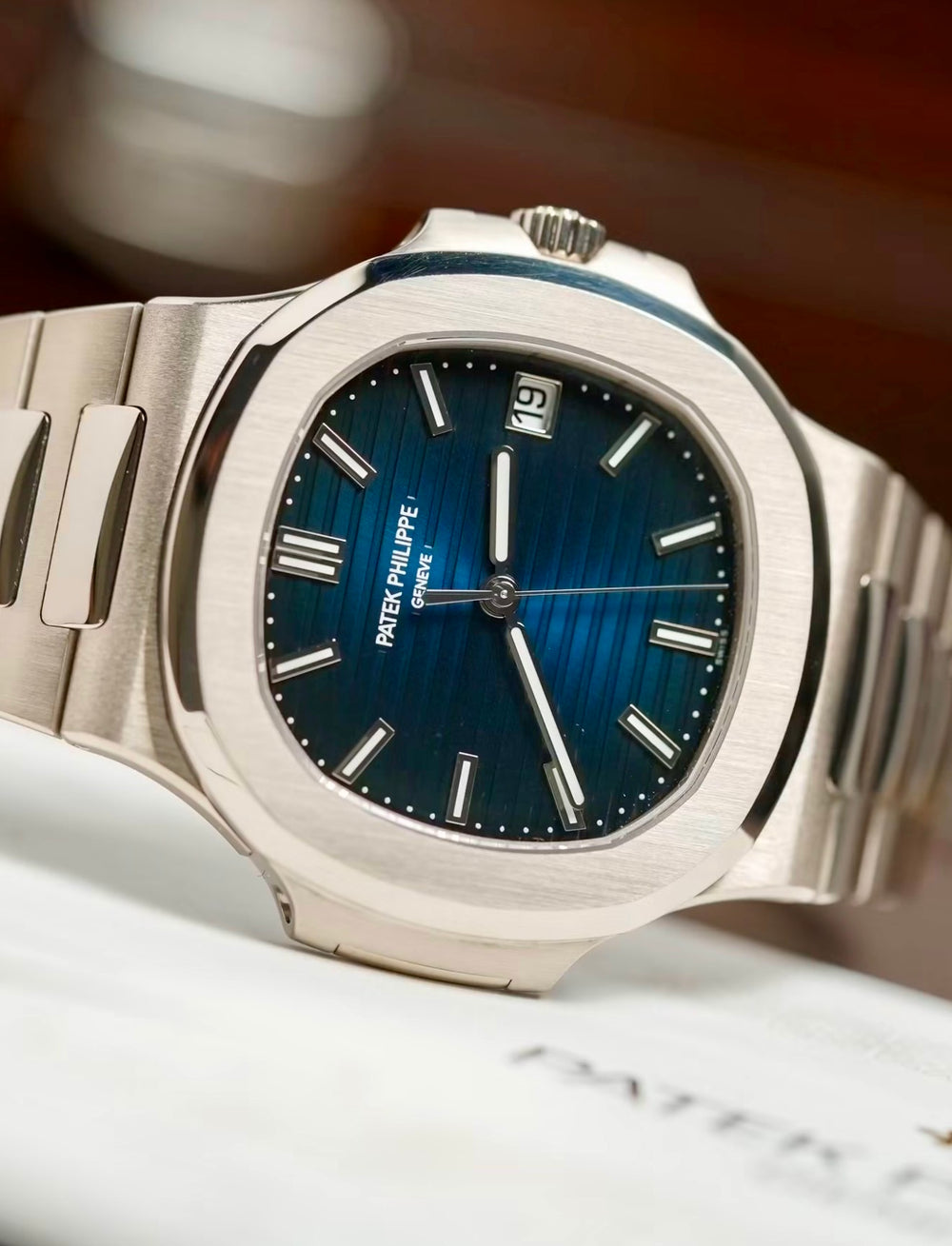 Patek Philippe Nautilus 5811/1G, blue dialView current listing →
Rolex
Patek Philippe Nautilus 5811/1G, blue dialView current listing →
Rolex
 Rolex Cosmograph Daytona 126500LN, black dialView current listing →
The bottom line
Which is better: Patek Philippe or Rolex?
For most first-time buyers who want one watch for frequent wear, Rolex is the more practical default. For a collector who prioritizes traditional finishing, movement architecture and complicated watchmaking, Patek Philippe is the stronger fit. That is a buyer-fit verdict—not a quality ranking. A Calatrava and a Submariner solve different problems; so do a Nautilus and a Daytona.
At-a-glance comparison
Patek Philippe vs. Rolex comparison table
Patek Philippe’s clearest advantage is its stated commitment to manual finishing and a catalog that reaches deeply into high complications. Rolex’s clearest advantage is broad daily utility: current references frequently pair self-winding movements with whole-watch precision testing, substantial reserves and purpose-specific Oyster cases.
| Decision axis | Patek Philippe | Rolex | What it means for the buyer |
|---|---|---|---|
| Current identity | Genevan watchmaking, manual finishing and broad complication depth | Precision, Oyster architecture and classic/professional utility | Choose the system that matches the way the watch will actually be used |
| Published precision | Patek Philippe Seal: −1/+2 seconds per day for movements | Superlative Chronometer: −2/+2 seconds per day after casing | The test scopes differ, so the numbers do not produce a universal winner |
| Sports-watch path | Aquanaut, Nautilus and Cubitus | Submariner, GMT-Master II and Daytona | The functions and intended use are not interchangeable |
| Complication breadth | Dedicated Complications and Grand Complications families | Focused practical functions including chronograph, travel time and annual calendar | Patek is the stronger fit when traditional complication depth leads the decision |
| Representative water use | Cited Calatrava, Aquanaut and Nautilus examples: 30 m | Cited 1908: 50 m; Daytona: 100 m; Submariner: 300 m | Water resistance is reference-specific and condition-dependent |
| Representative reserve | Cited examples range from 35–45 h to a minimum 65 h | Cited examples range from about 66 h to about 72 h | Compare the exact caliber; brand-wide reserve claims are unreliable |
| Suggested service interval | Every eight to ten years for mechanical and quartz watches | Approximately every ten years depending on model and use | Water exposure, shock, performance and complication can justify earlier inspection |
| Value outcome | Reference, condition, completeness, service and purchase-price dependent | Reference, condition, completeness, service and purchase-price dependent | Neither brand can be promised to appreciate or preserve capital |
Official basis: Patek Philippe Seal, Rolex guarantee and Superlative Chronometer overview, plus the exact-reference sources listed below.
Decision framework
Choose the brand by the job the watch must do
Choose Rolex if…
- You want one recognizable luxury watch for frequent wear.
- Water resistance and a purpose-built sports architecture are central.
- A longer reserve on many cited current references improves ownership.
- You value clearly separated professional functions: dive, chronograph or travel.
- You want a broad independent-market selection across materials and price levels.
Choose Patek Philippe if…
- Traditional movement finishing is part of the reason to own the watch.
- You want greater breadth in annual calendars, perpetual calendars, world time or repeaters.
- A thinner dress or prestige-sport format outweighs higher water resistance.
- You are comfortable evaluating documentation, service and condition at a specialist level.
- You want a more specialized collector experience rather than the broadest public recognition.
Representative references
Four model-to-model matchups that clarify the decision
These are representative current references, not perfectly interchangeable watches. Specifications apply only to the exact cited configuration and should not be generalized across a historical family.
| Matchup | Choose the Patek when | Choose the Rolex when | Critical verified distinction |
|---|---|---|---|
| Calatrava 6119G vs 1908 52508 | Manual winding, thin published profile and finishing lead | Automatic winding and a higher cited water rating lead | Both are 39 mm; cited ratings are 30 m versus 50 m |
| Aquanaut 5167A vs Submariner 124060 | Thin high-horology sport design and date lead | Professional dive construction and bracelet adjustment lead | 30 m and 35–45 h versus 300 m and about 70 h |
| Nautilus 5811/1G vs Daytona 126500LN | Thin white-gold sports design and date lead | Chronograph function and greater water rating lead | Time/date at 30 m versus chronograph at 100 m |
| Patek 5326G vs Sky-Dweller 336934 | Elaborate calendar, Travel Time and moon phase lead | Water rating, reserve and Ring Command lead | 30 m and 38–48 h versus 100 m and about 72 h |
Calatrava 6119G vs. Rolex 1908 52508: the dress-watch decision
Dealer verdict: choose the Calatrava for manual winding, its thinner published profile and Patek’s finishing language. Choose the 1908 for automatic winding, a higher cited water rating and Rolex’s modern dress-watch architecture.
Both cited watches are 39 mm. The Patek is white gold, 8.08 mm thick, manual-wind and rated to 30 m with a minimum 65-hour reserve. The cited yellow-gold Rolex is automatic, rated to 50 m and offers approximately 66 hours.
Patek 6119G official specifications · Rolex 52508 official specifications
Aquanaut 5167A vs. Submariner 124060: sport luxury or dive tool?
Dealer verdict: choose the Aquanaut for a thin, date-equipped high-horology sports watch on composite strap. Choose the Submariner for actual dive-watch capability, 300 m water resistance, Glidelock bracelet adjustment and a longer stated reserve.
The cited steel Aquanaut measures 40.8 mm at 10–4 o’clock and 8.1 mm thick, is rated to 30 m and provides 35–45 hours. The Oystersteel Submariner is 41 mm, rated to 300 m and provides approximately 70 hours.
Patek 5167A official specifications · Rolex 124060 official specifications
Nautilus 5811/1G vs. Daytona 126500LN: two icons, different jobs
Dealer verdict: choose the Nautilus for thin precious-metal sports design, date display and Patek finishing. Choose the Daytona for chronograph function, a higher water rating and a longer published reserve.
The cited white-gold Nautilus is 41 mm at 10–4 o’clock, 8.2 mm thick, rated to 30 m and provides 35–45 hours. The Oystersteel Daytona is 40 mm, rated to 100 m and provides approximately 72 hours with chronograph timing.
Patek 5811/1G official specifications · Rolex 126500LN official specifications
Patek 5326G vs. Sky-Dweller 336934: calendar and travel
Dealer verdict: choose the 5326G for a richer annual-calendar and Travel Time display, moon phase and traditional finishing. Choose the Sky-Dweller for 100 m water resistance, about 72 hours of reserve and Ring Command setting.
The cited 41 mm Patek is rated to 30 m and provides 38–48 hours; its date follows local time. The 42 mm White Rolesor Rolex is rated to 100 m and provides approximately 72 hours with its annual calendar and 24-hour second-zone display.
Patek 5326G official specifications · Rolex 336934 official specifications
Current visual examples
Compare four current watch families from each brand
These images come from current Superlative Watch Co. listings, not manufacturer websites. The starting references were verified as active, published and available on August 20, 2026. Current availability is checked when this page loads. Condition and asking price can change; follow the linked listing for current details.
 Patek Philippe Calatrava 6119R, rose gold and silver dialView current listing →
 Rolex Perpetual 1908 52509, white gold and white dialView current listing →
 Patek Philippe Aquanaut 5168G, blue dialView current listing →
 Rolex Submariner 124060, black dialView current listing →
 Patek Philippe Nautilus 5811/1G, blue dialView current listing →
 Rolex Cosmograph Daytona 126500LN, black dialView current listing →
 Patek Philippe 5905R-010 Annual Calendar Chronograph, blue dialView current listing →
 Rolex Sky-Dweller 336934, black dialView current listing →
Craft and manufacturing
Why the brands feel fundamentally different
Patek Philippe says all watch parts it produces are hand finished and that its Seal defines 65 quality criteria across four dimensions for the complete finished watch. Its current collection structure reaches from Calatrava into Complications and Grand Complications.
Rolex’s published identity centers on chronometric precision, the waterproof Oyster case introduced in 1926 and the Perpetual rotor patented from 1931. Current watches pair industrial repeatability with whole-watch testing after casing.
The defensible distinction is not “handmade versus machine-made.” Both use modern manufacturing and skilled human work. Patek explicitly foregrounds manual finishing and complication craft; Rolex foregrounds controlled engineering, functional architecture and repeatable performance.
Precision
The published numbers do not create a clean winner
Patek Philippe currently states a rate tolerance of no more than −1/+2 seconds per day for movements under its Seal. Rolex states −2/+2 seconds per day after casing for Superlative Chronometer watches.
Those are not controlled head-to-head results. The stated test scope differs, and real performance also depends on reference, regulation, position, wear, magnetism and service condition. It would be misleading to turn the numbers into “Patek is one second more accurate.”
Daily wear
Rolex is the practical default—but exact references still rule
A current Datejust, Submariner and Daytona each present a different ownership profile, yet many cited Rolex references combine self-winding movements, approximately 70- or 72-hour reserves and 100 m or greater water resistance. That makes the Rolex catalog easier to navigate when frequent wear is the starting requirement.
Patek Philippe is not automatically “special-occasion only.” A Calatrava, Aquanaut, Nautilus and 5326G simply ask different questions about finish sensitivity, strap material, water rating and servicing. A 30 m rating is not a synonym for zero water contact, but it is not equivalent to a 300 m dive-watch rating either.
Durability and water
Compare water resistance by reference—not by brand stereotype
Patek’s current care guidance says a water-resistant Patek rated to 30 m may support ordinary aquatic activity, including swimming, when the crown, seals and overall watch condition are appropriate. Controls should not be operated underwater, and leather straps require separate care. A used watch should be pressure-tested before planned water exposure.
The cited Rolex 1908 is rated to 50 m, the cited Daytona and Sky-Dweller to 100 m, and the cited Submariner to 300 m. Those figures describe exact current references, not every watch the brands have produced.
Read Patek’s own water-care guidanceComplications
Patek offers greater breadth; Rolex emphasizes practical functions
Patek’s current collections include annual calendars, perpetual calendars, world time, Travel Time, chronographs, minute repeaters and more. The 5326G pairs Annual Calendar and Travel Time while coordinating the date to local time.
Rolex does make complications: the Daytona is a chronograph, the GMT-Master II is a travel watch and the Sky-Dweller combines annual calendar and dual time. The distinction is breadth and brand emphasis—not the claim that one brand “has complications” and the other does not.
Service and documentation
Long-term ownership requires more than a box and papers
Both brands publish long service horizons, but age, water use, shock, amplitude, timekeeping and function should override a calendar rule. A complete set supports provenance; it does not authenticate the watch or prove that every component remains original.
- Published interval: Patek says every eight to ten years; Rolex says approximately every ten years depending on model and use.
- Long-term commitment: Patek pledges to service, repair or restore any Patek regardless of age; Rolex maintains a worldwide official service system.
- Authorized full-service coverage: Patek publishes two years in its authorized network; Rolex publishes an international two-year service guarantee.
- Used-watch action: for either brand, verify service history, case, movement, replacement parts and documentation.
Price, availability and value
Treat value retention as a risk factor, not a promise
Official retail prices and independent-market asking prices are different data points. Some references trade above official retail and others below; the relationship can change.
- Compare the exact reference, material, year, condition, delivery set and service history.
- Separate official-retail allocation from independent-market availability.
- Include transaction costs, servicing, insurance and the chance of selling below purchase price.
- Do not use a generic wait time; none is universal across retailers, buyers and references.
- Do not infer factory coverage from “unworn” or model year alone; verify the dated card or certificate and current terms.
No watch in this guide is represented as a guaranteed investment. The practical question is whether the exact watch, at the exact acquisition price, fits the buyer’s use and risk tolerance.
Dealer-reviewed checklist
Before buying either brand
- Identify the exact reference and configuration. Family names can contain materially different cases, calibers, clasps and ratings.
- Match listing claims to the watch and documents. Condition labels alone do not establish age, originality or factory coverage.
- Inspect the complete watch. Review case geometry, dial, hands, movement, bracelet or strap, clasp, links and functional behavior.
- Confirm the delivery set. List the box, papers, cards, manuals, service records, extra straps and every included component.
- Check service and water status. A nominal depth rating does not prove current seals or pressure performance.
- Compare like for like. An official list price, an independent asking price and a completed transaction are different measures.
- Document the transaction. Confirm seller identity, invoice, insured shipping, payment, return and delivery terms.
- Buy for the intended use first. Potential resale is uncertain; ownership fit is knowable before purchase.
Buyer questions
Patek Philippe vs. Rolex FAQ
Each answer is intentionally conditional and reference-specific. Open any question for the concise dealer verdict.
Is Patek Philippe better than Rolex?
Neither is universally better. Rolex is usually the stronger starting point for robust daily wear, water resistance and practical professional functions, while Patek Philippe is stronger for traditional hand finishing and breadth of complicated watchmaking. The better choice depends on the exact model and how it will be worn.
Is Patek Philippe more prestigious than Rolex?
Prestige is subjective. Patek Philippe occupies a more specialized haute-horlogerie position built around hand finishing, limited-quantity production and complications, while Rolex has broader global recognition and a strong reputation for precision, reliability and professional-watch design.
Which brand is better for everyday wear?
For most buyers, Rolex offers the broader everyday range because many current models combine automatic winding, 70- or 72-hour reserves and 100 m or greater water resistance. A Patek Aquanaut or Nautilus can also be worn regularly, but its exact 30 m rating, strap, finish and service condition should guide use.
Which brand makes the more durable watch?
Durability is model-specific. A Rolex Submariner’s 300 m rating and dive-watch architecture are designed for a different purpose than a 30 m Patek Calatrava, Aquanaut or Nautilus. Case material, water rating, crown design, bracelet or strap and condition matter more than the brand name alone.
Which is more accurate, Patek Philippe or Rolex?
The published standards are not directly equivalent. Patek Philippe currently states −1/+2 seconds per day for movements under its Seal, while Rolex states −2/+2 seconds per day after casing for Superlative Chronometer watches. Actual performance depends on the exact watch, regulation and condition.
Which brand makes more complicated watches?
Patek Philippe has the broader current complication catalog, with dedicated Complications and Grand Complications collections. Rolex focuses on practical functions such as the Daytona chronograph, GMT-Master II travel display and Sky-Dweller annual calendar with dual time.
Why does a Patek Philippe often cost more than a Rolex?
The price reflects the exact reference, material, production context, movement complexity, finishing, condition and demand. Patek explicitly emphasizes manual finishing and complicated watchmaking, but brand-level generalizations cannot explain every price. Compare exact watches and live prices.
Does Patek Philippe hold value better than Rolex?
Not across every reference. Value retention depends on purchase price, model, material, condition, completeness, service history, current supply and market demand. Neither brand should be presented as guaranteed to appreciate.
Is a Rolex or Patek Philippe a better investment?
Neither is a guaranteed investment. Buy only after considering the enjoyment and utility of the watch as well as transaction costs, servicing, insurance, market volatility and the possibility of selling below the purchase price.
Which is better as a first luxury watch?
Rolex is usually the simpler first ownership experience for a buyer who wants broad daily utility and familiar models. Patek Philippe is the stronger first choice when the buyer already values movement architecture, finishing, complications and a more specialized collector experience.
Patek Philippe Calatrava or Rolex 1908?
Choose the Calatrava 6119 for manual winding, a published 8.08 mm case and Patek’s hobnail-bezel tradition. Choose the Rolex 1908 for automatic winding, a 50 m rating and Rolex’s modern dress-watch architecture. Both cited representative references are 39 mm.
Patek Philippe Aquanaut or Rolex Submariner?
Choose the Aquanaut for a thin, casual high-horology sports watch with a composite strap and date. Choose the Submariner for professional dive-watch construction, 300 m water resistance, Glidelock bracelet adjustment and a longer stated reserve. They are not direct functional equivalents.
Patek Philippe Nautilus or Rolex Daytona?
Choose the Nautilus 5811 for a thin white-gold elegant sports watch with a date and Patek finishing. Choose the steel Daytona 126500LN for chronograph timing, 100 m water resistance and an approximately 72-hour reserve. Market prominence does not make their functions equivalent.
Patek Philippe annual calendar or Rolex Sky-Dweller?
The Patek 5326G combines an annual calendar, Travel Time, local-date synchronization and moon phases. The Rolex Sky-Dweller combines an annual calendar, second time zone, 100 m water resistance and Ring Command setting. Choose by display complexity, finishing, wear format and water resistance.
Can you swim with a Patek Philippe?
Patek states that a water-resistant watch rated to 30 m can be used for normal aquatic activities, including swimming, when properly secured and maintained. Verify the exact model, crown, seals and recent pressure test, avoid operating controls underwater and remember that leather straps are not ideal for water exposure.
Is a Rolex more water-resistant than a Patek Philippe?
Many representative Rolex models have higher published ratings, but the comparison must be reference-specific. The cited Rolex 1908 is 50 m, Datejust and Daytona are 100 m and Submariner is 300 m; the cited Patek Calatrava, Aquanaut and Nautilus examples are 30 m.
How often should a Patek Philippe be serviced?
Patek’s current care guidance recommends servicing mechanical and quartz watches every eight to ten years through an official service center or authorized retailer. Usage, water exposure, shocks and movement complexity can justify earlier inspection.
How often should a Rolex be serviced?
Rolex recommends service approximately every ten years, depending on the model and actual use. A watch exposed to water, impact or abnormal performance should be evaluated based on its condition rather than waiting for a calendar deadline.
What warranty comes with a new Rolex?
Rolex states that new watches purchased from an Official Rolex Jeweler receive a five-year international guarantee, subject to its card, sales-channel and condition requirements. An independent seller should describe any remaining manufacturer coverage only after verifying the exact card and purchase history.
What warranty comes with a Patek Philippe?
Patek states that the Certificate of Origin identifies the watch and serves as its warranty document. Because coverage terms must be tied to the exact dated certificate and original sales channel, verify the document and current manufacturer terms rather than assuming coverage from the model year alone.
Does authorized service include a warranty?
Yes. Patek states that its maintenance services carry a two-year warranty across its authorized service network, and Rolex states that a full authorized service carries an international two-year service guarantee covering replacement parts and labor under its terms.
Which brand is easier to buy?
There is no universal official wait time. New watches are distributed through each brand’s authorized retail network, while independent-market availability and pricing vary by reference. Confirm the exact watch, seller, documentation, price and delivery timeline rather than relying on a generic waitlist claim.
Should I buy new, unworn or pre-owned?
Choose based on price, condition, documentation, remaining coverage, service history and availability. “Unworn” is a condition description, not proof of an authorized-retail sale or automatic factory warranty. A carefully verified pre-owned watch may be the better value for some references.
What should I verify before buying either brand?
Verify the reference and serial identifiers, case and movement condition, originality of major components, bracelet or strap completeness, box and papers, service history, seller terms, water-resistance expectations and the exact return, shipping and payment policies. Match every claim to the actual watch offered.
Evidence and editorial method
Official sources and review methodology
Technical specifications, brand history, care and manufacturer-coverage statements were checked against the 28 current first-party pages below on August 20, 2026. Product images and destinations are drawn from current Superlative Watch Co. listings. We excluded static MSRP, universal wait times, unsourced annual production, appreciation forecasts and any implication that Superlative Watch Co. is an authorized retailer.
Specifications apply only to the exact cited reference. For current condition, included items, price and availability, rely on the linked listing. See our editorial standards for how these guides are researched and reviewed.
Patek Philippe first-party sources: Patek Philippe official site and values · Patek Philippe origins in Geneva · The Stern family · The Patek Philippe Seal · Patek Philippe watch-care recommendations · Patek Philippe service commitment · Patek Philippe service costs and service warranty · Patek Philippe Certificate of Origin · Calatrava 6119G-001 · Aquanaut 5167A-001 · Nautilus 5811/1G-001 · Aquanaut Chronograph 5968A-001 · Cubitus 5821/1A-001 · Complications 5205R-011 · Complications 5326G-001 · Grand Complications 5327G-001
Rolex first-party sources: Rolex history: 1905–1919 · Oyster Perpetual history · The Rolex guarantee · Rolex care and service FAQ · The Rolex servicing procedure · Rolex Service Card · Perpetual 1908 ref. 52508 · Submariner ref. 124060 · Cosmograph Daytona ref. 126500LN · Sky-Dweller ref. 336934 · Datejust 41 ref. 126334 · Day-Date 40 ref. 228238
Continue comparing
Complete the three-brand decision
Make the decision concrete
Compare the exact watches—not abstract prestige
Tell the Buying Desk your wrist size, preferred function, material, condition, budget range and intended wear. We can narrow the decision to exact references and current availability.
Superlative Watch Co. is an independent watch dealer and is not affiliated with or an authorized retailer for Patek Philippe or Rolex. Brand and model names are trademarks of their respective owners.