

Patek Philippe Movements and Calibers Guide
A buyer-readable framework for identifying Patek Philippe calibers, understanding movement families and connecting the mechanism inside a watch to its functions, dimensions and care.
Read a Caliber as a Family Plus Functions
A Patek Philippe caliber name identifies a movement family and often appends letters for the functions or display architecture fitted to that base. The difference between 26-330 S C, 26-330 S C FUS and 26-330 S QA LU is therefore substantive: the suffix distinguishes date and seconds, Travel Time or Annual Calendar and moon-phase functionality.
Do not decode a caliber from memory and stop there. Patek Philippe publishes a movement page with the official functions, dimensions, parts, jewels, frequency, power reserve, rotor and related references. Use that page and the exact product page together because similar-looking references can contain different generations or variants.
- Base family identifies the underlying architecture
- Suffixes identify the exact function package
- Reference and production generation remain necessary
- Match the calibre and functions to the exact watch reference
Major Caliber Families Buyers Encounter
The 26-330 is a modern self-winding family used across time-and-date, Travel Time and calendar references. The 240 is an ultra-thin self-winding micro-rotor family that supports time-only watches, perpetual calendars, moon-phase and power-reserve displays, World Time and Celestial mechanisms. Its thinness also underpins the 2026 hours-and-minutes Nautilus 5810/1G.
Patek Philippe uses dedicated chronograph, calendar and acoustic families rather than one universal movement. CH 29-535 denotes a manually wound chronograph architecture, while CH 28-520 is a self-winding flyback family. The 31-260 supports advanced calendar constructions, and R 27 identifies self-winding minute-repeater variants.
| Caliber family | Architecture | Representative use |
|---|---|---|
| 26-330 | Self-winding central rotor | 5811 date and seconds, 5164 Travel Time, 5261 Annual Calendar |
| 240 | Ultra-thin self-winding micro-rotor | 5810 hours and minutes, 5740 perpetual calendar, 5712 moon phases |
| CH 29-535 | Manually wound chronograph | 5172 chronograph and calendar-chronograph derivatives |
| CH 28-520 | Self-winding flyback chronograph | 5968 Aquanaut and 5905 Annual Calendar chronograph |
| 31-260 | Self-winding advanced calendar family | 5236 in-line perpetual calendar and 5326 Annual Calendar Travel Time |
| R 27 | Self-winding minute repeater family | 7047, 5178, 5531 and 5374 variants |
Winding System, Frequency and Power Reserve
Manual winding creates a direct daily or periodic interaction and allows a movement to omit an automatic winding system. A central rotor can wind efficiently but adds architecture above the movement; an off-center micro-rotor supports thinness and leaves more of the movement visible. None is categorically superior—the correct choice depends on case design, function and owner preference.
Frequency, stated power-reserve range and stop-seconds behavior are caliber-specific. They should not be borrowed from a neighboring reference. A long power reserve can be useful for calendar ownership, but continuous operation still depends on winding habits, activity and movement condition. A published maximum is not a guarantee for an untested secondary-market watch.
- Manual winding: evaluate crown feel and owner routine
- Central rotor: assess winding performance and movement condition
- Micro-rotor: understand the thinness and architecture it enables
- Power reserve: compare official range with tested individual performance
- Frequency and stop-seconds: verify on the exact caliber page
Patek Philippe Seal, Identification and Service
The Patek Philippe Seal applies to the complete watch under the manufacture's standards; it should not be reduced to a decorative movement mark. Finishing can support identification, but a photograph of bridges and rotor is not a complete authentication. Case, dial, hands, movement, numbers, reference and provenance must be evaluated together.
Movement service history matters because lubrication, adjustment and replacement components are not visible from a caseback photograph. Ask who serviced the watch, when, what work was performed and whether documents exist. An archive extract, service paper and original certificate serve different purposes. Independent-dealer terms must state what has actually been verified.
- Match caliber and suffix to the exact reference
- Inspect numbers and physical configuration through qualified channels
- Review timing, amplitude and function only as part of broader diagnosis
- Document manufacturer or specialist service evidence
- Never infer authenticity from one movement image or engraving
Current watches illustrating different Patek Philippe caliber families
Use these live store records as reference-level examples. Manufacturer editorial images elsewhere in the guide do not depict the exact inventory watch.
 Patek Philippe Calatrava Calatrava 6119R UNWORN 2025
$38,550.00
Available now
View exact watch
VIEW WATCHView this exact reference — 5811/1G-001
Patek Philippe Calatrava Calatrava 6119R UNWORN 2025
$38,550.00
Available now
View exact watch
VIEW WATCHView this exact reference — 5811/1G-001
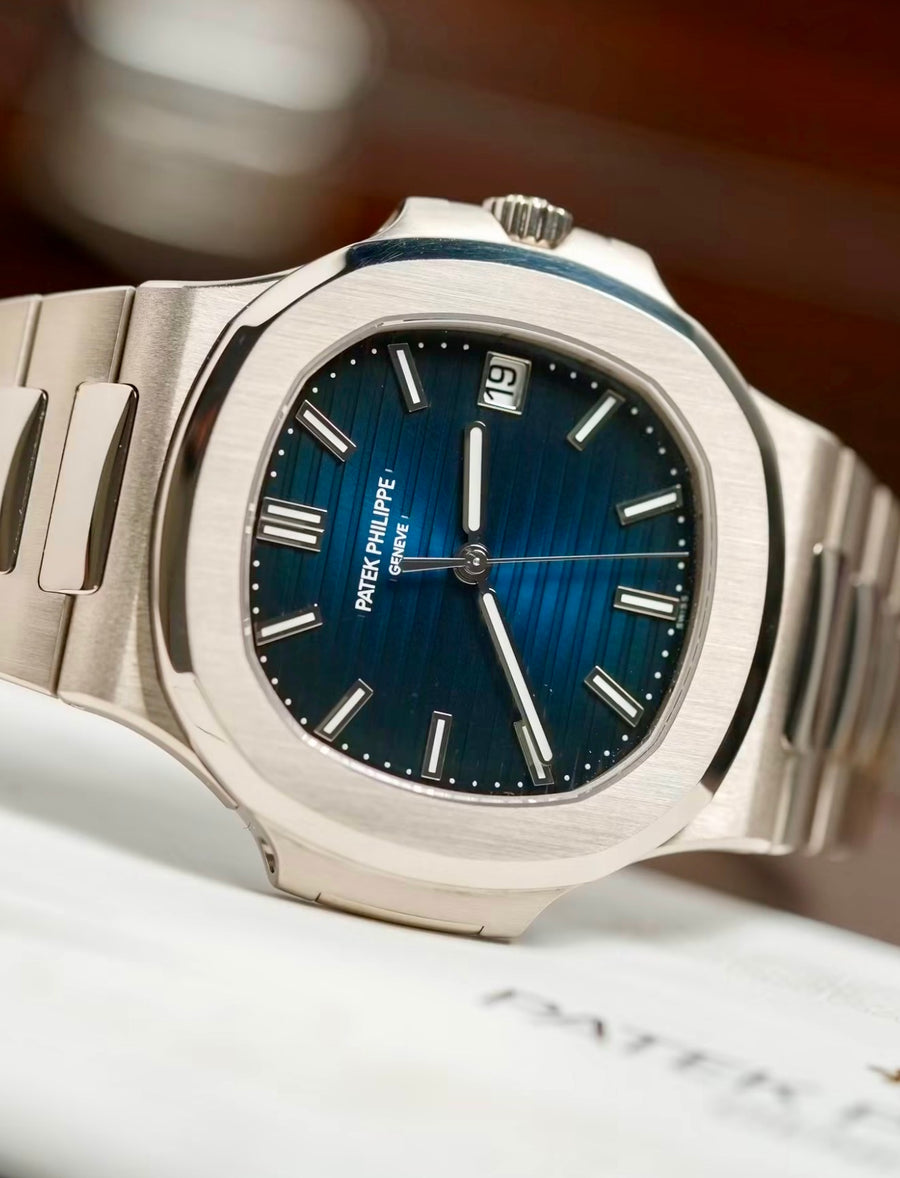 Patek Philippe Nautilus 5811/1G 18KT White Gold Unworn 2026
$199,500.00
Available now
View exact watch
VIEW WATCHView this exact reference — 5326G-001
Patek Philippe Nautilus 5811/1G 18KT White Gold Unworn 2026
$199,500.00
Available now
View exact watch
VIEW WATCHView this exact reference — 5326G-001
 Patek Philippe Complications Annual Calendar Travel Time Charcoal Gray Dial 5326G-001 Unworn
$75,000.00
Available now
View exact watch
VIEW WATCHView this exact reference — 5270P-014
Patek Philippe Complications Annual Calendar Travel Time Charcoal Gray Dial 5326G-001 Unworn
$75,000.00
Available now
View exact watch
VIEW WATCHView this exact reference — 5270P-014
 Patek Philippe Grand Complications 5270P-014 Green Ombré Dial UNWORN 2026
$172,500.00
Available now
View exact watch
VIEW WATCHView this exact reference — 7300/1200A-011
Patek Philippe Grand Complications 5270P-014 Green Ombré Dial UNWORN 2026
$172,500.00
Available now
View exact watch
VIEW WATCHView this exact reference — 7300/1200A-011
 Patek Philippe Twenty-4 Automatic GREEN DIAL 7300/1200A UNWORN 2025
$27,500.00
Available now
View exact watch
Patek Philippe Twenty-4 Automatic GREEN DIAL 7300/1200A UNWORN 2025
$27,500.00
Available now
View exact watch
Patek Philippe Movements and Calibers Guide FAQs
What is a Patek Philippe caliber?
It is the specific mechanical movement architecture inside a watch. A base number identifies the family, while suffixes often identify the fitted functions.
What is a micro-rotor?
It is a compact off-center automatic winding rotor integrated into the movement architecture, helping families such as caliber 240 remain thin.
Do the 5711, 5810 and 5811 use the same movement?
No single statement covers every 5711 generation. The 2026 5810/1G uses caliber 240, while the 5811/1G uses 26-330 S C; earlier 5711 production used multiple calibers over time.
What caliber powers the Aquanaut 5968?
Current 5968 product pages identify the self-winding CH 28-520 C flyback chronograph caliber. Verify the exact reference and suffix.
Does a display caseback prove a Patek Philippe is authentic?
No. Movement appearance is one input. Authentication must reconcile the complete watch, numbers, reference, construction, provenance and expert inspection.
Is a published power reserve guaranteed on a pre-owned watch?
No. The manufacturer specification describes the caliber. Actual performance depends on the individual movement's condition, winding and service state.
Sources and verification
Official Patek Philippe source 1 · Official Patek Philippe source 2 · Official Patek Philippe source 3 · Official Patek Philippe source 4 · Official Patek Philippe source 5 · Official Patek Philippe source 6 · Official Patek Philippe source 7
Current-reference details were checked against Patek Philippe's official catalog on July 27, 2026. Open each watch listing for its current photographs, price and availability.
Editorial review: July 27, 2026. Superlative Watch Co. is an independent luxury-watch dealer and educational publisher; it is not affiliated with or authorized by Patek Philippe. Manufacturer imagery is credited to Patek Philippe and does not represent the exact inventory watch unless expressly stated. Availability, pricing, market conditions, and manufacturer specifications can change.